
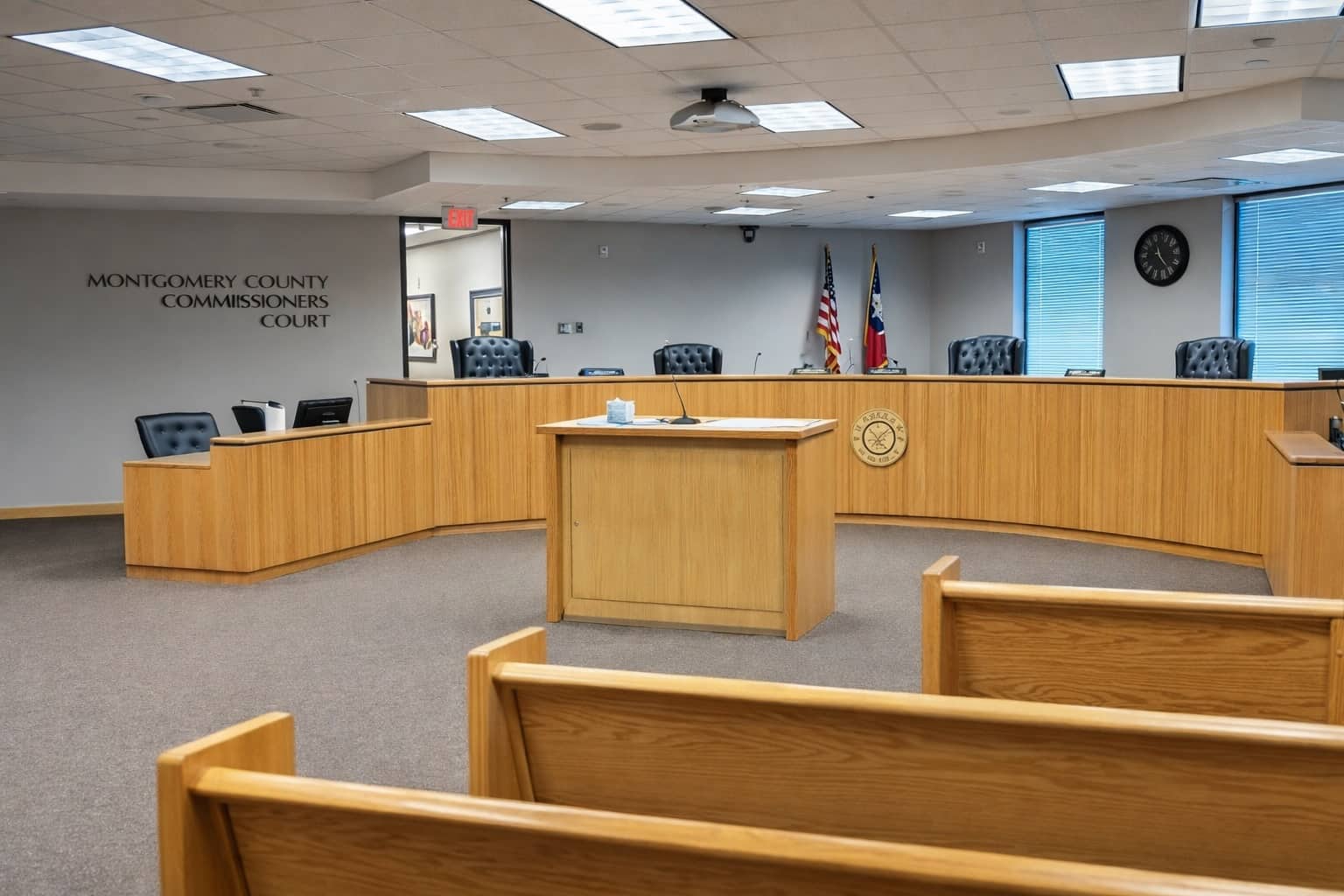
In the complex machinery of Texas government, the Commissioners Court is the engine room. Despite the name, it isn’t a “court” in the judicial sense—it is the executive and administrative heartbeat of the county. In this second part of our series, we explore how these five individuals shape the landscape of Montgomery County, how they influence the pace of development, and why the most critical political decisions are often made long before November arrives.
Who Sits at the Table?
The Commissioners Court is composed of five members: one County Judge and four County Commissioners. Together, they represent a blend of executive leadership and localized representation.
The County Judge: The “CEO”
The County Judge serves as the presiding officer of the Commissioners Court. Beyond leading meetings, the Judge is the face of the county’s executive branch and, in Montgomery County, serves as the Director of Emergency Management.
While the Texas Constitution allows County Judges to hear probate and small civil cases—a “judicial twist” from the office’s origins—larger counties typically delegate these tasks to specialized courts. Interestingly, a County Judge does not need to be a licensed attorney; the law simply requires them to be “well-informed in the laws of the state,” a US citizen, and a resident of the county.
The County Commissioners: Frontline Managers
The county is divided into four geographic precincts, each represented by a Commissioner. These individuals are the frontline managers of the county’s physical and economic growth. Their jurisdiction is local; they are the primary point of contact for residents regarding the specific infrastructure and services within their precinct.
All members of the court serve four-year staggered terms. This structure ensures that the court maintains institutional knowledge, as the entire body is never up for election at the same time.
Key Responsibilities in Montgomery County
Beyond general governance, the Commissioners Court holds the checkbook and the blueprints for the county’s future. Their duties are divided into five primary pillars:
- Policy & Budget: Along with the County Judge, commissioners approve the annual budget, set tax rates, and authorize all major county contracts.
- Infrastructure & Roads: They are directly responsible for the construction, maintenance, and repair of county roads, bridges, and drainage systems within their specific precinct.
- Precinct Maintenance & Services: They oversee local parks, community centers, and specialized precinct-level projects.
- Administrative Oversight: The court fills vacancies in elective offices, sets employee salaries, and manages county-wide services like libraries and emergency management.
- Public Representation: Commissioners act as the lead advocates for their constituents, particularly on matters of public safety and mobility.
Growth and Development
In a high-growth region like Montgomery County, “development” is a constant tension. Commissioners possess significant leverage to either accelerate or moderate this expansion.
Driving Over-Development
Commissioners can fuel rapid growth through tax abatements, offering financial incentives to corporations that bring density to the area. Furthermore, they can act as “infrastructure leads.” By proactively paving roads into untouched land—the “build it and they will come” philosophy—they signal to developers that a remote area is ripe for a new subdivision. Even the pace of plat approval serves as a lever; a pro-growth court may streamline approvals with minimal friction for developers.
Mitigating the Strain
Conversely, a court can protect existing residents by tightening subdivision regulations. While Texas counties lack the “zoning” powers held by cities, commissioners can mandate stricter drainage standards and wider road requirements. By updating drainage criteria and requiring higher detention capacity, the court ensures that new projects do not flood established neighborhoods, effectively forcing developers to pay for the impact of their footprint.
The Road Strategy: County vs. State
A recurring debate in local governance is whether a commissioner should prioritize building county roads over relying on state highways. It is a high-stakes chess move.
The State Road Dilemma: Highways like I-45 or SH 242 bring massive traffic volume but are controlled by Austin (TxDOT). If the state expands a road, the county has little say in the resulting explosion of commercial development along that corridor.
The County Road Strategy: By building “Collector” and “Arterial” county roads, commissioners can steer traffic away from congested state corridors and into areas they prefer to develop. However, there is a catch: the funding. State roads are largely funded by gas taxes, while county roads are funded by local property taxes. Shifting to a county-led system gives local leaders more control, but it places the full financial burden squarely on the local taxpayer.
The “Primary Problem” in Montgomery County
Montgomery County is one of the “reddest” large counties in the nation. This political reality has created what is effectively a one-party system at the local level.
In many election cycles, the Democratic Party does not field a candidate for Commissioner or County Judge. As a result, Republican candidates frequently run entirely unopposed in the November General Election. This means the Republican Primary in March is the true election.
If three candidates run for a seat, the winner of that primary—or the subsequent runoff—is effectively the next person in office. Consequently, a tiny fraction of the population (those who participate in the primary) chooses the leadership for the entire county. For the average resident, waiting until November to cast a ballot often means the choice has already been made.