Dallas Fed: Wildfire Smoke Raises Hospital Borrowing Costs
A Nov. 24 Dallas Fed Economics essay finds that persistent wildfire-smoke exposure is associated with higher hospital bond yields and slower investment, including from smoke that blows in from other states.
Wildfire smoke can raise hospitals' borrowing costs, cut into profits in some markets and slow investment even in places where no property burns, according to a Nov. 24 Dallas Fed Economics essay by Luis Lopez, Dermot Murphy, Nitzan Tzur-Ilan and Sean Wilkoff. The authors said the number of wildfires nationwide in 2025 exceeded the 20-year average, and that in summer 2026 smoke from Canadian fires reached as far south as the U.S. mid-Atlantic and triggered air quality warnings. The views, the essay says, are the authors' and should not be attributed to the Federal Reserve Bank of Dallas or the Federal Reserve System.
Smoke carries fine particulate matter known as PM2.5, roughly 30 times smaller than the width of a human hair, the authors wrote. That material can increase demand for emergency care at hospitals far from a fire. Their research, they said, finds that this demand adversely affects hospitals' borrowing costs, profitability and investment, particularly where hospitals serve many uninsured or publicly insured patients.
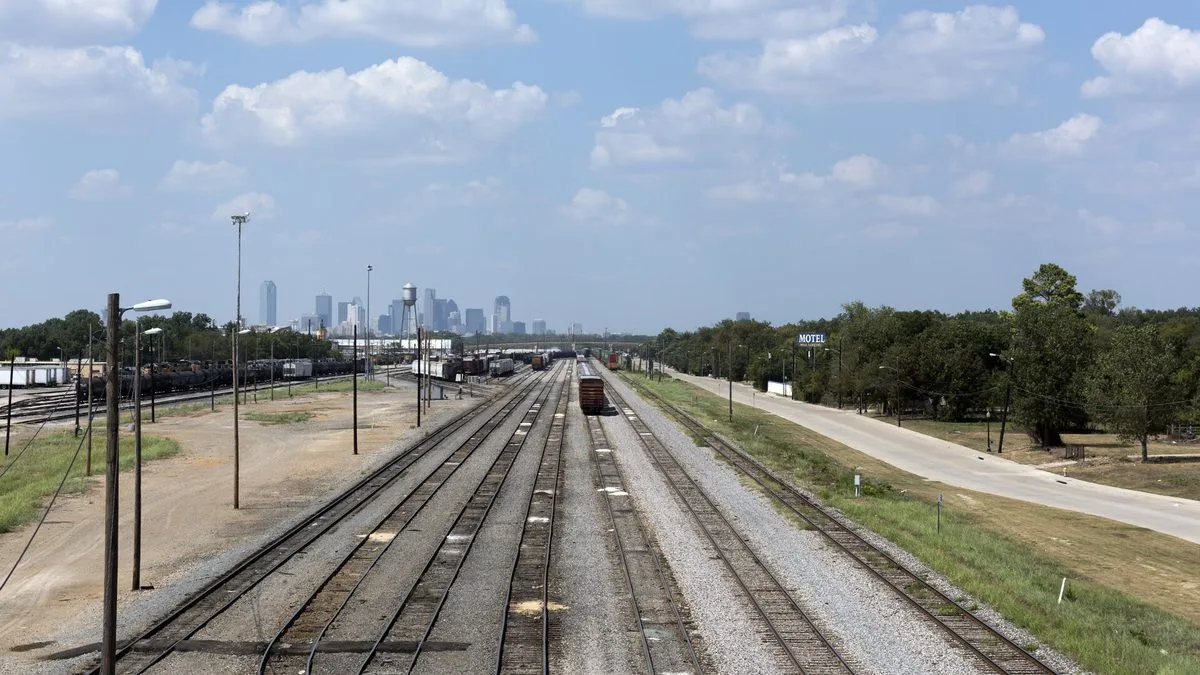
A freight yard in the southern reaches of Dallas, with the skyline in the distance, photographed Sept. 9, 2014. File photo. Photo: Carol M. Highsmith, Library of Congress, Public domain.
What Investors Price, and What They Don't
The authors measured exposure by calculating daily smoke-related PM2.5 concentrations over a year, capturing both how heavy the smoke was and how long it lasted. Average county-level exposure in 2016–20 was about 40 percent higher than in 2006–10, they said. They then split exposure into expected exposure, a county's trailing three-year average, and unexpected exposure, the deviation from that average. Looking at healthcare municipal bonds issued from 2010 to 2019, they compared the yield gap between healthcare bonds and other municipal bonds issued in the same state and month, then examined how that gap varied with the issuing county's smoke exposure.
A one-standard-deviation increase in expected smoke exposure was associated with a 12-basis-point increase in healthcare bond offering yield spreads relative to non-healthcare issuance, they wrote, equal to about 12.9 percent of the yield gap between Moody's Aaa and Baa1 municipal bonds. Year-to-year deviations from expected smoke had a small, statistically insignificant effect of 2 basis points, consistent with investors pricing persistent exposure rather than reacting to each year's smoke. Applying that estimate to $28.4 billion of healthcare municipal bonds issued in counties with above-average expected smoke exposure implied about $327 million in additional interest costs in present-value terms, using the sample's average bond duration of 10 years. If expected exposure keeps rising at its recent pace, they wrote, reissuing the sample's $92.6 billion of healthcare bonds a decade from now would cost roughly $1.19 billion more in present-value interest.
The effect was specific to healthcare, they said. Yields on non-healthcare bonds in the same counties did not rise with expected smoke. The results also held as the same bonds traded in the secondary market, and they were not unique to California and surrounding areas.
To separate nearby fires from drifting smoke, the authors split exposure into a part explained by wildfires within a state and a remaining portion largely reflecting smoke blown in from elsewhere. Expected out-of-state smoke raised hospital bond yields by 11.6 basis points per standard deviation, compared with 15.1 basis points for expected in-state smoke. The two effects were not statistically different, they wrote, suggesting that smoke from other states is an important source of hospital credit risk. As an illustration, they said that if repeated California fire seasons raised expected out-of-state smoke exposure in Nevada by one standard deviation, healthcare borrowing costs would rise by 11.6 basis points, or about $732,000 in present value for hospital issuance averaging $63.1 million and a duration of about 10 years.
Emergency Rooms, Patient Mix and Investment
Under the Emergency Medical Treatment and Labor Act, hospitals must screen and stabilize anyone seeking emergency care, regardless of ability to pay, the authors noted. They grouped uninsured, Medicaid-insured and Medicare-insured patients under the term "underinsured" because, they said, hospital emergency rooms on average lose money on these patients. A one-standard-deviation increase in expected quarterly smoke exposure was associated with a 1.7 percent increase in visits among underinsured patients and a 1.3 percent increase among privately insured patients. Underinsured patients account for roughly three-quarters of emergency department discharges, they wrote. For a hospital that typically discharges 3,000 underinsured and 1,000 privately insured patients per quarter, that implied about 51 additional underinsured discharges versus 13 additional privately insured discharges. A back-of-the-envelope calculation, they said, implied an average negative margin of roughly 9.5 percent on smoke-related ER demand: for every $100 a hospital collects for these extra patients, it spends about $109.50 treating them.
Across all hospitals, they found no significant change in profit margins when expected smoke or smoke deviations increased. The relationship was more adverse, however, in counties with a higher ratio of underinsured residents per hospital, where both expected smoke and smoke deviations were associated with lower profit margins. Smoke's effect on borrowing costs was also about 45 percent larger in counties where that underinsured-per-hospital measure was one standard deviation above average. After a state expanded Medicaid coverage under the Affordable Care Act, the sensitivity of healthcare bond yields to expected smoke fell significantly in counties with high pre-expansion uninsurance rates, they wrote.
A one-standard-deviation increase in expected smoke exposure was associated with a 2.4-percentage-point reduction in net fixed-asset growth over the following year, based on hospital cost reports filed with the Centers for Medicare and Medicaid Services. Deviations from expected exposure had no statistically significant effect. By comparison, the average one-year growth rate of net fixed assets in the sample was 3.7 percent. The essay is a national study of healthcare municipal bonds and hospital reports; it does not isolate Texas hospitals or give a Texas-only cost figure.