
TXSE Amends Circuit-Breaker Rule Ahead of Overnight Trading
A Federal Register notice says the Texas Stock Exchange filed a Nov. 20 rule change, now operative, so trading would not resume until 4 a.m. Eastern or later the next day after a Level 3 market-wide halt.
The Texas Stock Exchange has changed its rule on when trading may resume after the most severe kind of market-wide halt, so that a planned move to overnight sessions at some U.S. exchanges does not shorten the cooling-off period. In a notice published in the Federal Register, the Securities and Exchange Commission said Texas Stock Exchange LLC filed the proposed change on Nov. 20, 2026, and that the Commission has designated the change operative upon filing.
The exchange proposes to amend TXSE Rule 11.021, which covers trading halts due to extraordinary market volatility, also called market-wide circuit breakers. The amendment concerns the resumption of trading after a Level 3 market decline, in connection with the industry's expansion of trading hours to 23 hours a day, five days a week. The filing says some exchanges, including NYSE Arca, plan to offer overnight sessions from 9 p.m. to 4 a.m. Eastern Time starting Dec. 6, 2026.
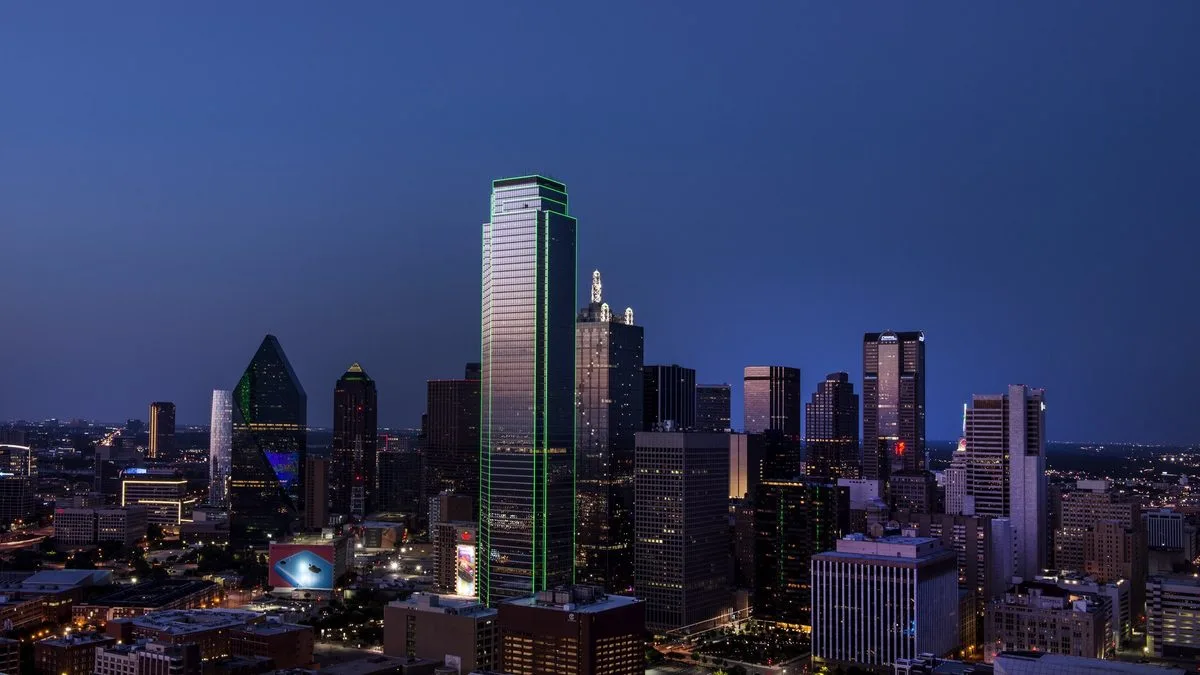
The Dallas skyline at dusk, photographed from Reunion Tower on May 11, 2014. File photo. Photo: Carol M. Highsmith, Library of Congress, Public domain.
What a Level 3 Halt Is, and Why the Wording Matters
Under the current mechanism, as described in the filing, a market-wide halt is triggered if the S&P 500 Index declines by set percentages from the prior day's close: 7% (Level 1), 13% (Level 2) and 20% (Level 3). A Level 1 or Level 2 decline after 9:30 a.m. and up to and including 3:25 p.m. Eastern (or 12:25 p.m. on an early scheduled close) would halt trading market-wide for 15 minutes. A similar decline after 3:25 p.m. would not. If a Level 3 decline occurs at any time during the trading day, trading in all stocks would halt on the exchange for the remainder of the trading day.
As written now, the filing says, that "remainder of the trading day" language would, once overnight sessions begin, push a possible reopening to 9 p.m. Eastern the same calendar day on exchanges that open overnight books at that hour. Today, with no self-regulatory organization open before 4 a.m. Eastern, the earliest reopen after a Level 3 halt is 4 a.m. the following day. The Texas Stock Exchange "does not believe that this is an expected or desired result" and is amending the rule, in coordination with other self-regulatory organizations, so that trading on any such organization will not resume until 4 a.m. Eastern or later the following trading day, "consistent with current market practice."
The exchange says the change is not intended to alter the substance of the circuit-breaker mechanism. It would delete the "remainder of the trading day" language in Rule 11.021(b)(2) and replace it with an explicit halt until 4 a.m. Eastern or later the next trading day. The filing traces the uniform circuit-breaker rules to 2012, when U.S. equity exchanges and FINRA adopted them to slow extreme price movement when severe declines may exhaust market liquidity.
The exchange gives three reasons for keeping the later reopen. First, the mechanism was designed to give market participants time to evaluate what caused the decline before the next day's trading; a 9 p.m. reopen could "materially" shorten that cooling-off period. Second, overnight sessions may have different liquidity and participation than pre-market trading that starts at or after 4 a.m., and the exchange expects institutional investors to take longer to move to a round-the-clock model. Opening in hours those investors "do not normally trade," it says, may hurt price discovery at a volatile moment. Third, the Commission recently approved an amendment to the Plan to Address Extraordinary Market Volatility that would set new price bands from 9 p.m. to 4 a.m. Eastern. The exchange is concerned those bands, useful in normal conditions, could impede price discovery right after a Level 3 decline.
The exchange does not believe the change will impose any unnecessary burden on competition, and it says other self-regulatory organizations intend to file similar changes so the 4 a.m. resumption time stays consistent across markets. It also said it has neither solicited nor received written comments on the proposal.
The Commission found that waiver of the usual 30-day operative delay is consistent with the protection of investors and the public interest, and it designated the change operative upon filing so the exchange can implement it alongside other organizations ahead of the planned Dec. 6 start of 23-hour trading. The Commission may, within 60 days of the filing, temporarily suspend the change if that appears necessary or appropriate in the public interest, for the protection of investors, or otherwise in furtherance of the purposes of the Exchange Act. Comments on file number SR-TXSE-2026-055 are due on or before Dec. 18, 2026.
The exchange's contact page lists its office at 4550 Travis Street, Suite 650, Dallas, Texas 75205. The Federal Register notice is a Commission publication of the exchange's filing; it is not a Commission order approving a new overnight trading session at the Texas Stock Exchange itself.