Ancient Texas Bison Jump Shows Hunters Returned for 3,000 Years
Radiocarbon dates show Indigenous hunters returned to a Caprock Canyons bison jump at least seven times across roughly 3,000 years.
A cliff in the Texas Panhandle has preserved evidence of an enormous community effort repeated across thousands of years.
At the Nighthawk site in what is now Caprock Canyons State Park, archaeologists found bison bones, stone tools and other evidence showing that Indigenous hunters drove herds over a cliff on at least seven separate occasions spanning roughly 3,000 years.
The finding makes Nighthawk only the second scientifically verified bison jump in Texas. It also challenges a long-standing assumption that this large-scale hunting method was largely confined to the northern Great Plains.
What Is a Bison Jump?
A bison jump was not a simple chase. Hunters had to locate a herd, move it toward the right grazing area and funnel it toward a cliff without causing the animals to break formation too early.
According to the Rice University research announcement, specialized teams likely guided the herd, emerged from hiding to direct the final movement, dispatched injured animals and processed the meat, hides, bones and other materials before they spoiled.
That level of coordination would have required far more people than an ordinary hunting party. Researchers say the gatherings may also have supported trade, ceremonies, celebrations and relationships among communities.
A Site Used Again and Again
The Nighthawk site was discovered in 2021 after Texas Historical Commission steward Rick Day and Susan Day noticed bison remains eroding from deposits beneath a cliff. Follow-up work documented multiple bone concentrations and showed that erosion was continuing to expose and damage the site.
Researchers initially thought the remains represented at least two hunting events. Twenty-seven radiocarbon measurements taken from bone collagen and charcoal revealed a much longer history: at least seven separate mass hunts from the Late Archaic through the Protohistoric period.
Generations returned even as their technology and surroundings changed. The record crosses the transition from stone-tipped spears to bows and arrows, the introduction of pottery and major environmental shifts across the Southern Plains.
Why the Texas Evidence Is Rare
Bison jumps are well documented farther north, but securely dated examples are scarce in Texas and Oklahoma. The Caprock Escarpment has the cliffs needed for the technique, yet its geology is highly vulnerable to erosion. That means other sites may have disappeared or survive only in fragments.
The Nighthawk evidence shows that Southern Plains hunters were using highly organized, landscape-scale methods much earlier and more repeatedly than many archaeologists had assumed.
The peer-reviewed study, published open access in American Antiquity, describes the site as a rare example of communal bison hunting extending across an unusually long period.
A Protected Archaeological Site
Nighthawk is within Caprock Canyons State Park, but it should not be treated as an unofficial attraction or searched for outside designated visitor areas. Archaeological sites on public land are protected, and disturbance can destroy information that researchers have only one opportunity to document.
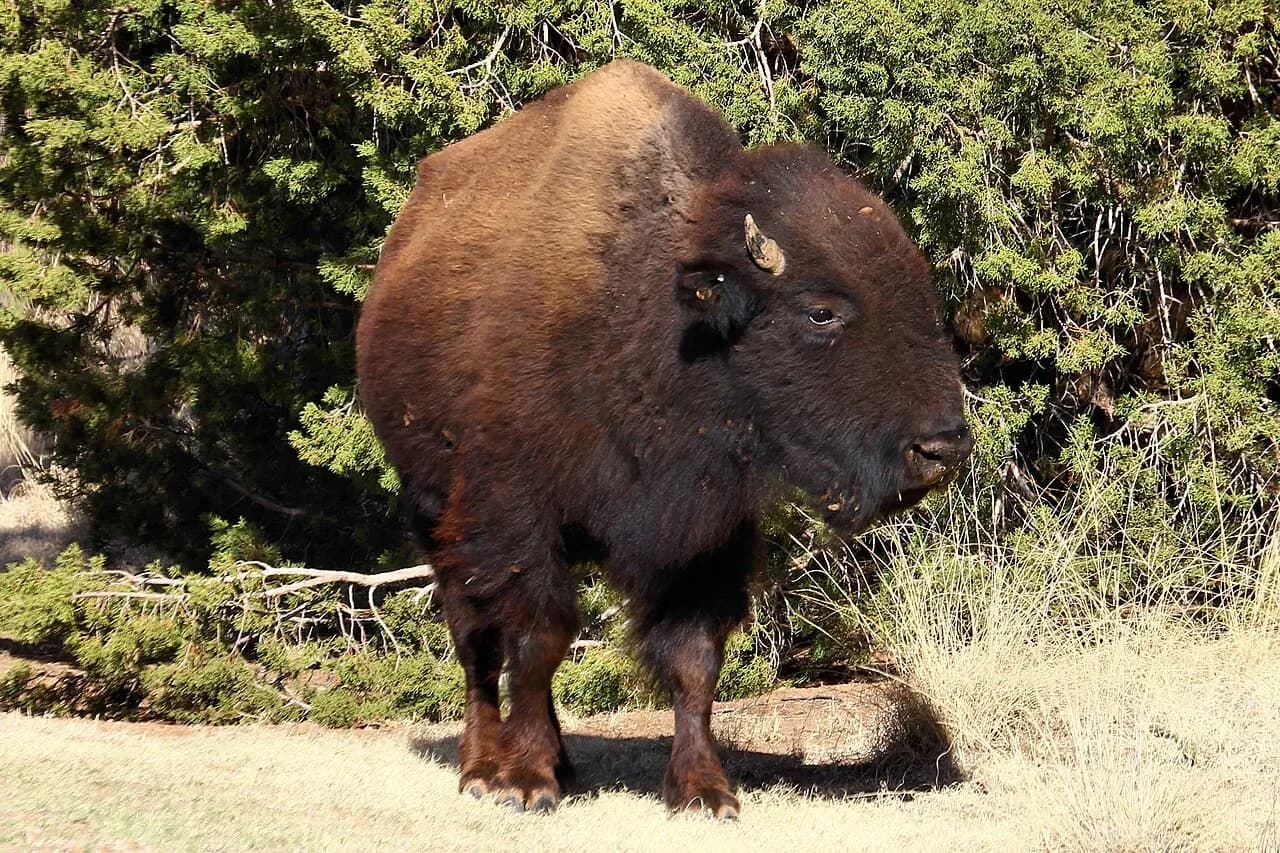
Visitors can still see descendants of the animal at the center of the discovery. Caprock Canyons is home to the official Texas State Bison Herd, connecting the park's living landscape with a history that reaches back thousands of years.
Photo: A modern plains bison from the official Texas State Bison Herd at Caprock Canyons State Park, photographed by Larry D. Moore in 2023. Wikimedia Commons, CC BY 4.0. Cropped for display. This is not an excavation photograph.