

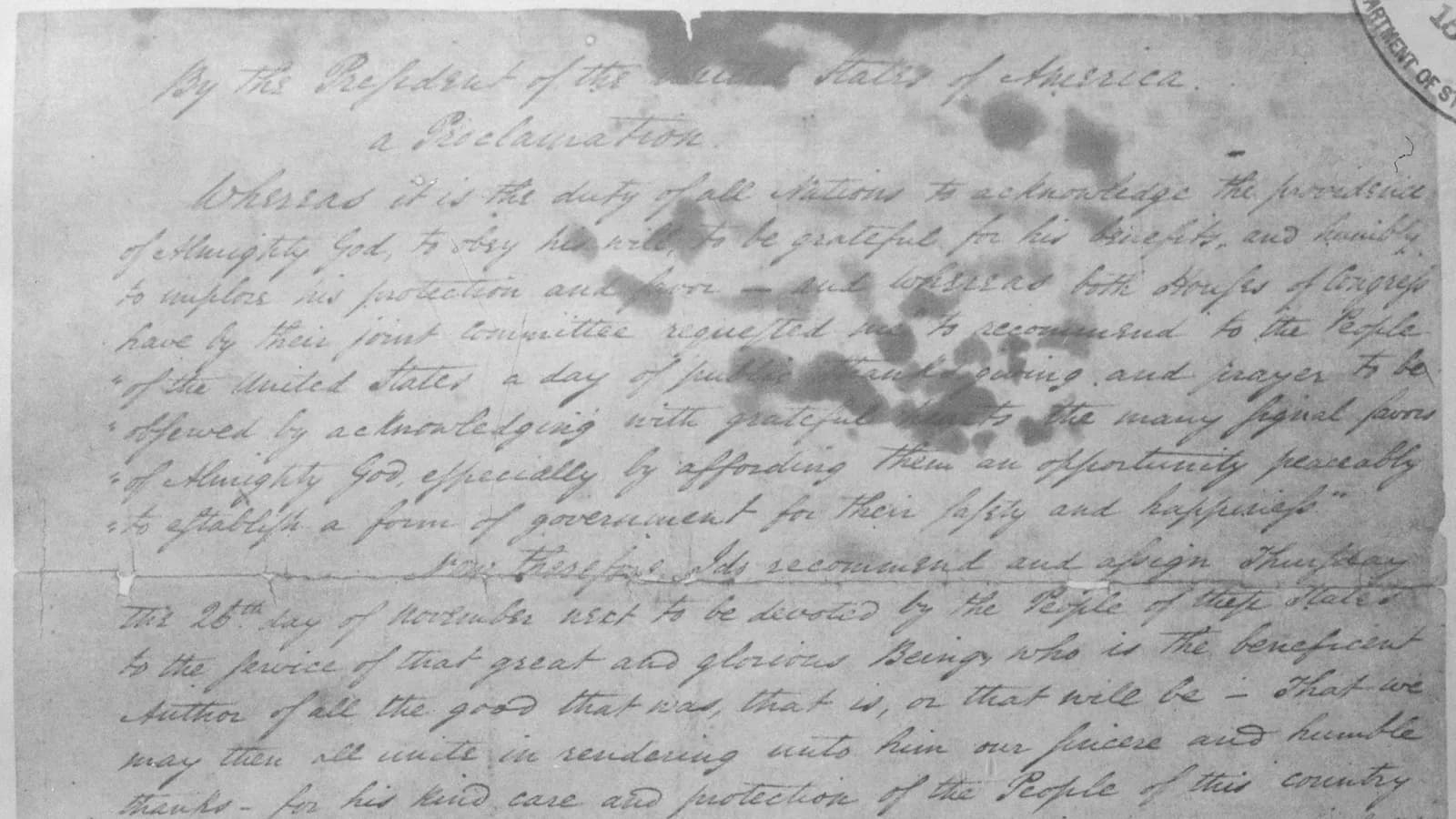
Washington's 1789 Thanksgiving Proclamation Asked for Pardon, Too. Give Thanks Without Boasting.
Washington’s proclamation paired gratitude to God with pardon for transgressions and a prayer for wise, just and constitutional government.
The facts come first below. My opinion follows in the section marked as opinion.
George Washington's 1789 Thanksgiving proclamation did not merely congratulate a successful nation. It called for gratitude to God, asked pardon for transgressions and prayed for a government guided by wise, just and constitutional laws. Its gratitude was paired with a request for pardon.
This evergreen examination uses the proclamation's full text in the National Archives' Founders Online and the University of California, Santa Barbara's American Presidency Project. It is not an announcement of a new holiday, a current presidential proclamation or a ruling about modern church-state law.
A particular day, plainly named
Washington issued the proclamation in New York on Oct. 3, 1789. It recommended Thursday, Nov. 26, as a day devoted to thanksgiving and prayer. The text preserved in Founders Online records a request from both houses of Congress that he recommend such an observance to the people.
The document names that particular date. It does not give the recurring calendar formula for today's Thanksgiving observance. Its wording also matters: Washington described what he recommended. Reading that historical recommendation is not the same exercise as deciding what a public official may compel a citizen to do today.
The opening identifies the object of gratitude as Almighty God. Washington urged the nation to acknowledge providence, obey God's will and seek His protection. The American Presidency Project's transcription likewise preserves that explicit religious language. Treating the text as nothing more than a secular expression of national pride would leave out what it actually says.
Gratitude did not mean perfection
Washington listed reasons for thanks: protection before nationhood, providence during the war, peace, the establishment of constitutions and the new national government. He also included "the civil and religious liberty with which we are blessed" and opportunities to acquire and spread useful knowledge.
Those are the proclamation's descriptions of the country. Quoting them does not require a reader to conclude that every American enjoyed liberty equally or that the nation's conduct was beyond criticism. Indeed, the next portion of the same document asks God "to pardon our national and other transgressions". Thanksgiving and confession stand together in Washington's own text.
He also prayed for people in public and private stations to perform their duties properly. His hope for the government was not simply that it become powerful. He asked that it bless all the people through "wise, just, and constitutional laws, discreetly and faithfully executed and obeyed".
The prayer extended beyond the United States. The proclamation sought protection and guidance for other sovereigns and nations, good government, peace and concord. It asked for the practice of religion and virtue, the increase of science and a measure of prosperity for humanity. The closing vision was not confined to America's own success.
Prayer and national remembrance also appear in a different historical setting in Why Veterans Day Stays on Nov. 11, and Why Its History Includes Prayer. Give Thanks Without Making an Idol.
Opinion: Give thanks without crowning ourselves
A Christian should not need a presidential proclamation to thank God. Nor should we use Washington's words as a shortcut around hard questions about our own behavior. The most uncomfortable phrase may be the request for pardon. It leaves no room for pretending the nation has nothing to confess.
Love of country is not the same as believing our country is always right. We can be grateful for liberty while admitting failures, honoring lawful authority while demanding honest administration, and praying for our neighbors without measuring their worth by their vote.
The call for faithful execution of just laws is especially worth keeping close. Constitutional limits are not annoyances to discard when our side holds office. If we praise lawful government in November, we should demand it when the rules frustrate a favored leader in January.
Keep gratitude voluntary and sincere. Do not turn another person's prayer into a test of political loyalty. At the family table, in the church and in our private habits, give thanks without boasting. Ask forgiveness without excuses. Pray that the good we have received will make us more responsible, not more pleased with ourselves.
More Faith Stories
 Yesterday
Why Veterans Day Stays on Nov. 11, and Why Its History Includes Prayer. Give Thanks Without Making an Idol.
 Last Week
Supreme Court Hears Colorado Catholic Preschool Case Over Marriage Teaching. Do Not Force the Church to Deny Scripture.
 Last Week