Lake Conroe Already Knows What the Great Lakes Are Afraid Of
Texas used grass carp to solve a genuine hydrilla problem and watched them erase the underwater nursery along with it. That Lake Conroe history explains why engineers are spending more than a billion dollars to stop additional invasive carp before they reach the Great Lakes.
Texas used grass carp to solve a genuine hydrilla problem and watched them erase the underwater nursery along with it. That Lake Conroe history explains why engineers are spending more than a billion dollars to stop additional invasive carp before they reach the Great Lakes.
Lake Conroe had a plant problem before it had a carp problem.
Hydrilla, an aggressive invasive plant, arrived in the reservoir in the 1970s and spread until it covered roughly 10,000 acres. It clogged coves, crowded docks and made boating and fishing difficult. Nobody invented that problem later to excuse what happened next. It was real, visible and getting worse.
So managers reached for a tool that looked almost perfectly designed for the job: grass carp. The fish eat aquatic plants, grow large and can clear water that mechanical harvesters and herbicides struggle to keep open.
Lake Conroe received about 270,000 of them in the early 1980s.
The plan worked. Then it kept working.
By October 1983, Texas Parks and Wildlife Department records say the reservoir's aquatic vegetation was essentially gone—not only the hydrilla that managers wanted removed, but the native plant beds that young fish had been using as cover, feeding grounds and nurseries.
That is why people around Lake Conroe hear the Great Lakes carp story differently. To much of the country, invasive carp are still a future tense: a fish moving north, a barrier under construction, a danger that might be stopped. Here, the lesson is already in the water.
The trouble is that “carp” describes several very different threats.
The Solution Outlived the Crisis

Lake Conroe’s first large stocking involved fertile, or diploid, grass carp. The fish did exactly what their name suggests. They ate vegetation—and they did not know the difference between an invasive weed blocking a boat lane and a native plant sheltering a two-inch bluegill.
A peer-reviewed study of the reservoir’s fish community found that more than 3,600 hectares of vegetation disappeared within a year of the stocking. Biomass declined in eight of the 17 common fish species examined. Bluegill, several other sunfish and crappie showed notable declines, and the density of largemouth bass age one and older also fell.
That does not mean the lake became fishless. It means something more useful: removing the plant community changed the fish community.
Underwater vegetation is not decoration. It slows waves, holds sediment, takes up nutrients and gives small fish places to hide long enough to become larger fish. When the nursery disappears, predators have less structure to hunt around and young prey fish have fewer places to survive.
The lake eventually recovered some native vegetation. San Jacinto River Authority records say coverage grew from negligible levels in the mid-1990s to more than 1,200 acres in the early and middle 2000s. Then hydrilla returned, and between 2006 and 2008 managers stocked about 130,000 sterile triploid grass carp under a different management approach.
Hydrilla declined again. Much of the native vegetation declined with it.
Today, TPWD still describes Lake Conroe’s aquatic vegetation as low density. Agencies and volunteers grow and plant native species, protect young plants in cages and add artificial fish-attractor structures to replace some of the complexity the lake lost.
Dock Line has covered that long effort in Lake Conroe Aquatic Vegetation Highs and Lows. It is worth reading because the argument is not that every plant is good or that hydrilla should have been left alone. The argument is that a lake needs more than open water to remain a healthy fishery.
Carp Is a Family Name, Not a Job Description

The fish worrying Great Lakes managers are usually grouped together as invasive carp: grass, silver, bighead and black carp. They came to the United States for different forms of biological control or aquaculture and escaped into connected rivers. They do not all eat the same thing, and they would not all change a lake in the same way.
Grass carp eat the house. They consume the vegetation that creates underwater habitat. Depending on water temperature, plant type, fish size and other conditions, the U.S. Fish and Wildlife Service says a grass carp may eat 20 to 100 percent of its body weight in vegetation in a day. It digests only part of that material, returning nutrients to the water while taking away shelter and spawning cover.
Silver and bighead carp empty the pantry. They filter plankton from the water—the tiny organisms that support young native fish and other parts of the food web. In rivers where these carp become abundant, they can compete with native species at the bottom of the food chain. Silver carp also have the famous habit of leaping when startled by boat motors, but the aerial circus is not the deepest concern. The quiet feeding below the surface matters more.
Black carp go after the cleanup crew. Adults feed primarily on mussels and snails, crushing shells with teeth in their throats. Native freshwater mussels help filter water and cycle nutrients, and many species are already imperiled. Black carp are harder to study because they stay near the bottom, but managers do not need to see them jumping to understand the risk.
Put simply: grass carp can take away the house. Silver and bighead carp can empty the pantry. Black carp can thin out part of the crew that keeps the place running. Same family name. Different damage.
One Kind Is Already There
The Great Lakes carp story is often told as though all four species are waiting outside one door. That is not accurate.
Grass carp have already been detected in every Great Lake except Lake Superior, according to the Invasive Carp Regional Coordinating Committee. They are found regularly in Lake Erie, and natural reproduction has been documented in western Lake Erie tributaries. U.S. Geological Survey researchers confirmed spawning in the Sandusky River, then the Maumee River, and later found evidence in the Huron River system.
That matters because a sterile fish released for vegetation control is one management problem. A reproducing population moving through connected waters is another.
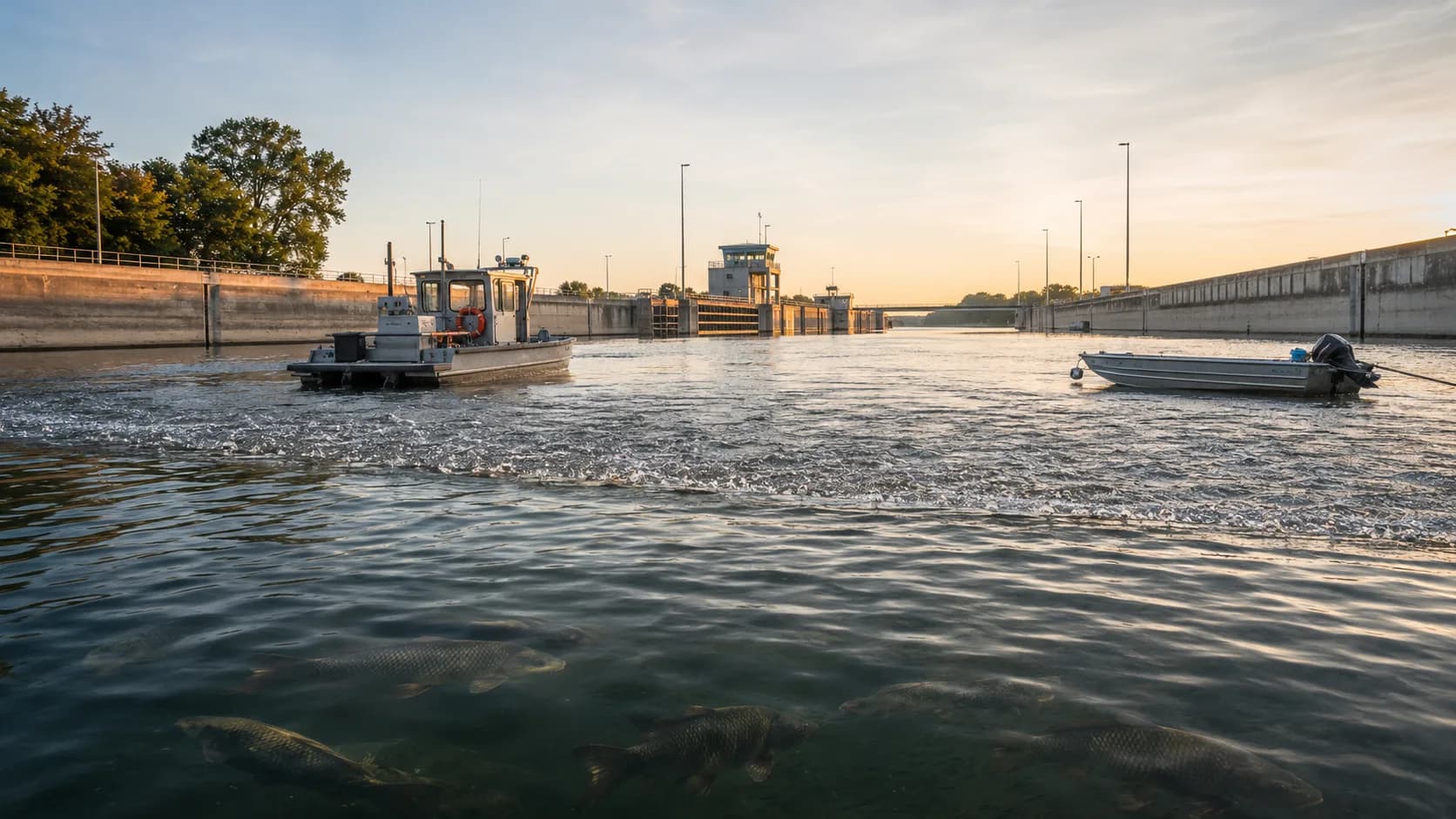
The species at the center of the expensive Chicago-area defense are primarily silver and bighead carp. Their established population front remains in the Illinois Waterway, south of Lake Michigan. During a 2026 survey of Lake Calumet, U.S. Army Corps of Engineers crews found no silver or bighead carp. The Corps placed the population front about 47 miles from Lake Michigan, with an existing electric barrier system roughly 37 miles from the lake.
That is good news. It is also the kind of good news that has to be purchased again every year through monitoring, removal and prevention.
In 2025 alone, coordinated crews removed more than seven million pounds of invasive carp from the Illinois River. Over roughly 15 years, the total has approached 50 million pounds. That effort suppresses populations and reduces pressure farther upstream, but removal is not the same as eradication. Once a fast-reproducing fish spreads through a connected river system, managers are no longer choosing between “carp” and “no carp.” They are choosing how much carp they can afford to keep taking out.
A $1.15 Billion Door

Near Joliet, Illinois, the Brandon Road Lock and Dam sits at a natural choke point between the Mississippi River basin and the Great Lakes watershed. Engineers are turning that narrow approach into a layered defensive line.
The Brandon Road Interbasin Project has an estimated cost of about $1.15 billion. Its planned defenses include a bubble curtain, acoustic deterrents, an electric deterrent, an automated system meant to clear fish from barges, an engineered channel and a flushing lock. The idea is not to trust one wall or one gadget. It is to make every remaining mile harder for fish to cross—whether they swim on their own or hitch a ride in the water around a barge.
In spring 2026, the Corps awarded a $113.8 million contract for the project’s first line of operating deterrents. Additional construction increments will follow.
A billion-dollar fish barrier sounds absurd until the alternative is considered. The Great Lakes support a vast commercial and recreational fishery, drinking-water systems, ports, beaches and communities spread across two countries. The lakes are not simply enormous versions of Lake Conroe, and what happened in a Texas reservoir does not prove that every Great Lake would follow the same path.
The Great Lakes are colder, deeper and vastly more complex. Risk varies by species and by lake. Researchers expect productive shallows, tributaries and Lake Erie to offer better habitat for bighead and silver carp than the cold, open middle of Lake Superior. Establishment is not guaranteed, and neither is one uniform ecological collapse.
But Lake Conroe proves something that scale does not erase: a biological solution can alter habitat faster than people can rebuild it.
Prevention looks expensive because the invoice arrives before the disaster. Restoration looks reasonable only because its bills arrive afterward, scattered across decades of monitoring, planting, fish habitat work and lost opportunity.
What Lake Conroe Learned the Hard Way
The fair version of Lake Conroe’s history does not need a villain.
Hydrilla was a serious invasive plant. Managers used the tools and knowledge available to them. Later stockings shifted to sterile triploid fish, and today’s decisions involve permits, plant surveys, stocking recommendations and habitat restoration that did not exist in the same form four decades ago.
The lesson is not “never control anything.” It is “control the problem without erasing the system around it.”
That means treating vegetation as habitat, not merely obstruction. It means remembering that a clear boat lane and a healthy nursery can exist in the same lake. It means measuring success after the target plant disappears, because that is when the rest of the ecosystem begins sending the bill.
The same principle explains the machinery going into Brandon Road. Engineers are not building a monument to a fish that already conquered Lake Michigan. They are trying to keep that sentence from ever becoming true.
If the barrier works, most people will never see the catastrophe it prevented. There will be no dramatic before-and-after photographs, no empty marina and no single day when everyone agrees the investment paid off. There will only be another survey boat returning without a silver or bighead carp in its net.
That can look like nothing happened.
Around Lake Conroe, we ought to know better. Sometimes nothing happening is the whole point.