TPWD and a Guadalupe River Group Are Working to Conserve Texas' State Fish After the Floods
A Nov. 9 TPWD release says Guadalupe River Trout Unlimited donated $20,000 for hatchery upgrades after recent floods. The state fish is found only in Texas.
The Texas Parks and Wildlife Department is partnering with Guadalupe River Trout Unlimited to help conserve Guadalupe bass, the official state fish, in its namesake river, the department said in a Nov. 9 news release. TPWD said the work is a response to "the devastating flood events of the past two summers."
Shortly after the 2025 flood, the department's Inland Fisheries Division began surveys on the Guadalupe River to assess how the flood affected Guadalupe bass populations and their habitats and to develop conservation strategies, the release said.
A $20,000 gift and a long stocking record
Guadalupe River Trout Unlimited's "Mend the River" fundraisers raised $20,000, which the chapter donated to Inland Fisheries to improve and expand facilities at the Heart of the Hills Fisheries Science Center for production and stocking of Guadalupe bass and other native species, according to the release.
The release said the science center has raised and stocked over four million Guadalupe bass back into the Guadalupe River headwaters since the 1990s, to conserve the species and keep fishable populations for current and future generations.
"These facility improvements are critical for expanding our capacity to recover Texas fishes like the Guadalupe Bass," Nate Smith, a research biologist at the center, said in the release. "We plan to continue Guadalupe Bass restoration stocking in the upper Guadalupe River and throughout the Hill Country." The release said the upgrades will also allow future propagation work with other Texas species of greatest conservation need, including the state-threatened blue sucker.
Chris Johnson, Texas State Council and Conservation Chair for the chapter, said the group's "longstanding partnership with Texas Parks and Wildlife is something that the chapter holds in highest regard." He added, "The opportunity to invest in the future of our state's fish and to support the facilities and personnel that ensure their survival, is truly an honor."
What an older department conservation page still says
TPWD's Guadalupe bass conservation page describes a restoration initiative launched in 1991. It says the department and partners have restored or conserved fishable populations in 14 central Texas rivers, supported by conservation stocking of over 2.4 million fingerlings, nearly 50 habitat restoration or preservation projects, and watershed-scale management of riparian invasive plants in eight watersheds. Efforts to assess, monitor or restore additional populations are planned or underway in another 13 rivers, the page says. The resources it lists go through a 2021 annual report.
Those figures are not the same as the November release's "over four million" stocked into the Guadalupe headwaters. Dock Line is not combining them. The conservation page may not reflect the most recent hatchery totals.
The same page says TPWD currently manages 20 public river access areas that offer angling opportunities for Guadalupe bass. Among those listed are Guadalupe River State Park, South Llano River State Park, Pedernales Falls State Park, Colorado Bend State Park and Inks Lake. We previously wrote about walking the granite at Fall Hikes at Inks Lake State Park Near Burnet: Pink Rock and Short Trails.
A game fish found only in Texas
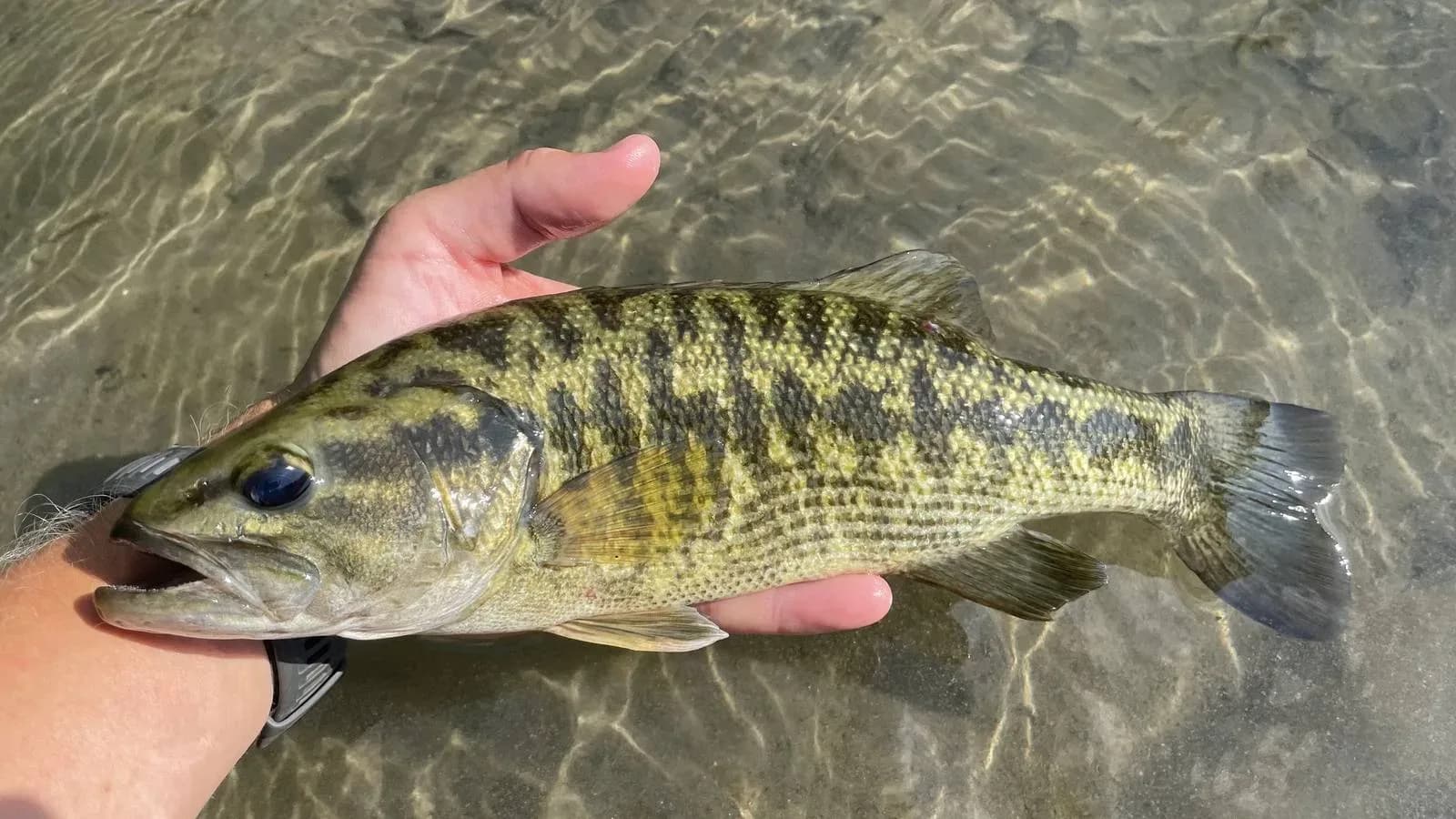
According to TPWD's species profile, the Guadalupe bass is found only in Texas and is endemic to the northern and eastern Edwards Plateau, including headwaters of the San Antonio River, the Guadalupe River above Gonzales, the Colorado River north of Austin, and portions of the Brazos River drainage. Relatively small populations can also be found outside the Edwards Plateau, primarily in the lower Colorado River. Introduced populations exist in the Nueces River system.
The profile says Guadalupe bass do not grow to large size because they are adapted to small streams, though specimens in excess of 3.5 pounds have been landed, and that their use of fast water makes them a desirable sport fish. They are a game fish; anglers should check current statewide bag and size limits and any lake-specific exceptions. The profile notes they are not a true bass but a member of the sunfish family, and that they can be distinguished from similar Texas black bass in part because the jaw does not extend beyond the eyes as in largemouth bass.
After the water went down
The November release said TPWD later partnered with multiple organizations to host three restoration workshops for more than 100 flood-affected riverside landowners, encouraging practices that benefit riparian and aquatic habitats. Those partners also coordinated the growth of 23,000 riparian grasses and sedges and the purchase of 6,400 pounds of native seed for no-cost distribution to landowners. Inland Fisheries staff organized volunteer planting along the Kerrville riverside trail network, where more than 100 volunteers installed nearly 2,000 live stakes of several tree species, the release said.
Twenty thousand dollars does not rebuild a river, and a press release does not put a fish back in a scoured hole. Surveys, hatchery work, seed and volunteers might. That is slow work, which is how streams actually recover.
Psalm 24:1 says, "The earth is the Lord's, and the fulness thereof; the world, and they that dwell therein." The Guadalupe bass lives nowhere else. Texans who fish those Hill Country rivers, and the landowners along them, have a duty to leave the fish and the banks in better shape than the flood left them.