The Cameras Are Watching the Cars. Who's Watching the Cameras?
Conroe's license plate readers can help police find stolen vehicles, wanted suspects and missing people. They also create searchable records of where vehicles were seen. As City Council considers a binding referendum, the larger question is who sets the rules around a powerful tool.
Conroe's license plate readers can help police find stolen vehicles, wanted suspects and missing people. They also create searchable records of where vehicles were seen. As City Council considers a binding referendum, the larger question is who sets the rules around a powerful tool.
Conroe police say 51 automated license plate readers help find stolen vehicles, wanted suspects and missing people. Critics worry about searchable location data and misuse. With a binding referendum on the August 13 City Council agenda, the argument is moving from technology to trust.
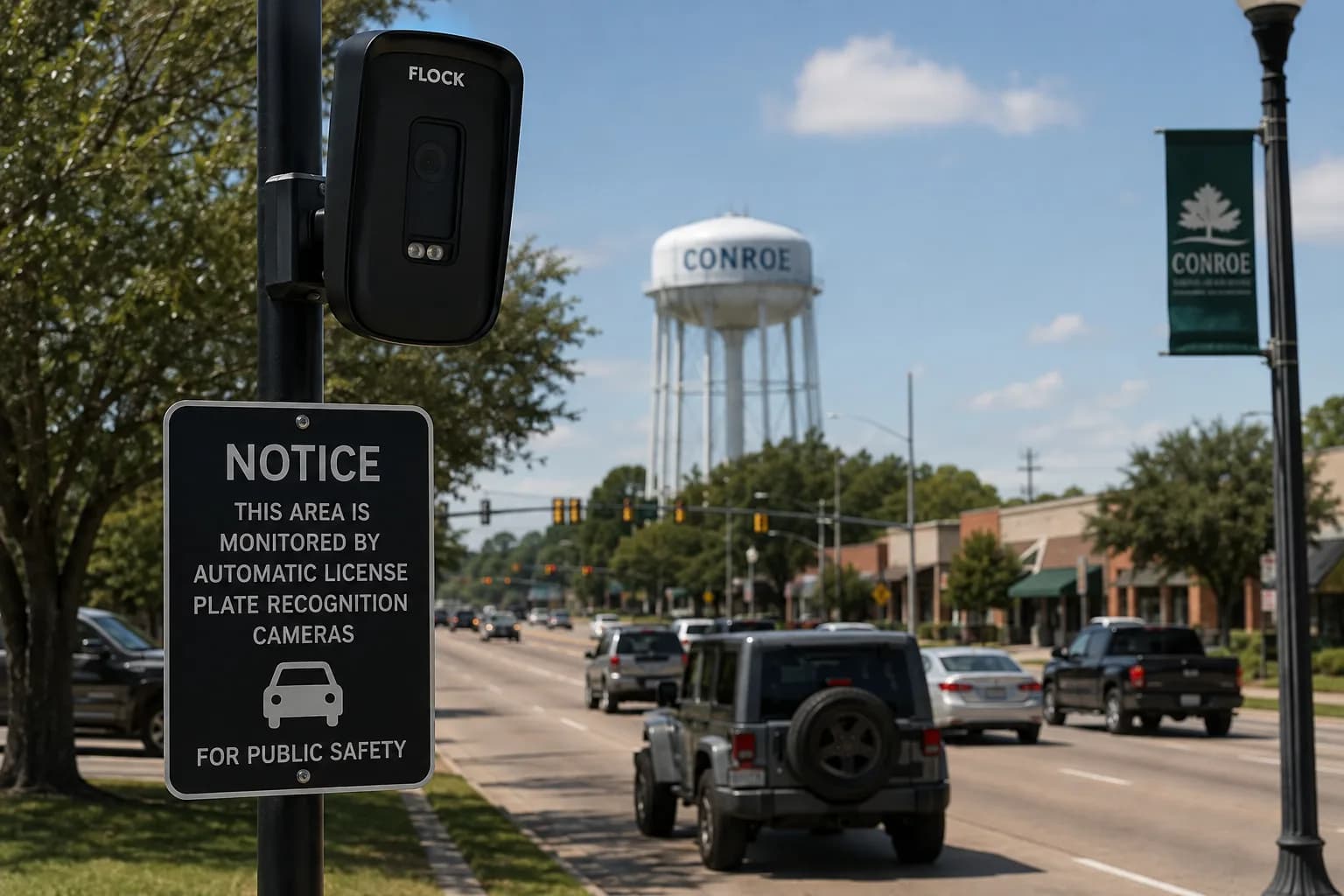
Drive around Conroe long enough and there is a good chance your vehicle will pass one without you giving it much thought. A small camera sits near the road, quietly looking at traffic. It is not a red-light camera. It does not write speeding tickets. It is not watching a live video feed of everyone who passes.
What it does is more specific - and, in some ways, more powerful. Conroe's Flock Safety cameras capture a vehicle image, license plate number, make, model and color, along with the date, time and location of the detection. That information becomes searchable when police are looking for a vehicle connected to an investigation.
One plate read is a moment. Thousands of reads become a system. In a June presentation to the Conroe City Council, Police Chief Jon Buckholtz said the city's cameras recorded about 14.4 million reads during the previous 30 days - an average of 480,880 per day. He also said Conroe police conducted 1,733 searches during that period, or about 60 a day. The same vehicle can be counted more than once as it passes different cameras or the same camera on different trips.
Those numbers are part of why a debate that once sounded technical has become personal. The question is no longer simply whether a camera can read a license plate. The question is what happens after it does.
Why Police Call It a Force Multiplier
There is a practical reason law enforcement agencies like automated license plate readers: cars are often part of the story before police know who is driving them.
A stolen vehicle may pass a camera. So may a car associated with a wanted suspect, an Amber Alert, a Silver Alert, a burglary or a hit-and-run. An officer cannot stand at every intersection reading every plate, but a camera can compare vehicle information against law-enforcement alerts and give investigators a place to start.
Buckholtz told council the Conroe Police Department's Crime Reduction Unit had made 202 arrests since it was created in August 2025, with Flock playing a role in 84 of them. From January 1 through June 10, he said the system generated alerts involving 553 warrants, 166 stolen vehicles and 38 missing persons.
Those figures do not mean every camera alert becomes an arrest, and they do not prove what would have happened without the system. They do explain why police see value in it. Buckholtz described Flock as a 'force multiplier' for a department with limited personnel.
For a family waiting for a missing person to be found, or for an officer trying to locate a stolen car before it disappears into another county, that value is not theoretical. Speed matters. Information matters. A useful lead can matter a great deal.
What the Cameras Do - and Do Not Do
Some of the public argument has become muddled because people use the word surveillance to mean very different things.

According to Conroe police, the city's Flock system does not use facial recognition, does not identify vehicle occupants, does not record audio and does not provide continuous video surveillance. It is not used for traffic enforcement or speeding tickets. The cameras record vehicle information at the place and time a vehicle passes a camera.
Flock Safety's current license plate reader policy describes the stored information as a license plate image, vehicle image, vehicle characteristics, plate number and state, date, time and camera location. The company says the default retention period is 30 days and that searches are logged for auditing, including the user, date, time, stated purpose and search information.
That distinction matters. A single detection is not the same thing as a police officer following someone around town. But a searchable collection of time-stamped detections can still reveal where a vehicle was seen. That is precisely what makes the system useful to investigators - and precisely what makes some residents uneasy.
The Privacy Question Is Not Imaginary
It would be easy to reduce the Conroe argument to two camps: people who support police and people who support privacy. Real life is not that tidy.

A person can want police to have effective tools and still ask who may search the data, for what reason, how long it is kept, which agencies can see it and what happens when someone uses the system improperly.
Those are not hypothetical questions. In July, documents obtained by ABC13 showed that a Fort Bend County Sheriff's Office lieutenant had searched one license plate 41 times and another 148 times over several years. The lieutenant admitted the searches were not connected to official law-enforcement work. An internal affairs investigation found policy violations, and the lieutenant received a two-day suspension.
That case does not establish that Conroe officers have misused the system. Buckholtz told the council in June that he was not aware of a Conroe employee doing so. It does demonstrate why residents asking about oversight are not necessarily arguing that the technology has no public-safety value. Powerful tools create a second responsibility: making sure the tool is used only for the reason the public was told it would be used.
Conroe police say searches are auditable and that misuse can cost an employee a job and potentially lead to a public-integrity investigation. Buckholtz also said Conroe shares information with the Montgomery County Sheriff's Office and nearby law-enforcement agencies within a 50-mile radius, but does not allow access for immigration enforcement or reproductive-care investigations and does not share its data with federal agencies.
Transparency Became Part of the Fight
The debate grew sharper this spring when Conroe resident James Fletes sought records about the program, including contracts, policies, camera locations, city communications and information about searches. The city released some information and sought to withhold other material. In July, the Texas Attorney General's Office said Conroe had to release some basic information while allowing other sensitive information to remain confidential.
That disagreement matters because trust in a surveillance-related system is built differently from trust in a fire truck or a water line. Residents cannot see how the database is searched from the road. The safeguards exist mostly in policy, permissions, audit logs and the conduct of the people allowed inside the system.
For supporters, that is an argument for strong rules and enforcement rather than removing a useful police tool. For critics, it is evidence that the public needs more visibility before accepting a network that records the time and place vehicles are seen.
Both positions eventually arrive at the same place: the guardrails are not a side issue. They are part of the product.
Conroe May Let the Voters Decide
Now the argument is heading back to City Hall.

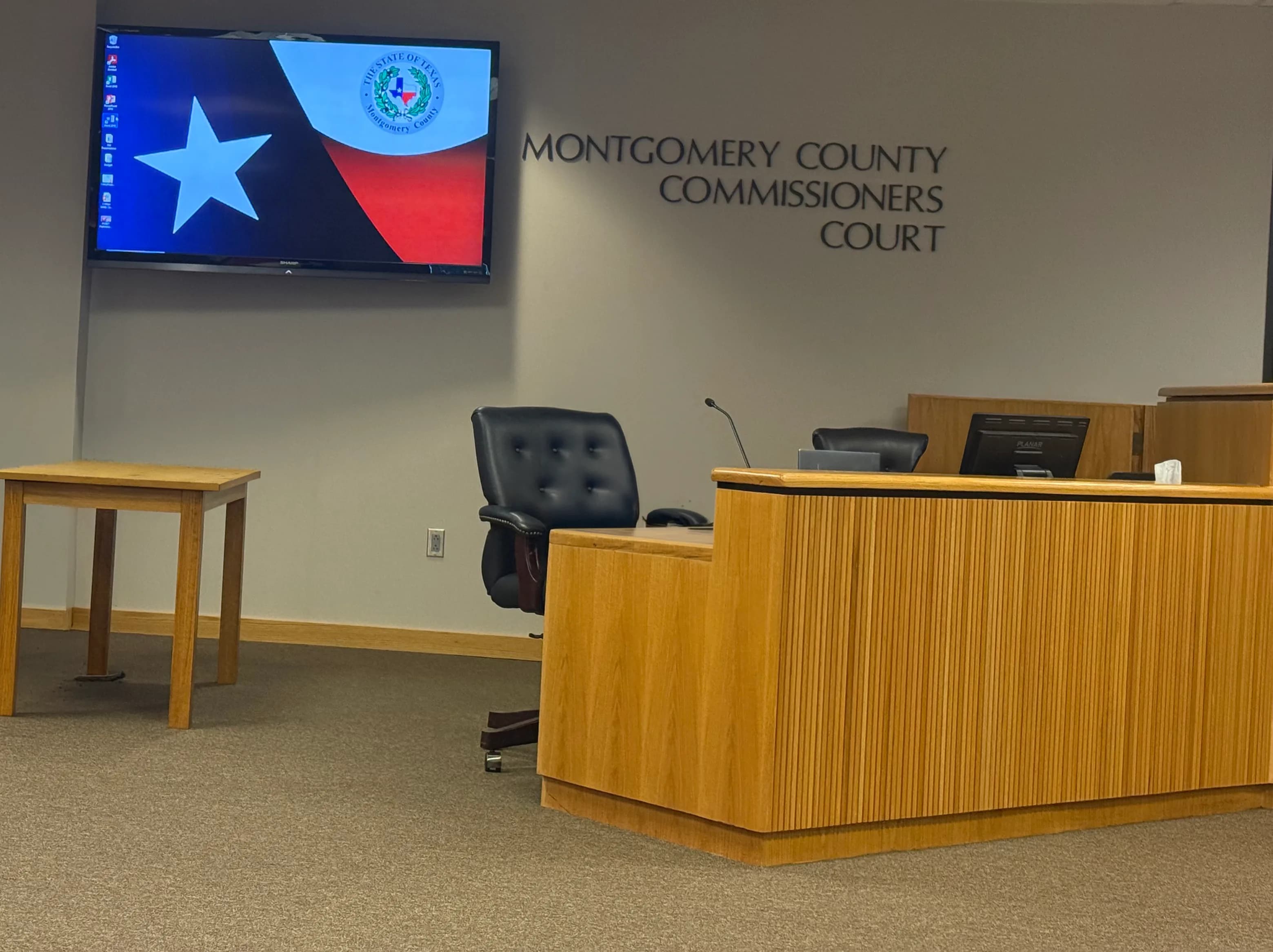
The August 13 Conroe City Council agenda includes a proposal from Council Members David Hairel and Shana Arthur for a binding referendum on the November 3 ballot. A draft ordinance prepared for the meeting says Conroe's current system consists of 51 cameras and asks whether the city should cease participating in and using an automated license plate recognition system and stop using the collected data for law-enforcement purposes.
That is an important detail: under the draft language, a YES vote would be a vote to end the city's participation and use of the system. If approved by voters, the accompanying resolution would take effect after the election results are canvassed and finally tabulated.
The proposal follows a strange few weeks at council. On July 23, members unanimously tabled both a proposed citizen advisory committee and a proposal to explore putting the camera issue before voters. Hairel and Arthur later said they regretted the decision to table the election question and moved to bring it back before the August 17 deadline for placing measures on the November ballot.
The council is scheduled to meet at 6 p.m. August 13 at Conroe City Hall. Its immediate decision is not whether every Flock camera stays or goes. It is whether Conroe voters will be given the binding choice in November.
The Question Behind the Question
Flock cameras are useful because they remember something people cannot: a particular vehicle passed a particular place at a particular time.
That capability can help find a missing person. It can help recover a stolen vehicle. It can give an investigator a lead when there may be little else to work with.
The same capability also deserves rules strong enough to survive the day when somebody is tempted to use it for the wrong reason. That is not an accusation against the Conroe Police Department. It is a basic principle of public technology: good policy should not depend entirely on every future user always making the right choice.
Maybe that is where Conroe's conversation can become more useful. Instead of asking residents to choose between being pro-police or pro-privacy, the community can ask harder questions. What access is necessary? What sharing is appropriate? How often should audit logs be reviewed? What information should be public? What penalties should follow misuse? And who should decide when the technology changes enough that yesterday's rules no longer fit today's capabilities?
A camera can tell police where a car was. It cannot tell Conroe where the line should be.
That part is still our job.