Iran's Government Can Still Give Orders. Can It Carry Them Out?
Months of physical damage have been followed by a second blow: shrinking access to the fuel, parts, money and machinery needed to repair what was lost.
Months of physical damage have been followed by a second blow: shrinking access to the fuel, parts, money and machinery needed to repair what was lost.
An order is only as powerful as the machinery behind it. A government can announce that trucks will move, officers will report and factories will produce. But the order does not put gasoline in a tank. It does not manufacture a missing bearing, restore a damaged refinery or make an unpaid worker appear for another shift.
That is the question now hanging over Iran. Not whether its leaders can still speak with authority — they can. Not whether the government still possesses weapons or security forces — it does. The more revealing question is whether the system can continue supplying, moving, repairing and paying the people and equipment required to carry those orders out.
The First Blow Damaged the Machinery

Iran is not entering this economic crisis as the country it was five months ago. Since the war began in late February, strikes have damaged military bases, ports, refineries, command facilities and weapons-production sites. Satellite imagery examined by The Washington Post showed extensive damage at the Khojir missile-production complex near Tehran, including facilities connected to propellants and specialized manufacturing.
The damage is not limited to equipment that can simply be replaced from a warehouse. A recent Center for Strategic and International Studies assessment described damaged ports, shipyards, production sites and research facilities. Rebuilding would require marine salvage equipment, precision machine tools, drone components, engines, electronics and the industrial equipment needed to restart domestic production.
That distinction matters. Destroying a vehicle removes one vehicle. Damaging the plant, machine tools, supply network and technicians needed to replace it can remove the next several vehicles as well. Every additional breakdown lasts longer because the system behind the repair has also been weakened.
The Second Blow Makes Repair Harder
On August 24, the United States expanded its pressure campaign beyond Iran's traditional oil and banking vulnerabilities. The U.S. Treasury Department announced new exposure to secondary sanctions in five sectors — technology, aviation, shipping, gold and digital assets — and sanctioned nearly 60 entities, individuals and vessels connected to procurement, cyber operations and oil revenue.
Those categories reach directly into Iran's ability to recover. Technology restrictions can complicate the purchase of precision tools and electronics. Shipping pressure can interrupt the movement of fuel, replacement equipment and raw materials. Aviation restrictions can close another route for moving money, components and people. Financial pressure makes every remaining transaction slower, more expensive and more dependent on middlemen willing to take the risk.
The first blow damaged the machinery. The second makes the parts, fuel and financing needed to repair it harder to obtain. That is not one problem added to another. It is one problem multiplying the other.
A Country That Produces Oil Can Still Run Short of Gasoline

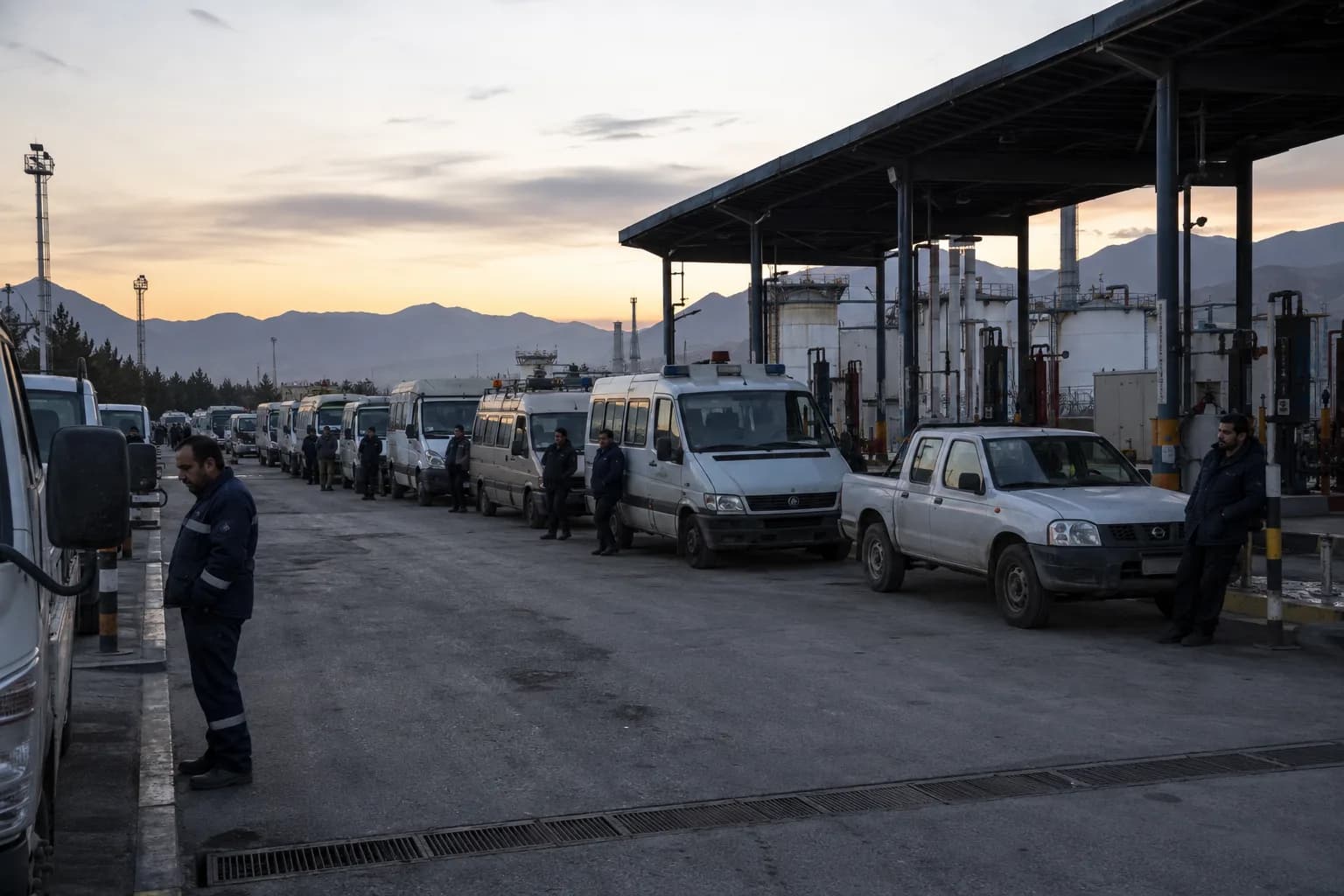
The effects are becoming visible at the pump. The Financial Times reported long gasoline lines in Tehran, a national shortfall of roughly 15 million liters per day and limits of about 20 liters per car at some stations. Iran produces enormous quantities of crude oil, but it has long depended on imported gasoline to cover the difference between domestic production and demand. The blockade has restricted those imports while earlier attacks damaged refining capacity.
A fuel shortage is not confined to frustrated motorists. It slows delivery trucks, buses, municipal equipment, ambulances, repair crews and the vehicles used by the government itself. A line of work trucks waiting for fuel may look ordinary from a distance. If those trucks once filled up every morning before heading to assignments and now cannot leave, the shortage has moved beyond economics. It has become an operational failure.
The government will attempt to reserve scarce fuel for the Revolutionary Guard, police and other essential operations. That may preserve enforcement for a time, but it creates another choice. Every liter protected for security is a liter unavailable to transportation, food distribution, public services or ordinary families. More scarcity creates more anger. More anger demands more deployments. More deployments consume still more scarce fuel and money.
Propaganda Cannot Fill an Empty Fuel Tank

Iran's leaders can blame Israel, the United States and foreign sanctions for the latest squeeze. Outside pressure is plainly part of the present crisis. But people living inside Iran have nearly half a century of experience with corruption, repression, broken promises and national wealth directed toward preserving the state rather than serving the public.
On August 24, Iran International reported another gathering of retirees in Tehran over pensions and declining living conditions. Such reporting from opposition media requires appropriate caution, but the grievances are not difficult to understand. People know whether their pension arrived, whether medicine is affordable and whether the truck that normally serves their neighborhood showed up.
Propaganda can explain an empty fuel tank. It cannot fill one. It can identify an enemy, but it cannot make a pension payment appear or return a disabled machine to service. When personal experience repeatedly contradicts official television, the argument over who should be blamed begins moving beyond the government's control.
The Government Has Survived More Than Many Expected
None of this guarantees that Iran's government is about to fall. Earlier in the conflict, the security structure remained cohesive despite leadership losses, intensive strikes and public hardship. A Guardian report drawing on ACLED research described a government capable of organizing supportive demonstrations, restricting communications, making mass arrests and suppressing dissent. Authoritarian systems often preserve the institutions protecting the leadership long after ordinary public services deteriorate.
Iran has also spent decades learning how to evade sanctions, use intermediaries and shift trade toward countries willing to resist American pressure. It can ration fuel, commandeer civilian supplies, concentrate resources around Tehran and abandon services in areas it considers less important. A government does not need to control every street equally. It needs to control the roads, communications, banks, fuel depots and institutions that keep power concentrated.
But that strategy has limits. Enforcement requires logistics. Security personnel need transportation, food, communications, maintenance and dependable pay. Their families also live with inflation, shortages and failing services. A force that cannot move, cannot repair its equipment or no longer trusts that its own household will be protected becomes less reliable — even before anyone openly refuses an order.
The Order May Be Given. Then What?
The most important signs will not necessarily appear in a televised speech. They will be found in delayed responses, government vehicles remaining at their depots, municipal equipment disappearing from the streets, fuel moving under armed guard, factories waiting for parts and local officials improvising because the central government cannot supply them.
The decisive moment would come if physical shortages, unpaid obligations and public protest begin reinforcing one another. Retirees, truckers, merchants, factory workers and government employees do not have to agree about every political question. They only have to conclude at roughly the same time that the existing system can no longer provide for them, reform itself or reliably carry out its own decisions.
Iran's government can still issue orders. It can still threaten, arrest and command. But five months of physical degradation followed by economic and logistical isolation has changed the meaning of those orders. The question is no longer simply whether someone will obey. It is whether the driver can find fuel, the mechanic can find the part, the worker will be paid and the machinery will start when the order arrives. A government can sound powerful on paper long after the system that makes its power real has begun to stop.