Three No Votes, One Small Business: Is Magnolia City Hall Closing the Door on Local Entrepreneurs?
Paul Montealvo says he spent months following Magnolia City Hall’s instructions to move Magnolia Auto Plex to Nichols Sawmill Road. After multiple hearings and a final rejection, the city still owes its business community a clear explanation.
Paul Montealvo says he spent months following City Hall’s instructions to move Magnolia Auto Plex to Nichols Sawmill Road. After multiple hearings, changing zoning approaches, and a final rejection, Magnolia owes its business community a clear explanation.
Paul Montealvo is the owner of Magnolia Auto Plex, an established used-car dealership currently operating at 201 9th Street in Magnolia. A business-directory listing identifies Montealvo as the owner and lists the company’s opening date as 2009.
Montealvo has been seeking permission to operate the business on property at 32002 Nichols Sawmill Road, Magnolia, Texas 77355. City records describe the property as approximately 0.470 acres, legally identified as A0177 Dawson Gamble, Tract 10-B, with Montgomery County Appraisal District Property ID 40510.
What could have been a relatively straightforward land-use application instead became a months-long process involving city staff, the Planning and Zoning Commission, and City Council.

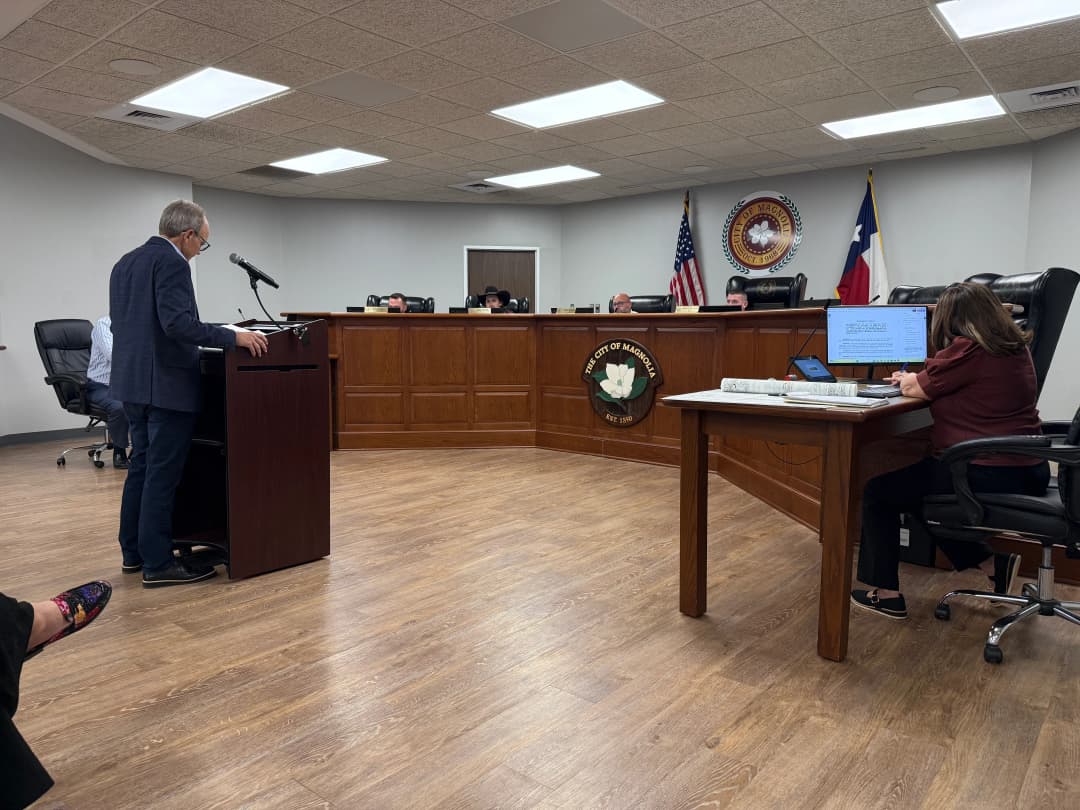
Magnolia City Hall. Photo: Dock Line Magazine
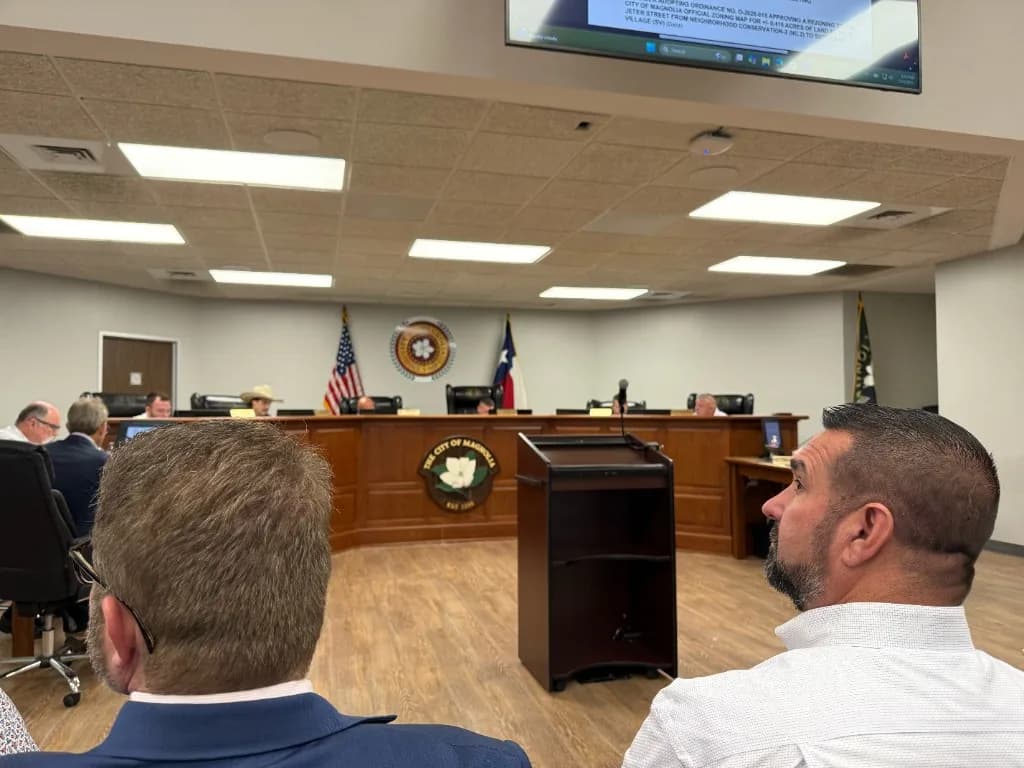
According to attendees and information provided to Dock Line Magazine, three council members voted against Montealvo’s proposal at the July 14, 2026, City Council meeting, preventing it from passing.
The official agenda confirms that the council was scheduled to consider both a rezoning ordinance and a conditional-use ordinance involving Montealvo’s property. However, the City had not posted approved minutes documenting the final vote at the time this article was prepared.
That leaves Magnolia’s business community with a serious question:
Did the city apply a clear, consistent land-use standard, or did a longtime small-business owner follow a process in which the requirements and destination repeatedly changed?
The Original Request: Auto-Urban Commercial
The city’s February 19 Planning and Zoning Commission records show that Montealvo initially sought to rezone the property from Public Use (PU) to Auto-Urban Commercial (AC).
City Planner Dana Berry presented the item. The minutes state that Montealvo told commissioners he had purchased the property approximately five or six years earlier and had been doing business in Magnolia since 2009. The commission then considered and approved a motion recommending denial of the rezoning request.
The distinction between zoning classifications matters. Magnolia’s land-use table identifies used automobile sales as a permitted use in an Auto-Urban Commercial district. That means the original AC request would have placed the business in a district where automobile sales were already contemplated as an ordinary permitted activity.
May 12: Another Trip to City Hall
May 12 became another important date in Montealvo’s attempt to secure approval.
Montealvo and supporters publicly described the meeting as an opportunity to present the matter to a newly elected mayor and council. The City’s official archive confirms that a City Council meeting occurred on May 12, although complete approved minutes establishing precisely what direction was given to Montealvo were not publicly available during this review.
That missing documentation is significant.
If city officials told Montealvo to pursue a different zoning classification, revise his request, or return through Planning and Zoning, the public deserves to know exactly what instructions he received and whether he complied with them.
The Second Path: Suburban Village and a Conditional-Use Permit
By the July 14 meeting, the proposed path had changed.
The official agenda listed an ordinance to rezone the property from Public Use to Suburban Village, along with a separate ordinance that would approve a conditional-use permit for automobile sales at the same address.
Under Magnolia’s zoning table, used automobile sales are not automatically prohibited in a Suburban Village district. They are identified as a conditional use.
The code explains that:
“P” means the activity is a permitted use.
“C” means the activity may be approved as a conditional use after public hearings and City Council consideration.
Used automobile sales are marked “C” in Suburban Village and “P” in Auto-Urban Commercial.
That means the July application was not asking the city to authorize an activity its code never contemplated. The city’s own regulations allow automobile sales in Suburban Village when council approves the use and any appropriate conditions.
The council therefore had more options than a simple unconditional yes or no. It could potentially have considered conditions involving:
Hours of operation
Landscaping and buffering
Lighting
Signage
Vehicle placement
Screening or fencing
Driveway access
Drainage
The number of vehicles displayed
Site-plan compliance
If the application could not satisfy the city’s standards even with reasonable conditions, the opposing council members should identify the exact standard it failed.
Was Montealvo Given a Realistic Path to Approval?
This is the central accountability question.
Montealvo initially pursued Auto-Urban Commercial zoning, where automobile sales would have been a permitted use. Planning and Zoning recommended denying that request.
The matter then proceeded through additional appearances and eventually returned as a proposed Suburban Village rezoning accompanied by a conditional-use permit.
That later path placed the business under a higher level of discretionary review.
If city staff recommended that change, residents deserve to know why. If Montealvo followed that recommendation, residents deserve to know why the resulting application was still rejected. If city staff never advised him to follow that path, the city should release the correspondence and staff reports establishing what he was actually told.
A city cannot claim to support local business while making its application process impossible to understand.
Is Dana Berry Responsible?
Montealvo’s supporters have placed significant responsibility on City Planner Dana Berry because she was involved in presenting and processing the zoning requests.
Berry’s role deserves examination. The official Planning and Zoning record confirms that she presented the original February rezoning item.
But Berry did not cast the final City Council votes.
Without written evidence showing that she provided incorrect instructions, changed the required process without justification, or acted outside city policy, it would be premature to assign her sole responsibility.
Staff must answer for the guidance it provided. Planning and Zoning must answer for its recommendation. The elected members of City Council must answer for their final votes.
Are the Three Council Members Against Small Business?
One zoning vote does not automatically prove that a council member opposes small business. Council members have legitimate obligations to consider traffic, neighboring property, drainage, access, compatibility, and the city’s adopted development standards.
But those responsibilities do not eliminate the obligation to explain a vote.
If three elected officials defeated Montealvo’s proposal, they should tell the public:
What specific standard did the application fail?
Did city staff recommend approval or denial?
Were there documented traffic or safety concerns?
Were neighboring property owners opposed?
Could the concerns have been addressed through conditions?
Why was conditional approval rejected?
What would Montealvo have needed to change to receive approval?
Was he clearly told those requirements before the final vote?
The City of Magnolia’s current council roster is available here: cityofmagnolia.com/mayor-city-council.
The city should publish the final roll-call vote before anyone definitively identifies the three opposing members in a news article.
A Small-Business Test for Magnolia
This dispute matters beyond one car dealership.
Small-business owners make expensive decisions based on guidance from local government. They purchase property, hire engineers, submit applications, pay fees, and attend public hearings.
A city that genuinely supports local businesses should provide a process that is:
Predictable
Consistent
Documented
Timely
Understandable
Based on identifiable standards
A process that repeatedly sends an applicant from one city body to another, changes the proposed zoning path, and then ends in denial without clear written findings creates the appearance that City Hall is moving the goalposts.
That perception can discourage other entrepreneurs from investing inside the city.
The Records Magnolia Should Release
To clear up the dispute, the City should release:
Every staff report prepared for the property.
The complete application history.
Correspondence between Montealvo and city staff.
Any written recommendation from Dana Berry.
Any engineering, traffic, drainage, or fire-safety analysis.
The specific findings supporting denial.
The official July 14 roll-call vote.
The approved minutes from the May 12 and July 14 meetings.
Any conditions staff or council considered as alternatives to denial.
A written explanation of what would be required for the property to receive approval.
Transparency would protect both the applicant and the city.
If Montealvo failed to satisfy a clearly communicated requirement, the records should show it. If he followed city instructions and was still denied without a consistent explanation, the records should show that too.
The Question City Hall Must Answer
This is not an argument that every rezoning application should be approved.
It is an argument that government must apply its rules clearly, consistently, and fairly.
Paul Montealvo operates an existing Magnolia business. He sought permission to use property he owns for an activity that Magnolia’s development code recognizes as either permitted or conditionally allowable, depending on the zoning district.
After multiple hearings and more than one proposed zoning path, the application failed.
The three council members who reportedly opposed it may have legitimate reasons. But residents and business owners deserve more than a no vote.
They deserve an answer to one straightforward question:
What exactly did Paul Montealvo need to do to receive approval, and was he ever given a fair and realistic opportunity to do it?
Until Magnolia City Hall answers that question with documents and specific findings, the perception will remain that the city did more than deny a land-use application.
It closed the door on a local small business without adequately explaining why.
Fact Box
Business: Magnolia Auto Plex
Owner: Paul Montealvo
Current business address: 201 9th Street, Magnolia, Texas 77355
Property at issue: 32002 Nichols Sawmill Road, Magnolia, Texas 77355
Parcel size: Approximately 0.470 acres
Property identification: A0177 Dawson Gamble, Tract 10-B; MCAD Property ID 40510
Original requested zoning: Public Use to Auto-Urban Commercial
Later proposed zoning: Public Use to Suburban Village
Related request: Conditional-use permit for automobile sales
Reported July 14 result: Proposal failed after three council members reportedly voted against it
Verification status: Official July 14 approved minutes and roll-call vote had not been posted at the time of publication
Sources
Editorial note: The vote outcome reported in this article is based on accounts from meeting attendees and information supplied to Dock Line Magazine. The City of Magnolia’s approved July 14 minutes were not publicly available at the time of publication. This article should be updated with the official roll-call vote, council-member names, and any stated reasons once the City posts those records.