We Used to Worry About the Price at the Pump. What About the Price at the Faucet?
Texas once planned dams by the dozen. Decades later, growth, groundwater disputes, aging infrastructure and unfinished projects are changing what families pay for water.
Texas once planned dams by the dozen. Decades later, growth, groundwater disputes, aging infrastructure and unfinished projects are changing what families pay for water.
“The price at the faucet is not simply the price of water. It is the price of every decision made before the water arrives.”
Gasoline announces its price on a tall sign beside the highway. Water is quieter.
It comes through the wall, turns a meter most people never see and appears on a bill weeks later. Because water falls from the sky and rests beneath the ground, it is easy to think the water itself should be nearly free.
But the water coming from a kitchen faucet is not merely rain. It has been captured, stored, pumped, treated, tested, pressurized and delivered through a network that may have taken generations to build. The monthly bill also carries part of the cost of debt, electricity, chemicals, employees, repairs, lawsuits and decisions made long before the current homeowner moved into town.
Montgomery County offers an unusually clear view of how that price develops. For years, Dock Line readers have heard pieces of the story from the San Jacinto River Authority and the Lone Star Groundwater Conservation District. There was a lake built after drought, concern about falling well levels, a groundwater district, a half-billion-dollar surface-water system, years of courtroom fights and now a new debate over whether the county may safely pump far more groundwater than planners once believed.
Seen separately, each chapter can sound like another technical water argument. Put together, they explain why the next major price people watch may not be posted at a gasoline pump. It may be printed on the water bill.
When Texas Planned Dams by the Dozen
The story begins before most of today’s subdivisions, highways and shopping centers existed.

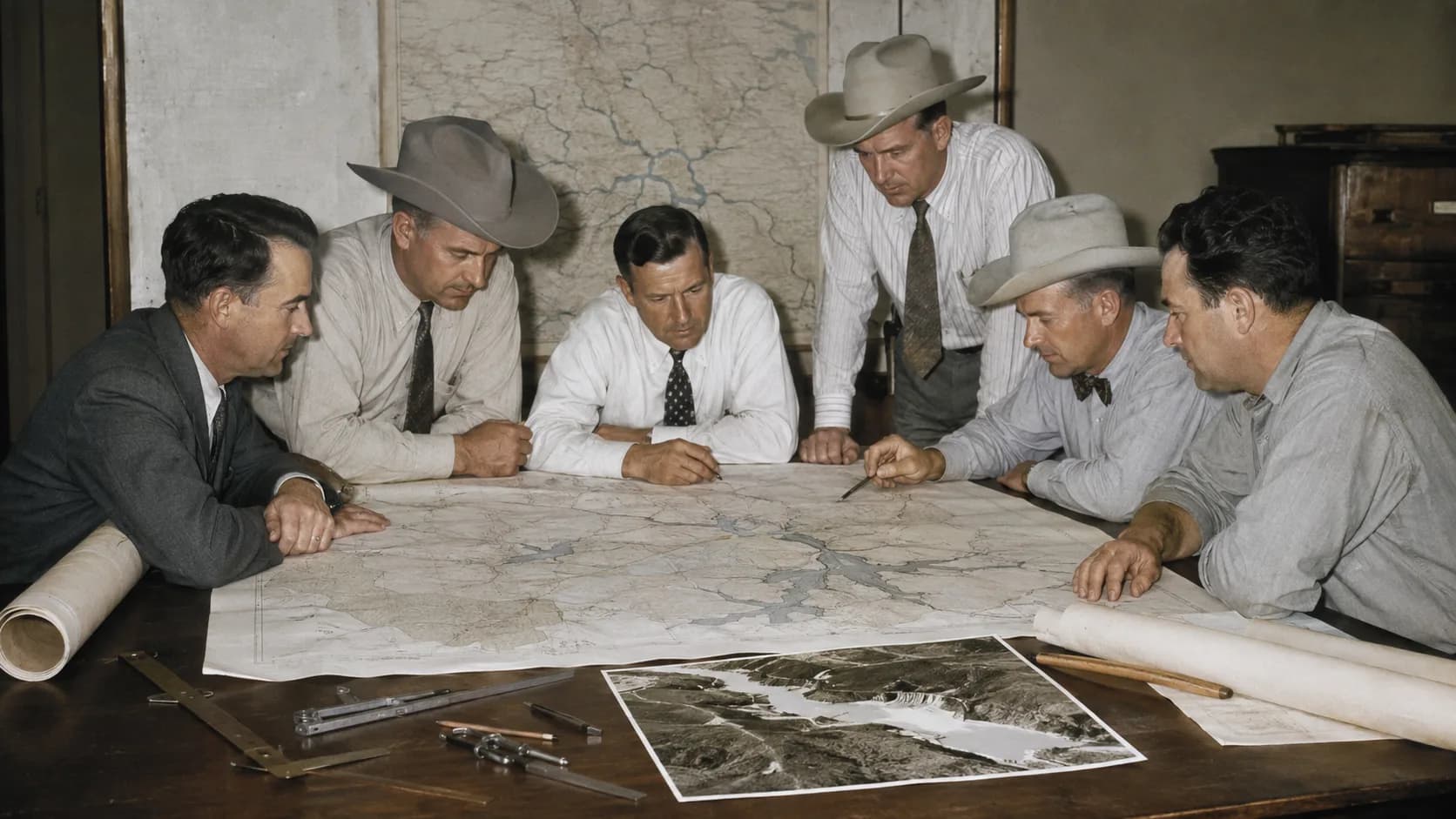
The Texas Legislature created what is now the San Jacinto River Authority in 1937 to develop, conserve and protect the water resources of the San Jacinto River basin. In 1943, the Authority’s master plan considered 14 dams and reservoirs with approximately 886,000 acre-feet of storage for water supply and flood mitigation. The estimated construction cost at the time was about $22.2 million, with another $1 million for channel improvements.
Those projects were not 14 fully funded construction jobs waiting for bulldozers. They were planning alternatives—ideas for what a growing region might eventually need. A 1957 update again examined dams, reservoirs and drainage improvements. The plans demonstrate that local leaders understood the basic challenge early: Southeast Texas receives plenty of rain over time, but the rain does not arrive on a dependable schedule, and much of it rushes toward the Gulf before it can be saved.
The record drought of the 1950s pushed Texas into a major reservoir-building era. Lake Houston was completed in 1953. In 1968, SJRA, the City of Houston and the Texas Water Development Board agreed to build Lake Conroe on the West Fork of the San Jacinto River. Construction began in 1969, the dam was completed in 1973 and the lake filled that October.
The region ultimately came to depend heavily on Lake Houston and Lake Conroe rather than the larger network of reservoirs imagined in early plans. Lake Conroe became a defining part of Montgomery County’s identity, but its original purpose was not waterfront homes, marinas or fishing. It was built as a water-supply reservoir.
The Reservoir Boom Slowed Down
What happened locally also happened across Texas.
The state built many of its major reservoirs during the 1960s and 1970s, then construction slowed dramatically. The Texas Water Development Board says the 1984 State Water Plan proposed 44 reservoirs. Later plans recommended fewer as suitable sites became harder to find, environmental and land requirements became more demanding and construction costs climbed.
The 2022 State Water Plan recommended 23 new major reservoirs by 2070. By spring 2025, two had completed construction. Five had received water-right permits and were moving through design or land acquisition, three more held permits, and 13 had not yet received water-right permits.
That record explains why people can remember hearing about lakes that never appeared. A reservoir may spend decades moving through feasibility studies, water-right applications, environmental reviews, federal permits, land acquisition, financing, design and construction. It may flood farms, homes, cemeteries, wildlife habitat and family land. It may also lose enormous amounts of water to evaporation. Some proposed sites no longer make economic or environmental sense by the time the paperwork is complete.
Calling all of that red tape is too simple. Some delays are unnecessary. Others are the process of deciding whose land will be covered by water, what happens downstream and whether the lake will produce enough dependable supply to justify its cost.
The result, however, is the same: population can grow much faster than reservoirs can be built.
When the County Looked Underground
For much of Montgomery County’s growth, groundwater carried the load.
Wells drew from the Gulf Coast Aquifer system beneath the county. Groundwater often looked like the inexpensive answer because the source was nearby and utilities did not need to build a regional reservoir, treatment plant and long transmission system before serving the next customer.
But inexpensive today is not always inexpensive forever.
After nearly two decades of declining water levels in wells operated by cities and utilities, community leaders asked the Legislature to create the Lone Star Groundwater Conservation District in 2001. Its job was to manage groundwater production in Montgomery County and balance private-property rights, present demand and the condition of the aquifers future residents would inherit.
In 2006, Lone Star adopted a regulatory plan targeting 64,000 acre-feet per year as the maximum groundwater production level for the county. In 2009, the district required large-volume users to reduce groundwater use to no more than 70 percent of their 2009 permitted amounts by January 1, 2016.
The rule did not tell every family to stop using a well. It told the county’s largest water providers that continued growth could no longer rely on groundwater alone.
The Half-Billion-Dollar Answer
SJRA responded with a regional Groundwater Reduction Plan, usually called the GRP.

Instead of requiring every city, municipal utility district and private utility to invent its own replacement supply, SJRA proposed a shared system. Surface water would be taken from Lake Conroe, treated to drinking-water standards and delivered through a regional pipeline network. Participants would share the cost, and the county as a whole could meet the required groundwater reduction.
By 2010, water providers representing roughly 80 percent of Montgomery County’s water use had joined the plan. Construction began on a project that ultimately included a surface-water treatment plant at the Lake Conroe Dam, about 55 miles of transmission pipelines, metering and blending facilities and the equipment needed to deliver treated water to participating utilities.
The project cost roughly half a billion dollars and was financed largely through long-term bonds supported by wholesale water charges and pumpage fees. The system began delivering Lake Conroe water in September 2015, just ahead of the 2016 groundwater-reduction deadline.
That arrangement created a new reality. Customers receiving surface water paid for the water delivered. Participants continuing to pump groundwater paid a fee that helped support the regional system built so the group could comply together.
The water was no longer cheap simply because it came from beneath local soil. The bill now included the cost of creating an alternative.
Then the Legal Ground Shifted
The system had been built, the bonds had been issued and the pipelines were in the ground when the legal foundation beneath the original pumping limits changed.
Cities and private utilities challenged Lone Star’s regulatory plan. In 2018, a district court concluded that the plan’s pumpage limits had been adopted without legal authority and declared those limits unlawful, void and unenforceable. The ruling did not establish that the aquifers were limitless or that groundwater management was unnecessary. It addressed the legal authority used to impose that particular set of restrictions.
A newly elected Lone Star board later removed the conservation rules from the district’s regulatory materials. But invalidating the original limits did not make the treatment plant disappear. It did not unbuild the pipelines or erase the debt. The GRP participants had signed long-term contracts, and the regional system continued operating.
That distinction fueled years of anger. Some customers asked why they should keep paying for a project built to satisfy rules a court later struck down. SJRA and other participants answered that the contracts financed a real facility, the bonds still had to be repaid and the county still needed a diversified supply as it grew.
Both statements can be true at the same time. The legal requirement changed. The infrastructure and its cost did not.
The Rate Fight
The disagreement moved from water meetings into courtrooms.
Conroe and Magnolia objected to rate and fee increases beginning in 2016 and 2017. Conroe paid for the surface water it received but withheld disputed increases, placing millions of dollars in escrow. SJRA argued that the unpaid amounts threatened a system financed for the benefit of all participants. The cities challenged the rates, the contracts and SJRA’s ability to sue them.
The litigation wound through Texas courts for years. In 2024, the Texas Supreme Court ruled on a key governmental-immunity issue and allowed SJRA’s payment claims to proceed. In August 2025, SJRA and Conroe announced a settlement ending their portion of the long-running dispute.
Under the announced terms, Conroe paid the amount it had held back, agreed to pay current rates and gained access to additional surface water. SJRA shortened Conroe’s contract term, forgave penalties and clarified that Conroe would not be required to participate in future GRP expansions. SJRA said the payment and reduced legal expenses would help lower wholesale rates.
The settlement did not declare one side morally correct and the other wrong. It demonstrated something more practical: when water infrastructure is financed for decades, a policy dispute can outlive the officials who started it and still appear on household bills years later.
Now the Groundwater Number May Nearly Double
The newest chapter may be the most confusing of all.

In 2026, Lone Star began supporting a proposed long-term groundwater goal that could increase Montgomery County’s modeled available groundwater from approximately 97,000 acre-feet per year to about 199,000 acre-feet. Supporters say an improved Texas Water Development Board model provides a better picture of the aquifers and indicates that more water can be produced while retaining the long-term goal of leaving a median 70 percent of available drawdown through 2080.
The proposal does not automatically double every permit, and it had not become a final pumping rule at the time of this writing. It is part of the joint-planning process conducted through Groundwater Management Area 14.
Still, the number naturally raises a public question: If the county can safely pump nearly twice as much groundwater as previously modeled, was the expensive surface-water system unnecessary?
The honest answer is not a simple yes or no.
Updated science may show that earlier models were too restrictive. At the same time, Montgomery County has added hundreds of thousands of residents, the GRP has provided an operating second source, and Conroe has recently sought more Lake Conroe water while dealing with growth and infrastructure limitations. A diversified system can have value even if the exact balance between surface water and groundwater changes.
The real danger is pretending that any model is permanent. Water planning stretches across 50 years while science, population, land use and politics change every few years. Communities must build expensive systems using the best information available, knowing that later information may alter the plan but will not refund the concrete.
What the Faucet Is Really Charging For
This is why the price of water cannot be understood by asking only how many gallons a family used.
A modern water bill may support wells, pumps, treatment chemicals, laboratories, power, employees, storage tanks, old pipe replacement, new subdivisions, drought planning, regulatory compliance, debt service and the purchase or transport of water from somewhere else. It may also carry the cost of decisions delayed until an emergency made them unavoidable.
The national numbers are enormous. The U.S. Environmental Protection Agency estimates that American drinking-water systems will need about $625 billion over 20 years for pipes, treatment plants, storage and other essential assets. Most of that need is in distribution and transmission—the buried infrastructure people rarely notice until it breaks.
Texas faces the same pressure at state scale. The 2027 State Water Plan projects that population will grow 53 percent between 2030 and 2080 while existing supplies dependable during drought decline about 10 percent. The plan contains roughly 6,700 water-management strategies and 3,000 projects with an estimated capital cost of approximately $174 billion.
Those billions eventually become somebody’s rate, tax, fee, bond payment or development charge. Water does not send the bill. Infrastructure does.
The Remedy Is Not One More Lake
Texas will still need new reservoirs where the location, yield, environmental effects and economics make sense. But the era when one giant lake could be treated as the complete answer is over.
A dependable water portfolio may include off-channel reservoirs that capture high river flows without permanently damming the main channel; aquifer storage and recovery that places treated water underground for drought years; reclaimed wastewater for industry, irrigation and cooling; brackish-groundwater desalination; conservation; leak detection; replacement of aging mains; and stronger rules requiring new development and large industrial users to pay a fair share of the infrastructure created to serve them.
It also requires something less dramatic: honest public accounting.
Residents should be able to see what portion of a rate pays for current water, what portion repays old construction, what portion prepares for growth and what assumptions were used when the project was approved. When a model changes, officials should explain what changed. When a project is delayed, the public should know whether the barrier is money, land, engineering, environmental review or lack of political will.
Water planning is difficult enough without forcing people to guess.
The Price at the Faucet
Gasoline and water are not the same product. We can drive less, change vehicles or postpone a trip. A household cannot simply decide it no longer needs safe water.
But the comparison is becoming harder to dismiss. Gasoline costs money because it must be found, processed, transported, stored and sold through a vast system. Clean water must also be captured or pumped, treated, moved, stored and delivered through infrastructure that costs more every year to build and repair.
The San Jacinto basin once considered dams by the dozen. One great lake was built locally, groundwater carried much of the next wave of growth, and a costly regional treatment system was added when officials believed the aquifers needed relief. Then the rules changed, the courts intervened and the scientific model changed again.
None of that means the money was simply wasted. It means the price at the faucet contains history.
The next water crisis may not begin with an empty reservoir or a dry well. It may begin when communities realize they waited too long to build, repair, reuse and explain the systems everyone depends upon—and ordinary families can no longer ignore the cost.
We used to watch the sign at the gasoline station.
It may be time to watch the faucet just as closely.