

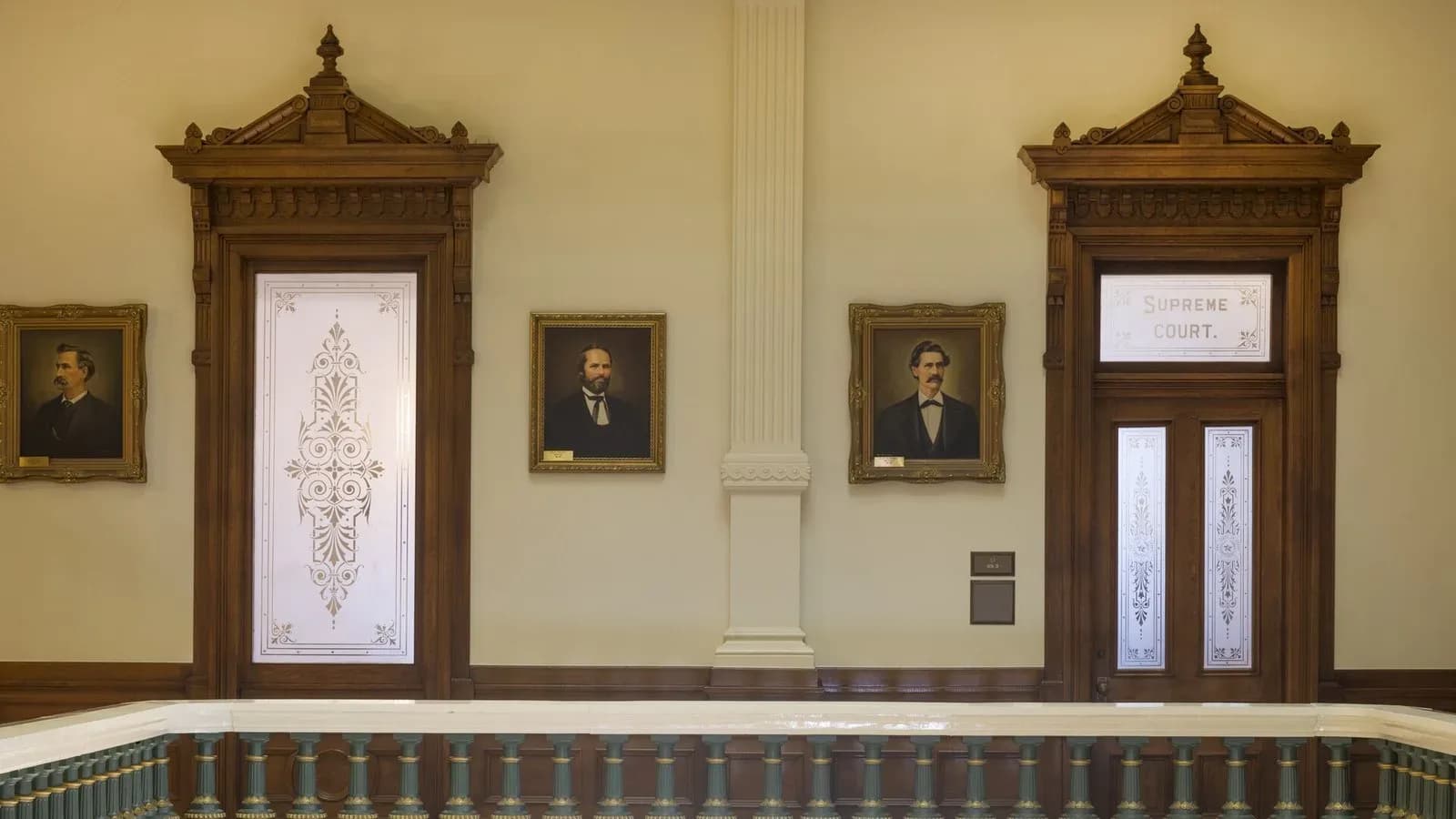
No Constitutional Amendments Are on the Texas Ballot This Year. The Court Races Below the Headliners Matter
Texans will not vote on any statewide propositions Nov. 3. They will choose four Texas Supreme Court justices, three Court of Criminal Appeals judges and the first elected bench of the new 15th Court of Appeals.
If you are looking for a list of constitutional amendments on your Nov. 3 ballot, you will not find one. This year there are none.
The Texas Secretary of State's sample ballot for the Nov. 3 general election lists candidate races only. It carries no statewide propositions. The Legislative Reference Library's list of amendment election dates shows the most recent constitutional amendment election was Nov. 4, 2025, when voters decided 17 amendments. No 2026 amendment election is listed.
That is normal. Amendments must pass the Legislature by a two-thirds vote of both chambers, and the Legislature holds its regular sessions in odd-numbered years. Those amendments usually go to voters that November. Local propositions, such as school bonds and city charter changes, are still on many ballots, so check with your county.
With no amendments to study, it is a good year to give some attention to the races at the bottom of the statewide ballot. Most voters skip past them. They should not.
Texas Supreme Court
The Supreme Court is the state's highest court for civil cases. It has nine members elected statewide to staggered six-year terms, and all nine seats are held by Republicans, according to the San Antonio Report's judicial voter guide. Four seats are on the ballot.
Chief Justice: Republican Jimmy Blacklock, appointed chief justice by Gov. Greg Abbott in 2025 after Nathan Hecht reached the state's judicial age cap, faces Democrat Maggie Ellis, a justice on the 3rd Court of Appeals in Austin.
Place 2 (unexpired term): Republican James P. Sullivan, appointed when Blacklock became chief justice, faces Democrat Chari Kelly, a former Army paratrooper and JAG who serves on the 3rd Court of Appeals.
Place 7: Republican Kyle Hawkins, a former Texas solicitor general appointed in October 2025 to replace retiring Justice Jeff Boyd, faces Democrat Kristen Hawkins, a Harris County district judge since 2016.
Place 8: Republican Brett Busby, on the court since 2019, faces Democrat Gisela Triana of the 3rd Court of Appeals in a rematch.
Court of Criminal Appeals
The Court of Criminal Appeals is the state's highest court for criminal cases, It also has nine members elected statewide, all Republicans. The San Antonio Report notes the court saw big turnover in the 2024 primaries after Attorney General Ken Paxton campaigned against Republican judges who had ruled he lacked broad authority to prosecute election fraud on his own. Two remaining judges from that ruling, Bert Richardson and David Newell, are not seeking reelection.
Place 3: Republican Thomas Smith, who worked for Paxton in the attorney general's office and in his Senate office, faces Democrat Okey Anyiam, a Dallas defense lawyer, and Libertarian Mark Ash.
Place 4: Republican Kevin Patrick Yeary, first elected in 2014 and the only incumbent on the court seeking reelection, faces Democrat Audra Riley, a Dallas criminal district judge.
Place 9: Republican John Messinger, general counsel in the Office of State Prosecuting Attorney since 2010, faces Democrat Holly Taylor, a defense attorney who spent more than 17 years as a prosecutor.
A new court on the ballot for the first time
The 15th Court of Appeals was created by the Legislature in 2023. It hears cases involving the state and state leaders, challenges to state law and appeals from the new business court. Its three justices were appointed by Abbott and are on the ballot for the first time, elected statewide.
Chief Justice: Republican Scott Brister faces Democrat Jerry Zimmerer.
Place 2: Republican Scott K. Field faces Democrat Tom Baker.
Place 3: Republican April Farris faces Democrat Marc M. Meyer.
Two special elections
Some voters will see one more race. Abbott ordered a special election in Senate District 22 to finish the term of Sen. Brian Birdwell, who resigned. The district covers Bosque, Comanche, Eastland, Erath, Falls, Hamilton, Hill, Hood, McLennan and Somervell counties, plus parts of Ellis and Tarrant counties. A special election in House District 93, in Tarrant County, will fill the seat Rep. Nate Schatzline resigned. Both are listed on the Secretary of State's Nov. 3 election page.
Why judges deserve your time
In Texas, most judges are elected. That is a real trust. Judges decide whether a contract is honored, whether a conviction stands and how far the other branches of government may go. Scripture says, "Judges and officers shalt thou make thee in all thy gates... and they shall judge the people with just judgment" (Deuteronomy 16:18). In Texas, the people do the making.
Read the candidates' records before you vote, not just the party label. Early voting ends Friday, Oct. 30, and Election Day is Tuesday, Nov. 3. The full list of statewide races is in our guide to what is on every Texas ballot, and if something goes wrong at the polls, here is how a provisional ballot works.
More Politics & Government Stories
 Today
Justice Department Sues to Block Alaska's Senate Certification if Sullivan Loses. Let Alaska Count Its Own Votes.
 Today
Colorado and Washington Voters Will Decide Whether Girls' Sports Belong to Girls. Fairness Is on the Ballot.
 Today