Written By Cheryl Conley
Lake Creek Nature Preserve Board of Directors
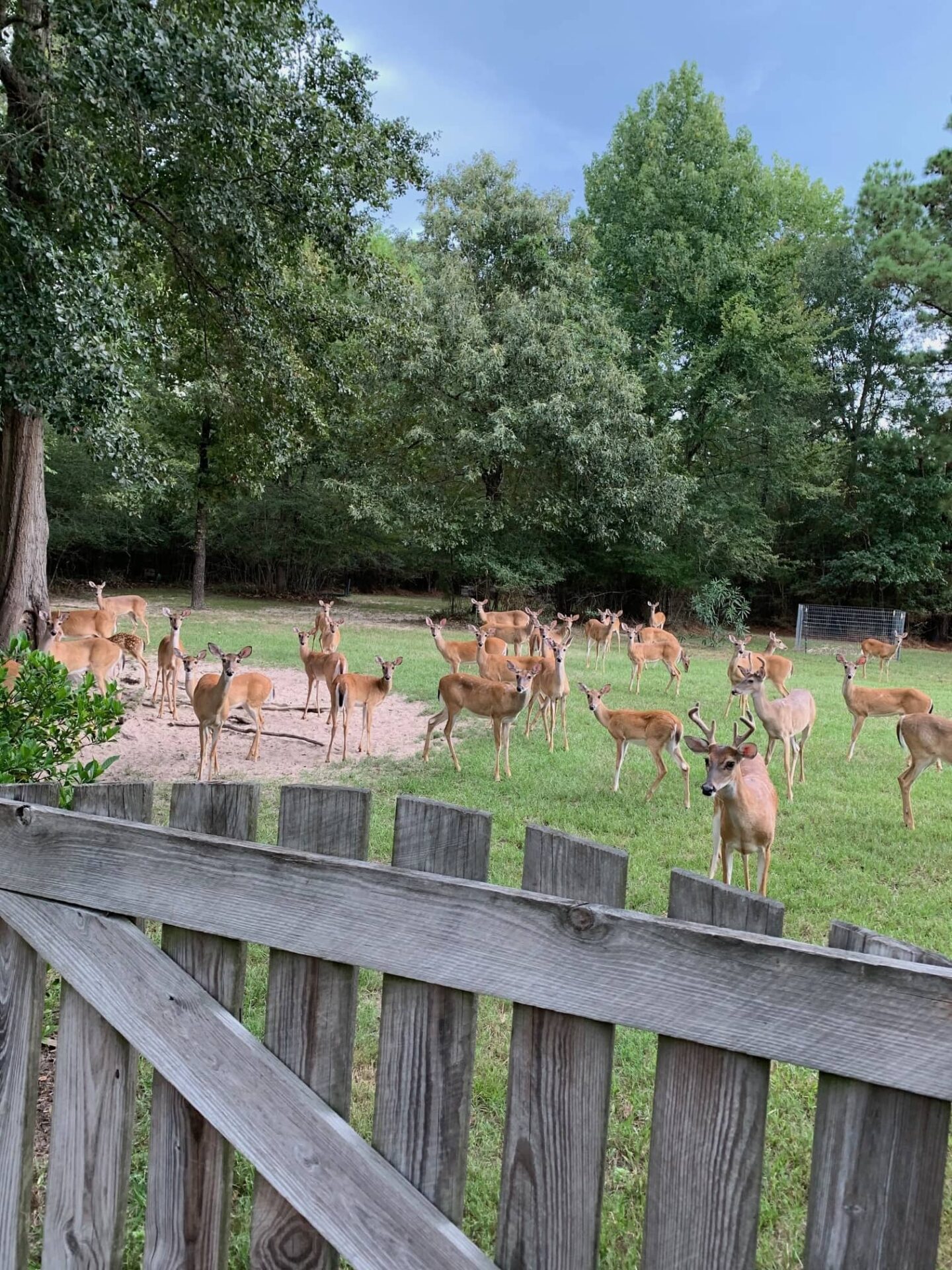
The deer in my area may not wear wristwatches, but don’t be fooled—they are obsessively punctual. It seems like an invisible alarm clock goes off in the woods, and right on cue they report for duty. Well, not really duty–food! Around 4:00pm every day, my own local herd arrives for their daily snack of corn. Remember the slogan associated with mail carriers? “Neither snow nor rain nor heat nor gloom of night stays these couriers from the swift completion of their appointed rounds.” This certainly applies when it comes to snack time. This uncanny punctuality isn’t coincidence or politeness—it’s biology. From birds to beetles to extremely food-motivated deer, animals run on powerful internal clocks that govern when they eat, migrate, sleep, and show up expecting snacks. Call it nature’s timekeeping system: no batteries required, but surprisingly accurate.
What I’ve noticed with deer happens with other species in the animal kingdom as well. Almost all mammals, including us, have internal clocks that tell them when to eat, when to be active, and when to sleep. It’s known as a circadian clock. In simple terms, it works like a master clock in the brain called the suprachiasmatic nucleus (SCN), located in the hypothalamus. It coordinates many smaller clocks throughout the body. Almost every cell in the body has its own independent, smaller clock.
Mammals rely on external clues from the environment to help reset the 24- hour biological clock. These external cues are known as “zeitgebers,” which is a German word meaning “time-givers.” Without zeitgebers, mammals might wake up at the wrong time or eat at the wrong time. Light is the main zeitgeber for almost all species. Other examples are:
- Artificial light – can interfere with an animal’s activities like foraging, mating, and migration. Exposure to lights at the “wrong” time can have adverse effects on the internal clock.
- While natural light is the main zeitgeber, food availability is second. In anticipation of eating, mammals display increased wakefulness,
body temperature, and locomotor activity. Eating at “normal” times ensures synchronization of internal rhythms. When food is scarce it forces animals to change their eating patterns. More time is spent looking for food which can interfere with sleep-wake cycles. - Temperature – changes in temperatures play a role in synchronizing the 24-hour day-night cycle. Normally, cooler temperatures signal rest or nighttime for animals but extreme cold during daylight hours may send the wrong signal. Extreme cold can force animals into abnormal behavior. They may be forced to look for food into the night, disrupting their circadian rhythm.
Light and darkness may be nature’s most reliable alarm clock, but depending on the species, the cue to eat, move, mate, or migrate might come from the tides or the moon, a whiff of pheromones, a change in humidity, a drop in barometric pressure, or even Earth’s magnetic field. Toss in social interactions, rainfall, oxidative stress, and a dozen other signals, and it becomes clear: nature runs on more clocks than a watch store.
What remains most remarkable is the way life pays attention. Across forests, fields, oceans, and skies, species of every kind read the planet’s subtle cues—light, water, pressure, and motion—and respond in quiet, precise ways. Without clocks or conscious thought, they adapt and endure, moving in rhythm with forces far older than themselves. It’s a reminder that survival is not just about resilience, but about belonging—an ongoing conversation between living things and the world that shapes them.