

He Is Not Building Five Companies. He Is Building One System.
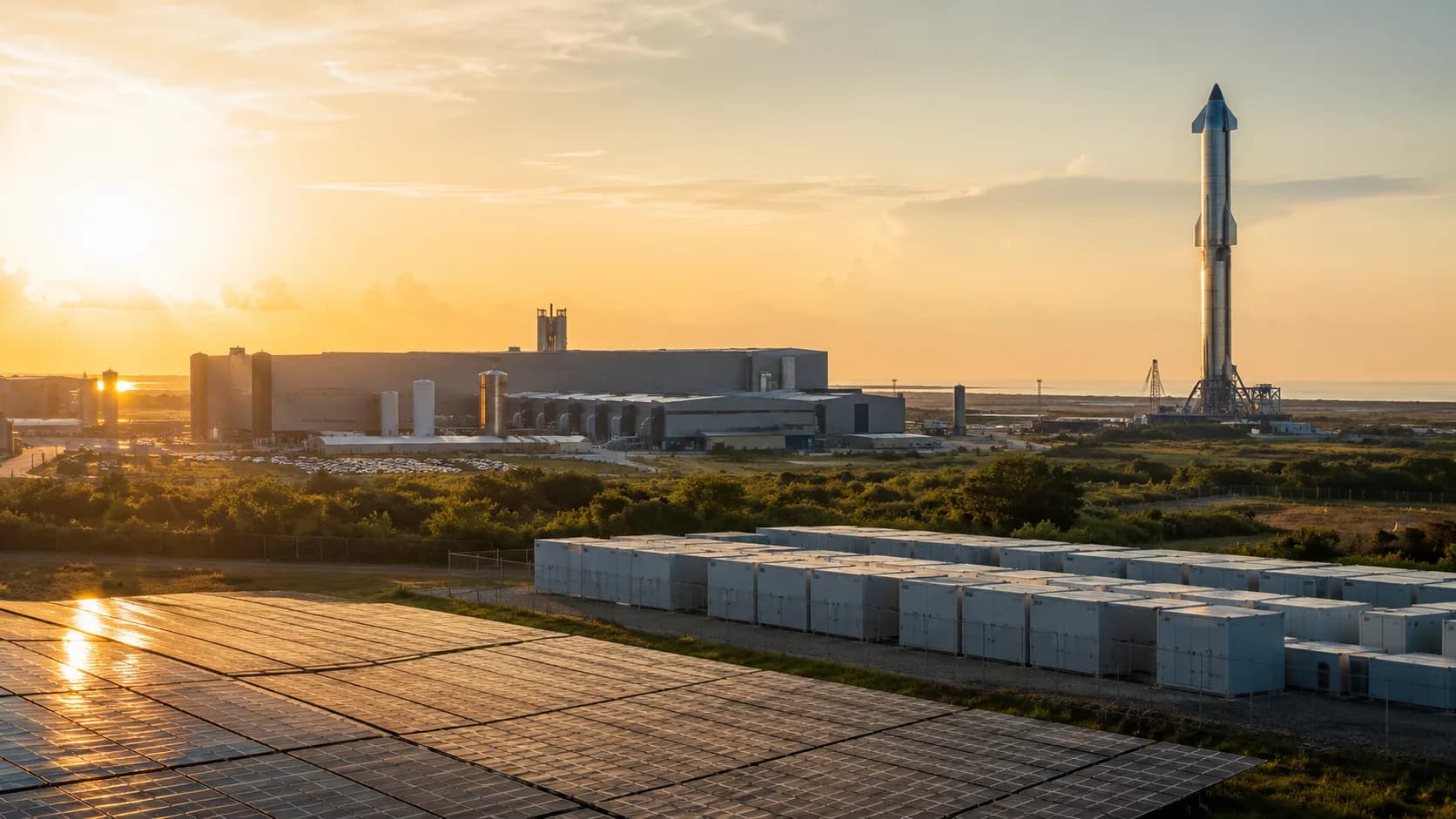
Rockets, satellites, robots, chips and artificial intelligence are starting to look less like separate Musk ventures and more like parts of one machine, with Texas becoming its factory floor and the Sun becoming its intended power source.
Rockets, satellites, robots, chips and artificial intelligence are starting to look less like separate Musk ventures and more like parts of one machine, with Texas becoming its factory floor and the Sun becoming its intended power source.
The future is arriving as a stack of unrelated headlines.
A reusable rocket launches another batch of satellites. A NASA crew prepares to ride a commercial capsule. A humanoid robot learns another factory task. A rural Texas county signs an agreement for a semiconductor plant. Somewhere else, another field of solar panels is paired with another row of industrial batteries.
Read one at a time, they look like stories about different companies competing in different industries.
Read them together, and something larger begins to appear.
Elon Musk is no longer simply building a car company, a rocket company, a satellite network, an artificial-intelligence business and a robotics program. The parts increasingly depend on one another. The rockets carry the network. The network moves the information. The chips run the intelligence. The robots turn that intelligence into physical work. Solar generation and batteries are meant to feed the whole arrangement with energy.
This is not a finished system. Some pieces work every day. Some are entering construction. Some remain on a presentation slide, a regulatory filing or Musk's famously impatient calendar.
But the connections are no longer imaginary.
Begin With What Already Works

The easiest mistake is to judge the entire plan by its strangest promise. Moon factories and orbital computing centers make better arguments than evidence. SpaceX's ordinary work provides the evidence.
Falcon launches have become so frequent that a successful mission and booster landing can pass with little national attention. Dragon flights now carry astronauts as part of NASA's regular crew rotations. Starlink reported more than 9 million customers across more than 155 countries and markets in its 2025 progress report. Its first generation of direct-to-cell satellites had connected more than 12 million people at least once, often where ordinary networks were unavailable.
None of that requires believing a prediction about 2030. It is infrastructure operating now.
That matters because the ambitious pieces are being built on top of businesses that already know how to manufacture satellites, launch them, recover rockets, operate a global network and sell a service directly to millions of customers. The future plan is not beginning with an empty warehouse and a clever speech.
September Is a Marker, Not a Finish Line
The next few weeks offer a useful glimpse of the range SpaceX now covers.
NASA's Nancy Grace Roman Space Telescope is scheduled to launch aboard a Falcon Heavy on August 30. Roman is designed to study dark energy, dark matter and distant worlds with a field of view roughly 100 times larger than Hubble's. No earlier than mid-September, NASA's SpaceX Crew-13 mission is expected to carry four people from three space agencies to the International Space Station for a long-duration science expedition.
One mission looks deep into the universe. The other keeps human beings working in orbit. Both ride hardware from the same company that is launching communications satellites at industrial cadence.
Musk has also predicted that artificial-intelligence revenue could overtake SpaceX's other product lines as early as September. That is a forecast, not a scheduled launch, and it deserves a different kind of ink. A NASA mission has a crew, a vehicle and a target window. A revenue prediction is an argument about a business that is still being assembled.
The honest story needs both, but it cannot pretend they are the same thing.
The Factory Between the Companies

The most revealing development may not be at a launchpad. It may be taking shape near Gibbons Creek Reservoir in Grimes County, Texas.
SpaceX has signed a county agreement connected to Terafab, a proposed vertically integrated semiconductor and advanced-computing complex. The written agreement calls for at least $5 billion in investment by 2030 and 1,800 full-time jobs by 2035. Much larger numbers have appeared in project descriptions and news reports, but those figures describe proposed phases and possible full buildout, not money already poured into concrete.
The fine print matters. The same agreement reportedly allows SpaceX to leave with 30 days' written notice. Residents have raised questions about water, chemicals, traffic, emergency services, tax incentives and what an industrial project of extraordinary scale would do to a rural county. Those concerns are not side notes. A system this large does not arrive on an empty map.
Still, Terafab reveals the bottleneck Musk is trying to remove. Tesla needs chips for vehicles, autonomy and Optimus. Artificial intelligence consumes enormous quantities of computing hardware. Satellites need onboard processing. Space-based computing, if it ever reaches meaningful scale, would need chips in numbers the present supply chain was never designed to provide to one customer.
If the available factories cannot make enough of the required chips, the Musk answer is becoming predictable: build the factory too.
The Sun Is Upstream
Chips, robots and rockets make the visible products. Energy determines how many of them can operate.
Tesla's current master plan explicitly connects solar generation, large-scale battery storage, electric transportation, autonomy, manufacturing and humanoid robots. The idea is not merely to sell electricity or store it. It is to build an energy layer beneath the machines that do the work.
That does not mean every Musk facility runs only on sunlight today. It does not mean Terafab will. County documents describing the proposed complex contemplate natural-gas-fired power generation, and a semiconductor plant of that scale would require dependable electricity, water, cooling and backup systems around the clock. Solar is the intended direction, not the present wiring diagram.
In orbit, the attraction becomes even clearer. A computing platform can collect solar energy directly, but space does not make the engineering free. Satellites still pass through darkness in many orbits. Heat must be rejected through radiators. Electronics face radiation, debris and difficult repairs. Launching equipment is expensive even when rockets are reusable.
The Sun may supply the energy. Human beings still have to build the system that can use it.
Starship Is Not Just a Larger Rocket
Falcon made frequent launch possible. Starship is intended to change what can be launched and how often.
SpaceX describes Starship and Super Heavy as a fully reusable transportation system for Earth orbit, the Moon, Mars and beyond. The important phrase is not Mars. It is fully reusable. If a very large vehicle can fly, return and fly again at aircraft-like cadence, satellites stop being precious individual machines and begin to resemble equipment delivered through a freight network.
That is why orbital refueling, rapid reuse and reliable recovery matter more than a spectacular test-flight video. SpaceX's lunar architecture depends on tanker vehicles and propellant depots in orbit. NASA's current Artemis plan calls for a 2027 low-Earth-orbit demonstration of commercial landing systems, followed by a targeted crewed lunar landing in 2028. SpaceX says Starship cargo flights to the lunar surface could begin no earlier than 2028.
Those dates may move. The engineering gates will not. A Moon economy cannot be built from one heroic launch. It requires transportation that behaves like logistics.
AI Is the Thread, Not the Whole Story

Artificial intelligence receives most of the attention because it appears to be the thinking part. In this system, however, intelligence is useful only when it can reach something physical.
A model can design a component, direct a robot, optimize a battery, route a satellite connection or help a spacecraft react faster than a distant controller. But without chips, electricity, factories, communications and transportation, it remains computation waiting for somewhere to go.
That may be the idea Musk sometimes appears to be reaching for when ordinary business language no longer fits. Not a new branch of humanity, exactly, but a second operating layer of civilization: human intentions moving through machine intelligence and becoming physical work at a speed and scale people have not experienced before.
That description should not be mistaken for endorsement of every outcome. The more decisions move through machines, the more important human judgment becomes. What people teach the systems, what they reward, who controls them and who carries the consequences will not be solved by a larger solar array.
Technology can multiply an intention. It does not guarantee the intention was wise.
What the Next Five Years Could Actually Change
By 2030, the most believable outcome is not a city on Mars or an army of robots doing every unpleasant job. It is a much tighter connection among capabilities that already exist.
Starlink can grow from a broadband provider into a communications layer that reaches phones, vehicles, aircraft, ships and machines. Starship can either prove repeatable flight, recovery and orbital refueling or show exactly where the schedule must slow down. Terafab can move from agreement and land clearing into real construction and partial production, while revealing the true cost in power, water and public infrastructure. Tesla's energy business can place more storage beside renewable generation. Robots can become useful in narrower factory jobs before they become the general-purpose helpers shown on a stage.
Orbital computing may begin as limited demonstrations rather than an instant replacement for terrestrial data centers. Lunar cargo may arrive before lunar industry. The spectacular version will probably come in pieces.
That is precisely why it can pass people by.
Most transformations do not arrive as one morning when the world looks different. They arrive as another launch that went well, another county vote, another factory wall, another software update and another job a machine can perform without supervision. Each change is small enough to dismiss. The connection among them is not.
The System Is the Story
There are plenty of reasons the plan could slow down. Starship remains a development program. Semiconductor factories are among the most complicated industrial projects on Earth. Orbital computing has unresolved economics. Robots are improving faster than they are becoming ordinary employees. Communities may decide that the cost of hosting these facilities is higher than the promised benefit.
The point is not that every forecast will come true on schedule.
The point is that the objective has changed.
Musk's companies are trying to remove the outside dependency between an idea and its execution: generate the energy, store it, manufacture the chip, train the intelligence, give it a physical worker, connect that worker to a global network and build the vehicle that carries the whole arrangement beyond Earth.
The rockets make the most noise, so they receive the attention. The quieter ambition is to connect sunlight to intelligence, and intelligence to work.
People who keep watching only the individual companies may continue asking which product comes next.
People watching the connections are beginning to ask a different question.
How much of the future belongs to whoever controls the entire chain?
More Business Stories
 September 21, 2026
He Told Himself the Truth in a Bathroom Mirror. Then He Went Looking for Purpose.
 September 4, 2026
The Homes Didn't Stop Selling. The Frenzy Did.
 September 3, 2026