Rice Researchers Turn Carbon Dioxide Into Industrial Feedstock With Light
A Rice University catalyst split carbon dioxide under visible light for nearly four hours, but commercial-scale reactors remain the next challenge.
Rice University researchers have demonstrated a laboratory catalyst that uses visible light to split carbon dioxide into carbon monoxide and oxygen—a result that could eventually help manufacturers reuse a greenhouse gas as an industrial raw material.
The Houston research combines copper nanoparticles, cerium oxide and ruthenium reaction sites. Each component handles a different part of a difficult chemical problem, allowing the system to keep producing carbon monoxide far longer than the heat-driven comparison used in the study.
It is an early laboratory demonstration, not a commercial carbon-recycling machine. Scaling the process from a laser-powered reactor to industrial equipment is the next major challenge.
Why Carbon Monoxide Is Useful
Carbon monoxide is hazardous to breathe, but inside controlled industrial systems it is an important building block. Manufacturers use it to make synthetic fuels, plastics and many other chemicals.
Carbon dioxide is much harder to break apart because its chemical bonds are extremely stable. Conventional direct-splitting methods can require furnace temperatures between 700 and 1,500 degrees Celsius or powerful electrical discharges.
The Rice team is investigating whether light can supply the energy in a more targeted way, potentially allowing captured carbon dioxide to become feedstock instead of waste.
How the Light-Driven Catalyst Works
In the system described by Rice University, copper nanoparticles act like tiny antennas. Visible light energizes electrons that move into ruthenium reaction sites, where carbon dioxide molecules split into carbon monoxide and oxygen.
Free oxygen creates a problem because it can quickly recombine with carbon monoxide to form carbon dioxide again, or damage the catalyst. Cerium oxide serves as what the researchers call an “oxygen sponge,” temporarily storing the oxygen in its crystal structure. The material can then be regenerated under light with nitrogen gas for another cycle.
Nearly Four Hours of Steady Production
The catalyst reached its highest output under blue light with a wavelength of 475 nanometers. It produced carbon monoxide at a rate of 15,000 micromoles per hour per gram and maintained steady production for 238 minutes—nearly four hours.
That was almost seven times longer than the study's heat-driven control, which degraded after approximately 35 minutes. The full material also produced nearly three times as much carbon monoxide as test materials that did not contain the cerium oxide oxygen reservoir.
The results are reported in the peer-reviewed paper “Direct CO2 Splitting Using Light-Based Catalysis and an Oxygen Reservoir” in the Proceedings of the National Academy of Sciences.
“Room Temperature” Needs an Explanation
Rice describes the reaction system as operating at room temperature because it does not depend on heating the entire chamber to the extreme temperatures used by conventional furnaces. That does not mean every part of the catalyst stayed cool.
Under laser illumination, the catalyst surface reached approximately 300 to 386 degrees Celsius, or 572 to 726 degrees Fahrenheit. The researchers also found that externally cooling the surrounding chamber to 10 degrees Celsius improved production by helping carbon dioxide molecules attach to the catalyst surface.
That distinction matters: the experiment shifts where and how energy is delivered, but it does not eliminate heat from the illuminated material.
Houston Company Is Working on Scale-Up
The underlying antenna-reactor technology has been licensed to Syzygy Plasmonics, a Houston clean-technology company co-founded by Rice researchers. Syzygy is developing light-driven chemical reactors intended to replace laboratory lasers with scalable lighting arrays.
Before the approach can be judged commercially, engineers still need to demonstrate long-term durability, overall energy efficiency, reliable oxygen handling and cost-effective production at much larger scale. The 238-minute laboratory run is encouraging, but industrial plants must operate reliably for far longer.
For now, the work shows a new route through a stubborn chemical problem: use light-harvesting particles and an oxygen reservoir together so carbon dioxide can be split without immediately rebuilding itself.
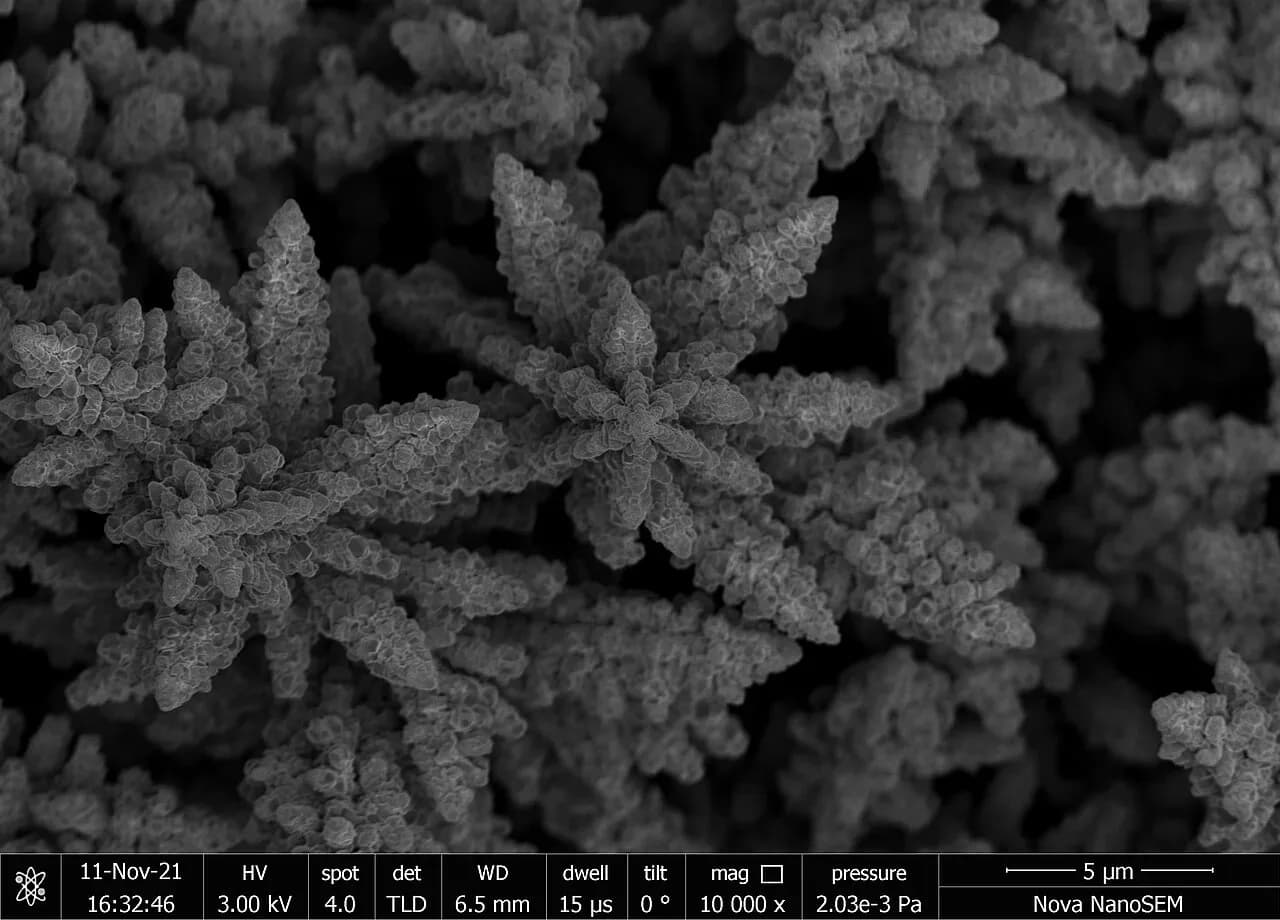
Photo: Scanning electron microscope image of a copper catalyst, created by SvenOras in 2021. Wikimedia Commons, CC BY 4.0. Cropped for display. This is a representative catalyst image and is not the material used in the Rice experiment.