How Far Do You Have to Go to Find the Country Again?
The Woodlands, Conroe, Montgomery, Magnolia and Willis have all felt the pressure of a fast-growing region. Now some residents are looking farther out for land, quiet and breathing room—and wondering how long the next country town will stay country.
The Woodlands, Conroe, Montgomery, Magnolia and Willis have all felt the pressure of a fast-growing region. Now some residents are looking farther out for land, quiet and breathing room—and wondering how long the next country town will stay country.
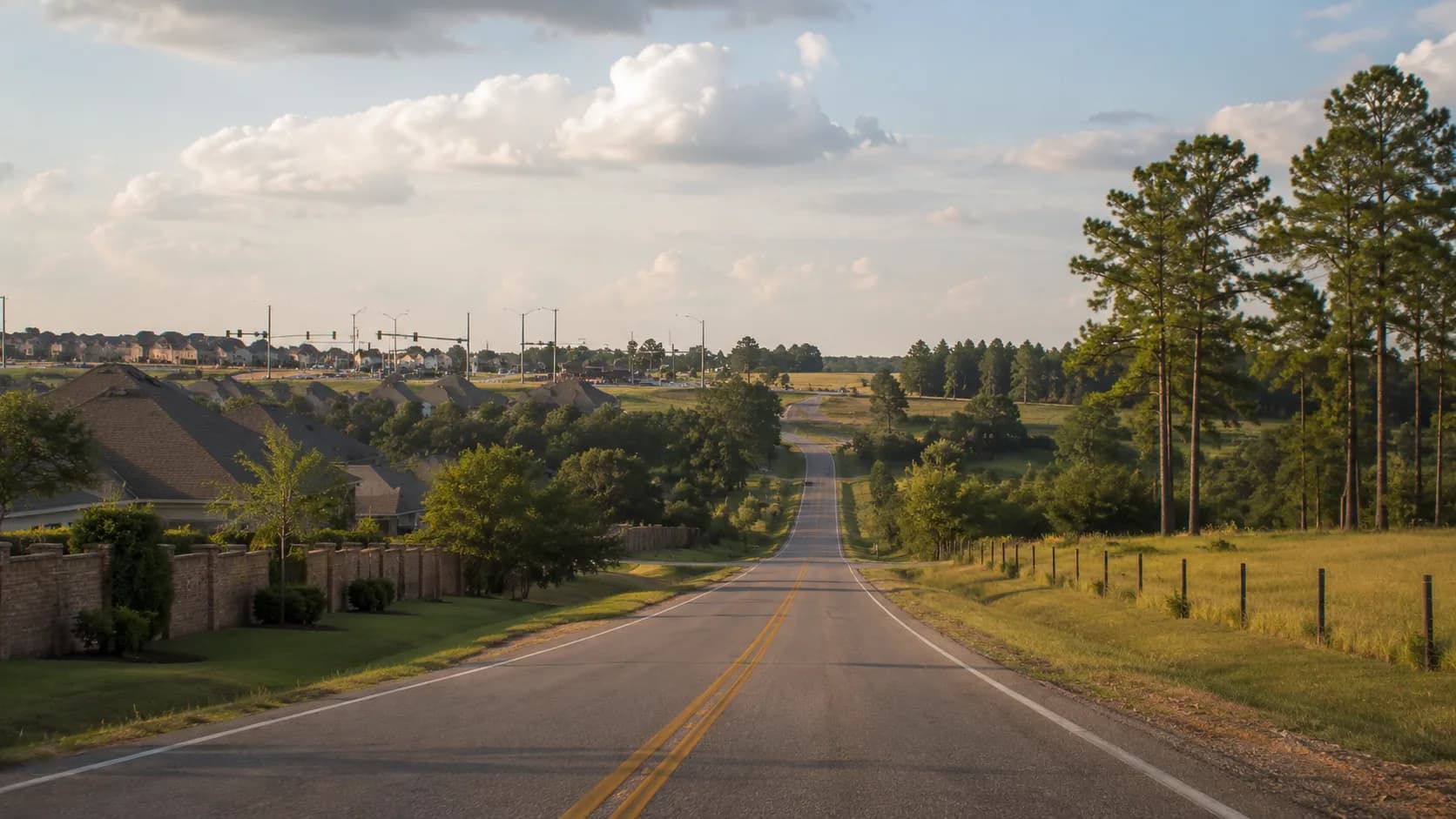
There is a particular kind of drive that happens around Montgomery County now. It begins on a road that somebody remembers as country. There used to be pasture on one side, trees on the other and maybe a stop sign at the end. Then came rooftops. Then a school. Then a turn lane. Then another traffic light. Eventually the driver looks through the windshield and asks a question that would have sounded ridiculous twenty years ago: How far do I have to go to find the country again?
That question can be heard in different forms around The Woodlands, Conroe, Montgomery, Magnolia and Willis. Some people welcome the new restaurants, hospitals, stores, schools and jobs. Others watch the same growth and see longer drives, smaller tracts, more traffic and one more patch of woods disappearing behind a development sign.
Both views can be true. Growth can create opportunity and still change the very thing that attracted people in the first place.
Growth Is Not Just a Feeling
The numbers explain why the change can feel so fast. The U.S. Census Bureau estimates Montgomery County had 781,194 residents in July 2025. Its 2020 estimate base was 620,551. That is a 25.9 percent increase in roughly five years—more than 160,000 additional people.
Conroe grew even faster. The Census Bureau's 2025 estimate puts the city at 119,564 residents, up 33 percent from its 2020 estimate base. Willis was estimated at 7,652 residents in 2025, up 19.4 percent from its 2020 base.
Magnolia's recent numbers are more complicated because small-city estimates can be affected by changing boundaries, but the direction is hard to miss. The Census Bureau's 2025 estimate is 8,095 residents, and the City of Magnolia itself describes the community as being in its largest growth spurt since incorporation. The Woodlands is different because it is a census-designated place rather than an incorporated city and does not receive the same annual city estimates, but the 2020 Census counted 114,436 residents there, compared with 93,847 in 2010.
Even the City of Montgomery—long associated with historic buildings, lake country and a small-town pace—has been wrestling publicly with how to accept development without losing its identity. That tension is not unique to Montgomery. It is becoming part of the identity of the entire northwestern and northern edge of the Houston region.
What Growth Gives—and What It Takes
It would be easy to turn this into an argument that growth is bad. That would also be wrong.

Population growth helps support new businesses, medical services, entertainment, schools, tax base and infrastructure. A family that once drove half an hour for groceries may eventually have several choices nearby. A business owner gains customers. A teenager may find a job closer to home. A community can afford amenities that were unrealistic when the population was smaller.
But growth sends a bill too. Roads must carry more vehicles. Water and wastewater systems must serve more connections. Schools must add classrooms. Police, fire and emergency services cover more rooftops. Drainage, utilities and intersections that worked well for a smaller community can become obvious bottlenecks.
The road system provides a literal example. TxDOT says the SH 105 East corridor has experienced steady growth, with increasing traffic beginning to exceed roadway capacity and create congestion. The agency is studying reconstruction and widening from Conroe eastward through Montgomery, San Jacinto and Liberty counties. In other words, the same road that can carry someone away from growth is itself being redesigned because growth is following the road.
Yesterday’s Country Keeps Becoming Tomorrow’s Suburb
The irony is familiar to anyone who has lived here long enough. The Woodlands once felt far from Houston. Conroe once felt far from The Woodlands. Montgomery and Magnolia were the places people drove when they wanted more room. Willis sat farther up I-45, still close enough to reach the city but far enough to feel separate from it.
Then the region kept moving.
A new subdivision is rarely the problem by itself. Neither is a new grocery store, school or traffic light. The transformation happens one decision at a time until the place people moved to for breathing room begins to feel like the place they were trying to leave.
That is when the map comes back out. Some people start looking north, east or west for larger lots, fewer neighbors and roads that still get dark at night. For Montgomery County residents looking east, San Jacinto County and Coldspring are an obvious next chapter.
Coldspring Was Country Long Before “Moving to the Country” Became a Plan
Coldspring has been reinventing itself for almost 180 years, although not for the reasons people talk about today. The first post office opened in 1847 under the name Coonskin. It soon became Fireman's Hill, then Cold Spring in 1850, and the spelling eventually became Coldspring. When San Jacinto County was created in 1870, Coldspring became the county seat.

County government, agriculture and lumber shaped the town. After the courthouse burned in 1915, the townsite shifted to higher ground and a new courthouse was built. The old jail remains as a marker of the earlier town.
Today the scale is still dramatically different from Montgomery County. Coldspring had 819 residents in the 2020 Census. San Jacinto County as a whole was estimated at 29,488 residents in 2025, up 7.6 percent from its 2020 estimate base. Montgomery County added more people in roughly five years than five entire San Jacinto Counties could hold at today's population.
The attraction is not hard to understand. San Jacinto County sits in East Texas pine country. The Sam Houston National Forest includes tens of thousands of acres in the county, and the Lake Livingston region offers fishing, boating, camping and forest recreation nearby. Coldspring is still a county-seat town rather than a suburban center, and the landscape around it can feel like an immediate change of pace from the I-45 corridor.
Country Living Is a Trade, Not a Vacation
The farther-out life can look wonderful from a traffic jam, but it is still a trade.
More land can mean more maintenance. Fewer nearby stores can mean longer drives. A private well or septic system may put responsibilities on the homeowner that were invisible with municipal service. Medical care, specialized shopping, entertainment and some jobs may be farther away. A commute that feels peaceful twice a week can feel very different when it becomes two hours of every workday.
That is why the question is not simply where land is cheaper or where the roads are quieter. It is what a household values enough to drive farther for—and what conveniences it is willing to leave behind.
For one family, country means five acres and a workshop. For another, it means being able to sit on the porch without hearing traffic. Someone else wants room for horses, a garden or grandchildren. The word country describes a place, but it also describes a tolerance for distance.
The Growth Paradox
Then comes the uncomfortable part: everybody who moves to the country becomes one more household in the country.
One new house does not erase a rural landscape. Neither do ten. But roads attract driveways, driveways attract rooftops, rooftops attract services, services attract more rooftops, and eventually the place that felt undiscovered has its own rush hour.
That does not mean newcomers are the enemy and longtime residents own the scenery. Communities change because people are free to buy land, build homes, start businesses and make lives. The challenge is deciding how much of the original character can be protected while still allowing the next family to arrive.
Good growth asks harder questions than how many rooftops will fit on a tract. Are the roads ready? Is water available? Where will runoff go? Can emergency services reach the new homes? What happens to trees, floodplains and open land? Who pays for the infrastructure that new development requires? Those questions do not stop growth. They determine whether growth improves a place or simply consumes it.
How Far Is Far Enough?
There is no mileage marker where suburbia officially ends and country begins. For one person it may be north of Willis. For another it is west of Magnolia, beyond Montgomery, east toward Coldspring or somewhere still farther from Houston's expanding orbit.

What is clear is that Montgomery County is no longer the lightly populated edge it once was. It is one of the places the edge is pushing through.
Coldspring and San Jacinto County are not guaranteed to become the next Montgomery County, and the current population numbers do not show anything close to the same growth rate. That distinction matters. Rural communities should not be declared the next boomtown simply because people in a neighboring county are tired of traffic.
But the question is worth asking before the answer arrives. The best time to decide what should remain rural is before every pasture has a site plan. The best time to decide how growth should pay for itself is before infrastructure is overwhelmed. And the best time to decide what makes a place worth moving to is before those qualities become marketing language for the next development.
The country is still out there. The harder question is how long it stays there once the rest of us find it.
Research checked August 7, 2026. Population estimates are Census Bureau Vintage 2025 unless otherwise noted.