Yoakum: Railroad Shops, Tomatoes and the Leather Tom-Tom
Named for a railroad manager in 1887, Yoakum grew around shops and a roundhouse, later shipped tomatoes, and still marks its leather trade with the annual Tom-Tom Festival.
Yoakum straddles the Lavaca-DeWitt county line on land granted to John May by Coahuila and Texas in 1835. According to the Handbook of Texas, the ground once gathered cattle for the Chisholm Trail. The town itself did not grow until the San Antonio and Aransas Pass Railway arrived in 1887.
A townsite was laid out and named for Benjamin F. Yoakum, vice president and general manager of the line. J. P. Jamieson opened a store that year, and a post office followed. Railroad shops came in 1888, and hundreds of workers found jobs at a large roundhouse. That rail payroll pulled people from surrounding farms and smaller settlements into a new county-line town.
The Handbook notes that the shops and roundhouse were the early economic core. Without them Yoakum would have been another whistle-stop rather than a working railroad town.
From incorporation to cotton and leather
Yoakum incorporated on May 13, 1889, with L. W. Thomas as mayor. By 1896 it had a cotton mill, three gins, a compress, churches, a bank, an ice factory, stores, newspapers, a school system with 700 pupils and about 3,000 people. By 1914 the Handbook lists 7,500 residents. Those early figures show how quickly a rail shop town could grow when cotton and trade followed the tracks.
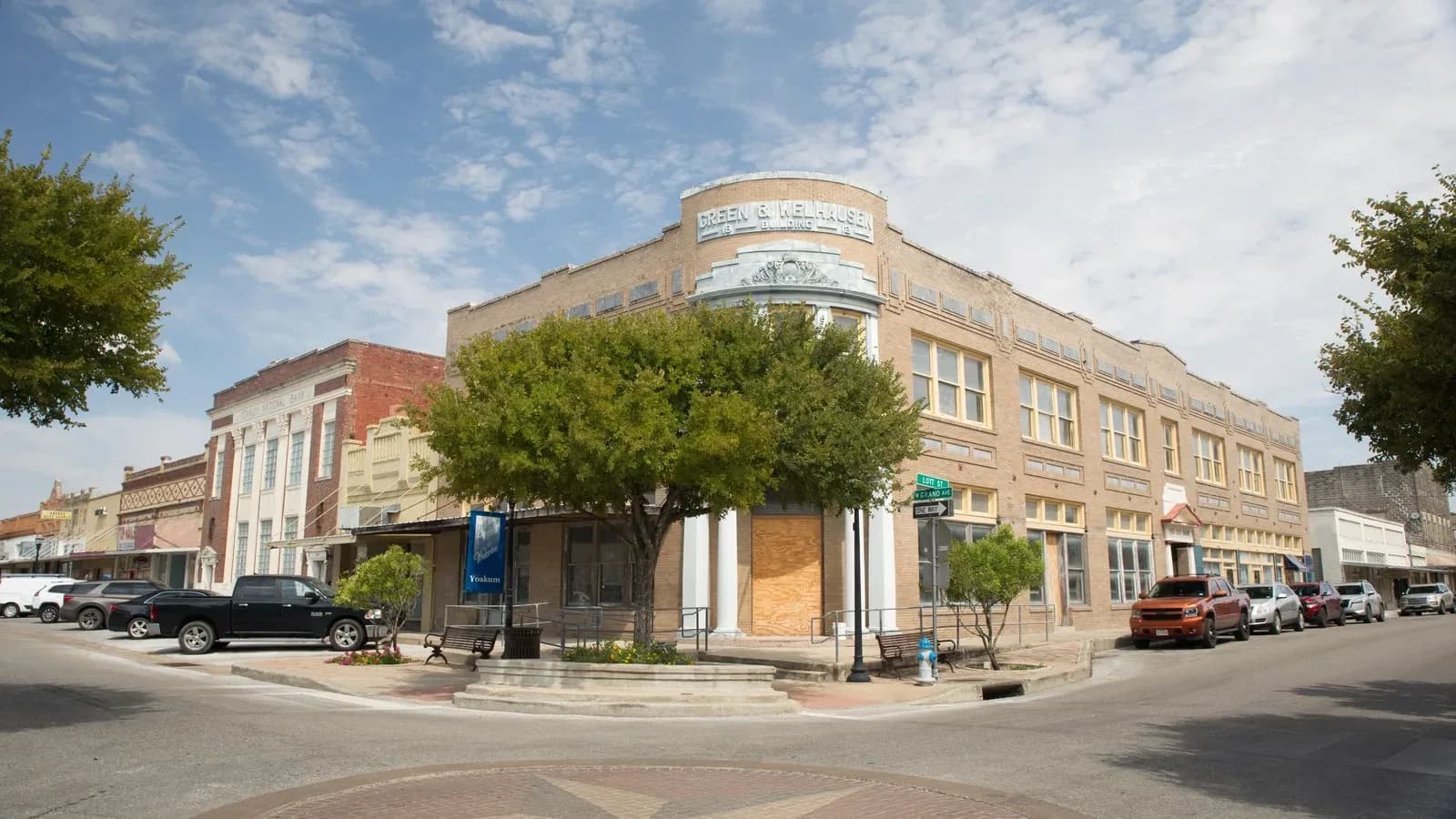
In 1919 Carl Welhausen took over a small tannery that became Tex-Tan, making saddles, bridles, harnesses, belts and related goods and later joining the Tandy Corporation. By 1940 other industries included a creamery and a mattress factory. Those are historical business notes, not a current factory roster. Leather work, though, left a lasting mark on how the town presents itself.
Tomato capital nickname and later festivals
Commercial tomatoes were first grown around Yoakum in 1926. By the 1940s fifteen packing sheds shipped tomatoes north, and the town was sometimes called the tomato capital of south central Texas. The May Tom-Tom Festival began in 1928 to publicize that trade, paused for five years in World War II, resumed in 1946, and later shifted to celebrate leather as the Leather Tom-Tom Festival. A Youth Rodeo is listed for each July. The Handbook also notes a spring wildflower trail started in 1960.
Population figures in the Handbook's table include 4,733 in 1940, 6,148 in 1980, 5,611 in 1990, 5,731 in 2000, 5,908 in 2020 and 5,923 in 2021. In 1984 the Handbook split 3,283 residents in Lavaca County and 2,325 in DeWitt County. Those numbers are from the Handbook, not a new city estimate.
Community services listed for 1989 include a nursing home, hospital, library, park and municipal airport. The Bluebonnet Youth Ranch for neglected children was founded by Charles Kvinta in 1968. The Yoakum Heritage Museum opened in 1982 in a former Elkins-Browning home. St. Joseph's Catholic Church marked a centennial in 1969; First Baptist and First Methodist buildings date to 1889. Those institutions show a settled town long after the first shops opened.
City offices today are at 808 Hwy 77A South, Yoakum, Texas 77995, according to the city website, phone 361-293-6321.
Related reading: Dublin, Texas: Railroad Town, Streetcars and Ben Hogan's Hometown.