Ballinger: Railroad Lot Sale and a Carnegie Library
A June 1886 railroad lot sale drew thousands to Runnels County. Ballinger later built a Carnegie library and remains the county's shipping and distribution center.
Ballinger sits at the junction of U.S. highways 67 and 83 and State Highway 158 in south-central Runnels County, where the Colorado River and Elm Creek meet. According to the Handbook of Texas, the town was established when the Gulf, Colorado and Santa Fe Railway built west from Brownwood in 1886.
Runnels City, the original county seat, sought the railroad terminal but lost out to a better water supply five miles south—the future site of Ballinger. The Atchison, Topeka and Santa Fe line still marks the town's place on the map in the Handbook's account.
A lot sale that filled the prairie
Extensive newspaper advertising in Dallas, Fort Worth, Austin, San Antonio and Galveston brought about 6,000 people to the sale of town lots on June 29, 1886. Railroad ads in the Dallas Morning News as early as June 7 promoted half-price excursion trains from Dallas. The 1.7-square-mile townsite included a courthouse square and a public park. Roughly half the lots sold the first day.
Santa Fe officials offered free property to anyone who would move a home from Runnels City and to any church that would build. The settlement was first called Gresham, then Hutchings, before taking the name of William Pitt Ballinger, a Galveston attorney and Santa Fe stockholder.
Boom years, drought and a library gift
Early growth brought saloons, gambling halls and stagecoach robberies. By 1888 the railroad reached San Angelo, the overland stage business ended, and more permanent settlers arrived. A post office opened June 1, 1886. The town incorporated in 1892 and began using the commission form of city government.
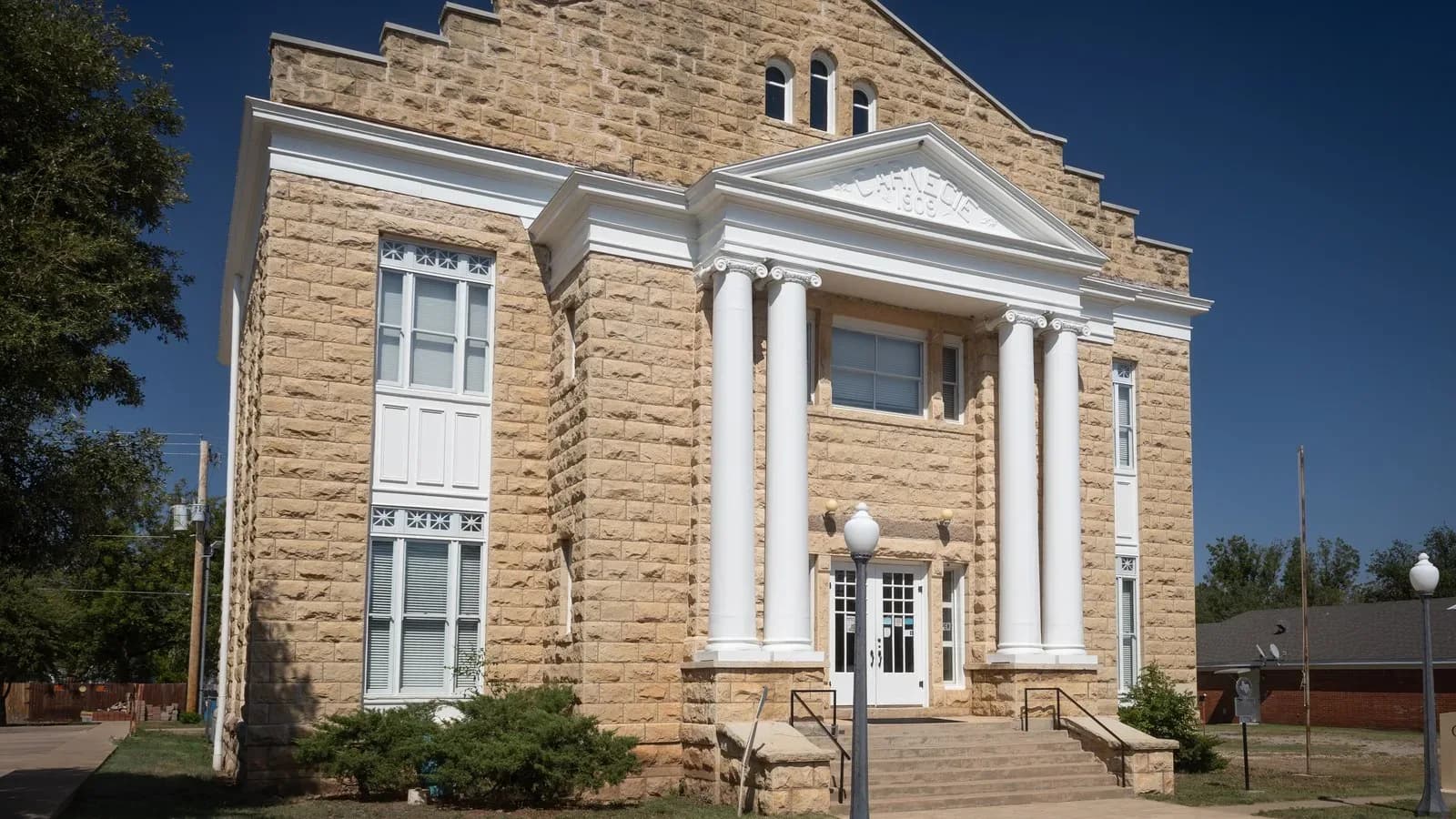
Population rose from 1,128 in 1900 to 3,536 in 1910 as farming overtook stock raising. By 1904 Ballinger had four cotton gins, city waterworks, three newspapers and a long list of stores and trades recorded in the Handbook. In 1909 Andrew Carnegie gave $12,500 for a library that opened in 1911. During World War II the second-floor auditorium served as an Army-Navy Club for cadets from Harmon Training Center. After years of neglect, a Bicentennial renovation effort followed in 1975, and the library was placed on the National Register of Historic Places.
Drought from 1916 to 1918 cut the population to 2,767 in 1920. Counts later peaked at 5,302 in 1950. The Handbook's table lists 3,619 in 2020 and 3,580 in 2021. Those are historical census figures, not a claim about today's street-level business mix.
Work and civic life
Ballinger became Runnels County's main shipping and distribution center. Employment sources named in the entry include light manufacturing, mining and retail trade. Business counts in the Handbook reached 290 in 1940, fell after World War II, then climbed again to 210 in 1950 and stood at 90 in 1990—dated figures, not a current chamber tally. The community has maintained paid fire and police departments and radio station KRUN. Seasonal events listed historically include the Rattlesnake Roundup, an ethnic cultures fair, a Pinto Bean Cookoff and a Miss Ballinger pageant—dated community markers, not a current events calendar.
For a present civic address, the City of Ballinger staff page lists City Hall at 700 Railroad Ave., Ballinger, Texas 76821, phone 325-365-3511.
Related reading: Dublin, Texas: Railroad Town, Streetcars and Ben Hogan's Hometown.