The History of Goliad, Texas
Goliad, Texas (ZIP 77963) began as Spanish La Bahía on the San Antonio River, was renamed in 1829 as an anagram of Hidalgo, and in 1836 saw James W. Fannin’s command executed after Coleto. The sources still disagree on how many prisoners Portilla held that Palm Sunday.
Editor’s note. This is the twenty-fifth installment of “Texas Towns: The Stories Behind the Map.” Two stops ago the series went to Gonzales, where the Texas Revolution began with a cannon and a painted flag. The last one went north to Jacksboro and Fort Richardson. This one turns south to the San Antonio River and a Spanish fort whose walls still hold the hardest chapter of that war.
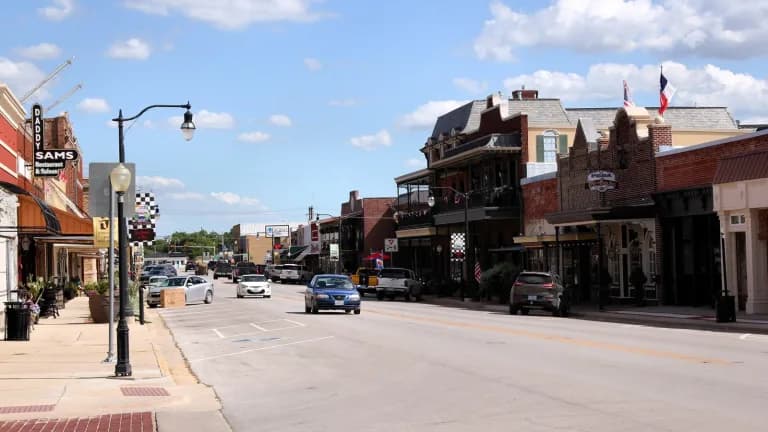
Goliad, Texas, sits on the San Antonio River where U.S. Highway 59 meets U.S. Highway 183 and State Highway 239, about twenty-five miles inland from Copano Bay and roughly ninety miles southeast of San Antonio. It is the county seat of Goliad County and the only incorporated town in the county. The Southern Pacific Railroad once ran through it. The mailing ZIP is 77963. [1] [2]
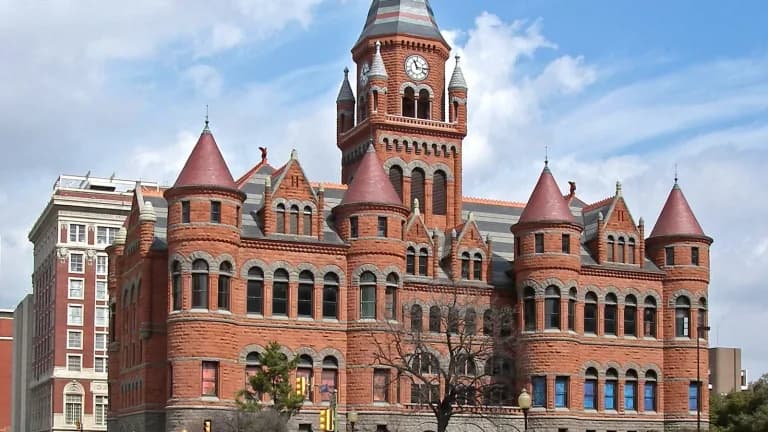
The 2020 Census counted 1,620 people in the city. A driver coming in on the square passes a pale limestone courthouse built in 1894. South of the river, on a low hill, stands the stone chapel and walls of Presidio La Bahía. Across the river, in what is now Goliad State Park and Historic Site, stands the restored Mission Espíritu Santo. The town grew up between those two Spanish foundations, and the record of one cannot be told without the other. [1] [3]
1721–1749: from the bay to Santa Dorotea
Before Europeans stayed, the land that became Goliad County was home to Aranama, Karankawa, Tonkawa and Tamique peoples. Comanche, Lipan Apache and Tawakoni raids later marked the early nineteenth century. Álvar Núñez Cabeza de Vaca may have crossed the country about 1535, and René Robert Cavelier, Sieur de La Salle, crossed it on his expeditions in 1685, but neither left a lasting Spanish town here. [2] [12]
Spanish occupation of this stretch of coast began after the Aguayo expedition moved to reclaim Texas from French pressure. In April 1721 a detachment under Domingo Ramón founded a presidio on the ruins of La Salle’s Fort St. Louis, generally placed on Garcitas Creek. The full Spanish name was long; people shortened it to Nuestra Señora de Loreto Presidio, and the place to Presidio La Bahía. In 1722 the Marqués de Aguayo authorized Father Agustín Patrón y Guzmán to found Nuestra Señora del Espíritu Santo de Zúñiga Mission across the creek from that post. The Spanish governor fixed April 10, 1722, as the official day of the mission’s establishment. Both names clung to the bay they were leaving behind. [3] [4]
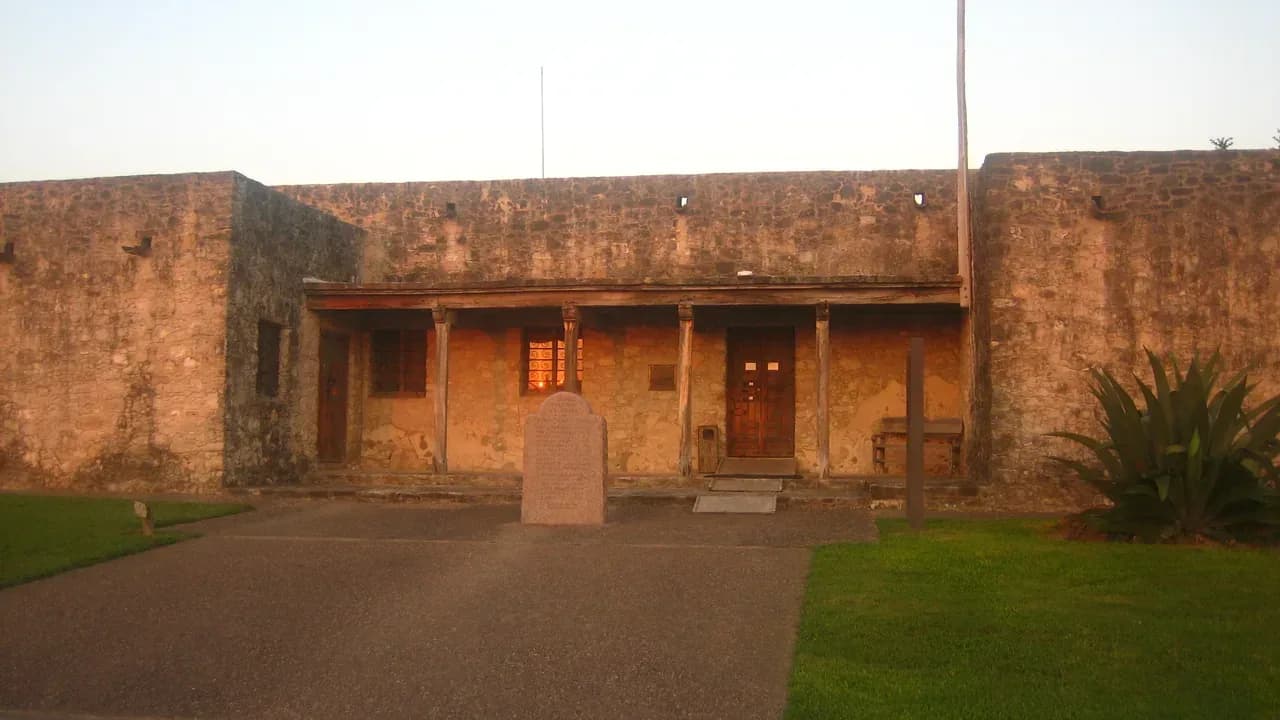
The mission and presidio did not stay on the bay. They moved inland about 1726 to the Guadalupe River near present Mission Valley in Victoria County, among Aranama and Tamique people the Franciscans hoped to hold. In October 1749, on the advice of colonizer José de Escandón, both were moved again to a site called Santa Dorotea on the San Antonio River. The new presidio rose on a hill south of the river, where sand, limestone and timber were abundant. Mission Espíritu Santo stood on the opposite bank. Around the fort walls grew the civic settlement that people still called La Bahía. [1] [3] [4]
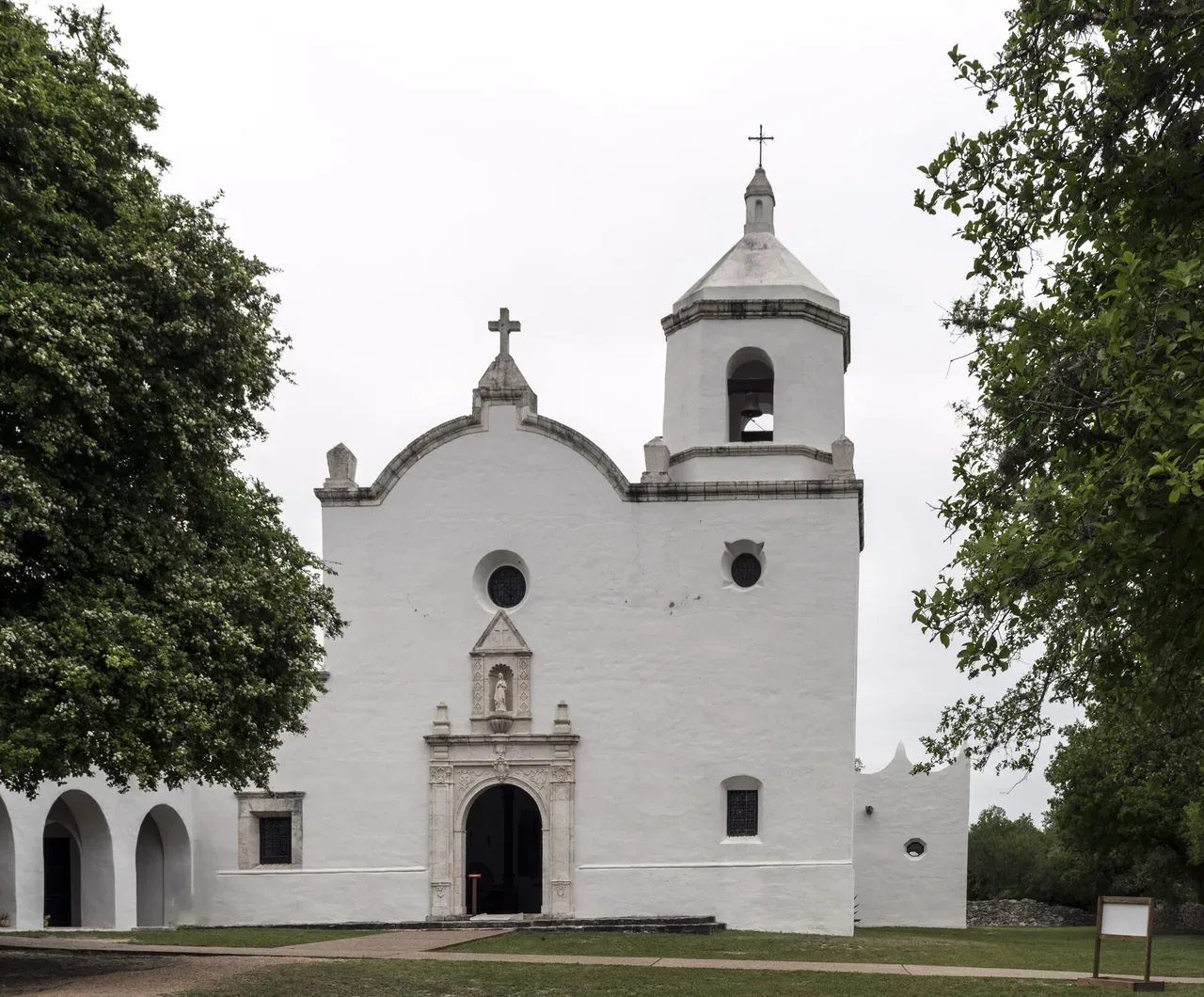
The re-created Mission Nuestra Señora del Espíritu Santo de Zúñiga, on the north bank of the San Antonio River opposite Presidio La Bahía. The mission was moved to this site in 1749. After the city and county transferred the ruin to the state in 1931, Civilian Conservation Corps crews rebuilt it in the 1930s; further work in the 1960s returned the complex to its mid-eighteenth-century appearance. This photograph shows the chapel that stands now, not the original fabric. Carol M. Highsmith, Library of Congress Prints and Photographs Division (LCCN 2014633552), public domain.
1749–1829: La Bahía becomes Villa de Goliad
For the rest of the Spanish period La Bahía was one of the three principal Spanish settlements in Texas, with San Antonio de Béxar and Nacogdoches. The fort sent men to Bernardo de Gálvez’s army in the American colonists’ war against Britain between 1779 and 1782, and it garrisoned Spanish troops through the Mexican war of independence of 1810–21. After 1812 it saw repeated attempts to pry Texas free of Spain. The Gutiérrez-Magee expedition took La Bahía in November 1812 and held it until February 1813 in what the Handbook calls the longest siege in American military history. Henry Perry failed to take it in June 1817. James Long surprised the garrison in 1821 and lasted three days before royalist troops from San Antonio unseated him. [1] [3]
Early in 1829 a local resident, Rafael Antonio Manchola, freshly elected to the Coahuila and Texas legislature, petitioned to change the town’s name. He argued that “La Bahía” had become meaningless because neither mission nor fort had stood on the bay since 1726. He proposed Goliad, an anagram of the name of Father Miguel Hidalgo y Costilla, the priest who touched off the Mexican independence movement. By decree on February 4, 1829, La Bahía became Villa de Goliad. At the time the town had stone houses belonging to wealthy citizens and dozens of jacales of post-and-mortar construction for most of the rest. [1] [3]
On March 24, 1829, in one of those stone houses, Ignacio Seguín Zaragoza was born. He would become a Mexican general and the victor of the Battle of Puebla on May 5, 1862—the Cinco de Mayo that Mexico still marks. The Handbook notes that his mother, María de Jesús Seguín of Béxar, was a relative of Juan José Erasmo Seguín. After Mexico lost Texas, the family left Goliad for Matamoros. In the 1960s Texas established General Zaragoza State Historic Site near his birthplace, and in 1980 a bronze statue of him was dedicated in the state park as a gift from the state of Puebla. [13] [1]
A cholera epidemic nearly destroyed the settlement in 1834. It survived. [1]
October–December 1835: the fort and the first declaration
The fourth and best-known effort to make Texas independent from this place began after the fight at Gonzales in October 1835. Texans under Benjamin R. Milam and George Collinsworth took the Goliad fort and its stores from a twenty-four-man Mexican garrison. James Walker Fannin, Jr., a Georgia-born West Point dropout who had come to Texas in 1834 and whose own letters, the Handbook says, affirm that he was a slave trader, was already agitating for revolution and fighting as a volunteer. [1] [6]
On December 20, 1835, citizens of Goliad and South Texas colonists met in the presidio chapel and signed the Goliad Declaration of Independence, drafted by Ira Ingram. Ninety-one people signed it, including José Miguel Aldrete and José María Jesús Carbajal. Capt. Philip Dimmitt was a strong supporter; many in his volunteer company signed, and afterward his flag of independence went up over the walls. The document resolved that the former department of Texas ought to be a “free, sovereign, and independent State.” It reached the General Council at San Felipe on December 30 and embarrassed negotiations then underway with Mexican Federalists. The council shelved it. It still preceded the Texas Declaration of Independence at Washington-on-the-Brazos by seventy-three days. [8] [1]
February–March 1836: Coleto and Palm Sunday
Fannin took command of the post in February 1836, rebuilt the old Spanish fort under the name Fort Defiance, and then hesitated. He sent most of his force toward Refugio. On March 14 he received Sam Houston’s order to retreat to Victoria. Waiting for Amon B. King’s and William Ward’s men to return, he delayed. When he finally marched out on March 19 in a heavy fog, the column was late and confused. He insisted on hauling nine brass cannons and five hundred spare muskets. On the open prairie between Manahuilla and Coleto creeks he halted to rest men and oxen. Gen. José de Urrea’s army closed around him. After fighting on March 19–20, Fannin’s command surrendered. [5] [6]
What the Texans thought they had surrendered for, and what Mexico’s law allowed, are not the same story, and the Handbook prints both. Fannin’s men had written terms asking to be treated as prisoners of war and returned to the United States. Urrea, bound by Santa Anna’s orders and by a Mexican congressional decree of December 30, 1835, that foreigners taken in arms should be treated as pirates and shot, could not grant those terms. He took a written surrender that put the Texans “at the disposal of the Supreme Mexican Government,” told Fannin he knew of no case in which a prisoner who trusted Mexican clemency had lost his life, and said he would recommend clemency to Santa Anna. Fannin did not tell his men how conditional that assurance was. One Mexican commissioner greeted them with words the Handbook records as, “Well, gentlemen! In eight days, home and liberty!” [7] [5]
About 230 or 240 unwounded or slightly wounded men were marched back to Goliad and locked in the chapel of the Loreto Presidio. The wounded, about fifty by one count and higher by others, including Fannin, came over the next two days. Ward and about eighty men of the Georgia Battalion, who had surrendered near Dimitt’s Landing on the same terms, were added on March 25. Santa Anna ordered immediate execution. Col. José Nicolás de la Portilla, left in command at Goliad, received Santa Anna’s order on March 26 and, two hours later, a conflicting order from Urrea to treat the prisoners with consideration. Portilla obeyed Santa Anna. [7] [10]
At sunrise on Palm Sunday, March 27, 1836, the unwounded Texans were formed into three groups and marched out under heavy guard on three roads—toward the upper ford of the San Antonio River, toward Victoria, and toward San Patricio. They had been told they were going to gather wood, drive cattle, march to Matamoros, or embark at Copano for New Orleans. The night before, they had sung “Home Sweet Home.” At selected spots half to three-quarters of a mile from the fort, the guards fired at close range. Nearly all fell at the first volley. Those who did not were pursued and killed by gunfire, bayonet or lance. Fannin and the wounded who could not march were shot inside the presidio. [7]
A man-by-man study cited in the Handbook indicates that 342 were executed at Goliad that day. Twenty-eight escaped the firing squads; about twenty more were spared as physicians, orderlies, interpreters or mechanics, many through the intervention of Francita Alavez, whom the Texans called the Angel of Goliad, and of Col. Francisco Garay. Portilla wrote that he held 445 prisoners, exclusive of William P. Miller’s eighty men captured unarmed at Copano and spared. Texan sources put the number at 407 exclusive of Miller’s men. The page does not reconcile those totals, and this article prints both. [7]
The bodies were burned and left exposed until June 3, 1836, when Gen. Thomas J. Rusk, passing through in pursuit of the retreating Mexican army after San Jacinto, gathered the remains and buried them with military honors. The common grave went unmarked for decades. A pink-granite Centennial monument was dedicated on the site on June 4, 1938. [7]
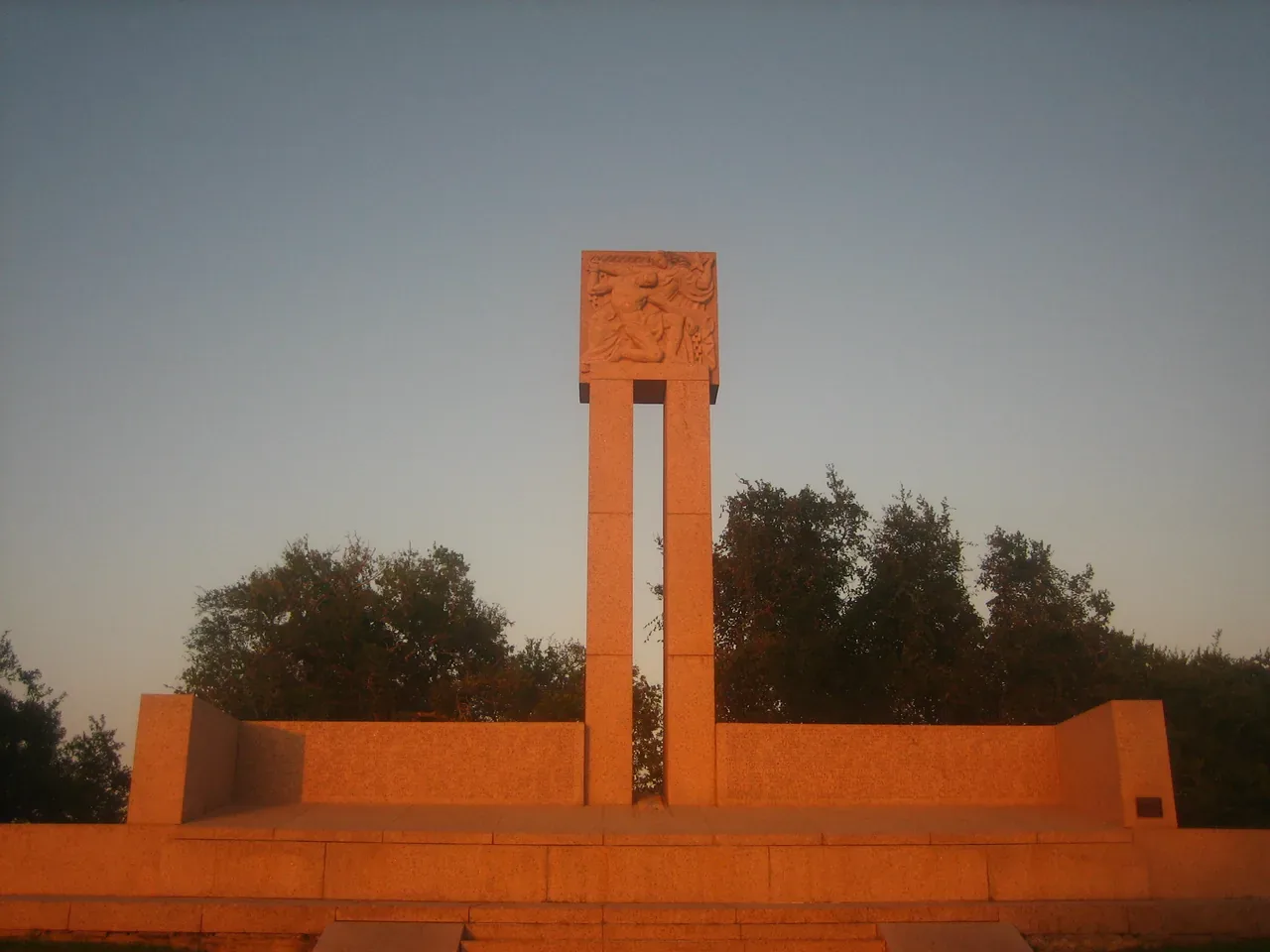
The Fannin Memorial Monument, built by the State of Texas for the 1936 Centennial and dedicated June 4, 1938, over the common grave of the men killed in the Goliad Massacre. Harbert Davenport’s Centennial address there was later published as “The Men of Goliad.” This is the monument that stands now, not a photograph from 1836. Billy Hathorn, CC BY-SA 3.0, via Wikimedia Commons.
1836–1861: a new townsite, a hanging tree and two colleges
After San Jacinto the old town below the fort was largely deserted. Many Hispanic residents fled to Mexico; Anglo-Americans moved north of the river to the present townsite. The Handbook says people feared buying old-town lots because Spanish and Mexican titles were uncertain. Goliad County, named for the city, was established in 1836 and organized in 1837; Goliad became the county seat and was incorporated under the Republic three years later. A four-league grant offered to La Bahía in the Mexican era was validated and signed by Houston in 1844. A post office opened in 1847. [1] [2]
Paine Female Institute was founded in 1852. Aranama College was chartered in 1854 and closed early in the Civil War when most of its students left for the Confederate Army. Paine began accepting males in 1873, added a military academy in 1877, and eventually became Goliad College. The Goliad Advance-Guard began publication in 1855. [1]
In 1850 the county counted 435 White residents and 213 enslaved people. By 1860 those figures were 2,541 and 843. Stock raising was the main industry; cattle in the county rose from 7,731 in 1850 to 66,031 in 1860. Cotton and corn were grown too. The enslaved population belongs in the record alongside the revolutionary story the town is famous for. [2]
In 1857 the Cart War broke out between Mexican-Texan and Anglo-Texan teamsters fighting for control of the freight road. Texas Rangers finally stopped it. The Cart War Oak, or Hanging Tree, still standing on the north lawn of the courthouse lot, saw both court-approved hangings and unauthorized executions during that conflict. The Handbook’s county entry calls it one of the oldest oaks in Texas and notes that it was used again and again as a place of execution. [1] [2]
1885–1942: rails, a limestone courthouse and two storms
When the railroad reached Goliad is one of the places the Handbook does not speak with one voice. The town entry says the railroad arrived in 1885–86. The county entry says that despite tireless promotion by Pryor Lea, no railroad extended into Goliad County before 1889. We print both. The town grew to a population of 2,500 by 1890, the town narrative says. A new courthouse went up in 1894. [1] [2]
On May 18, 1902, a tornado destroyed more than a hundred buildings. The town entry says it killed 115 people and injured 230. The county entry says 114 were killed and 230 injured, and that at least fifty of the dead were members of Goliad’s Black Methodist church. The 1894 courthouse served as hospital and morgue. The town then had a little more than a thousand residents. The Handbook’s Texas Almanac table on the town page lists 1,261 for 1900; the narrative’s “1,261 residents in 1904” sits next to that figure without explanation. We print the numbers as they stand. [1] [2]
Local farmers raised cotton and later cattle. Population rose and fell with the crops and the Depression: the narrative gives 2,500 by 1925 and about 1,400 in the hard years; the Almanac table gives 2,500 for 1920 and 1,424 for 1930. In 1940 the town had two cotton gins, a gristmill, a poultry-packing plant, a broom factory and fifty businesses. In 1942 another disastrous storm damaged the area and tore the courthouse clock tower and turrets off. [1]
1931–2025: parks, a Main Street square and a modern count
In 1931 the city of Goliad and Goliad County transferred the Mission Espíritu Santo site to the state. During the New Deal, Civilian Conservation Corps labor rebuilt the mission under National Park Service and University of Texas supervision. Further work in the 1960s brought it back to a mid-eighteenth-century appearance. A Texas Centennial marker went up in 1936; the mission entered the National Register in 1977. Presidio La Bahía and its chapel, which had survived as a residence and then as a church after the Catholic Church regained the chapel about 1853, were restored in the 1960s by the Kathryn O’Connor Foundation. In 2025 the Catholic Diocese of Victoria sold the presidio and chapel to the Texas Historical Commission for a state historic site. [4] [3]
La Bahia Downs began drawing race crowds in 1961. In 1976 the downtown square was listed in the National Register of Historic Places. The Main Street Project renovated downtown buildings in 1984–85, and Goliad was recognized as a National Main Street City in 2003. A weekly paper, the Texan Express, began in 1983. A general aviation airport opened in 2001 on a closed naval landing field. [1]
Population in the late twentieth century moved in a narrow band. The Handbook gives 2,285 by 1989, 1,946 in 1990, 1,975 in 2000 and 1,620 in 2020, with 241 reported businesses that year. The Almanac table on the same page lists 1,620 for 2020 and 1,624 for 2021. Heritage tourism—Goliad State Park and Historic Site, Presidio La Bahía, the Zaragoza site and the Fannin monument—joined oil, cattle and other agribusiness as pillars of the local economy. [1] [2]
The complete story of Goliad
It is the story of a Spanish mission and a royal fort that kept the name of a bay they no longer touched. It is the story of a villa renamed as an anagram of Hidalgo, and of a child born in one of its stone houses who later stopped a French army at Puebla. It is the story of a chapel declaration that the General Council set aside, and of a Palm Sunday when three columns of prisoners were marched out of those same walls and shot. It is the story of a hanging tree on a courthouse lawn, of two colleges emptied by war, of a tornado that filled the 1894 courthouse with the dead and the wounded, and of CCC crews who put the mission back on its hill. The fort is still there. So is the river. So is the town.
Questions people ask
Why is it called Goliad? The settlement grew up as La Bahía around Presidio La Bahía. On February 4, 1829, after Rafael Antonio Manchola’s petition, Mexico renamed it Villa de Goliad—an anagram of the name of Father Miguel Hidalgo y Costilla. [1] [3]
What happened at the Goliad Massacre? On March 27, 1836, after James W. Fannin’s command surrendered at the battle of Coleto, Mexican forces under orders from Santa Anna executed hundreds of prisoners at Presidio La Bahía. A Handbook man-by-man study puts the number killed that day at 342; twenty-eight escaped the firing squads and others were spared. [7]
Was the Goliad Declaration the Texas Declaration of Independence? No. The Goliad Declaration was signed December 20, 1835, in the presidio chapel. It was set aside by the General Council at San Felipe. The Texas Declaration of Independence was adopted at Washington-on-the-Brazos seventy-three days later. [8]
Is Presidio La Bahía the same as Mission Espíritu Santo? No. The mission stands on the north bank of the San Antonio River; the presidio stands on the south. Both were moved to the Goliad site in 1749. The surviving chapel at the fort was long called “La Bahía Mission,” which the Handbook says caused lasting confusion with the actual mission across the river. [3] [4]
What is Goliad’s ZIP code? 77963. Goliad is the county seat of Goliad County, at U.S. 59, U.S. 183 and State Highway 239 on the San Antonio River. [1]
Sources
Jeri Robison Turner, “Goliad, TX,” Handbook of Texas Online, Texas State Historical Association, revised April 22, 2026. tshaonline.org/handbook/entries/goliad-tx. Originally published 1952.
Craig H. Roell, “Goliad County,” Handbook of Texas Online, revised April 22, 2026. tshaonline.org/handbook/entries/goliad-county. Originally published 1952.
Craig H. Roell, “La Bahía,” Handbook of Texas Online, revised April 22, 2026. tshaonline.org/handbook/entries/la-bahia. Originally published 1976. Notes the 2025 transfer of Presidio La Bahía to the Texas Historical Commission.
Craig H. Roell, “Nuestra Señora del Espíritu Santo de Zúñiga Mission,” Handbook of Texas Online, revised April 22, 2026. tshaonline.org/handbook/entries/nuestra-senora-del-espiritu-santo-de-zuniga-mission. Originally published 1976.
Harbert Davenport and Craig H. Roell, “Goliad Campaign of 1836,” Handbook of Texas Online, revised April 7, 2016. tshaonline.org/handbook/entries/goliad-campaign-of-1836. Originally published 1952.
Clinton P. Hartmann, “Fannin, James Walker, Jr.,” Handbook of Texas Online, revised July 29, 2020. tshaonline.org/handbook/entries/fannin-james-walker-jr. Originally published 1952. Its bibliography includes Harbert Davenport’s work on Fannin’s command.
Harbert Davenport and Craig H. Roell, “Goliad Massacre,” Handbook of Texas Online, revised March 22, 2018. tshaonline.org/handbook/entries/goliad-massacre. Originally published 1952. Its bibliography includes Davenport, “The Men of Goliad,” Southwestern Historical Quarterly 43 (July 1939).
Hobart Huson, “Goliad Declaration of Independence,” Handbook of Texas Online, revised August 2, 2020. tshaonline.org/handbook/entries/goliad-declaration-of-independence. Originally published 1952.
Sheila M. Ohlendorf, “Urrea, José de,” Handbook of Texas Online, revised August 12, 2020. tshaonline.org/handbook/entries/urrea-jose-de. Originally published 1976.
Craig H. Roell, “Portilla, José Nicolás de la,” Handbook of Texas Online, revised August 4, 2020. tshaonline.org/handbook/entries/portilla-jose-nicolas-de-la. Originally published 1952.
Craig H. Roell, “Ward, William,” Handbook of Texas Online, revised September 24, 2019. tshaonline.org/handbook/entries/ward-william. Originally published 1952.
Thomas N. Campbell, “Aranama Indians,” Handbook of Texas Online, revised June 1, 1995. tshaonline.org/handbook/entries/aranama-indians. Originally published 1976.
“Zaragoza, Ignacio Seguín,” Handbook of Texas Online, revised April 15, 2026. tshaonline.org/handbook/entries/zaragoza-ignacio-seguin. Originally published 1976.
U.S. Census Bureau, QuickFacts and decennial counts as reported in the Handbook’s Goliad town entry (Texas Almanac population table): 1,620 (2020). census.gov/quickfacts/fact/table/goliadcitytexas.