Dock Line

Author

Dock Line History Desk

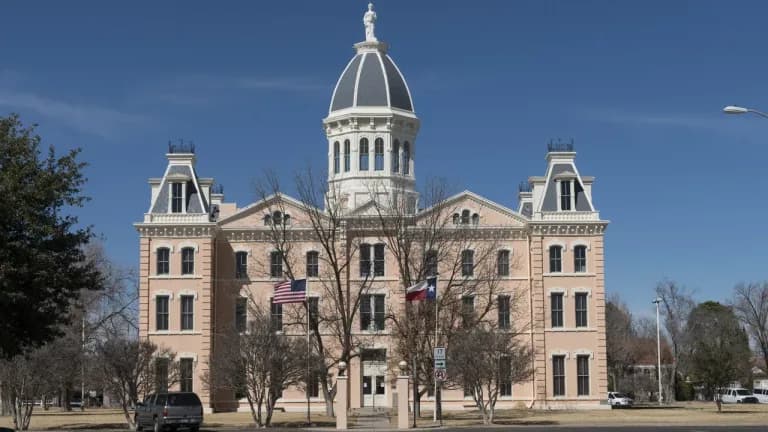
The Presidio County Courthouse in Marfa, Texas, seen head-on across the street under a deep blue winter sky: a three-story pale pink building with cream trim in the Second Empire style, with tall arched windows, a pedimented center bay, mansard-roofed corner towers topped with iron cresting, and a central cupola with a gray segmented dome crowned by a white statue of Justice. Bare trees stand on the lawn, U.S. and Texas flags fly in front, and a pickup truck is parked at the left.
CommunityLast Week

The History of Marfa, Texas

Marfa, Texas (ZIP 79843) began in 1883 as a railroad water stop and took the Presidio County seat from Fort Davis two years later. Even its name is disputed: the Handbook now credits Jules Verne rather than Dostoevsky, and the state’s own records give its courthouse three different construction dates.
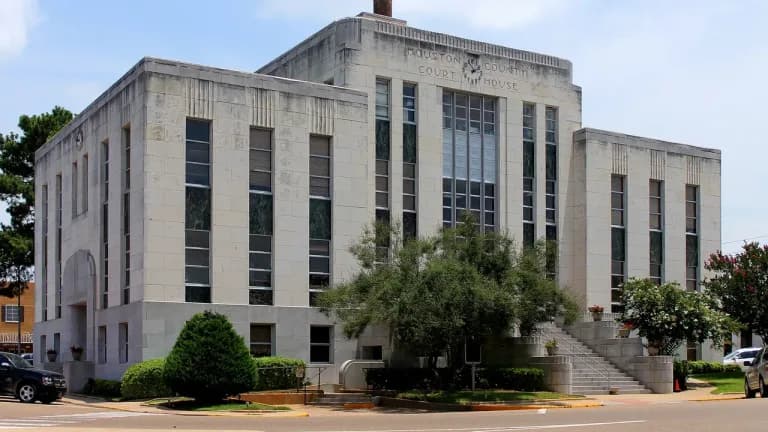
The Houston County Courthouse in Crockett, Texas, on a summer day under a blue sky: a three-story pale limestone building in the stripped Moderne style, with tall recessed vertical window bands, lower two-story wings on each side, a clock face set into the top of the central block above the carved words Houston County Court House, broad steps at the right, crape myrtles and shrubs along the lawn, and parked cars at the street corners.
CommunityLast Week

The History of Crockett, Texas

Crockett, Texas (ZIP 75835) was laid out in 1837 on land Andrew Gossett gave beside the Old San Antonio Road and named for David Crockett, who died at the Alamo the year before. The sources still disagree on where Crockett camped in 1836, and the town burned again and again before its fifth courthouse rose in 1939.

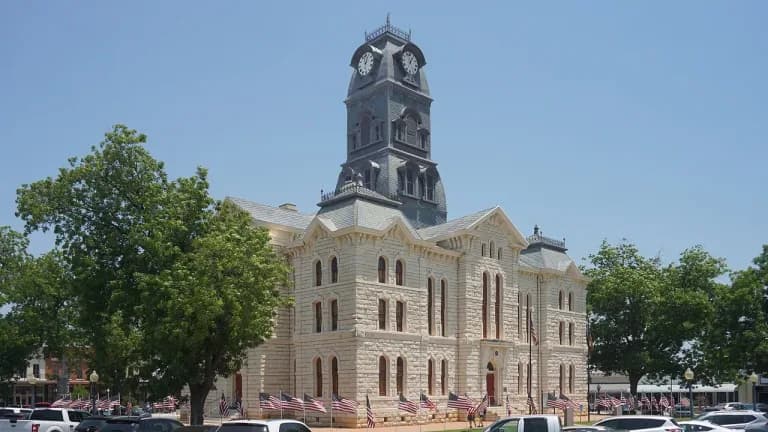
The Hood County Courthouse in Granbury, Texas, on a clear summer day: a pale rusticated limestone building in the Second Empire style with arched windows, gabled pavilions and a gray mansard roof, topped by a tall central clock tower with clock faces, rows of small American flags along the lawn, shade trees on both sides and parked cars and a pickup in the foreground
CommunityLast Week

The History of Granbury, Texas

Granbury, Texas (ZIP 76048) grew up on land west of the Brazos where David Crockett’s widow settled in the 1850s, and in 1974 its square became the first in Texas on the National Register. The sources still disagree on who donated the townsite and how many courthouses burned.

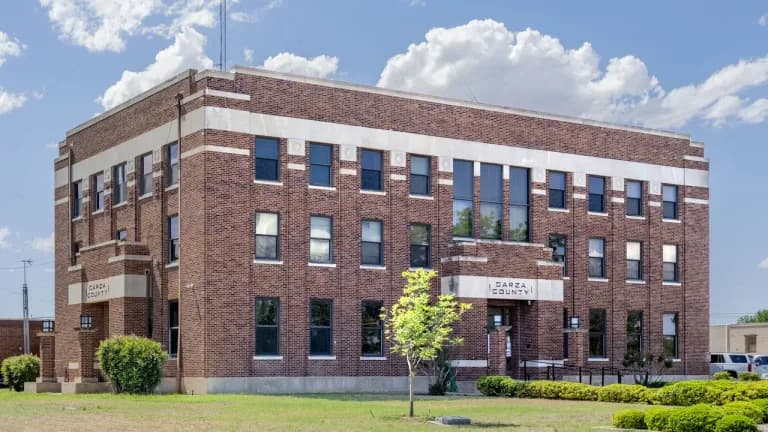
The Garza County Courthouse in Post, Texas, under a blue sky with white clouds: a three-story red-brown brick building with pale cast-stone bands and trim, rows of tall dark windows, two projecting entrance bays with stone panels lettered Garza County, one at the left end and one near the center, low shrubs along the front, a young tree on a green lawn in the foreground and a parked white pickup at the right edge
CommunityThis Month

The History of Post, Texas

Post, Texas (ZIP 79356) began in 1907 as Post City, a dry model town built by cereal millionaire C. W. Post, who later fired dynamite into the sky to make it rain. The sources still disagree on how much land he bought: anywhere from 200,000 to 250,000 acres.

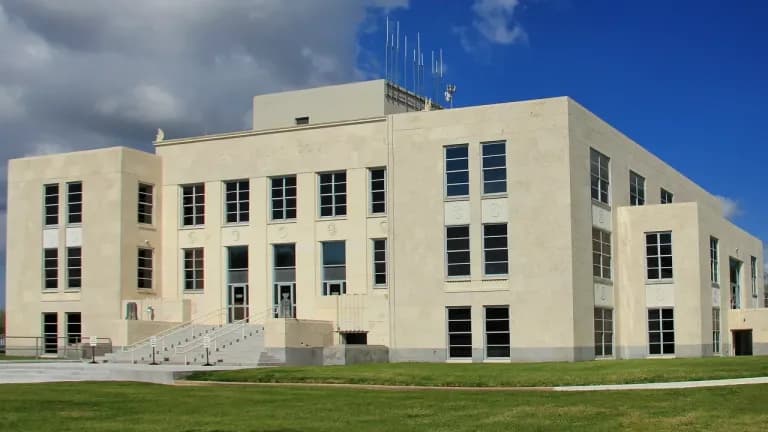
The Chambers County Courthouse in Anahuac, Texas, under a blue sky with white clouds: a three-story pale limestone building in a spare 1930s modernistic style, with a raised central block, stepped side wings, tall rows of dark-framed windows, carved round medallions between the floors, the words Chambers County lettered faintly across the top of the central section, broad entrance steps with metal handrails at left, and a wide green lawn in front
CommunityThis Month

The History of Anahuac, Texas

Anahuac, Texas (ZIP 77514) began as a Mexican customs fort on Trinity Bay in 1830, where the jailing of William B. Travis set off fighting in 1832. Thomas Jefferson Chambers, who fought over the townsite for decades, was shot through his parlor window in 1865; the marker on his house says 1863.

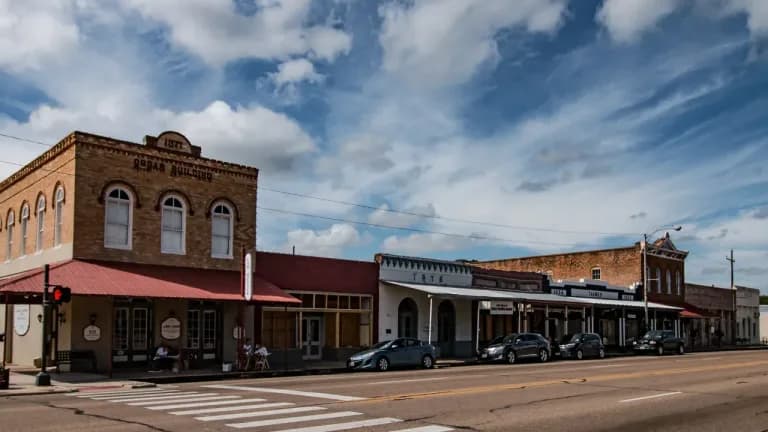
Main Street in Calvert, Texas, under a blue sky with scattered white clouds: on the left a two-story tan brick commercial building with three arched upper windows, the date 1877 in a raised parapet and the words Oscar Building lettered across the top, with a red metal awning over the sidewalk; beyond it a continuous row of one- and two-story brick storefronts with metal awnings, date stones reading 1878, 1877 and 1934, cars parked at the curb, and a striped crosswalk on the wide paved highway in the foregro
CommunityThis Month

The History of Calvert, Texas

Calvert, Texas (ZIP 77837) was platted in 1868 for the Houston and Texas Central and named for a planter who died of yellow fever the year before. It held the county seat for most of the 1870s and claimed the world’s largest cotton gin; the Handbook dates that claim to 1871, a federal building survey to 1912.

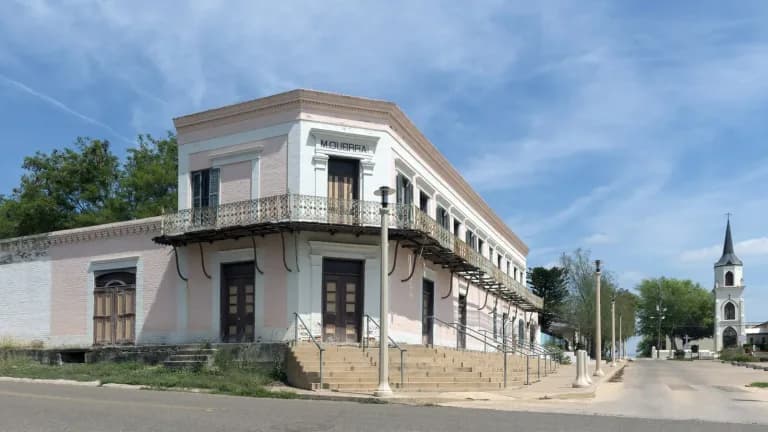
The Manuel Guerra residence and store in Roma, Texas: a two-story corner building of painted brick in pale pink and white, with an iron-railed balcony wrapping the upper floor on curved iron brackets, the name M. Guerra lettered above the corner, tall wooden double doors on the ground floor reached by broad concrete steps, a one-story brick wing at left, and at right, down a paved street lined with lamp posts, a white church steeple against a blue sky
CommunityThis Month

The History of Roma, Texas

Roma, Texas (ZIP 78584) began as ranch land of Mier, granted in 1767 under José de Escandón, and became the head of steamboat travel on the Rio Grande. The Handbook says it was renamed Roma in 1848; a federal landmark study says Stephen F. Austin already called it Roma in 1823.

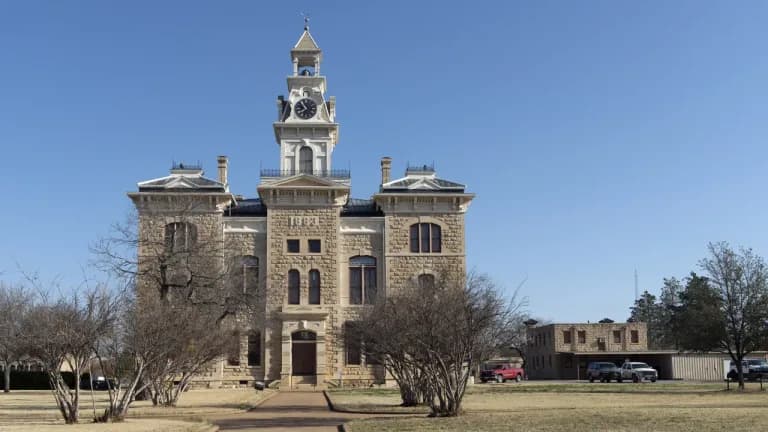
The Shackelford County Courthouse in Albany, Texas, a three-story building of rough-cut tan limestone with a mansard roof, small corner pavilions and a tall white clock tower topped by a weathervane, the date 1883 carved in a stone panel above the entrance, seen down a straight brick walk across a winter lawn with bare trees under a clear blue sky
CommunityThis Month

The History of Albany, Texas

Albany, Texas (ZIP 76430) was laid out in 1874 as the seat of Shackelford County, fifteen miles from the lawless town below Fort Griffin. In 1878 a former sheriff was shot by masked men in its jail; the sources still name no one.

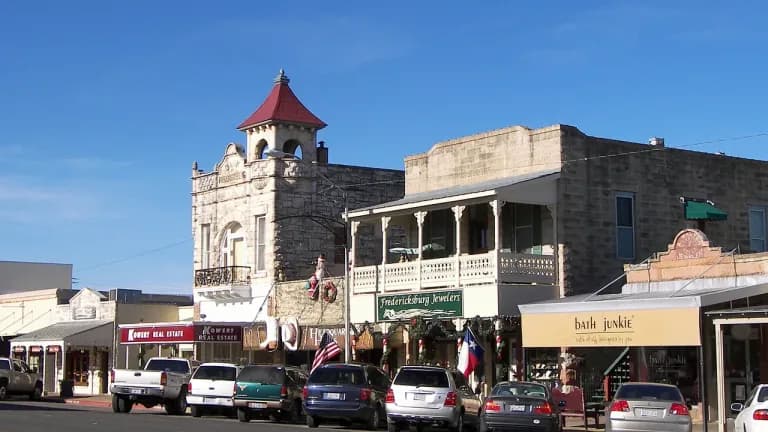
The 100 block of East Main Street in Fredericksburg, Texas, a row of two-story limestone commercial buildings under a clear blue sky, led by an 1889 bank building with a pointed red tower roof and arched windows, beside a stone building with a white-railed wooden gallery, with cars parked at the curb and Christmas garlands on the storefronts
CommunityThis Month

The History of Fredericksburg, Texas

Fredericksburg, Texas (ZIP 78624) was laid out in 1846 by German immigrants under John O. Meusebach, who made a treaty with Comanche chiefs on the San Saba the next spring. Its eight-sided Vereins-Kirche was torn down in 1897; the one in the market square is a 1936 replica.

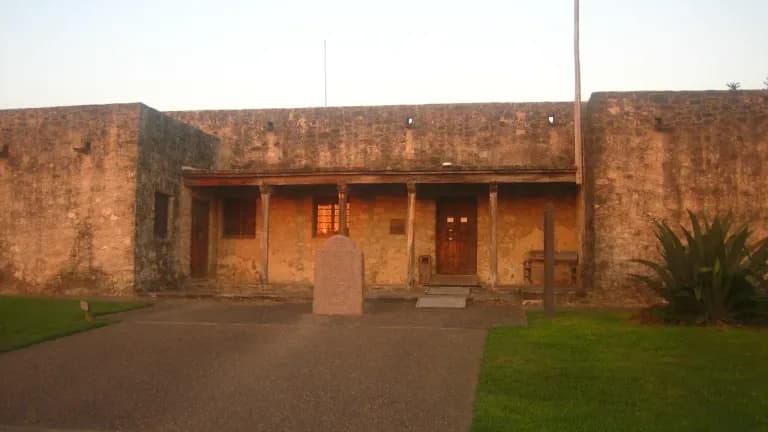
Presidio La Bahía near Goliad, Texas: low stone walls and a chapel with a white facade and single bell tower rising above the fort enclosure, photographed from outside the ramparts under a blue sky with scattered clouds
CommunityThis Month

The History of Goliad, Texas

Goliad, Texas (ZIP 77963) began as Spanish La Bahía on the San Antonio River, was renamed in 1829 as an anagram of Hidalgo, and in 1836 saw James W. Fannin’s command executed after Coleto. The sources still disagree on how many prisoners Portilla held that Palm Sunday.

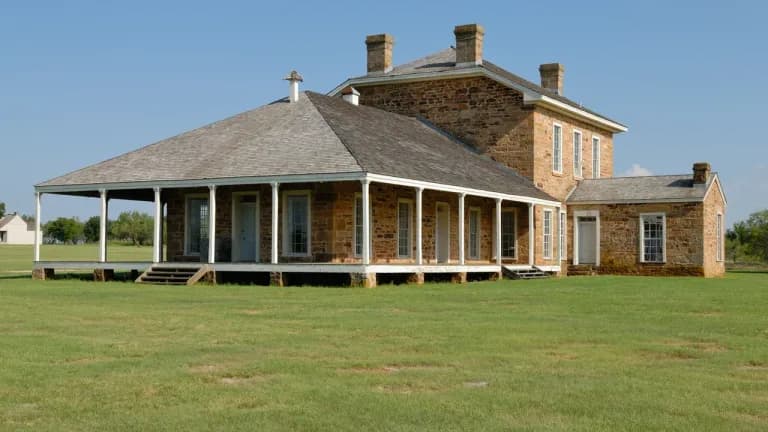
The Fort Richardson post hospital near Jacksboro, Texas, a two-story building of tan and brown stone with three chimneys, joined to a one-story wing wrapped by a deep white-columned porch under a hipped shingle roof, standing in a wide mown field under a clear blue sky
CommunityThis Month

The History of Jacksboro, Texas

Jacksboro, Texas (ZIP 76458) began as Mesquiteville on Lost Creek, was nearly emptied by raids during the Civil War and came back beside Fort Richardson. In 1871 two Kiowa chiefs were tried for murder upstairs in its courthouse. The sources still disagree on when the fort was founded.

The Gonzales County Courthouse in Gonzales, Texas, a red brick building with white limestone bands and arches, a tall central clock tower with a pointed roof, and corner turrets, under a blue sky with trees in front
CommunityThis Month

The History of Gonzales, Texas

Gonzales, Texas (ZIP 78629) was founded twice as the capital of Green DeWitt’s colony, refused to give a cannon back in 1835, sent thirty-two men to die at the Alamo and was burned by Sam Houston’s retreating army. Here is the fuller record, including the parts the slogan leaves out.