The History of Post, Texas
Post, Texas (ZIP 79356) began in 1907 as Post City, a dry model town built by cereal millionaire C. W. Post, who later fired dynamite into the sky to make it rain. The sources still disagree on how much land he bought: anywhere from 200,000 to 250,000 acres.
Editor’s note. This is the thirty-first installment of “Texas Towns: The Stories Behind the Map.” The last one went to Anahuac, a bluff on Trinity Bay where the trouble of 1832 began. This one leaves the coast for the foot of the Caprock on the South Plains. Readers of our Clarendon installment met a Panhandle town founded as a Methodist colony with no saloons. Post was a dry town too, but it was planned by one rich man, built by his company and named for him.
Post is the county seat of Garza County. It sits where U.S. highways 84 and 380 cross, on the old Santa Fe railroad line, just east of the Caprock escarpment near the west-central part of the county. The center of the county lies forty-two miles southeast of Lubbock. The mailing ZIP is 79356. [1] [2]
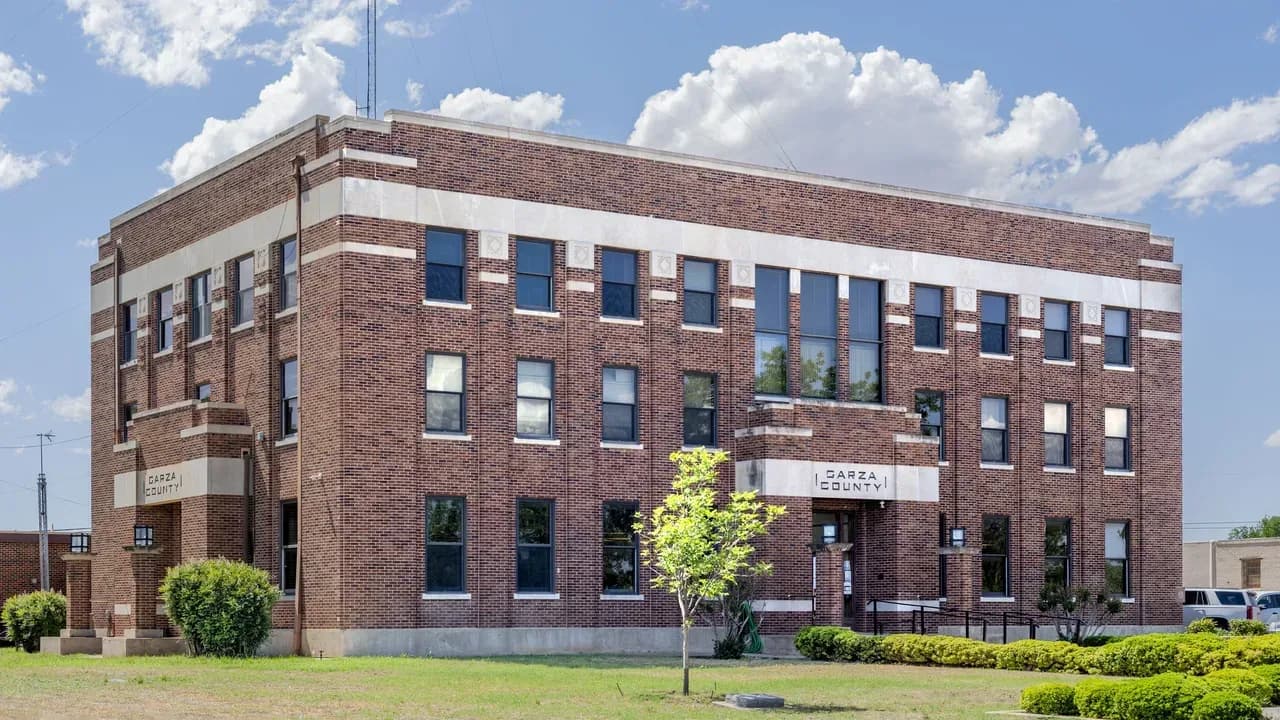
A driver coming through today sees a three-story brick courthouse from 1923 and, on its grounds, a statue of the town’s founder. Post did not grow up around a crossroads store or a railroad switch, the way so many in this series did. It was drawn on paper in 1907 by the company of Charles William Post, the cereal manufacturer behind Postum and Grape-Nuts, who wanted to build a model farming town on the edge of the High Plains. For its first seven years it was called Post City. [1] [3] [5]
Before Post City: hunters, the Comanche and the ranches
The land came first, and it is hard country. Garza County lies partly on the Llano Estacado and partly in the broken land below it, 914 square miles drained by tributaries of the Brazos River, with elevations from 2,100 to 3,000 feet. Rainfall averages under nineteen inches a year. Mesquite, grass, thorny scrub and cactus grow on its sandy and clay soils. [2]
People hunted here long before anyone drew a map of it. Clovis spearheads have been found in the county. In 1934 archeologists uncovered the sixteen-foot tusk of an imperial mammoth, and in the 1960s a type of arrowpoint used by hunters before A.D. 1500 turned up and was named the Garza point. From about 1700 to the 1870s the region belonged to the Kiowa and to Comanche bands who hunted it. The Handbook of Texas puts it plainly: they held the Southern Plains for 175 years before yielding to the United States Army in the 1870s. [2]
Ranchers moved in only after that, in the mid-1870s, when buffalo hunters had nearly wiped out the herds the Plains tribes lived on. Garza County was formed from Bexar County in 1876. It was named for a pioneer Bexar County family that included José Antonio de la Garza. Andy and Frank Long stocked the range south of the Double Mountain Fork of the Brazos for their OS Ranch. In 1879 W. C. Young and Ben Galbraith started the Llano Cattle Company in the northwest part of the county, and John B. Slaughter ran cattle here as well. The 1880 census counted thirty-six people in the whole county. The last Indian raid recorded in the county came in 1883, at the Llano Cattle Company’s Curry Comb Ranch. [2] [4]
The country was not kind to the ranchers either. The terrible winter of 1885–86 and the drought that followed drove some of them out, and by 1890 only fourteen residents were left. In the 1890s wet years and new wells brought ranchers and a few farmers back. By 1900 the county had thirty-eight farms and ranches and 185 people, though the courthouse nomination puts the figure at 180. Only 545 acres were improved that year. The cattle herds numbered 29,094 head. It was still ranch country, and there was no town of any size. [2] [5]
1886–1906: A cereal man who had been to Texas before
Charles William Post was born October 26, 1854, in Springfield, Illinois. He sold and built farm machinery for years and patented cultivators, a sulky plow, a harrow and a haystacker. After a breakdown in 1885, brought on by strain and overwork, he came to Texas in 1886 and joined a group of real estate men in Fort Worth developing the area now known as Riverside. The Post family later laid out a subdivision of its own on a ranch outside the city, with a woolen mill and a paper mill. [3]
A second breakdown in 1891 sent him to a sanitarium in Battle Creek, Michigan. The Handbook credits his recovery to rest and to a Christian Science practitioner. He began experimenting with a cereal drink he called Postum, and then with Grape-Nuts and Post Toasties. By the end of the century those breakfast foods had made him millions. The 1975 National Register nomination for the Post Sanitarium adds a story of its own. It says Post had met Texas farm wives who mixed chicory with roasted wheat and other grains as a makeshift coffee, and that he worked from that idea toward a drink without coffee’s ill effects. [3] [7]
Post’s politics are part of the record too. He served as president of the American Manufacturers Association and of the Citizens’ Industrial Association, and the Handbook calls him a bitter opponent of labor unions and an advocate of the open shop. The model town he built in West Texas would be a company town. [3]
1906–1907: Buying the ranches and organizing a county
In 1906, the Handbook says, Post decided he wanted to own a farming community in Texas. He bought ranchland along the Caprock escarpment in Garza and Lynn counties and picked a site near the center of Garza County for a town that would be the county seat. Veteran rancher T. P. Stevens helped him buy the land, and W. E. Alexander became manager of the colony in January 1907, according to the sanitarium nomination. [3] [7]
How much land he bought depends on which source you read, and they do not agree. The Handbook’s town entry says 200,000 acres. The entry on Post himself says some 225,000 acres. The county entry says 250,000 acres in Lynn and Garza counties. The 2001 courthouse nomination gives the most exact figure: 213,324 acres in Garza County and several hundred more in Lynn. The 1975 sanitarium nomination calls it a quarter-million-acre tract. We print all five and do not pick one. [1] [3] [2] [5] [7]
Part of it came from the OS Ranch. By 1906 Wilson E. Connell, John Scharbauer and E. W. Clark of Fort Worth owned the OS, and that year they sold 27,175 acres to Post. At a picnic in a chinaberry grove near the OS headquarters in 1906, plans were made to organize Garza County the next year. [4]
The election came in July 1907. It was held at the OS bunkhouse, and two OS cowboys won: James M. Boren became county judge and Oscar B. Kelly sheriff. The county was formally organized, with the new town of Post City as its seat. The commissioners court held its first meeting on the open prairie on July 15, 1907. One of its first orders was furniture for a courthouse that did not yet exist. [4] [5] [2]
1907–1913: Building a model town
Post City was a company town. Post’s Double U Company surveyed and platted the townsite, built a hotel, a company store and a commercial block, and put up houses it sold or rented to settlers. It laid out farms in 160-acre tracts. The 2001 courthouse nomination says each farm came with a house, barn, chicken coop and windmill already in place, and the sanitarium nomination says the houses had five or six rooms and were sold at low interest on long-term notes. The company planted trees along every street. It banned alcohol and brothels, and the county entry says land speculators were banned too. [1] [2] [5] [7]
There was no railroad yet, so many of the first buildings were made of sandstone hauled from a company-owned quarry about fifteen miles from town. Two Scottish stonemasons who had come to New York in 1905, George “Scottie” Samson and Jimmy Napier, quarried and cut white stone at the edge of the Caprock for the hotel and, later, the sanitarium. [5] [7] [9]
A post office opened in a tent in 1907. The county entry says Stockton Henry started the Post City Post that same year; the town entry says only that the town had a newspaper by 1909, along with a school and a bank. The county’s first business was carried on in rented space: on November 11, 1907, the commissioners agreed to use the northwest corner of the Double U Building as a temporary courthouse for $5 a month. In January 1908 they approved plans by M. S. Hall for a two-story stone courthouse, and F. L. Maupin built it for $5,044 by the summer of 1908. In May 1908 the court ordered an eight-by-fourteen-foot lumber “calaboose” for a jail. [1] [2] [5]
The hotel opened on July 17, 1908. It was named the Algerita, for the algerita bush that grows wild in the area. The 1975 nomination says it was designed by an architect working at Post’s company office in Battle Creek; the Lubbock Avalanche-Journal, citing the county museum, says Post designed it himself. Its rates were steep for the frontier, and guests complained. According to the nomination, Post had a sign hung behind the cashier’s desk: “The rate of this hotel is $2.50 a day. There are plenty of good boarding houses in town and plenty of room in the mesquite. Four-flushers, kickers, and other suspicious characters find board with the sheriff. When in doubt, hit the mesquite.” Waiters offered Postum in place of coffee, and Grape-Nuts sat in a covered dish on every table. [9] [10]
By one estimate more than 1,200 families followed the cereal millionaire to his colony. The Panhandle and Santa Fe Railway built south through the county in 1910. Post built a cotton gin in 1909 and a cotton mill in 1911. The model town was not a full success, though. The courthouse nomination says Post had to rent many of the farms he had built to sell. [2] [1] [5]
Post cared a great deal about health, and in 1912 Samson and Napier built a two-story stone sanitarium for the town. Dr. Arvel Ponton opened it in 1913. For a settlement five years old, it was unusually well equipped: an operating room with a skylight, an x-ray room, a laboratory, a diet kitchen and a training program for nurses. A gasoline engine ran its private electric plant until the cotton mill could supply power. The 1975 nomination notes an irony. Post had joined the Christian Science church after doctors failed to cure him, and stayed in that faith the rest of his life, yet he was the man who gave Garza County its first hospital. The sanitarium served through World War I and closed in 1920. It was an apartment house from 1928 to 1953, stood empty for thirteen years, and was bought by Garza County in 1966 for a museum. It was listed in the National Register in 1975. [7] [8]
1910–1914: The rain battles on the Caprock
The colony’s worst enemy was the weather, and Post went to war with it. He tried automatic farm machinery and dry-land methods and introduced grain sorghums such as milo and kafir. His most famous experiment was rainmaking with dynamite. He called the experiments “rain battles.” [3] [2]
The two Handbook entries describe them differently. The entry on Post says four-pound charges were set off every four minutes for several hours from firing stations along the rim of the Caprock, that he spent thousands of dollars on them between 1911 and 1914, and that they met with little success. The county entry dates them 1910 to 1913, says the explosives were fired from kites and towers, and reports that more than half of the “battles” were followed by measurable moisture, though the project did not actually make the colony succeed. Both agree it was spectacular. Neither says it worked. [3] [2]
1914: Post City becomes Post
Post’s health failed again in 1914. He died on May 9, 1914, at his home in Santa Barbara, California, and was buried in Battle Creek, Michigan. The sources do not speak about his death with the same certainty. The Handbook says he died “probably by suicide.” The 1975 sanitarium nomination states it as suicide and ties it to his despair after he agreed to an emergency appendectomy that, it says, went against his religious principles. We report what each source says and go no further. [3] [7]
That same year the town incorporated and dropped the word City. The Handbook dates the name change to the 1914 incorporation, the year of Post’s death. By then Post had about 1,000 people, ten retail businesses, a dentist, a doctor and the sanitarium, along with Baptist, Methodist and Presbyterian churches. [1] [3]
Post’s estate and the town still had big plans. In 1916 the estate pledged $75,000 and residents raised $35,000 to bring the proposed West Texas Agricultural and Mechanical College to Post. They lost. That school became Texas Tech University, in Lubbock. [1]
1913–1964: Postex, cotton and oil
Post was known for breakfast cereal, but his settlers grew little corn or wheat. Cotton became the base of the farm economy. By 1920 Garza County had 425 farms and ranches and 4,253 people, and cotton covered more than 18,000 acres. By 1929 there were 796 farms, and more than 51,100 acres were planted in cotton. [2]
The mill turned that cotton into cloth in town. Postex Cotton Mills began production in 1913 with 250 workers; the county entry and the courthouse nomination date the mill’s construction to 1911. It made sheets and other cotton goods, and the Handbook calls it the town’s leading industry. When the Post interests sold it to Ely and Walker Dry Goods Company of St. Louis in 1945, the plant was making six million yards of cloth a year and employed 375 people who turned out Postex sheets and Garza pillowcases. Ely and Walker sold it in 1955 to Burlington Industries, then the world’s largest textile maker, and by 1973 the plant employed 450 people. The town entry was last revised in 1995, and this article found no newer source on the mill, so we do not report its later history. [1] [2] [5]
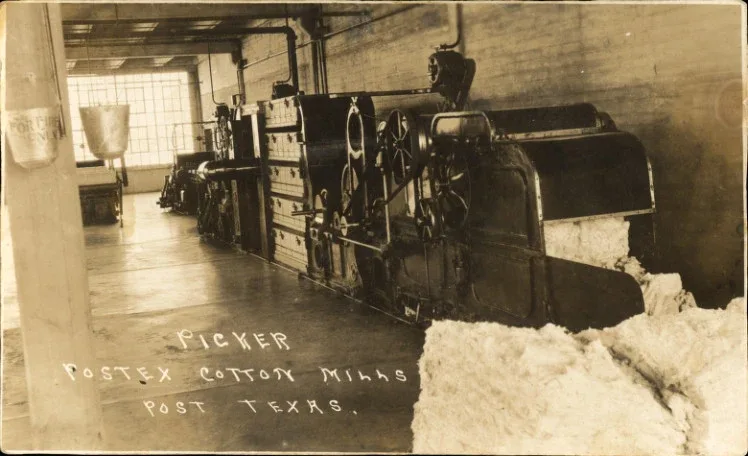
A picker, the machine that opens and cleans raw cotton, inside Postex Cotton Mills in Post, in a photograph dated between 1913 and 1918 in its library record. The lettering is on the original image. Courtesy of Special Collections, University of Houston Libraries; public domain, via Wikimedia Commons.
The town rose and fell with cotton. Post had 3,400 people in 1928. The Depression and the Dust Bowl hit the county hard, cotton acreage fell, and many farmers left their land; by 1940 the town was down to 2,000. Oil, discovered in the area in 1926, softened the worst of it. After the late 1940s it mattered a great deal: the county pumped more than 2.5 million barrels in 1948 and more than 5.5 million in 1956. Post climbed back to 3,100 in the 1950s and reached its peak of 4,800 in 1964. [1] [2]
A second paper, the Post Dispatch, started in June 1926. On its sixtieth anniversary the paper recalled that Eddie Warren founded it even though the town already had two established papers, and that Pauline Warren ran it through World War II while Eddie served in the Pacific. [1] [12]
1922–1972: The courthouse on the reserved square
The temporary stone courthouse lasted fifteen years. The original plat of Post City had set aside a courthouse square two blocks west of it, and in 1909 the commissioners ordered trees planted on the courthouse square in anticipation of a permanent building. In 1911 the county bought a small block of steel cells from San Antonio. The courthouse nomination says plainly that Post’s ideals ran into frontier reality. Saloons and brothels were banned, but not every citizen of Post City was of sterling character, and the county soon needed a jail. [5]
The cotton boom paid for the courthouse. Voters approved an $82,000 bond for a courthouse and jail on August 15, 1922, 579 to 355. A committee visited courthouses in Lamesa, Tahoka, Lubbock, Floydada and Crosbyton, and six architectural firms made presentations. Guy A. Carlander of Amarillo, a former draftsman for the Santa Fe railway, won the commission. Fred T. Bone Construction Company of Amarillo built the Prairie School–influenced brick courthouse for $65,490, and the whole job, jail and architect included, came to $81,026. The commissioners formally accepted the building on November 26, 1923. Exact dates for much of its early life are lost: the nomination says copies of the Post City Post from those years were lost to water damage. [5] [6]
The old stone courthouse was sold to the Odd Fellows lodge in 1924 for $4,000 and torn down sometime between 1928 and 1938; a service station took its place. The 1911 cells moved to a small brick building on the north side of the square, labeled “OLD JAIL” on the 1927 Sanborn map. The nomination records what it was used for: a drunk tank and a “colored” jail, until 1972. Segregation in Post was written into the very buildings on the square, and it lasted into living memory. [5]
In 1957 the county celebrated its fiftieth anniversary with a Golden Jubilee. Memorial gardens were built on the east side of the square, and a statue of C. W. Post was set up in the middle of them. His daughter, Marjorie Merriweather Post, gave the statue and came to the celebration with her daughter, the actress Dina Merrill. More than 2,000 people attended. A new law enforcement center went up west of the courthouse in 1973, and an oil well with a pump jack was drilled on the west edge of the grounds. The courthouse was listed in the National Register of Historic Places on November 21, 2001. [5] [6]
1908–2014: The hotel Post could not save
The Algerita did not stay a hotel for long. In 1917 its first floor became offices, and the First State Bank rented much of the front. The upstairs turned into rented rooms and apartments. A grocery store replaced the bank in 1932, and in 1958 the whole building was vacated. When the Texas Historical Commission nominated it to the National Register in 1975, it called the Algerita perhaps the earliest tangible reminder of the town’s heritage. The building was listed that April. [9]
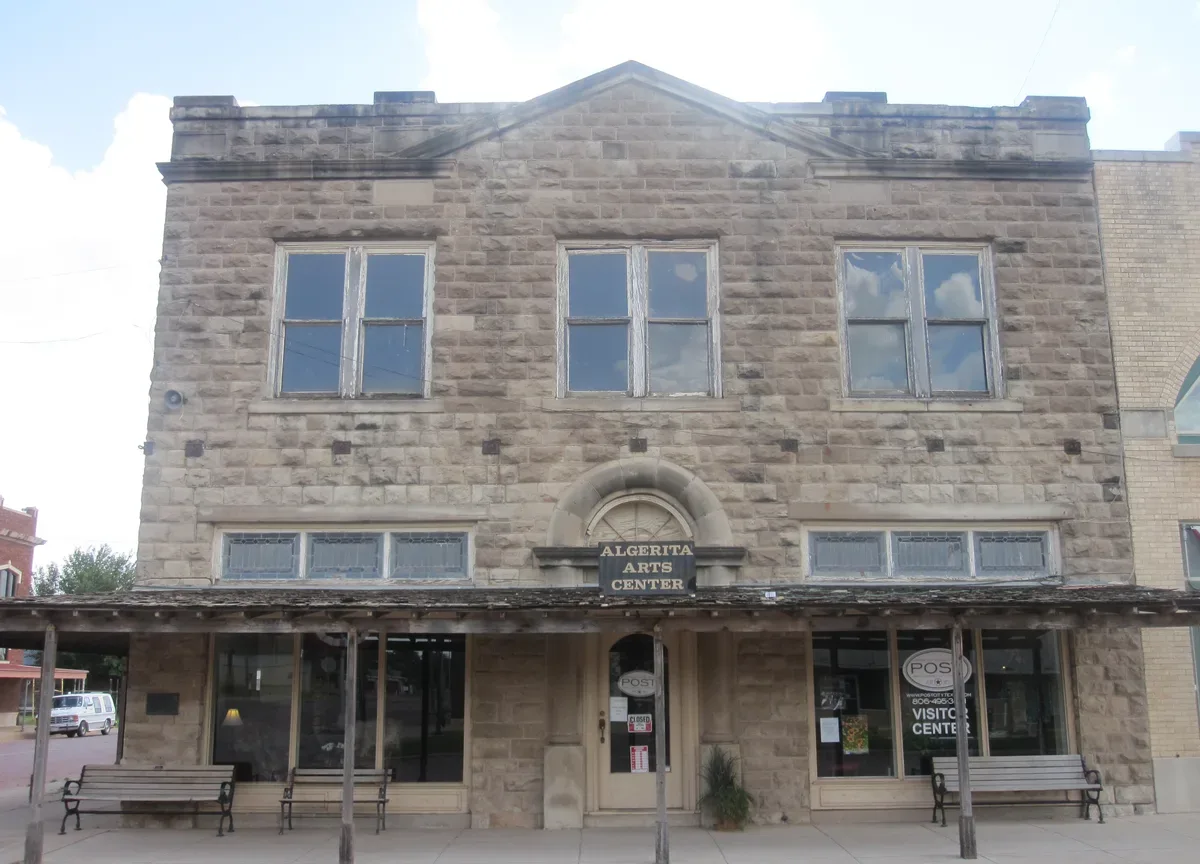
The Algerita Hotel building on Main Street, photographed July 25, 2010, when it housed the Algerita Arts Center and a visitor center. The hotel opened on July 17, 1908, and was demolished in November 2014, four years after this photograph was taken. Billy Hathorn, CC BY-SA 3.0, via Wikimedia Commons.
Saving it was another matter. A 1975 letter from the National Park Service in the nomination file regrets the trouble local citizens were having finding money to restore it, warns that demolition would be an irreparable loss, and points out that a National Register listing gave no government any power to stop an owner. In June 1986 the Post Dispatch reported that engineers called the south and west walls hazardous and said the south wall could collapse at any time. Their first estimate to make the building safe was $49,357. [9] [12]
The building lasted almost three more decades. It served at times as a doctor’s office and, for years, as the home of the Algerita Art Center. In November 2014 demolition began. Mark Kirkpatrick, treasurer of the Heritage Foundation that owned it, said three walls had major cracks, the south wall was pulling away and the walls stood on a rubble footing. “I think people in Post realize it was just beyond saving,” he told the Avalanche-Journal. Linda Puckett, curator of the Garza County Historical Museum, watched the demolition from an upstairs window. “I don’t think a new building’s gonna heal me up,” she said. [10]
The Algerita had also been a State Antiquities Landmark since 1981, and under state law the Texas Historical Commission should have been notified at least sixty days before it was torn down. It was not. The foundation said it did not know a permit was required; the commission said it would likely have issued one and did not plan legal action. The stones of the front facade were saved for a planned new Algerita, estimated in 2014 to cost about $3.5 million. This article found no source showing that the new building has been built. One small disagreement survives the building itself: the 1975 nomination describes white sandstone, while the 2014 newspaper report describes limestone walls. [11] [10] [9]
The complete story of Post
It is the story of land the Comanche and Kiowa held for generations, and of the cattlemen who came in behind the buffalo hunters. It is the story of a Michigan cereal fortune that bought somewhere between 200,000 and 250,000 acres, depending on the source, and drew a town on them with trees on every street and no saloons. It is the story of stonemasons from Scotland, a hotel with a sign telling complainers to go sleep in the mesquite, a hospital built by a Christian Scientist, and dynamite fired into the sky over the Caprock. [2] [1] [3] [9]
It is also the story of what the plan could not control. Farms meant for sale had to be rented. The rain did not come on command. The founder died in 1914, and his sources still describe that death with different degrees of certainty. A jail on the square held prisoners apart by race until 1972. The hotel that was supposed to advertise the town stood empty for decades and came down in 2014. What carried Post was cotton, a mill, oil and the people who stayed. [5] [3] [10]
C. W. Post wanted a model town. What he left was a real one. That is the history of Post.
Questions people ask
Why is the town called Post? It is named for its founder, the cereal manufacturer Charles William Post. It began in 1907 as Post City and became simply Post when it incorporated in 1914, the year he died. [1] [3]
Did C. W. Post really try to make it rain? Yes. Between about 1910 and 1914 he paid for “rain battles,” firing explosives along the rim of the Caprock. The Handbook’s two entries date them differently (1910–1913 and 1911–1914) and judge them differently, but neither says they made the colony succeed. [2] [3]
Is the Algerita Hotel still standing? No. It opened July 17, 1908, and was demolished in November 2014 after engineers and its owners judged its walls unsafe. Stones from its front were saved for a possible rebuilding. [9] [10] [11]
What can visitors still see from Post’s founding years? The 1912 sanitarium building at 117 North Avenue N, which Garza County bought in 1966 and has used as a museum, and the 1923 courthouse with the 1957 statue of C. W. Post. Both are listed in the National Register of Historic Places. [7] [8] [5] [6]
How many people live in Post? It depends on which number you use. The Census Bureau’s April 2020 estimates base is 4,788, and the Texas Almanac gives a count of 4,791 for 2021. The bureau’s annual estimates then jump to 5,227 for 2021 and fall to 3,472 for 2022; the 2025 estimate is 3,494. The Census table does not explain the swing, and this article will not guess at it. The Handbook’s town entry, last revised in 1995, stops at 3,708 in 2000. [13] [14] [1]
What is Post’s ZIP code? 79356. Post is the seat of Garza County, at the junction of U.S. highways 84 and 380. [1]
Sources
Paul M. Lucko, “Post, TX,” Handbook of Texas Online, Texas State Historical Association, revised May 1, 1995. Its bibliography includes Charles Dudley Eaves and Cecil Allen Hutchinson, Post City, Texas: C. W. Post’s Colonizing Activities in West Texas (Austin: Texas State Historical Association, 1952), and Garza County Historical Survey Committee, Wagon Wheels: A History of Garza County, ed. Charles Didway (1973). tshaonline.org/handbook/entries/post-tx.
John Leffler, “Garza County,” Handbook of Texas Online, Texas State Historical Association, revised August 27, 2016. tshaonline.org/handbook/entries/garza-county.
William M. Pearce, “Post, Charles William,” Handbook of Texas Online, Texas State Historical Association, revised May 1, 1995. Its bibliography includes Eaves and Hutchinson, Post City, Texas (1952), and Nettie Leitch Major, C. W. Post (1963). tshaonline.org/handbook/entries/post-charles-william.
Hugh Allen Anderson, “OS Ranch,” Handbook of Texas Online, Texas State Historical Association, revised August 4, 2020. tshaonline.org/handbook/entries/os-ranch.
National Register of Historic Places registration form, “Garza County Courthouse,” 300 West Main Street, Post, listed November 21, 2001 (reference no. 01001266), Section 8, statement of significance, drawing on the Garza County Commissioners Court minutes, 1907–1986. Texas Historical Commission Atlas. atlas.thc.texas.gov/NR/pdfs/01001266/01001266.pdf.
Texas Historical Commission, Texas Historic Sites Atlas, “Garza County Courthouse,” National Register listing, atlas no. 2001001266 (architect Guy A. Carlander; builder Fred T. Bone; style Prairie School). atlas.thc.texas.gov/Details/2001001266.
National Register of Historic Places nomination, “Old Post Sanitarium,” 117 North Avenue N, Post, prepared by the Texas Historical Commission (Joe R. Williams, Duncan Muckelroy and Marie Landon), March 1975; listed May 21, 1975 (reference no. 75001984). atlas.thc.texas.gov/NR/pdfs/75001984/75001984.pdf.
Texas Historical Commission, Texas Historic Sites Atlas, “Old Post Sanitarium,” National Register listing, atlas no. 2075001984. atlas.thc.texas.gov/Details/2075001984.
National Register of Historic Places nomination, “Old Algerita Hotel,” Post, prepared by the Texas Historical Commission, 1975; listed April 23, 1975 (reference no. 75001983). The file includes a 1975 National Park Service letter on local efforts to save the building. atlas.thc.texas.gov/NR/pdfs/75001983/75001983.pdf.
Blake Ursch, “Post community mourns loss of historic Algerita Hotel designed by C.W. Post,” Lubbock Avalanche-Journal, November 14, 2014. lubbockonline.com.
Blake Ursch, “Algerita Hotel demolished without sanction from Texas Historical Commission,” Lubbock Avalanche-Journal, November 20, 2014. lubbockonline.com.
The Post Dispatch, Wednesday, June 4, 1986, front page (“Algerita Walls Falling” and “Dispatch Celebrates 60th Anniversary”). Southwest Collection/Special Collections Library, Texas Tech University, digital newspapers. newspapers.swco.ttu.edu.
U.S. Census Bureau, Population Estimates Program, “City and Town Population Totals: 2020–2025” (sub-est2025), row for Post city, Texas: April 1, 2020 estimates base 4,788; July 1 estimates 4,782 (2020), 5,227 (2021), 3,472 (2022), 3,508 (2023), 3,532 (2024), 3,494 (2025). www2.census.gov … sub-est2025.csv.
Texas Almanac, “Post,” Texas State Historical Association (population count 4,791 for 2021). texasalmanac.com/places/post.
Aualliso, “Garza County Texas courthouse 2020.jpg,” photographed May 21, 2020, CC BY-SA 4.0, Wikimedia Commons. commons.wikimedia.org/wiki/File:Garza_County_Texas_courthouse_2020.jpg.
Billy Hathorn, “Algerita Arts Center, Post, TX IMG 4621.JPG,” photographed July 25, 2010, CC BY-SA 3.0, Wikimedia Commons. commons.wikimedia.org/wiki/File:Algerita_Arts_Center,_Post,_TX_IMG_4621.JPG.
“Picker, Postex Cotton Mills, Post, Texas,” photograph dated between 1913 and 1918, University of Houston Digital Library; public domain (courtesy of Special Collections, University of Houston Libraries), via Wikimedia Commons. commons.wikimedia.org/wiki/File:Picker_at_Postex_Cotton_Mills,_Post,_Texas.jpg.