The History of Clarendon, Texas
Clarendon, Texas (ZIP 79226) began in 1878 as a Methodist colony with no saloons, and cowboys nicknamed it Saints’ Roost. Nine years later the whole town moved five or six miles to the railroad, depending on which source you read, and the first site now lies under Greenbelt Lake.
Editor’s note. This is the twenty-second installment of “Texas Towns: The Stories Behind the Map.” The last two went to San Augustine, a Piney Woods town with a Spanish mission behind it, and Fort Davis, an army town in the Trans-Pecos that never got a railroad. This one goes north to the Panhandle, to a town that a Methodist preacher founded on the open range in 1878, that cowboys mocked as “Saints’ Roost,” and that picked itself up nine years later and moved to the railroad.
Clarendon, Texas, sits where U.S. Highway 287 crosses State Highway 70 in central Donley County, on the old Fort Worth and Denver City Railway line. It is the county seat and the county’s largest town. The Handbook of Texas places the county seat seventy miles southeast of Amarillo. The mailing ZIP is 79226. [1] [2]
The 2020 Census counted 1,877 people in the city. A driver coming in on 287 sees a red brick courthouse with towers, a college on the hill west of town and a museum in an old hospital. What a driver does not see is the first Clarendon. It stood on a flat by the Salt Fork of the Red River, a few miles north, and it has been under the water of Greenbelt Lake since the late 1960s. [17] [1] [13]
Before 1878: Apache, Comanche and the Red River War
The Handbook says the country that became Donley County belonged to the Plains Apaches until the eighteenth century, when Comanches and Kiowas moved in. Pedro Vial crossed it in 1787, and Santiago Fernández followed his route the next year. The first Americans of record were Capt. Randolph B. Marcy and Capt. George B. McClellan, who came through in 1852 surveying the Red River. [2]
It stayed Indian country until the Red River War of 1874–75. On September 7, 1874, during Col. Nelson A. Miles’s campaign, Lt. Frank D. Baldwin and a scout fought their way out of a Cheyenne ambush on Whitefish Creek, in what is now the northeastern part of the county. The Handbook says plainly what came next: the Indians were defeated and confined to reservations in Indian Territory, and that “left the area open to White settlement.” The legislature created Donley County in 1876 and named it for Stockton P. Donley, a pioneer lawyer who sat on the Texas Supreme Court after the Civil War. That same year Charles Goodnight and John Adair started the JA Ranch in Palo Duro Canyon, which took in the whole southwestern part of the county. [2] [20] [14]
1878: a Christian colony on the Salt Fork
Lewis Henry Carhart was born in Albany County, New York, in 1833. He trained for the ministry at Northwestern University and the Garrett Biblical Institute, served in the Union Army and came to Texas as a Methodist preacher. By 1877 he had a pastorate in Sherman. There, the Handbook says, he took up the idea of a Christian colony in the Panhandle that would discourage liquor and other “impure” activities. He advertised for colonists from Sherman and drew interest from the East and the Midwest. [3]
The money came through family. Carhart had married Clara Sully, a Canadian whose brother Alfred worked for Austin and Corbett, a New York investment firm. The promoters bought railroad land scrip good for 343 sections, most of it in Donley County. In the spring of 1878 Carhart and another brother-in-law, W. A. Allen, set up the colony on a flat where Carroll Creek runs into the Salt Fork of the Red River. They came in by way of Dodge City and Mobeetie, and supplies were freighted down the cattle trails from Dodge. [1] [3]
Where the name came from is not settled. The county entry and Carhart’s own entry say the town was named for his wife, Clara. The Handbook’s town entry calls that tradition and adds that “it has also been argued” the name was borrowed from Clarendon, England, to compliment the colony’s British backers. Those backers raise a second question. The town entry says an English firm, the Clarendon Land Investment and Agency Company, began backing Carhart in 1878. Carhart’s entry and the entry on his ranch say he sailed to England in 1884 or 1885 to sell stock and organized that company then. We print both. [1] [2] [3] [4]
1878–1882: “Saints’ Roost”
The settlers built with what the prairie offered: rock, adobe and pickets. A post office opened, and stagecoaches ran to Mobeetie and Tascosa. The Methodist church’s 1978 state marker says the first building put up in Clarendon was a combination church and school. By the early 1880s it was one of only three towns in the Panhandle. [1] [6] [2]
The town was openly religious and had no saloons. At one time, the Handbook says, seven Methodist ministers lived there. The rowdier men of the Panhandle took note, and cowboys started calling the place Saints’ Roost. The Handbook spells it “Saint’s Roost” in places; the town’s museum uses “Saints’ Roost.” The town did not run from the label. When Carhart started the Panhandle’s first newspaper, the Clarendon News, in 1879, its first issue, dated August 2, called Clarendon “a sobriety settlement.” Ed Carhart, a son of Lewis’s cousin, was its printer and later its editor. W. A. Allen opened a school, Allenton Academy, and began planning a Methodist college. [1] [3] [5]
Methodists were not the only believers on the Salt Fork. The 1971 marker at the Episcopal Church of St. John Baptist says the first Episcopal services in the area were held in November 1877, in the J. B. McClelland ranch house, by a Rev. Mr. Townsend of the Dallas diocese. That was before the colony arrived. [7]
In 1880 Carhart left to take a large Methodist pulpit in Dallas. His wife, the Handbook says, never wanted to live on the frontier for good and kept homes in Sherman and Dallas. Another brother-in-law, attorney Benjamin Horton White, ran the colony’s affairs with J. C. Murdock. When Donley County was organized in 1882, Clarendon became the county seat and White was elected the first county clerk. A rock building that had been a hotel became the courthouse. The 1936 state marker gives the organization date as March 22, 1882. The Handbook says ten other unorganized counties were attached to Donley for judicial purposes at one time. [1] [3] [20] [2]
1884–1887: the Quarter Circle Heart and the Big Die-Up
Carhart came back to Donley County in 1884 as a cattleman. He registered the Quarter Circle Heart brand and, with Sully’s help, sold stock in England. At its peak the Quarter Circle Heart range covered 250,000 acres, with the town of Clarendon in the middle of it, and ran somewhere between 15,000 and 35,000 longhorns. The town became the supply center for the ranches around it: the JA, the RO, the Half Circle K and the Diamond F. [4] [3]
It did not last. The drought and blizzard of 1886–87, the “Big Die-Up,” took their toll. British stockholders, many of whom had never seen a dividend, sent the company secretary, Count Cecil Kearney, to look for himself in June 1887. The Handbook says Carhart and his foreman, Al McKinney, learned when Kearney was coming and both resigned without notice and left. Kearney found only a fraction of the herd that was supposed to be there, and what the Handbook calls “signs of gross mismanagement in all areas.” The ranch was reorganized and later broken up into farms, school land and settlements. By 1895 the brand was gone. [4]
Carhart went back to preaching but, his biographer writes, never regained the leadership he once had. He moved to Hot Springs, Arkansas, in 1891 and put what money he had left into a bathhouse. He died in the Union soldiers’ home at Sawtelle, California. [3]
1887–1891: the town moves to the tracks
The same year the ranch fell apart, the railroad came. The Fort Worth and Denver City Railway laid out its line south of the townsite, and Clarendon’s people voted overwhelmingly to move their homes and businesses to the tracks. The county entry dates the move to October 1887 and says that by 1888 little remained of the old town. The sources do not agree on how far it went. The town entry and the Methodist marker say six miles. The county entry and the ranch entry say five. [1] [2] [6] [4]
The new Clarendon was a railroad division point, with shops and offices built in 1887 and 1888. The county entry says it kept that role until 1902. The town got an opera house, and its first bank in 1889. A circuit rider, the Rev. James T. Hosmer, held Methodist services in homes; in 1888 the Rev. Isaac L. Mills and fifteen charter members organized the Methodist Episcopal Church, South, and in 1890 they put up a frame church at Kearney and Fourth. The Methodist marker adds that a Northern Methodist church also existed in Clarendon until about the turn of the century. [1] [2] [6]
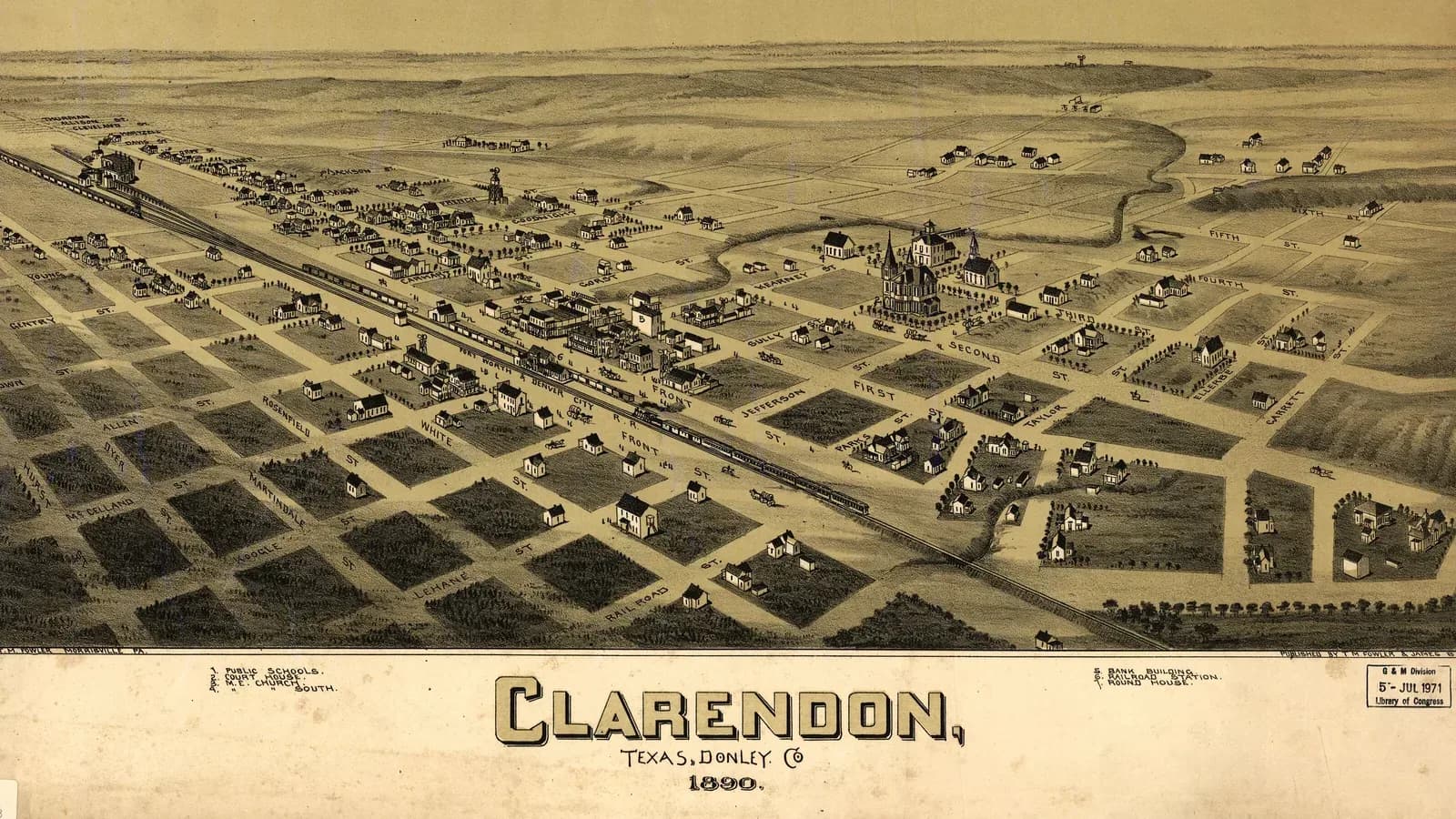
The bird’s-eye view at the top of this page was published in 1890, three years after the move. It shows the new grid laid out along the tracks, with a key below the picture listing the public schools, the courthouse, the M.E. Church, South, a bank, the railroad station and the roundhouse. [19]
The permanent courthouse went up next. The Handbook says the brick-and-stone building was completed in 1890. The Texas Historical Commission’s 2006 landmark marker says the Romanesque Revival courthouse, designed by Bulger and Rapp and built by Troutman Brothers, both of Trinidad, Colorado, opened in November 1891, and the commission’s courthouse program gives 1891 as the year it was completed. We print both years. [1] [9] [10]
In the 1930s the building lost its entire third floor. The marker says only that “work in the 1930s” removed it along with many details; the commission’s courthouse page says it was damage from a tornado that led to the removal of the third floor and tower. The county restored the courthouse and rededicated it on July 4, 2003. The commission calls it the oldest functioning courthouse in the Texas Panhandle. [9] [10]
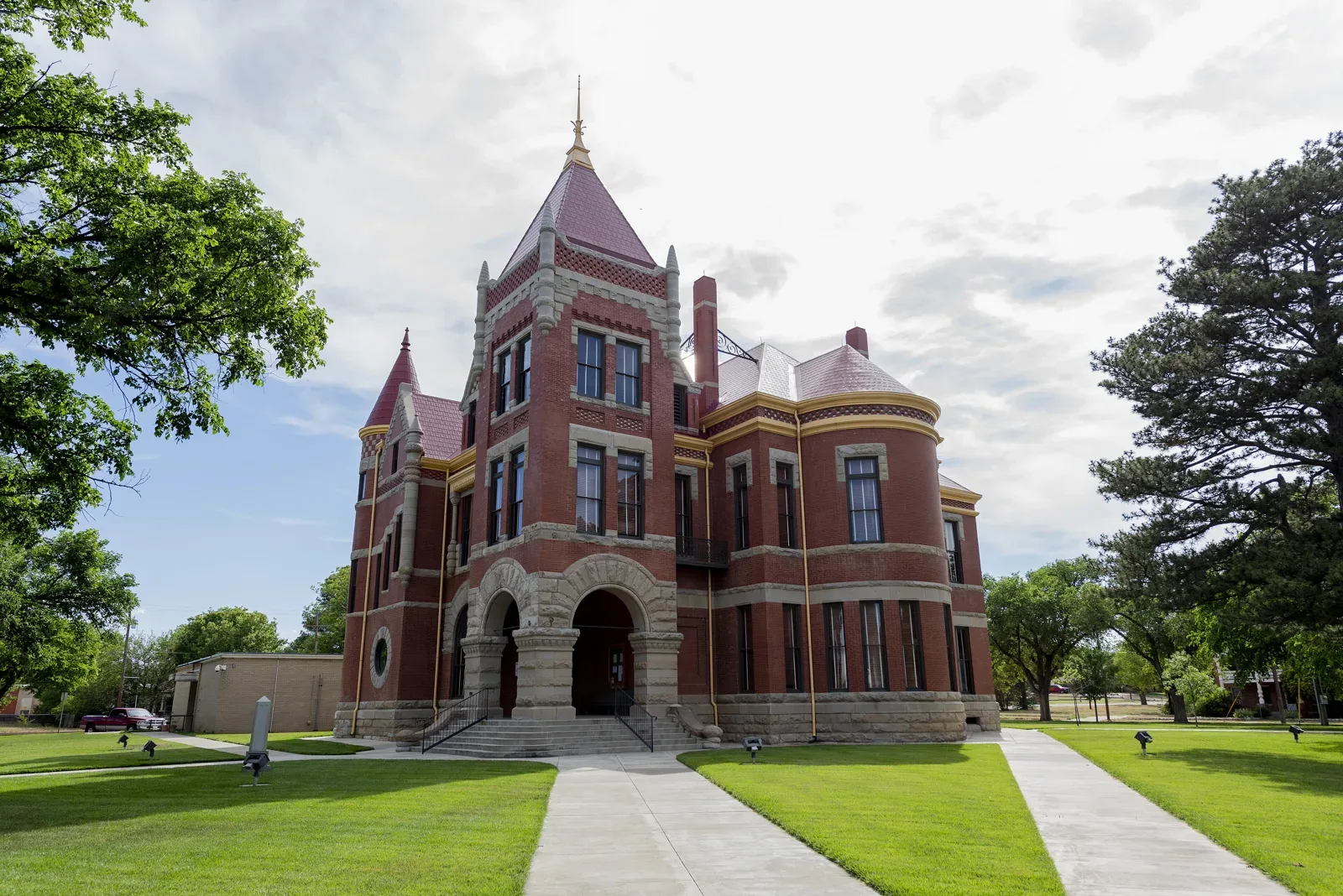
The Donley County Courthouse in May 2020, after the 2003 restoration that rebuilt its third floor. The building dates to 1890–91. Aualliso, CC BY-SA 4.0, via Wikimedia Commons.
1897–1910: Feather Hill, a college and the churches
The new town did not stay dry. The Handbook says saloons and gambling dens “flourished briefly” in a part of town called Feather Hill. The college entry explains why they went away. When the town moved, citizens offered the Northwest Texas Methodist Conference four acres and a two-story building to bring the college along, and church leaders answered that they would build only if the saloons were gone. A local Methodist pastor, the Rev. J. R. Henson, led the campaign. The sources differ on when it was won. The town entry says the dens were shut down and cleared in 1898 to make room for the college. The college entry says the campaign to clear Feather Hill and vote the county dry succeeded by 1902. [1] [5]
Clarendon College and University Training School was organized on April 2, 1898, and opened on September 5, according to the 2015 state marker. The Handbook says it opened that fall with four teachers and twenty-one students, and that for years it taught every grade from primary school up. The marker calls it the first college in the Texas Panhandle. Older sources are not unanimous: the county entry says Clarendon College was established in 1887. The college’s own entry and the marker say 1898, and the college entry traces the idea back to Allen’s academy of 1879. [11] [5] [2]
Other congregations were building too. The Episcopal Church of St. John Baptist went up in 1893 on a lot given by Isaac W. Carhart and was consecrated April 24 of that year; its marker calls it the oldest church in continuous use in the Panhandle. About the same time Catholics built St. Mary’s Academy. By then, the Handbook counts, Clarendon had 200 residences, forty-six businesses, six churches and forty-five windmills. [7] [1]
Black residents came with the railroad as well, and they built under segregation. The 2014 state marker for St. Stephen’s Baptist Church says African Americans in Clarendon first met in homes or under a shade tree to read the Bible. A young Black cowboy, Matthew “Bones” Hooks, met the Rev. Sid Stephens on the train into town and persuaded him to help organize a church. They found an empty shelter in 1897, and the congregation took the pastor’s name. A flood destroyed the building in May 1918, and the members found a new place. The marker calls St. Stephen’s the first African American church in the Panhandle; the marker itself has since been reported missing. The segregation was built into other institutions too. The Saints’ Roost Museum says a small building on its grounds first served as the hospital’s segregated waiting room. [8] [16]
Clarendon incorporated in 1901. The Panhandle’s first interscholastic football game is part of the college’s story, and here the dates split again. The Handbook says the Clarendon College Cowboys beat Goodnight Academy 16 to 10 on December 5, 1903. The 2015 marker gives the same score but says the Clarendon College Bulldogs beat the Goodnight College Buffaloes on February 21, 1903. In 1910 the Methodists put up the large classical revival church that still stands on South Jefferson Street. [1] [5] [11] [6]
June 3, 1910: the hanging
The Handbook gives one sentence to the darkest public day in the town’s record: “The last legal hanging in the Panhandle occurred there on June 3, 1910.” The man was G. R. Miller of Childress. In 1909 he went on a crime spree that ended with shootings aboard a westbound freight train out of Childress. Accounts differ on how many died. A Pampa museum’s account, drawn from a 1966 Amarillo newspaper story, says two young men were killed and two wounded; the guidebook Panhandle Pilgrimage says four men died and four were wounded. Miller got a life sentence for one killing and was sentenced to death for another. [1] [21] [22] [12]
Lubbock attorney and historian Chuck Lanehart, writing in 2021, describes a festive morning. Vendors sold food, families brought picnic baskets, and about a thousand men and boys gathered at the gallows; women were kept away. A Catholic priest and a Methodist minister went to the scaffold with Miller. He asked forgiveness for “the scandal and bad example” of his life and told the crowd, “All you children be good children.” He was buried in an unmarked grave in a small Catholic cemetery south of town. The local editor wrote that he “exceedingly regret[ted]” that a legal execution had been necessary in the county. Lanehart calls it the only judicial hanging ever carried out in the forty-six counties of the Panhandle–South Plains region. [12]
That same year Cornelia Adair, John Adair’s widow and Charles Goodnight’s partner in the JA Ranch, built the Adair Hospital in Clarendon for the JA’s cowboys and their families. [16] [14]
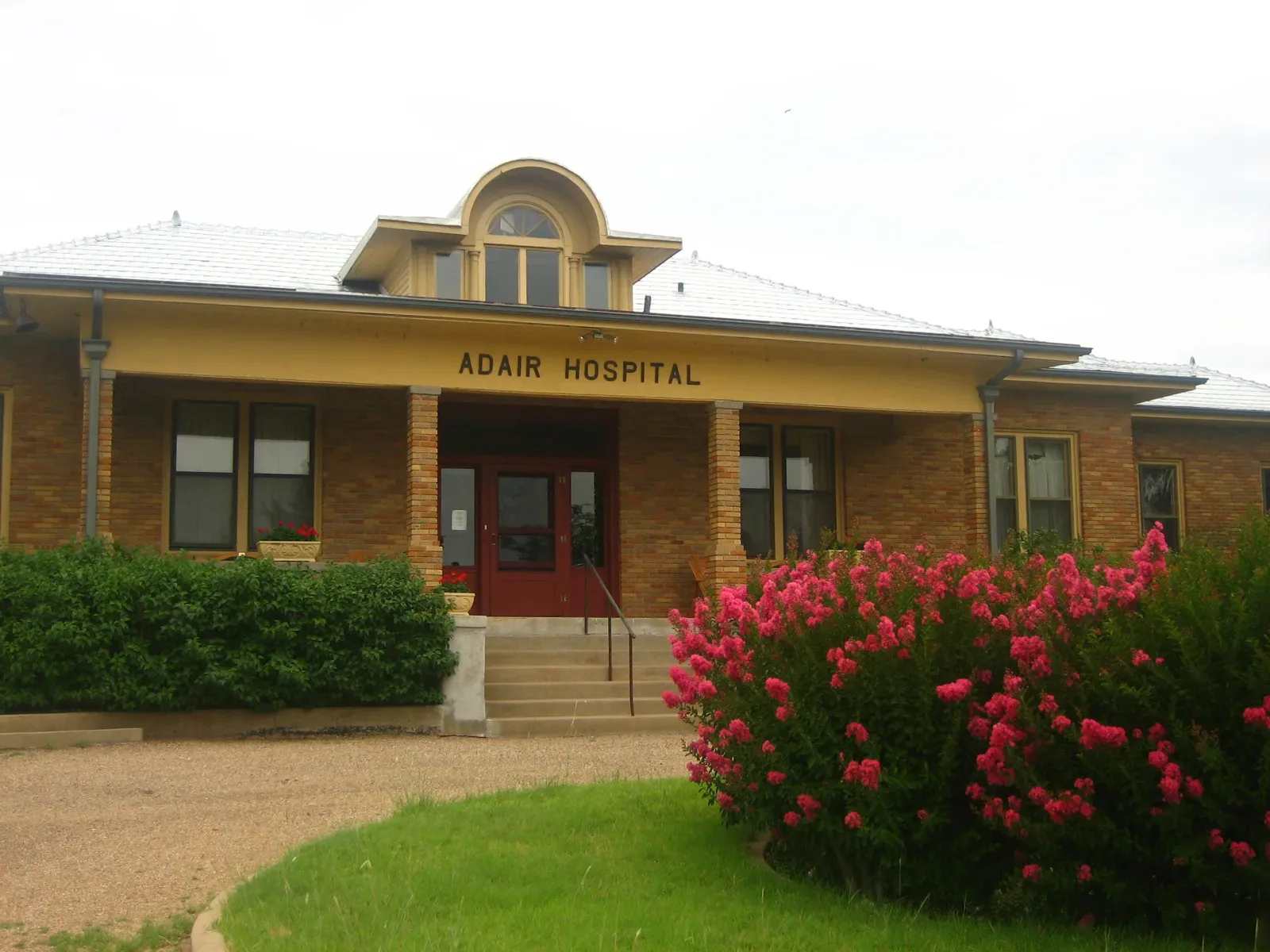
The former Adair Hospital, built in 1910 and now the Saints’ Roost Museum, photographed in July 2008. The museum says Cornelia Adair built it for the JA Ranch’s cowboys and their families. Billy Hathorn, CC BY-SA 3.0, via Wikimedia Commons.
1914–1950: an artist, a junior college and the WPA
In 1914 the family of Harold Dow Bugbee moved from Massachusetts to a ranch near Clarendon. Bugbee graduated from Clarendon High School in 1917, studied art, and spent his life drawing and painting the ranch country before it disappeared. He illustrated J. Evetts Haley’s 1936 biography of Charles Goodnight and thirty-four issues of the Panhandle-Plains Historical Review. The Handbook’s town entry dates the family’s two-story ranch home northeast of town to 1912, two years before the date in Bugbee’s own entry. [15] [1]
The college outgrew its beginnings. The Handbook says that in 1916 it had the largest enrollment of any junior college in the South, and by 1925 it was a four-year school. Then, after talk of moving it to Amarillo, the Methodist Church gave it up on August 15, 1927. Clarendon’s voters had the school board buy the property and reopen it as a municipal junior college. The Handbook says nineteen students received bachelor’s degrees, all in 1927; the marker says the college conferred twenty-eight. [5] [11]
Clarendon sits in a draw, and until the 1930s its streets flooded often. The Work Projects Administration built dams and terraces to turn the water away. The county around it was hit hard by the Depression and the drought of the early 1930s; the county had 10,262 people in 1930 and 7,487 by 1940. In town, new gins and hatcheries marked a turn toward agribusiness, and by 1950 Clarendon also made cotton bags and covers, farm and road equipment and leather goods. That year it counted 2,577 people. [1] [2]
1966–1968: the old town goes under
Work on Greenbelt Dam on the Salt Fork began on April 12, 1966, and the dam was closed and began holding water on December 5. The reservoir was built for city and industrial water. By 1968 the rising lake was about to cover the original townsite, and the old cemetery and what else was left of Saints’ Roost were moved. The Handbook’s town entry says the graves went south along State Highway 70. In the same years the college moved to a new campus on a hill west of town, on the former home site of rancher Thomas Sherman Bugbee. The marker credits an endowment from sisters Etta and Ida Harned for the move. [13] [1] [5] [11]
The population numbers since then move in a narrow band. The Handbook gives 2,172 in 1960, 1,974 in 1970, 2,220 in 1980, 2,067 in 1990, 1,974 in 2000 and 2,026 in 2010. The 2020 Census counted 1,877. The Census Bureau’s July 2025 estimate is 1,860. [1] [17] [18]
The complete story of Clarendon
It is the story of a preacher born in New York who came to the Panhandle with a plan for a town without liquor, and of the cowboys who laughed and gave it a name the town decided to keep. It is the story of a ranch where an inspector went looking for 35,000 cattle and found a fraction of them, and of a founder who left before the inspector arrived. It is the story of a town that packed up and moved to the railroad, fought its own saloon district to get a college, and saw its first site disappear under a lake.
It is also the story of Black families who met under a shade tree until they could build a church, of a hospital with a separate waiting room, and of a June morning in 1910 when a crowd brought lunch to a hanging. The record keeps all of it. That is the history of Clarendon.
Questions people ask
Why is Clarendon called Saints’ Roost? Cowboys gave it the name because the town was founded as a Methodist colony with no saloons and, at one point, seven Methodist ministers. The town’s museum carries the name today. [1] [16]
Who was Clarendon named for? Tradition and two Handbook entries say Clara Sully Carhart, the founder’s wife. The Handbook’s town entry notes it has also been argued the name came from Clarendon, England, to flatter British investors. [1] [3]
Where was the original Clarendon? At the mouth of Carroll Creek on the Salt Fork of the Red River, five or six miles north of the present town, depending on the source. The site has been under Greenbelt Lake since the late 1960s. [1] [13]
Is Clarendon College the oldest college in the Panhandle? The 2015 state marker calls it the first college in the Texas Panhandle, organized in 1898. It began as a Methodist school and became a public junior college in 1927. [11] [5]
Sources
Hugh Allen Anderson, “Clarendon, TX,” Handbook of Texas Online, Texas State Historical Association, revised September 20, 2023. tshaonline.org/handbook/entries/clarendon-tx. The entry’s bibliography cites Virginia Browder, Donley County: Land O’ Promise (1975), and Willie Newbury Lewis, Between Sun and Sod (1938; rev. ed. 1976).
Donald R. Abbe and Hugh Allen Anderson, “Donley County,” Handbook of Texas Online, revised October 21, 2020. tshaonline.org/handbook/entries/donley-county.
Hugh Allen Anderson, “Carhart, Lewis Henry,” Handbook of Texas Online, revised December 1, 1994. tshaonline.org/handbook/entries/carhart-lewis-henry.
Hugh Allen Anderson, “Quarter Circle Heart Ranch,” Handbook of Texas Online, published June 1, 1995. tshaonline.org/handbook/entries/quarter-circle-heart-ranch.
Hugh Allen Anderson, “Clarendon College,” Handbook of Texas Online, revised April 1, 2002. tshaonline.org/handbook/entries/clarendon-college. Its bibliography includes Kate Talley, History of Clarendon College (M.A. thesis, West Texas State University, 1933).
Texas Historical Commission, Atlas, “First United Methodist Church of Clarendon,” marker 1884 (1978), 420 S. Jefferson St. atlas.thc.texas.gov/Details/5129001884.
“Church of St. John Baptist,” Texas historical marker 854 (1971), Historical Marker Database. hmdb.org/m.asp?m=100427.
“St. Stephen’s Baptist Church,” Texas Historical Commission marker 18141 (2014), Historical Marker Database (marker reported missing). hmdb.org/m.asp?m=151616.
Texas Historical Commission, Atlas, “Donley County Courthouse,” marker 13596, Recorded Texas Historic Landmark (2006), 300 S. Sully St. atlas.thc.texas.gov/Details/5507013596.
Texas Historical Commission, “Donley County Courthouse,” Restored Historic Courthouses. thc.texas.gov.
“Clarendon College,” Texas Historical Commission marker 18210 (2015), 1122 College Drive, Historical Marker Database. hmdb.org/m.asp?m=151615.
Chuck Lanehart, “Caprock Chronicles: Last hanging in the Panhandle: The legend of George R. Miller – Part 2,” Lubbock Avalanche-Journal, June 12, 2021. lubbockonline.com.
Seth D. Breeding, “Greenbelt Lake,” Handbook of Texas Online, revised January 1, 1995. tshaonline.org/handbook/entries/greenbelt-lake.
Hugh Allen Anderson, “JA Ranch,” Handbook of Texas Online, revised May 27, 2026. tshaonline.org/handbook/entries/ja-ranch.
Caroline Remy, “Bugbee, Harold Dow,” Handbook of Texas Online, revised December 10, 2016. tshaonline.org/handbook/entries/bugbee-harold-dow.
Saints’ Roost Museum, “About” and “Exhibits,” 610 E. Harrington St., Clarendon. saintsroostmuseum.com.
U.S. Census Bureau, 2020 Census, Clarendon city, Texas, population 1,877. data.census.gov.
U.S. Census Bureau, Annual Estimates of the Resident Population for Incorporated Places, Vintage 2025 (estimates base 1,881; July 1, 2025, estimate 1,860). www2.census.gov.
T. M. Fowler and James B. Moyer, “Clarendon, Texas, Donley Co. 1890,” bird’s-eye view, Library of Congress Geography and Map Division, G4034.C47A3 1890 .F6. loc.gov/item/gm71005383.
“Donley County,” Texas Centennial marker 1250 (1936), Historical Marker Database. hmdb.org/m.asp?m=96829.
White Deer Land Museum, Pampa, “The Last Hanging,” after Lumarion Sumner, Amarillo Daily News, September 12, 1966. pampamuseum.org.
Panhandle Pilgrimage: Illustrated Tales Tracing History in the Texas Panhandle, p. 259, via The Portal to Texas History, University of North Texas Libraries. texashistory.unt.edu/ark:/67531/metapth225495.