The History of Gonzales, Texas
Gonzales, Texas (ZIP 78629) was founded twice as the capital of Green DeWitt’s colony, refused to give a cannon back in 1835, sent thirty-two men to die at the Alamo and was burned by Sam Houston’s retreating army. Here is the fuller record, including the parts the slogan leaves out.
Editor’s note. This is the twenty-third installment of “Texas Towns: The Stories Behind the Map.” The last one went to Clarendon, the Panhandle town that moved to the railroad. This one goes back to the Guadalupe River, to the old capital of Green DeWitt’s colony, where colonists refused in 1835 to hand a small cannon back to the Mexican army, where thirty-two men rode out to die at the Alamo, and where Sam Houston had the town burned behind him.
Gonzales, Texas, sits at the confluence of the Guadalupe and San Marcos rivers in the north central part of Gonzales County, where U.S. Highway 90 and U.S. Highway 183 cross State Highway 97. It is the county seat. The railroad that reaches it is a short spur, twelve miles of track built in 1882 to the main line at Harwood after the main line passed the town by. The mailing ZIP is 78629. [1] [12]
The 2020 Census counted 7,165 people in the city. A driver coming in sees a red brick courthouse with a clock tower, an old stone jail beside it and a white limestone museum built for the Texas Centennial. The town calls itself the “Lexington of Texas,” because the first shots of the Texas Revolution were fired just upriver. The record behind that name is fuller and harder than the slogan, and it starts with a town that had to be founded twice. [20] [1]
1825–1827: Kerr’s cabins and a second start
Green DeWitt, a Missouri militia captain and former sheriff, won an empresario grant from the state of Coahuila and Texas on April 15, 1825, to settle 400 Anglo-American families on the Guadalupe River next to Stephen F. Austin’s colony. His surveyor, James Kerr, laid out the capital that year near the meeting of the Guadalupe and San Marcos. It was named for Rafael Gonzales, the governor of Coahuila and Texas. [3] [1]
Kerr’s party built cabins on a nearby creek, ever after called Kerr’s Creek. The Handbook calls them the first Anglo community west of the Colorado River. After two Indian attacks, the first probably by Wacos and the second by Tonkawas, they abandoned the cabins in July 1826 for a place called Old Station near the mouth of the Lavaca. The Mexican government would not let them stay there, and late in 1827 some came back to the Gonzales townsite. [2] [1]
Jean Louis Berlandier came through in April 1828 and found six cabins near the river crossing inside a fort-like barricade, cotton and corn planted, and Tonkawa and Karankawa villages nearby. Money was so scarce that DeWitt issued handwritten scrip for colonists to buy their land, which the Handbook calls one of the earliest examples of Texas paper currency. [2] [3]
1831–1834: a cannon for the frontier
On January 1, 1831, DeWitt wrote the political chief at Béxar asking for a cannon to protect the colonists against Indian raids. On March 10, 1831, a colonist named James Tumlinson Jr. received one bronze cannon at Béxar to deliver to Gonzales, on the condition that it be returned to Mexican authorities on request. The Handbook says the colony’s population of 532 that year helped persuade the government to send it. It was probably swivel-mounted in one of the two blockhouses built in 1827. [5] [2]
New families kept coming. Almeron and Susanna Dickinson arrived with fifty-four other settlers on February 20, 1831, after a schooner trip from New Orleans. Byrd Lockhart resurveyed the town in August 1832, when it was given sixteen leagues of land, because the government had refused to recognize Kerr as the official surveyor. DeWitt’s contract expired in 1831 unfulfilled, and he died of illness, probably cholera, in Monclova in May 1835. [8] [1] [2] [3]
October 2, 1835: “Come and take it”
By September 1835 the colonists were at odds with Santa Anna’s centralist government. Col. Domingo de Ugartechea, the military commander at Béxar, sent a corporal and five soldiers to bring the cannon back. The Gonzales men said they were keeping it and took the soldiers prisoner. They buried the gun in George W. Davis’s peach orchard and sent riders to the Colorado River settlements for help. [5]
Ugartechea then sent Lt. Francisco de Castañeda with 100 dragoons. When they reached the Guadalupe opposite the town on September 29, high water and eighteen militiamen blocked the ford. Those men, later called the Old Eighteen, told him the alcalde, Andrew Ponton, was out of town and that he would have to wait on the west bank. Albert Martin was elected their captain. While Castañeda waited, volunteers poured in, and a Coushatta man told him the Texans numbered at least 140. [4] [6] [7]
The Texans dug the cannon up, mounted it at John Sowell’s blacksmith shop on the front wheels of Albert Martin’s cotton wagon, and raised a flag over it showing a cannon and the words “Come and Take It.” Castañeda moved seven miles upriver to Ezekiel Williams’s land. On the morning of October 2 the Texans, under John Henry Moore, attacked. In a lull, Castañeda told Moore he was himself a Federalist and only had orders to recover the gun. Moore invited him to join the Texans. Castañeda said a soldier follows orders, and when the firing resumed, outnumbered, he withdrew toward Béxar. [5] [4]
The Handbook is candid that it was “really only a brief skirmish.” It also says the fight marked a clear break with Mexico, and it is counted as the first battle of the Texas Revolution. On October 11 Stephen F. Austin took command of the volunteers gathered at Gonzales, and they marched on Béxar. [4] [1]
Two parts of the story are disputed in the Handbook itself. Green DeWitt’s biography says his widow, Sarah, and their daughter Naomi cut up Naomi’s wedding dress to make the banner. The revised 2025 entry on the cannon calls that account apocryphal, says a committee of five officers designed the flag with materials donated by the women of Gonzales, and says the flag was soon lost without a trace. The same entry says there were two guns at the battle: the bronze six-pounder and a much smaller iron gun called an esmeril, which Mexican accounts mention and American ones do not. [3] [5]
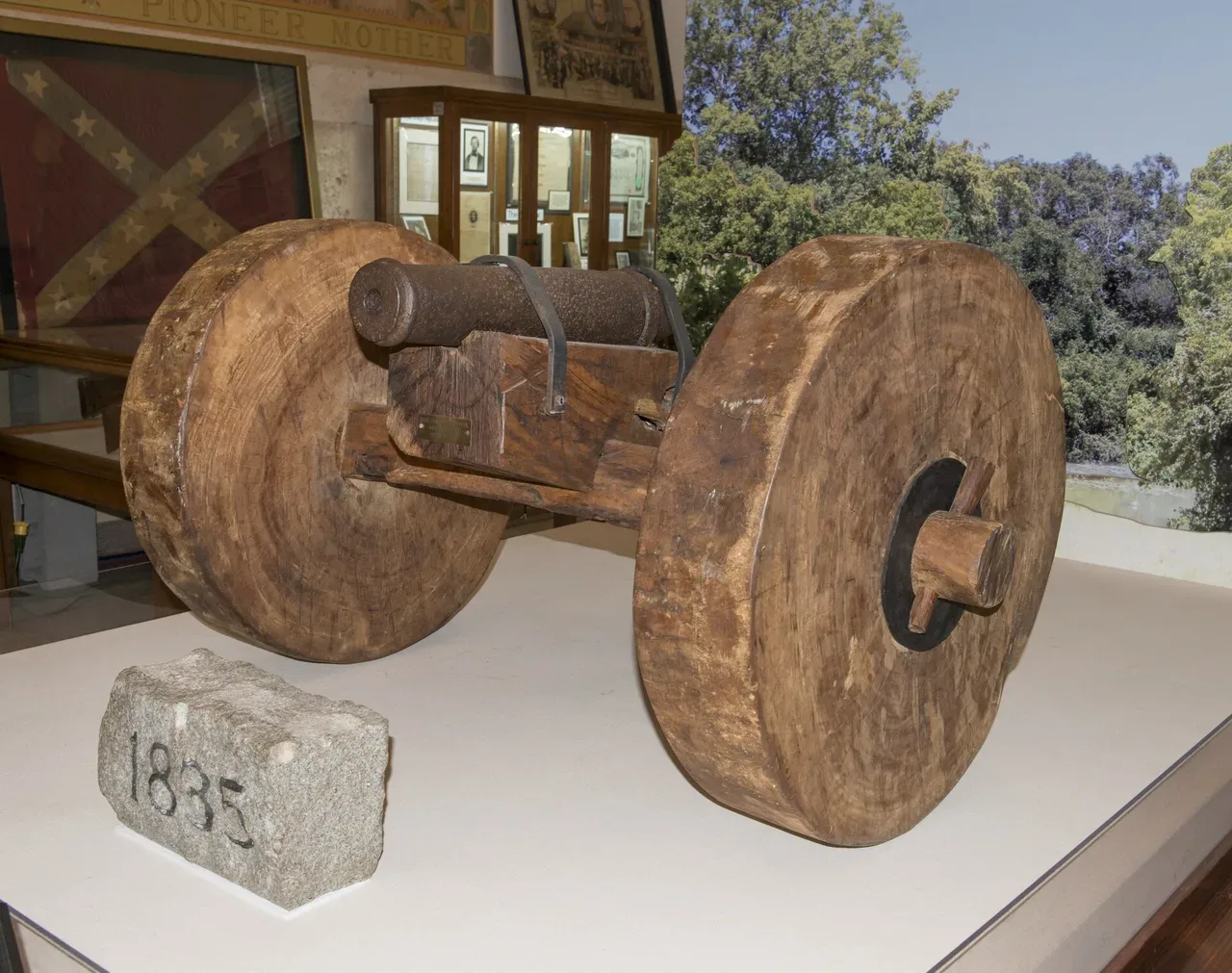
The small iron cannon on tree-trunk wheels displayed at the Gonzales Memorial Museum, photographed in 2014. The Library of Congress calls it the “Come and Take It” cannon; the Handbook of Texas’s 2025 revision identifies it as the smaller iron esmeril from the battle, uncovered by a flood in 1936. Carol M. Highsmith, Library of Congress (LCCN 2014632782), public domain.
February–March 1836: the thirty-two and the burning
On February 24, 1836, the second day of the siege of the Alamo, Albert Martin rode out carrying William Barret Travis’s letter “To the People of Texas” and added his own postscript: “Hurry on all the men you can in haste.” He handed it on to Lancelot Smither at Gonzales. On March 1 Martin rode back into the Alamo with the Gonzales Ranging Company of Mounted Volunteers, the men remembered as the Immortal Thirty-two. All of them died when the Alamo fell on March 6. [7] [1] [2]
Almeron Dickinson was among the dead. Santa Anna released Susanna and her baby daughter with a letter of warning to Sam Houston. On the road they met Joe, Travis’s enslaved servant, whom Santa Anna had freed, and scouts brought them to Houston at Gonzales. Her Handbook biography says they arrived after dark about March 12. The town entry says March 13. [8] [1]
Houston, who had reached Gonzales on March 11, ordered a retreat to the Colorado, ordered the people to come with him, and had Gonzales burned. Couriers carried the news outward, and families all over Texas left everything and ran. That flight, the Runaway Scrape, emptied settlements as far east as Nacogdoches and San Augustine. The Handbook describes rain, cold, hunger, disease and people “buried where they fell.” After San Jacinto many Gonzales citizens stayed in exile for a time. [9] [1]
1837–1860: county seat, churches, a college and slavery
The Republic of Texas incorporated Gonzales and created Gonzales County in 1837. The city council did not meet until March 1839, the same year a post office opened, and rebuilding concentrated on the original townsite by the early 1840s. In 1840 Gonzales volunteers rode to the battle of Plum Creek after the Comanche raid on Linnville. In 1842, during the Mexican invasions, many townspeople fled again. [1] [2]
The churches came early. The state marker at First Methodist says circuit-riding preachers held services in the area as early as 1824 and that the Rev. J. P. Sneed organized a church at Gonzales in 1841. The Handbook says the town’s first Baptist church was built in 1841. The Episcopal Church of the Messiah was established in 1855, and its Gothic Revival sanctuary, with walnut woodwork from Guadalupe River trees, was finished in 1881. [16] [1] [17]
Gonzales College is where the sources disagree on dates. The town entry says it opened in 1851. The college’s own entry says construction began in September 1851, the charter came in February 1852, and the first session opened on April 4, 1853, with fifty students. The town entry calls it the first college in Texas to award diplomas to women. The county entry says it was founded by slave-owning planters and was the first in Texas to confer A.B. degrees on women before the Civil War. The Gonzales Inquirer was founded in 1853. [1] [10] [2]
Those years were also built on slavery, and the Handbook gives the numbers. In 1850 the county had 1,492 people, 601 of them enslaved. In 1860 its 8,059 residents included 384 slaveholders and 3,168 enslaved people. Only one free Black person was reported in the county before the war. [2]
1861–1875: secession, a fort built with forced labor, and Reconstruction
On February 23, 1861, county voters chose secession, 802 to 80, and some twenty-two volunteer companies were organized. In 1862 the term at Gonzales College was cut short because most of the professors and many older students had enlisted. [2] [1]
In 1863 the Confederacy ordered an earthwork fort on Waldrip Hill on the north edge of town, meant as a supply depot and a defense on the Guadalupe. In December 1863 the chief engineer, Col. Albert Miller Lea, was instructed to use slave labor from the surrounding counties to build it. Work stopped by November 1864, unfinished. The site was named Fort Waul only in the late 1870s, for Confederate general Thomas N. Waul. Its outer walls are still visible. An engineer’s map of the works survives in the National Archives. [11] [2] [25]
Two Handbook entries tell the stone story in opposite directions. The college entry says a storm-damaged college building was torn down during the war and its stones used to fortify the town. The Fort Waul entry says the stones of the fort’s blockhouse were later used to rebuild the college dormitory. [10] [11]
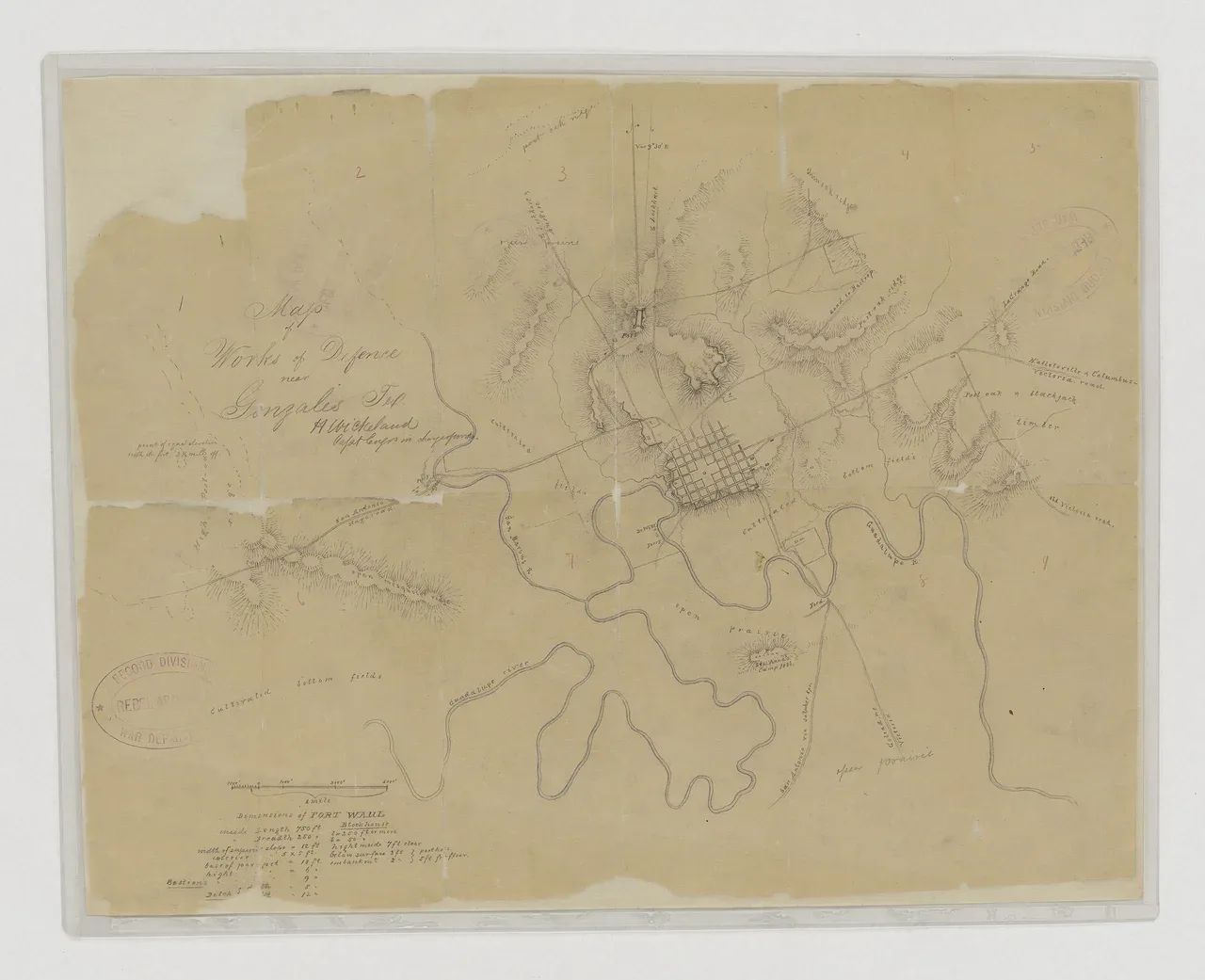
“Map of Works of Defence near Gonzales, Tex.,” signed H. Wickeland, the topographical engineer the Handbook names as one of the fort’s builders. Its table is headed “Dimensions of Fort Waul,” a name the Handbook says the site got only in the late 1870s. The National Archives dates the map only to 1861–1876. National Archives and Records Administration (NAID 70653126), public domain.
No Union troops fought in the county, but a small detachment camped on the public square during Reconstruction. In February 1868 the mayor complained that the soldiers were intimidating citizens. Months later, by the local newspaper’s account, two soldiers fired into the town, beat the postmaster and pulled a civilian into the street and murdered him. A military court found them not guilty. The Handbook also says the county “witnessed numerous lynchings” in the outlaw conflicts of the late 1860s and 1870s, and that several citizens were caught up in the Sutton-Taylor Feud. It gives no names or count, and this article does not supply them. [2]
1874–1896: the railroad that missed, a jail and a courthouse
The Galveston, Harrisburg and San Antonio Railway built through the county in 1874 and missed Gonzales. Local businessmen put up money and land for a branch, and the twelve miles of the Gonzales Branch Railroad to Harwood were finished in August 1882. The San Antonio and Aransas Pass arrived in 1885. The branch still runs as the Texas, Gonzales and Northern. The Handbook also records an 1880 incorporation, and its 1884 snapshot lists six churches, two banks, a 500-seat opera house and 2,900 people. [2] [12] [1]
The stone county jail beside the square was accepted by the commissioners court on January 28, 1887, according to its state marker, at a cost of $21,660.20. The Chamber of Commerce, which keeps it as the Old Jail Museum, says it was built in 1885. The Chamber also says Gonzales had six legal hangings, the first in 1855. In 1878 an estimated 4,000 people came to watch the hanging of Brown Bowen. Gallows went into the jail in 1891, and the last hanging in the county was Albert Howard’s on March 18, 1921. [14] [15]
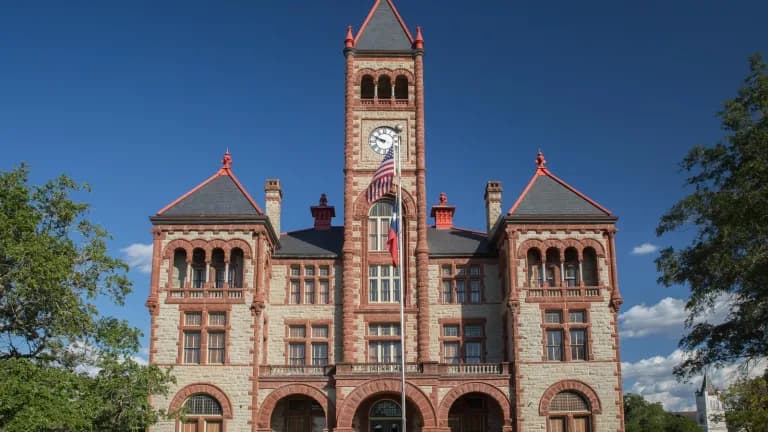
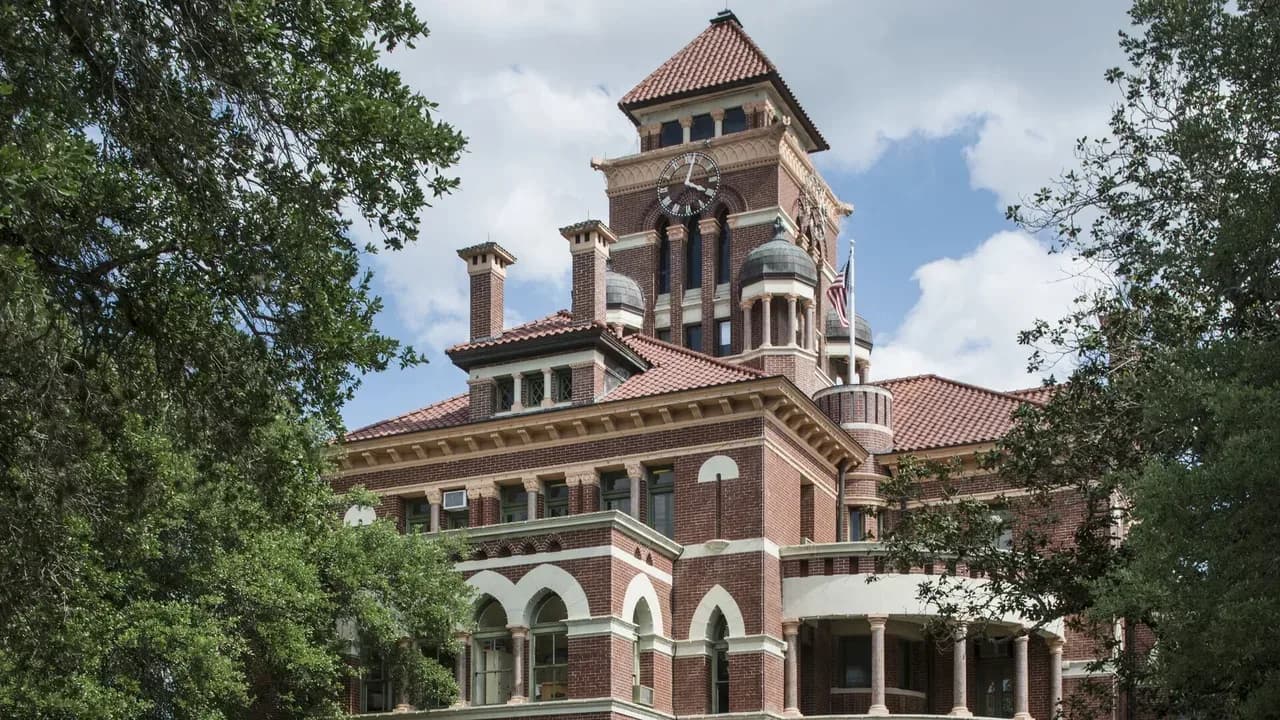
The first courthouse burned on December 3, 1893. Its replacement, built from 1894 to 1896 for $64,450, was designed by J. Riely Gordon in red brick and white limestone around a central clock tower. The Society of Architectural Historians’ guide says its corner entrance porches were a Gordon innovation introduced here, and that contractor Otto Kroeger provided the plans, so Gordon may not have been directly involved. [13] [23] [22]
Black families built their own institutions. The Handbook says Gonzales had a considerable number of African American landowners in the late nineteenth century, notably the Price family; descendant Walter Price became an acclaimed blues player. A 2021 marker on the square says the first Black neighborhood school met in Mrs. Myrtle Moses Mathis’s home in 1870, and that in 1896 the Knights of Peter Claver Hall School on Church Street reported 130 students. [1] [18]
1900–1965: segregation, a centennial museum and the polio hospital
The town counted 4,297 people in 1900 and 3,139 in 1910. In 1919 George Edwards was named principal of the district’s School for Colored, and the renamed Edwards High School graduated its first class in 1922. Segregation held until 1965, when Edwards closed and teachers Jesse A. Smith, Frank R. Fryer Sr. and Clara B. Mathis Fryer moved to Gonzales High School. A companion marker honors Smith, who kept a perfect attendance record over thirty-one years in the district. [1] [18] [19]
For the Texas Centennial, a monument to the Immortal Thirty-two was dedicated at the Alamo in 1936, and Gonzales got a memorial museum and amphitheater paid for with Centennial money. The Handbook says the museum was established in 1936; the Library of Congress record for its photograph says it was commissioned in 1935 and completed two years later. A 1936 flood uncovered the small iron cannon at Sandies Creek, and it is now on display there. On March 14, 1937, Gov. James Allred dedicated a monument to the first shot of the revolution near Cost. [2] [1] [24] [5]
In 1937 the Gonzales Warm Springs Foundation was chartered to treat polio; the Handbook calls it the state’s first specialty hospital for physical medicine and rehabilitation. Poultry became the other mainstay. By 1945 Gonzales ranked with the state’s top broiler producers, the Texas A&M Poultry Experiment Station opened in 1947, and in 1949 the town staged its first Fryer Frolic. [2] [1]
1950–2025: two population stories
The Handbook’s figures run 4,722 in 1940, 5,630 in 1950, 7,000 in 1976, 6,527 in 1990 and 7,237 in 2010. The 2020 Census counted 7,165, and the Census Bureau’s July 1, 2025, estimate is 7,239. The county entry in the same Handbook gives the town 7,410 without saying what year that figure is from. [1] [20] [2]
The older numbers do not line up. The Handbook puts the town at 300 in 1850 and 2,900 in 1884. The Texas Almanac’s census chart lists 1,072 for 1850, 1,581 for 1880 and 1,641 for 1890. Neither source explains the gap, and we print both rather than pick one. [1] [21]
The complete story of Gonzales
It is the story of a colony capital abandoned in its first year and resettled in its third, of a cannon lent against raids and refused back, and of a brief skirmish still counted as the start of a revolution. It is the story of thirty-two men who rode into the Alamo and a town burned by its own army. It is also the story of thousands of enslaved people whose labor built the county’s wealth and a Confederate fort, of lynchings the record names only in a phrase, and of Black families who started schools in a home and a lodge hall. The guns, the flag and the dress are still argued over. The town was burned, and it was built again.
Questions people ask
Why is Gonzales called the “Lexington of Texas”? Because the battle of Gonzales on October 2, 1835, is counted as the first battle of the Texas Revolution, the way Lexington opened the American Revolution. The town marks it each year with Come-and-Take-It Days. [1] [4]
Is the cannon in the Gonzales museum the real “Come and Take It” cannon? The Handbook’s 2025 revision says the bronze six-pounder at the center of the 1835 standoff was captured at the Alamo in 1836 and later buried there. It identifies the gun in the Gonzales Memorial Museum as a smaller iron esmeril that was also at the battle and was uncovered by a 1936 flood. [5]
Was the “Come and Take It” flag made from a wedding dress? One Handbook entry says Sarah DeWitt and her daughter Naomi made it from Naomi’s wedding dress. The revised cannon entry calls that apocryphal and says officers designed it with materials donated by the women of Gonzales. [3] [5]
Sources
Stephen L. Hardin, “Gonzales, TX,” Handbook of Texas Online, Texas State Historical Association, revised October 4, 2023. tshaonline.org/handbook/entries/gonzales-tx. The entry’s bibliography cites the Vertical Files, Dolph Briscoe Center for American History, University of Texas at Austin.
Dorcas Huff Baumgartner and Genevieve B. Vollentine, “Gonzales County,” Handbook of Texas Online, revised September 11, 2020. tshaonline.org/handbook/entries/gonzales-county. Its bibliography includes Gonzales County Historical Commission, History of Gonzales County (1986), and Edward Albert Lukes, De Witt Colony of Texas (1976).
Edward A. Lukes, “DeWitt, Green,” Handbook of Texas Online, revised July 5, 2016. tshaonline.org/handbook/entries/dewitt-green.
Stephen L. Hardin, “Gonzales, Battle of,” Handbook of Texas Online, revised August 2, 2020. tshaonline.org/handbook/entries/gonzales-battle-of. Its bibliography includes Miles S. Bennet, “The Battle of Gonzales: The ‘Lexington’ of the Texas Revolution,” Quarterly of the Texas State Historical Association 2 (April 1899).
Thomas Ricks Lindley, revised by James Woodrick, “Gonzales Come and Take It Cannon,” Handbook of Texas Online, revised August 5, 2025. tshaonline.org/handbook/entries/gonzales-come-and-take-it-cannon. Its bibliography includes Jane Bradfield, Rx, Take One Cannon (1981), and Noah Smithwick, The Evolution of a State (1900).
Stephen L. Hardin, “Old Eighteen,” Handbook of Texas Online, revised July 18, 2014. tshaonline.org/handbook/entries/old-eighteen.
Bill Groneman, revised by Francis J. Leazes Jr., “Martin, Albert,” Handbook of Texas Online, revised June 1, 2026. tshaonline.org/handbook/entries/martin-albert.
Margaret S. Henson, “Dickinson, Susanna Wilkerson,” Handbook of Texas Online, revised April 30, 2022. tshaonline.org/handbook/entries/dickinson-susanna-wilkerson. Its bibliography cites C. Richard King, Susanna Dickinson: Messenger of the Alamo (1976).
Carolyn Callaway Covington, “Runaway Scrape,” Handbook of Texas Online, revised July 25, 2016. tshaonline.org/handbook/entries/runaway-scrape.
“Gonzales College,” Handbook of Texas Online, revised January 22, 2020. tshaonline.org/handbook/entries/gonzales-college. Its bibliography includes G. R. Lacy, A History of Gonzales College (M.A. thesis, University of Texas, 1936).
James B. McCrain, “Fort Waul,” Handbook of Texas Online, published January 1, 1995. tshaonline.org/handbook/entries/fort-waul.
Nancy Beck Young, “Gonzales Branch Railroad,” Handbook of Texas Online, revised December 4, 2019. tshaonline.org/handbook/entries/gonzales-branch-railroad.
Texas Historical Commission, Atlas, “Gonzales Courthouse,” marker 2219 (Recorded Texas Historic Landmark, 1966). atlas.thc.texas.gov/Details/5177002219.
State Historical Survey Committee, “Gonzales County Jail,” marker 2218 (1966), transcribed at the Historical Marker Database. hmdb.org/m.asp?m=123638.
Gonzales Chamber of Commerce and Agriculture, “Museums” (Old Jail Museum and Gonzales Memorial Museum). gonzalestexas.com/museums.
Texas Historical Commission, “First Methodist Church of Gonzales,” marker 1756 (1991), transcribed at the Historical Marker Database. hmdb.org/m.asp?m=123645.
Texas Historical Commission, Atlas, “Episcopal Church of the Messiah,” marker 1491 (Recorded Texas Historic Landmark, 1981). atlas.thc.texas.gov/Details/5177001491.
Gonzales County Historical Commission and City of Gonzales, “Segregation in Gonzales: Edwards High School” (2021), transcribed at the Historical Marker Database. hmdb.org/m.asp?m=187606.
Gonzales County Historical Commission and City of Gonzales, “From Segregation to Integration” (2021), transcribed at the Historical Marker Database. hmdb.org/m.asp?m=187594.
U.S. Census Bureau, QuickFacts, Gonzales city, Texas (2020 Census, 7,165; 2010 Census, 7,237; July 1, 2025, estimate, 7,239). census.gov/quickfacts/fact/table/gonzalescitytexas.
Texas Almanac, “Charts for Gonzales,” population by census year. texasalmanac.com/charts/place/gonzales.
Society of Architectural Historians, SAH Archipedia, “Gonzales County Courthouse.” sah-archipedia.org/buildings/TX-01-SF5.
“Commissioners approve $10 million grant request to restore Courthouse,” The Gonzales Inquirer. gonzalesinquirer.com.
Carol M. Highsmith, “The Gonzales, Texas, Memorial Museum and Amphitheater, commissioned in 1935 and completed two years later with funds provided by the Texas Centennial Commission,” 2014, Library of Congress Prints and Photographs Division. loc.gov/item/2014633599.
H. Wickeland, “Map of the Works of Defense Near Gonzales, Texas,” National Archives and Records Administration, NAID 70653126. catalog.archives.gov/id/70653126.