The History of Crockett, Texas
Crockett, Texas (ZIP 75835) was laid out in 1837 on land Andrew Gossett gave beside the Old San Antonio Road and named for David Crockett, who died at the Alamo the year before. The sources still disagree on where Crockett camped in 1836, and the town burned again and again before its fifth courthouse rose in 1939.
Editor’s note. This is the thirty-third installment of “Texas Towns: The Stories Behind the Map.” The last one went to Granbury, where David Crockett’s widow, Elizabeth, settled in the 1850s. This one goes back east, into the Piney Woods, to the town that took his name a year after he died at the Alamo. Crockett grew up beside the same old Spanish road that runs through San Augustine, our twenty-second installment, and the two towns share a Presbyterian minister in their stories.
Crockett is the county seat and largest town of Houston County, the first county created by the Republic of Texas. It sits in the middle of the county where U.S. Highway 287 meets State highways 7, 19 and 21. The site was chosen in 1837 because it lay close to the Old San Antonio Road, the Spanish Camino Real that crossed this country for more than a century before anyone built a town here. The Houston and Great Northern Railroad reached Crockett in 1872; the Handbook lists the county’s railroad today as the Union Pacific. The mailing ZIP is 75835. [1] [2]
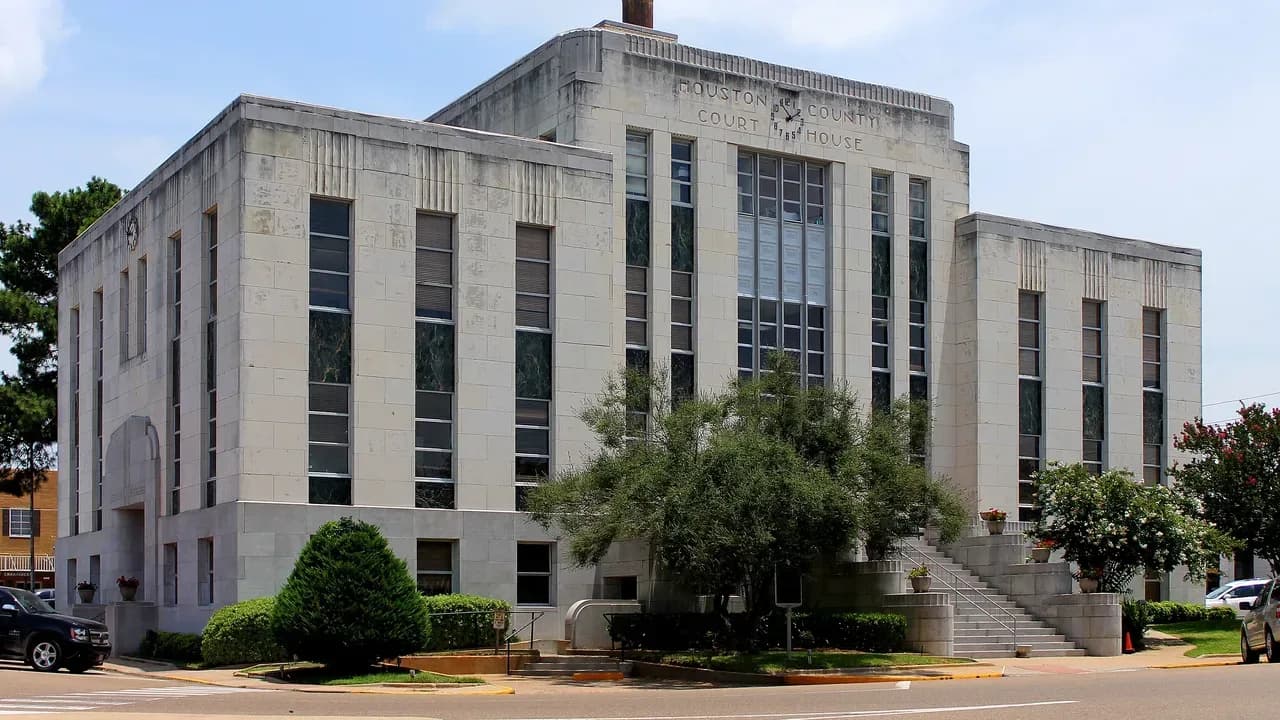
A visitor today sees a pale limestone courthouse built in 1939, in the stripped-down Moderne style of the New Deal, standing on a square that has held a courthouse since the 1830s. It is the fifth one. Two of the four before it burned, and one of those fires killed two men locked in the jail. Crockett’s history is full of fire, and also of people who rebuilt, taught and preached in the middle of it. [8] [9]
Before the town: the Camino Real and Hurricane Bayou
People lived in this part of East Texas for thousands of years before Europeans came. The Handbook of Texas says archeologists have found Archaic Period artifacts and traces of the Caddo culture that flourished between about A.D. 1000 and 1600, and that the area was later home to the Alabama-Coushatta, Cherokee and Tejas peoples. In 1690 Alonso De León’s second expedition founded San Francisco de los Tejas, the first Spanish mission in East Texas, near present Weches in the northeastern part of the county. It was abandoned in 1693; the county history describes “Indian hostility,” while the courthouse’s National Register nomination puts it as Native people defending their homelands. The Old San Antonio Road crossed the county, and travel and trade moved along it for about a hundred years before permanent settlement. [2] [8]
The first permanent Anglo settlers arrived around 1821, near present Augusta. Mexican land grants followed in 1828 under Joseph Vehlein’s colony. Among the families who came in that wave was Elijah Gossett, a Tennessean, who moved to Texas in 1833 with his family and settled on Hurricane Bayou, five miles north of the present site of Crockett. Gossett and his sons served in the Texas Revolution, and each received a 320-acre bounty grant for it. [2] [3] [4]
Many early settlers were planters from the Old South who brought enslaved people with them. The county tax rolls counted 308 enslaved people in 1840 and 545 in 1850. By 1860 the county had 8,058 residents, 2,819 of them enslaved. Before the Civil War, the Handbook says, enslaved people made up nearly half of all taxable property in the county. [2]
January 1836: where Crockett camped
The town’s name rests on a story about one night. The Handbook’s biographies of Elijah and Andrew Gossett say that David Crockett, a boyhood friend and neighbor of Elijah Gossett’s in Tennessee, camped on the Gossetts’ land near Hurricane Bayou in January 1836 on his way to San Antonio. He died at the Alamo that March. [3] [4]
The sources do not agree on where that camp was. The Gossett entries put it on Hurricane Bayou, about five miles north of town. The Handbook’s Crockett entry says only that Crockett “is said to have camped near the townsite.” The courthouse’s National Register nomination calls it “family tradition” that he camped on Gossett land “and renewed old acquaintance.” The City of Crockett, for its part, says he camped at a spring that still flows in Brewer Park, near downtown on East Goliad Avenue. A bronze city plaque there calls it “The David Crockett Spring,” marking “the camp site of the famous Texan on his historic journey to the Alamo.” We print all of these versions. None of the sources we found offers documentary proof for the downtown spring. [1] [3] [8] [14] [15]
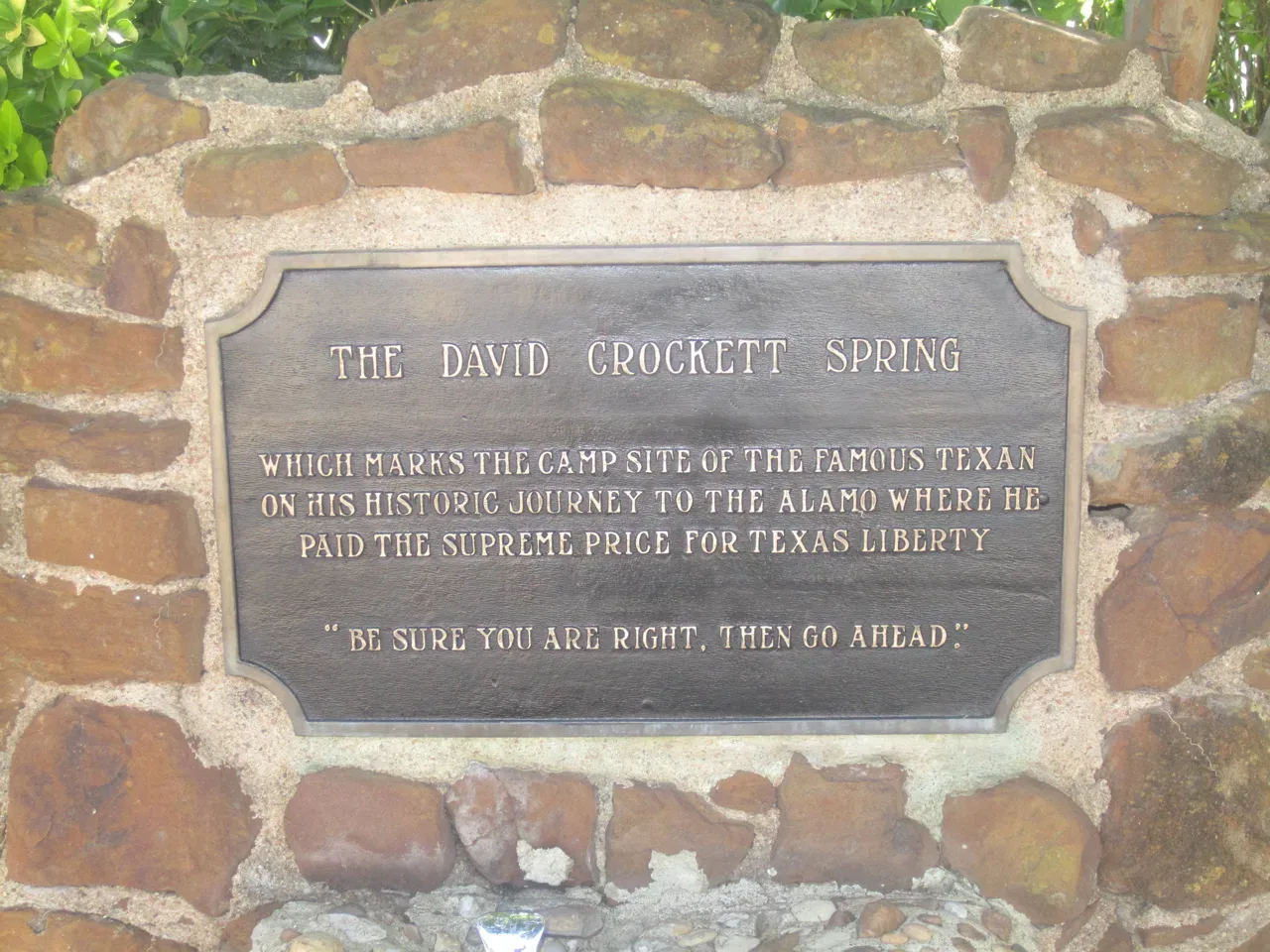
The City of Crockett’s plaque at the David Crockett Spring in Brewer Park, photographed in 2012. The plaque states the local tradition; the Handbook’s Gossett biographies place Crockett’s 1836 camp on Hurricane Bayou, about five miles north of town. Billy Hathorn, CC BY-SA 3.0, via Wikimedia Commons.
1837: a county, a town and a log courthouse
Houston County was cut out of Nacogdoches County in 1837 and named for Sam Houston. The Handbook says Houston signed the order establishing it on June 12, 1837; the courthouse’s National Register nomination says the Congress of Texas created it on June 4, 1837. We print both dates. The original county was huge. It took in what later became Trinity and Anderson counties and part of Henderson County. [2] [8]
Andrew Edwards Gossett, Elijah’s son, born in Tennessee in 1812, donated land for the county seat on the Old San Antonio Road. The sources tell the naming slightly differently. The Crockett entry says Andrew and his father named the town for Crockett, “a former neighbor in Tennessee.” The county entry says Andrew named it for “his father’s friend.” The Gossett biographies say father and son were given the right to name both the county and the seat, and chose Houston, their commander, and Crockett. County officials chose the site because it was close to the old road. Andrew Gossett built a house east of town in 1837 that is said to have been the first weatherboarded house in the Republic. He later served as sheriff, chief justice and county judge, and he is buried in Glenwood Cemetery in Crockett. [1] [2] [3] [8]
The Congress of the Republic incorporated Crockett on December 29, 1837, in the same act that gave city status to Houston, Washington and Refugio. On paper it was a town. On the ground, according to a reminiscence printed in the Crockett Printer in 1853, it was home in 1837 to a “solitary citizen who kept store in a sixteen-foot log cabin.” A post office opened on March 31, 1838. Mail came twice a month, and a stagecoach ran at intervals from Nacogdoches. A log building put up around 1838 served as the first courthouse. [1] [8]
Those years were violent. In October 1838, while many local men were away fighting in the Córdova Rebellion, an Indian band attacked the home of John Edens on San Pedro Creek, where women and children had taken refuge. More than half a dozen people were killed in what became known as the Edens-Madden massacre. In 1839, the Handbook says, raids by Alabama-Coushatta and Cherokee Indians forced Crockett’s residents to shelter in the fortified log courthouse, and sporadic attacks continued until the early 1850s. These accounts come from settler-side sources. They do not tell us how the Native people who were being pushed out of the region saw the same years. [1] [2]
1850s–1865: a brick courthouse, a newspaper and the war
In 1850, after 69 citizens petitioned for a special tax, the legislature allowed the county to build a better courthouse. A brick one replaced the log building the next year. By 1853 the town had a Masonic hall, six stores, two taverns, a boot and shoemaker, lawyers, doctors and several craft shops, the National Register nomination says, along with a telegraph office. The Crockett Printer, started that year by Oscar Dalton, told readers that “all the usual means and appliances of civilized life may be found in our village.” The Crockett Argus followed in 1857, and Crockett Academy opened half a mile east of the courthouse around 1855. [1] [8]
How big was Crockett before the war? The Texas Almanac’s population table, linked from the Handbook entry, gives 600 for 1850 and 1,500 for 1860. The National Register nomination, citing an 1872 source, says Crockett had 538 inhabitants in 1860. We cannot reconcile the two figures, so we print both. [1] [8]
Houston County voted 552 to 38 for secession. With a White population of little more than 5,000, it sent nearly 1,000 men into Confederate service, and Crockett served as a mustering point and training center for Confederate troops. Then came the fires. A blaze in 1864 destroyed 22 businesses and the town’s only hotel. In February 1865, with the war nearly over, the 1851 brick courthouse burned and took most of the county’s records with it. Armistead Aldrich, the county’s 1943 historian, wrote that the cause “was never solved, but a prominent citizen of Crockett was suspected of having caused the fire in order to destroy some records.” The Handbook’s shorter version says simply that in 1865 “the courthouse and most of the town burned.” [1] [2] [8]
1865–1882: freedom, Reconstruction and more fire
Emancipation ended slavery in a county where enslaved people had been close to half of all taxable wealth. The Handbook records White planters’ losses in dollars: the value of farms fell from $1,154,435 in 1860 to $57,180 in 1870. For freed people, it says, the change brought “only marginal improvement.” Most ended up farming on shares for a third or half of the crop. Black voters did make themselves felt, though. As late as 1873, largely because of them, Republican Edmund J. Davis narrowly carried the county in the governor’s race. The white primary and other discriminatory practices later shut most Black residents out of voting until the 1960s. [2]
The fires did not stop. A citizens’ petition to the legislature said an April 1871 fire consumed much of downtown, including the new county jail, and that “on the first day of October the entire portion of the town remaining was destroyed.” A two-story frame courthouse went up around 1871 and housed the courts, county offices and jail. On November 2, 1882, it burned too. The fire probably started in the jailer’s room, and two prisoners died. [8]
The year after the 1871 fires brought the turnaround. In 1872 the Houston and Great Northern Railroad built through Crockett on its way from Houston toward the Red River. The Handbook says the line secured Crockett’s place as a regional trading center and opened the pine forests of the county to lumbering. The county’s population roughly doubled between 1870 and 1880, to 16,702. [1] [2] [8]
1871–1886: a preacher, a Sabbath school and Mary Allen Seminary
Samuel Fisher Tenney came to the Crockett Presbyterian Church in 1871 and stayed until he died in 1926, fifty-five years in one pulpit. A Georgian, he had served in the Confederate army in Virginia. His Handbook biography says that for the first twenty years of his ministry he “labored against the prevailing opinion of the times” for “the evangelization and enlightenment of the freed people,” and that from the war to the end of his life he opposed the Ku Klux Klan. In 1871, his first year, his congregation started a Sabbath school for Black children. By 1875 it had a separate church with an educational wing, which grew into a parochial day school, the Moffatt academy. Tenney helped organize seven churches in Houston County, three Black and four White, and he also helped revive the Presbyterian church in San Augustine. [5] [6]
When Tenney saw that the northern Presbyterian Church wanted to open a school in Texas, he asked Richard H. Allen, secretary of its Board of Missions for Freedmen, to come to Crockett. Allen’s wife, Mary Esther Allen, championed “our Texas boarding school for colored girls.” After she died suddenly, the board named the school for her. Mary Allen Seminary opened on January 15, 1886, under the Rev. J. B. Smith, as a day and boarding school for Black girls, teaching everything from primary grades to teacher training. [5] [7]
The two Handbook accounts of the land differ. The Mary Allen entry says the community granted ten acres on a hilltop north of town, citizens added twelve more, and in 1889 the school acquired 300 acres next to the campus. The Handbook’s survey of Black colleges says an adjoining 260 acres were later donated by James Snydor of Illinois, and that the school first met in a vacant hotel rented by supporters. Mary Allen Hall, a four-story brick building, was finished on October 1, 1887, at a cost of $20,000 with furnishings. In 1890 the school had eight teachers besides the Smiths and 211 students. [5] [7]
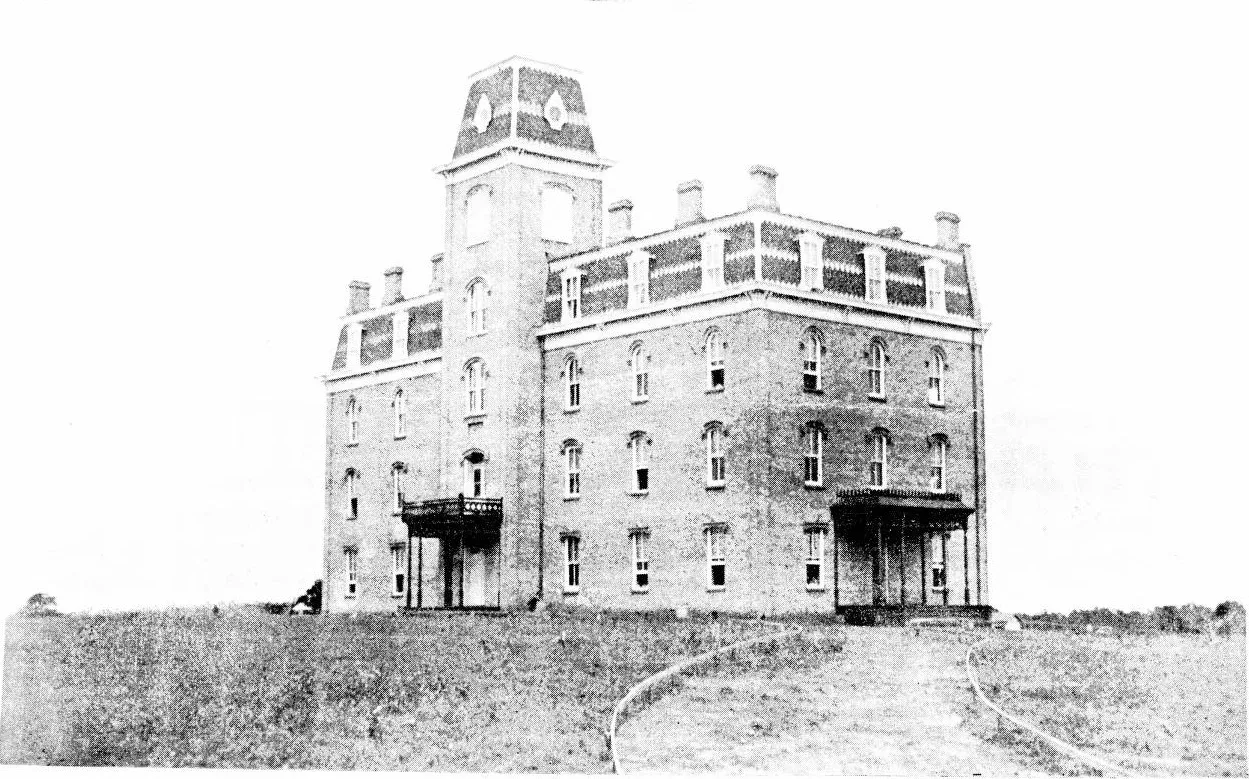
The main building of Mary Allen Seminary, Mary Allen Hall, as pictured in the school’s first annual catalogue for 1887–88. The Second Empire building was listed in the National Register of Historic Places in 1983. Photographer unknown; public domain, via Wikimedia Commons.
The years from 1910 to 1924 were, in the Handbook’s words, years of “discouragement, fire, and difficulty.” In 1924 the board sent the Rev. Burt Randall Smith, the school’s first Black administrator. He built an all-Black faculty, improved the library and laboratory, and got the high school accredited in 1925–26. The first junior-college class graduated in 1927. In 1933 the school admitted men and became Mary Allen Junior College. It closed in 1943 after a plan to turn it into a four-year state college for Black students stalled during World War II. It reopened in 1944 under the Missionary Baptist Convention of Texas and closed for good in September 1972; the Handbook’s Black colleges entry says declining enrollment and financial problems forced the closing. [5] [7]
1883–1940: the Dodson courthouse, lignite and the New Deal
After the 1882 fire the county issued $20,000 in bonds and hired the Waco architect W. C. Dodson, whose highly decorated brick courthouse went up in 1883 with a clock on each face. By 1885 Crockett had about 1,200 people, a bank, a hotel, an opera house, several schools, Baptist, Methodist and Presbyterian churches, and a weekly, the Texas Patron. [1] [8]
In 1904 a lignite mine opened just south of town. At its peak around 1910 it shipped twenty-five carloads a day. Wildcatting for oil began around the same time, but local oil was not produced commercially until 1934. The timber industry faded after World War I. Crockett still grew, to 3,063 people in 1925 and 4,441 in 1936, but the Depression hit the county’s farmers hard, and the Handbook notes that Black tenant farmers were particularly hard hit. In 1935 the federal government established Davy Crockett National Forest on cutover land in the eastern part of the county, which the Civilian Conservation Corps helped replant. [1] [2]
The town marked its centennial in 1936–37. Under Mayor John Gordon Beasley Sr., Crockett built a new city hall, the David Crockett Memorial Building and a 50-acre city park. A state marker in Davy Crockett Memorial Park records that it was dedicated on June 12, 1937. [8] [13]
The county voted on February 3, 1938, to seek Public Works Administration money for a new courthouse, hired the Houston architect Blum E. Hester, and moved out of the Dodson building by that October. The old courthouse was razed. Eckert-Fair Construction of Dallas built its replacement. The cornerstone was laid in July 1939, and the commissioners accepted the finished building on January 8, 1940, at a cost of more than $180,000. Hester kept one feature of the old building: a clock face on every side. The county’s funding application shows that segregation was part of the design. It listed separate toilets for white men, white women, “colored men” and “colored women,” and a top-floor jail with separate sections for white and “colored” men. The courthouse was listed in the National Register in 2010. [8] [9] [10]
1884 and 1932: two lynchings
Crockett’s record also includes mob murder. The Lynching in Texas project, which compiles newspaper reports, lists two lynchings in Crockett. On February 3, 1884, a Black man known as “Sandy” Robinson, accused of murder, was hanged by a mob; the project cites contemporary newspaper items from Brenham and Abbeville, Louisiana. Its record gives no further detail, and we add none. [16]
On April 1, 1932, Dave Tillis, a Black tenant farmer, was hanged from a tree near Crockett. He had been accused of entering a white woman’s bedroom; the Lynching in Texas project lists the allegation as rape. According to the case summary in Northeastern University’s Burnham-Nobles archive, his landlord said he was taking Tillis to the authorities when four men took him and hanged him. A Corsicana paper’s headline read “Negro Taken From Captor and Hanged to Black Jack Tree.” The archive records arrests, charges and a grand jury, but no trial or conviction. The two sources give different ages: 42 in the Lynching in Texas record and 52 in the Burnham-Nobles summary. Newspapers as far away as Baltimore reported it as the first Texas lynching of the year. [17] [18]
After 1945: the courthouse square and Mary Allen Hall
After World War II Crockett grew steadily. It passed 5,000 people in the early 1960s and reached about 7,000 in the 1980s. The Handbook counts 7,024 people and 180 rated businesses in 1990 and 7,141 people in 2000, with an economy built on agriculture and on making furniture, plastics, chemicals and clothing. The Fiddlers Festival in June and a July rodeo became regular events, and the National Register nomination notes that the square hosted street dances, election nights and parades that all circle the courthouse. The Houston County Historical Commission has kept its office in the courthouse since 1962. The 1909 Crockett depot now houses a visitor center and museum. [1] [2] [8]
Mary Allen Hall still stands on its hill about a mile north of the square, at 803 North Fourth Street. In 2014 Preservation Texas put it on its list of the state’s most endangered places. The group reported that after fire, neglect and natural disasters the brick walls were standing while the interior was “in a state of collapse,” and that the Mary Allen Museum of African-American Art and History, which owns it, was raising money to restore it. [11] [12]
Crockett’s population has held fairly steady. The Texas Almanac table counts 6,332 for 2020 and 6,406 for 2021. The Census Bureau’s estimates program starts from a 2020 base of 6,368 and puts the town at 6,346 on July 1, 2025. The figures come from different counting methods, so we print them side by side rather than choose one. [1] [19] [20]
The complete story of Crockett
It is the story of an old road that was here long before the town, and of the Caddo, Tejas, Alabama-Coushatta and Cherokee peoples who lived along it. It is the story of a Tennessee family that gave land for a county seat and named it for a friend who had died at the Alamo, and of a spring downtown that the town says marks his camp, even though the oldest family accounts put that camp five miles away. It is the story of a county where enslaved people were counted as nearly half the taxable wealth, and of the freed people who sharecropped, voted and were shut out again. [1] [2] [3] [8] [14]
It is the story of a town that burned again and again, in 1864, 1865, 1871 and 1882, and rebuilt every time. It is the story of a Confederate veteran turned preacher who spent his life teaching the children of freed people, and of a hilltop school that educated Black students, first girls only and later men as well, from 1886 to 1972. It is also the story of two Black men killed by mobs, one of them as late as 1932. And it is the story of a limestone courthouse with segregated restrooms built into its plans, which still keeps a clock on every side. [5] [6] [8] [16] [17]
That is the history of Crockett.
Questions people ask
Did Davy Crockett ever visit Crockett, Texas? The Handbook’s Gossett biographies say he camped on the Gossett family’s land near Hurricane Bayou, about five miles north of the present town, in January 1836 on his way to San Antonio. The City of Crockett marks a spring downtown as his campsite. The town itself was laid out in 1837, after his death at the Alamo. [3] [4] [14]
Is Houston County connected to the city of Houston? Only by name. Both honor Sam Houston. Houston County is an East Texas county east of Waco; the city of Houston is in Harris County. Houston County was the first county the Republic of Texas created, and Crockett has been its seat since the beginning. [2] [8]
What was Mary Allen Seminary? A Presbyterian boarding and day school for Black girls, opened in Crockett on January 15, 1886, and named for Mary Esther Allen. It became the coeducational Mary Allen Junior College in 1933 and closed in 1972. Its 1887 main building, Mary Allen Hall, is listed in the National Register. [5] [11]
How many courthouses has Crockett had? Five, all on the same square: a log building of about 1838, a brick one of 1851 that burned in 1865, a frame one of about 1871 that burned in 1882, W. C. Dodson’s 1883 brick courthouse, razed in 1938, and the 1939 Moderne courthouse still in use. [8]
Sources
Eliza H. Bishop and Christopher Long, “Crockett, TX,” Handbook of Texas Online, Texas State Historical Association, revised September 21, 2023. Its bibliography includes Armistead Albert Aldrich, The History of Houston County, Texas (San Antonio: Naylor, 1943), and Houston County Historical Commission, History of Houston County, Texas, 1687–1979 (Tulsa: Heritage, 1979). The entry’s linked Texas Almanac data also lists population counts by year. tshaonline.org/handbook/entries/crockett-tx.
Eliza H. Bishop, “Houston County,” Handbook of Texas Online, Texas State Historical Association, revised November 9, 2020. Its bibliography includes Thomas Nelms Mainer, Houston County in the Civil War (Crockett: Houston County Historical Commission, 1981), and Gifford E. White, The First Settlers of Houston County, Texas (Austin, 1983). tshaonline.org/handbook/entries/houston-county.
Christopher Long, “Gossett, Andrew Edwards,” Handbook of Texas Online, Texas State Historical Association, published January 1, 1995. tshaonline.org/handbook/entries/gossett-andrew-edwards.
Christopher Long, “Gossett, Elijah,” Handbook of Texas Online, Texas State Historical Association, published January 1, 1995. tshaonline.org/handbook/entries/gossett-elijah.
John R. “Pete” Hendrick, “Mary Allen Junior College,” Handbook of Texas Online, Texas State Historical Association, revised May 1, 1995. Its bibliography includes Inez Moore Parker, The Rise and Decline of the Program of Education for Black Presbyterians of the United Presbyterian Church, U.S.A., 1865–1970 (San Antonio: Trinity University Press, 1977). tshaonline.org/handbook/entries/mary-allen-junior-college.
John R. “Pete” Hendrick, “Tenney, Samuel Fisher,” Handbook of Texas Online, Texas State Historical Association, revised March 12, 2021. tshaonline.org/handbook/entries/tenney-samuel-fisher.
Michael R. Heintze, “Black Colleges,” Handbook of Texas Online, Texas State Historical Association, revised September 30, 2020. tshaonline.org/handbook/entries/black-colleges.
National Register of Historic Places registration form, “Houston County Courthouse,” 401 E. Houston Ave., Crockett, listed May 10, 2010 (reference no. 10000248), statement of significance, citing Aldrich (1943), the Houston County Historical Commission (1979), the Crockett Printer (1853) and Houston County Commissioners Court minutes; full text as transcribed at historic.one (the National Park Service has not yet posted a digitized PDF). historic.one.
Texas Historical Commission, Texas Historic Sites Atlas, “Houston County Courthouse,” National Register listing, atlas no. 2010000248 (listed May 10, 2010; Modern Movement, Moderne; architecture and politics/government). atlas.thc.texas.gov/Details/2010000248.
National Park Service, NPGallery, National Register Information System record 10000248, “Houston County Courthouse” (architect Blum E. Hester; significant year 1938). npgallery.nps.gov/AssetDetail/NRIS/10000248.
National Park Service, NPGallery, National Register Information System record 83004514, “Mary Allen Seminary for Colored Girls, Administration Building,” 803 N. 4th St., Crockett (Second Empire; education and architecture; significant year 1886; published May 12, 1983). npgallery.nps.gov/AssetDetail/NRIS/83004514.
Preservation Texas, “Mary Allen Seminary,” Texas’ Most Endangered Places (year listed 2014). preservationtexas.org.
Texas Historical Commission, Texas Historic Sites Atlas, “Davy Crockett Memorial Park,” marker no. 11090, Beasley Memorial Drive, Crockett, marker year 1971. atlas.thc.texas.gov/Details/5225011090.
City of Crockett, “History,” August 15, 2023. crocketttexas.org/community/page/history.
The Historical Marker Database, “The David Crockett Spring” (City of Crockett plaque, East Goliad Avenue at Rail Row), photographed by James Hulse, August 25, 2018. hmdb.org/m.asp?m=156960.
Lynching in Texas project, “Lynching of ‘Sandy’ Robinson: February 3, 1884,” citing the Brenham Weekly Banner, February 21, 1884, and the Abbeville Press and Banner, February 20, 1884. lynchingintexas.org/items/show/574.
Lynching in Texas project, “Lynching of Dave Tillis: April 1, 1932,” citing the NAACP’s Thirty Years of Lynching, the Baltimore Sun and Austin American (April 3, 1932) and the Corsicana Semi-Weekly Light (April 5, 1932). lynchingintexas.org/items/show/508.
Burnham-Nobles Digital Archive (Civil Rights and Restorative Justice Project, Northeastern University), “Killing of Dave Tillis in Texas in 1932.” crrjarchive.org/incidents/752.
U.S. Census Bureau, Population Estimates Program, “City and Town Population Totals: 2020–2025” (sub-est2025), row for Crockett city, Texas: April 1, 2020 estimates base 6,368; July 1 estimates 6,362 (2020), 6,397 (2021), 6,309 (2022), 6,352 (2023), 6,369 (2024), 6,346 (2025). www2.census.gov … sub-est2025.csv.
Texas Almanac, “Crockett,” Texas State Historical Association (population count 6,406 for 2021). texasalmanac.com/places/crockett.
Renelibrary, “HoustonCountyCourtHouse1.JPG” (Houston County Courthouse, Crockett), photographed July 3, 2014, CC BY-SA 3.0, Wikimedia Commons. commons.wikimedia.org.
“Mary Allen Seminary external view,” from the First Annual Catalogue of Mary Allen Seminary, Crockett, Texas, 1887–8 (Presbyterian Board of Missions for Freedmen, Pittsburgh), photographer unknown; public domain (PD-US-expired), via Wikimedia Commons. commons.wikimedia.org.
Billy Hathorn, “David Crockett Spring IMG 6242.JPG,” photographed June 1, 2012, CC BY-SA 3.0, Wikimedia Commons. commons.wikimedia.org.