Scientists May Find Hidden Planets by Listening to Ripples in Space-Time
NASA-led studies describe how a future space observatory could detect distant planets by the tiny fingerprints they leave in gravitational waves.
For most of astronomy’s history, finding a planet meant looking for light—or watching the light from a star change. NASA scientists are now describing another possibility: finding worlds through tiny changes in ripples moving through space-time.
Two studies led by NASA astrophysicists explain how the future Laser Interferometer Space Antenna, known as LISA, could detect planets orbiting tightly paired white-dwarf stars. The research was published in The Astrophysical Journal.
A planetary fingerprint in gravitational waves
White dwarfs are the dense, Earth-sized remnants left behind after stars like the Sun exhaust their fuel. When two white dwarfs orbit each other closely, they produce gravitational waves—subtle ripples in space-time first predicted by Albert Einstein.
If a large planet also circles that pair, its gravity causes the stars to wobble slightly. That motion changes the gravitational-wave signal in a recognizable way, creating secondary signals called sidebands.
NASA scientist Scott Noble compared those sidebands to radio communication: a main carrier frequency holds most of the energy, while nearby frequencies carry additional information. In this case, the extra information could reveal a planet that conventional telescopes might miss.
A detector larger than the Sun
LISA is being led by the European Space Agency with major NASA contributions. The observatory is planned as three spacecraft traveling around the Sun in a triangular formation, with each side of the triangle stretching approximately 1.6 million miles.
Laser beams passing between the spacecraft would measure changes smaller than the width of a helium atom. NASA says the mission is currently planned for the mid-2030s.
The studies suggest LISA could detect some Jupiter-mass planets in white-dwarf systems thousands of light-years away. A separate method using the James Webb Space Telescope’s infrared instruments could help confirm some of the closer candidates.
A prediction, not a new planet—yet
The research does not announce a newly discovered world. It describes what LISA may be capable of finding after the observatory is operating. No planet has yet been confirmed around a binary white-dwarf system, so successful detections could reveal an entirely new population of worlds.
NASA’s full explanation, including links to both scientific papers, is available at science.nasa.gov.
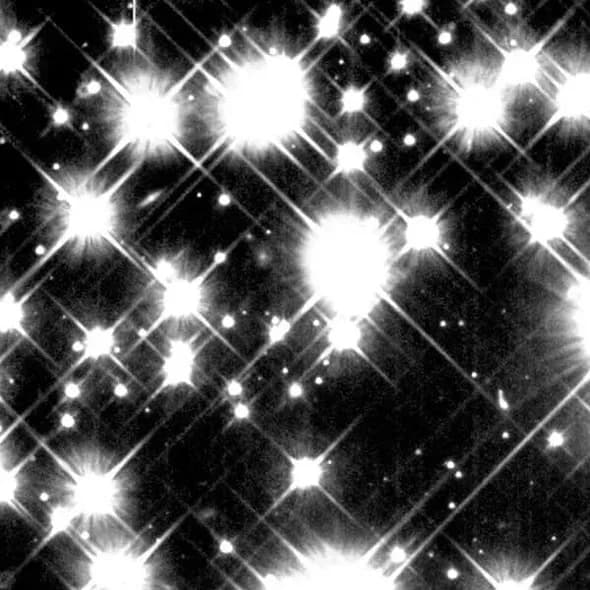
Photo: White-dwarf stars photographed by JPL’s Wide Field and Planetary Camera 2 aboard NASA’s Hubble Space Telescope. NASA/JPL, U.S. public domain. The photograph illustrates white-dwarf stars and does not show one of the proposed planetary systems. Wikimedia Commons source.