Shamrock: An Irish-Named Route 66 Town in the Texas Panhandle
Shamrock, a Wheeler County town on old Route 66, is known for its Irish name and for the 1936 Art Deco Tower Station and U-Drop Inn Café.
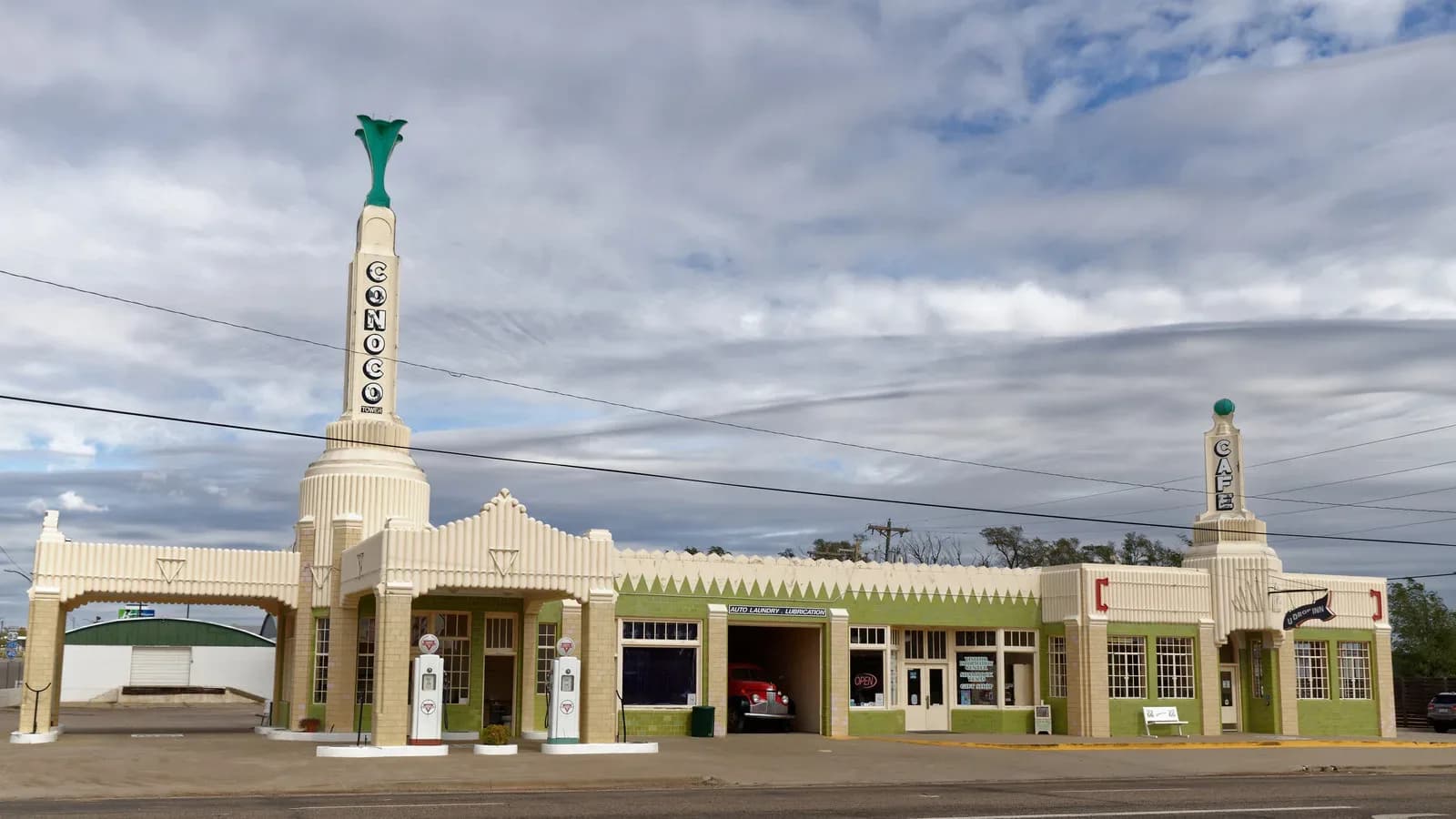
Shamrock, Texas, is a Wheeler County town on Interstate 40, the freeway that replaced U.S. 66 across the Panhandle. The building most people recognize stands on East 12th Street: the Tower Station and U-Drop Inn Café, a 1936 Art Deco filling station and diner with a tall Conoco tower, a matching café tower, curved walls, and neon. The Texas Historical Commission Atlas entry for the Tower Building, a 1994 Recorded Texas Historic Landmark at 105 E. 12th Street, credits Pampa architect J. C. Berry and local entrepreneur J. M. Tindall and describes the place as an excellent example of a 1930s gas station and diner. The National Park Service entered Tower Station in the National Register of Historic Places on Sept. 18, 1997, under National Register Information System ID 97001160, listing the address as 101 E. 12th Street and citing 1936 as the significant year, Art Deco as the style, and architecture and commerce as the areas of significance. Official records therefore list both 101 and 105 East 12th Street for the same landmark.
The Texas Historical Commission's Route 66 page traces about 178 miles of the old highway across Texas, passing through Shamrock, Lela, McLean, Alanreed, Groom, Conway, Amarillo, Bushland, Wildorado, Vega, Adrian, and Glenrio, among other communities, roughly along today's Interstate 40, and names the Tower Station and U-Drop Inn Café among the road's National Register properties in the state. In the Handbook of Texas, Hugh Allen Anderson writes that as U.S. 66 was improved, Shamrock's main street filled with garages, service stations, cafes, and tourist courts, and that much of that roadside business later closed or moved once Interstate 40 pulled through traffic onto the bypass.
The Irish name is older than the highway. Anderson writes that George Nickel, an Irish immigrant who ran sheep, put forward "Shamrock," a name he associated with luck and courage, when he asked in 1890 for a post office at his dugout, about six miles north of the later town. Postal officials accepted the name, but the office was never opened after the Nickel house burned that year. The settlement that lasted arrived with the Chicago, Rock Island and Gulf Railway in the summer of 1902. Lots at the present site, then known as Wheeler, went on sale in August. Frank Exum, already running a general store, applied for a post office under his own name, and the Shamrock office was briefly discontinued. In 1903 the railroad named the stop Shamrock, the post office reopened under that name, and a school opened the same year. From 1903 to 1907, Shamrock vied with Story and Benonine as a trading point; by 1906, businesses from those other settlements had relocated. By 1908 the town had two chartered banks and a cotton-oil mill in operation. It incorporated in 1911, with E. L. Woodley as the first mayor.
A water main from the nearby J. M. Porter ranch, laid in 1923, ended the practice of hauling water to town in barrels. Oil was found in the area in 1926. Anderson's narrative puts the population at 2,500 by 1925 and 3,778 by 1930, then 3,326 in 1950. For published census years, the counts below follow the population table on the same Handbook page, which disagrees slightly with that narrative for 1930 and 1950: 1,227 in 1920, 3,780 in 1930, 3,123 in 1940, 3,322 in 1950, 3,113 in 1960, 2,644 in 1970, 2,834 in 1980, 2,286 in 1990, 2,029 in 2000, 1,910 in 2010, 1,797 in 2019, 1,789 in 2020, and 1,773 in 2021, the table's last year, which is not a present-day 2026 count. Local gas wells and a lighting system, along with a compress, a carbon-black plant, and a gasoline-extraction plant, joined cattle, farming, and petroleum in the local economy. The official Wheeler County website still describes the county as a Panhandle community anchored by Wheeler and Shamrock, with roots in farming, ranching, and energy and with access to historic Route 66.
Since 1938, when town bandmaster Glen Truax began the custom, Shamrock has marked St. Patrick's Day on the weekend nearest March 17 with a parade, a banquet, and the crowning of Miss Irish Rose. In Elmore Park, a fragment of the Blarney Stone from Blarney Castle in County Cork, Ireland, stands on a pillar. City and county history is on view at the Pioneer West Museum, in the former Reynolds Hotel, a 1920s hotel of the kind that served traveling salesmen. A Census Bureau geocoder match for 105 E. 12th Street, and a second match for 101 E. 12th Street, both return Shamrock, TX 79079, inside Shamrock city in Wheeler County. Other Texas town portraits on Dock Line include the story of La Grange, named for Lafayette's château in Fayette County, and the profile of Giddings, which grew with the railroad in Lee County.