La Grange: A Fayette County Seat Named for Lafayette's Chateau
La Grange, named for Lafayette's chateau, has been Fayette County's seat since 1837 and still holds court in James Riely Gordon's 1891 courthouse.
La Grange is the county seat of Fayette County, on the Colorado River about 63 miles southeast of Austin, at the old crossing of the La Bahía Road, according to John Leffler's entry in the Handbook of Texas, published first in 1952 and revised most recently on Nov. 15, 2024. The county took its name from the Marquis de Lafayette, Leffler wrote, and the town took its name from Lafayette's chateau. The official City of La Grange website lists city offices at 155 E. Colorado St., La Grange, TX 78945, phone 979.968.5805. Fayette County's official courthouse and contact pages list the courthouse at 151 N Washington St., La Grange, TX 78945.
Leffler wrote that Aylett C. Buckner settled nearby about 1819, and that in 1826 John Henry Moore built a twin blockhouse, called Moore's Fort, inside what are now the city limits. Settlers used it as shelter, and a small community had formed around the fort by 1831. The town was platted in 1837. That same year, the Republic's Congress established Fayette County and made La Grange the seat of government. A post office opened in 1838. Leffler wrote that in 1838 the Republic's Congress passed a bill meant to place the national capital on a site adjoining La Grange; President Sam Houston vetoed it.
The town grew as a market for the surrounding plantation country. The La Grange Intelligencer began publishing in 1844, Methodist and Presbyterian congregations organized in the 1840s, and the city was incorporated in 1850. During those decades, increasing numbers of German and Czech immigrants came into Fayette County. In 1860, Heinrich Kreische, a German immigrant from Saxony, established in La Grange one of the state's first commercial breweries. La Grange was not a battlefield in the Civil War, but Reconstruction brought disorder, and in 1866 federal troops occupied the town and a Freedmen's Bureau agency was set up there. From August to December 1867, a yellow fever epidemic killed 240 people, about 20 percent of the population at the time, Leffler wrote; some of the dead were buried in mass graves.
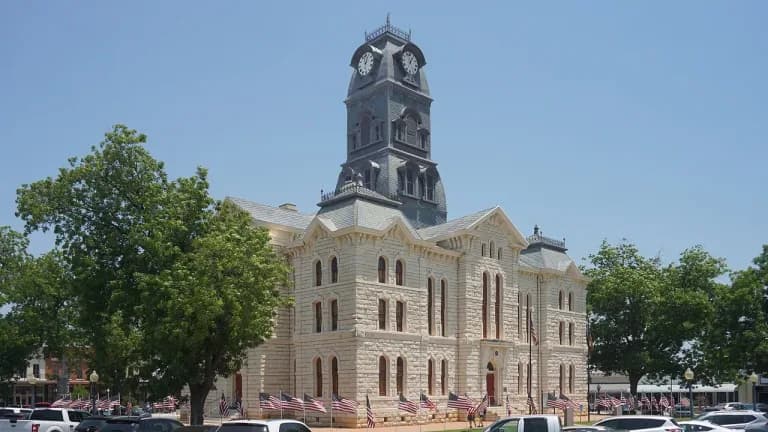
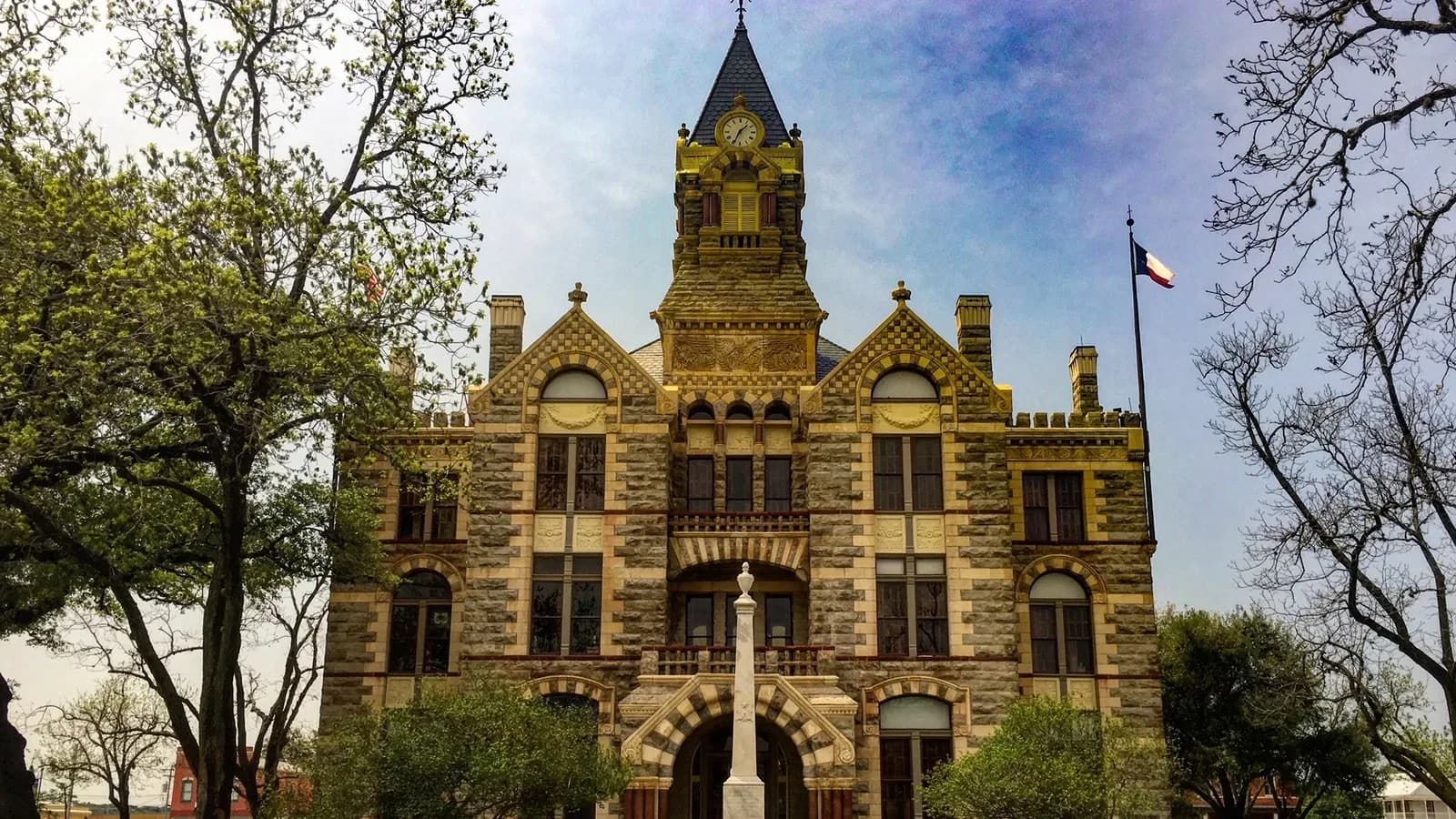
Trade revived after rail service arrived in 1880 on the Galveston, Harrisburg and San Antonio line and the city's first bridge crossed the Colorado River in 1883. The Handbook says the railroad helped put the Kreische brewery out of business, and that a three-story stone courthouse was completed in 1891. That building still stands on the square. A Recorded Texas Historic Landmark marker dedicated in 2001, on the west lawn at 151 N. Washington, says that about 1890 the safety of the county's third courthouse came into question. Commissioners hired San Antonio architect James Riely Gordon, then 27, and paid for the work with $90,000 in bonds. Martin, Byrnes and Johnston of Colorado City were the contractors. Gordon designed the building in the Romanesque Revival style and specified four native Texas stones for the exterior: blue Muldoon sandstone, Belton white limestone, Pecos red sandstone, and pink Burnet granite. A central open atrium was meant to bring in light and air. The marker calls the 1891 building the oldest existing J. Riely Gordon courthouse in Texas.
The official county courthouse page says the commissioners formally accepted the building on Dec. 1, 1891, at a total cost of $99,407.04, after the construction contract had been awarded on a bid of $82,750. It also records that the 1913 flood put five feet of water in the basement and first floor, and that the central courtyard was closed in 1949 to make room for a vault and more offices. The Texas Historical Commission's courthouse preservation page says a restoration begun in June 2003 and finished in March 2005 reopened that atrium and returned the building to its historic appearance.
Just outside town, the official Monument Hill State Historic Site, at 414 TX-92 Spur, La Grange, TX 78945, phone 979-968-5658, marks a common tomb. The Texas Historical Commission says nearby citizens reinterred there the men who died in the Dawson Massacre of September 1842 and in the Mier expedition of November 1842, which ended in the March 1843 "black bean" incident, and that a 1936 Centennial monument now stands over the tomb. The site lists daily grounds hours as 8 a.m. to 4:30 p.m., and visitors center hours as 9 a.m. to 4:30 p.m.
For census years, the counts below are taken from the Handbook table; where a narrative estimate in the same entry disagrees, the table is used. The table gives 1,165 people in 1870, 1,325 in 1880, 1,626 in 1890, 2,392 in 1900, 1,850 in 1910, 1,669 in 1920, 2,354 in 1930, 2,531 in 1940, 2,738 in 1950, 3,623 in 1960, 3,092 in 1970, 3,768 in 1980, 3,951 in 1990, 4,478 in 2000, 4,641 in 2010, 4,751 in 2019, 4,391 in 2020, and 4,423 in 2021, the table's last year, which is not a present-day 2026 count. Mid-20th-century lists of factories and gins in the entry are treated only as historical descriptions, not as a present-day roster of local firms. The Census Bureau geocodes 155 E. Colorado St. as La Grange, TX 78945, inside La Grange city in Fayette County, and makes the same place match for the courthouse at 151 N. Washington St.
Related: Schulenburg, also in Fayette County, recently rejected $8 million in certificates of obligation. Farther east, Giddings grew up as a railroad town that held the Lee County seat.