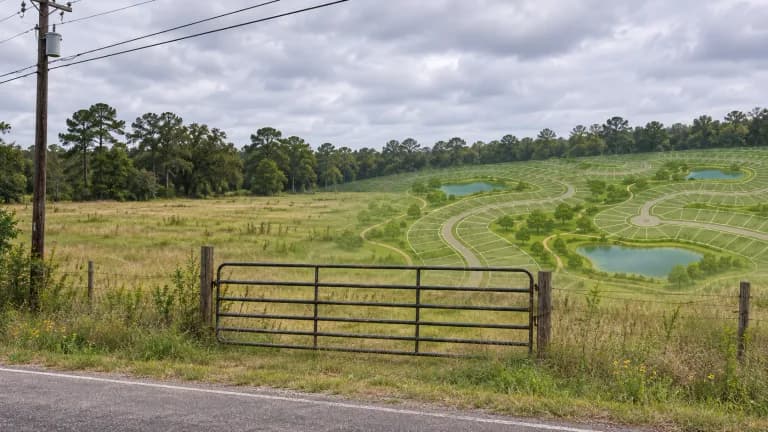
The History of Granbury, Texas
Granbury, Texas (ZIP 76048) grew up on land west of the Brazos where David Crockett’s widow settled in the 1850s, and in 1974 its square became the first in Texas on the National Register. The sources still disagree on who donated the townsite and how many courthouses burned.
Editor’s note. This is the thirty-second installment of “Texas Towns: The Stories Behind the Map.” The last one went to Post, the model town a cereal millionaire drew on paper below the Caprock. This one comes east to the Brazos River and the Western Cross Timbers, southwest of Fort Worth. Readers of our Jacksboro installment met another Cross Timbers county seat on a frontier that Comanche and Kiowa raids nearly emptied during the Civil War. Granbury still has most of the stone storefronts it built in the 1880s and 1890s, and that is no accident. It is also a town that has had to decide what to do with its legends and with the man it is named for.
Granbury is the county seat of Hood County. It sits on the shore of Lake Granbury, on U.S. Highway 377, where the old Fort Worth and Rio Grande Railway reached town in 1887. State Highway 144 also crosses the county. The mailing ZIP is 76048. The Handbook of Texas puts the town thirty-six miles southwest of Fort Worth in its Granbury entry and forty-one miles in its Hood County entry; we print both. [1] [2] [5]
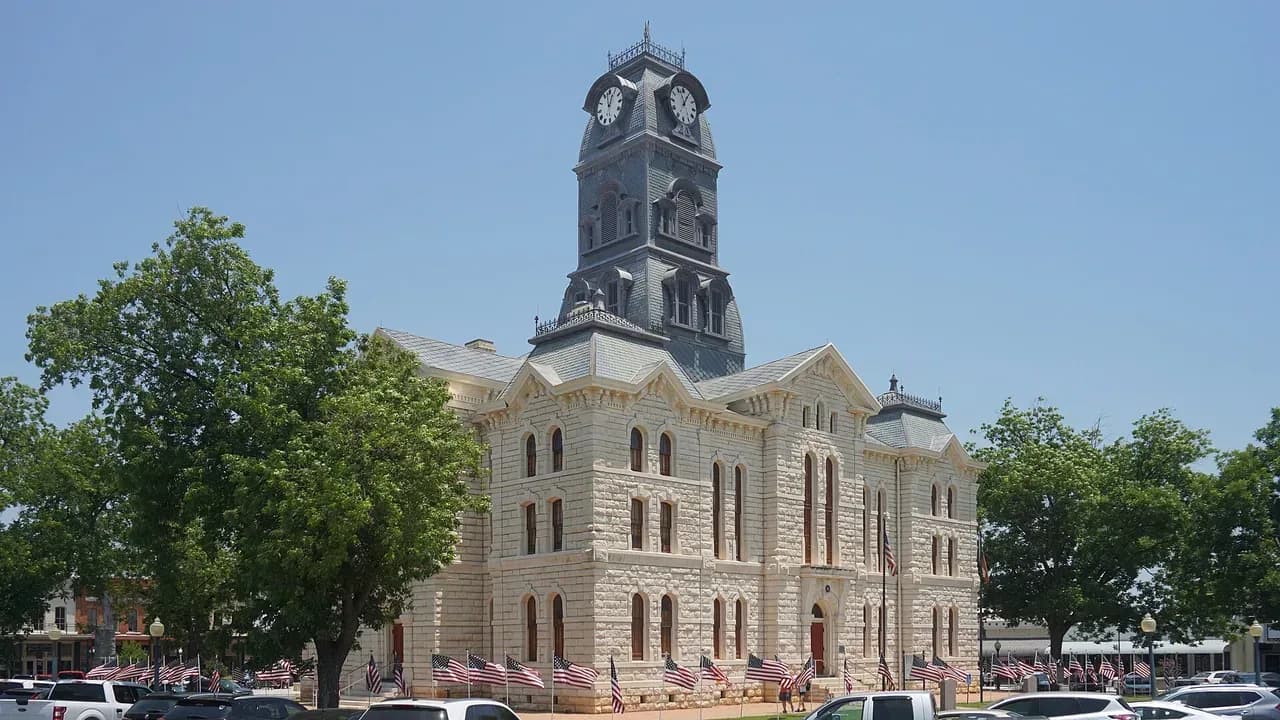
A driver who comes into town today finds subdivisions, marinas and a lake that did not exist before 1969. At the center of it all is a limestone courthouse with a clock tower, finished in 1891, and a square of two-story stone storefronts around it. In 1974 that square became the first town square in Texas listed in the National Register of Historic Places. The nomination called it “one of the most complete examples of a late nineteenth century courthouse square in Texas.” [7] [9] [10] [12]
Before the county: Comanche country and the Brazos line
Before settlers from the East arrived, the area was home to the Comanches and, to a lesser extent, the Lipan Apaches and Kiowas. The Handbook says a band of Comanches known as the Penatekas, or Honey-Eaters, roamed west of the Cross Timbers between the headwaters of the Colorado and the Brazos. Comanche Peak, the highest point in the county, was a Comanche meeting place. The Hood County Texas Historical Society calls it a “sacred Indian mesa” and says the Brazos River was considered the “dead line” between Comanche territory and the Anglo settlements east of the river. [2] [12]
Trading posts came before towns. Charles E. Barnard set up a trading post and Barnard’s Mill at a site now in Somervell County, and George B. Erath surveyed along the Brazos between 1846 and 1850. The local historical society adds that Charles Barnard’s wife, Juanah Cavasos, had been a Comanche captive as a young woman, and that George Barnard negotiated her release in exchange for supplies. [2] [12]
Stock raisers and farmers began settling the Brazos and Paluxy valleys in 1854. The Handbook’s Granbury entry says that in that year “Uncle Tommy” Lambert and Amon Bond led a group of emigrants, mostly from Tennessee, across to the west bank of the Brazos “into traditional Indian territory.” The settlers’ chief worry, in the county entry’s words, was “the frequent raids by the Comanches.” Horse-stealing raids continued through the Civil War and until 1872, when a party stole horses near Cresson. Nearly everything written about those years comes from the settlers’ side. The Comanche and Kiowa accounts of losing this country are largely missing from the sources this article could reach. [1] [2]
1854–1860: Elizabeth Crockett’s land
The best-known early settler was a widow. Elizabeth Patton Crockett, born in 1788 in what became Buncombe County, North Carolina, was the second wife of David Crockett. She had married him in Tennessee in 1815, after her first husband died in the Creek War. Her Handbook biographers write that she ran the family’s gristmill, powder mill and distillery while her husband was away, and that the two eventually lived apart, though they never divorced. He died at the Alamo in March 1836. [3]
Her biography does not leave out that the Crocketts were slaveholders. She raised the children “with the help of an enslaved woman.” Her father gave her three enslaved children in the late 1820s, and the 1830 census shows the household holding two, including a nine-year-old named Adaline. After creditors sued, David Crockett sold the family land and sold Adaline. [3]
In about 1854 she came to Texas with her son Robert and other family members. In February 1856 the legislature issued her a certificate for a league of land and allowed 320 acres of it to be surveyed where she was already living, a few miles north of Acton “in present-day Granbury,” next to the tract David Crockett’s heirs had received for his military service. The family built cabins and farmed. She died on January 31, 1860, at seventy-one, and was buried in Acton Cemetery. In 1913 the state unveiled a twenty-eight-foot monument over her grave, a pioneer woman shading her eyes and looking west. The Granbury entry says she arrived in 1854 and settled on a league awarded by the Republic of Texas; her own entry says the state certificate came in 1856. The Acton entry says the state placed her statue in 1911, the year the monument bill was introduced; her biography dates the unveiling to 1913. Today the grave is Acton State Historic Site, which the Acton entry calls the smallest state historic site in Texas. [1] [3] [8]
1866–1871: A town named by the legislature
Hood County was created in November 1866 by the Eleventh Legislature, cut from Johnson and Erath counties. It was named for Confederate general John Bell Hood. The same law said the county seat would be named for Hiram Bronson Granbury, a Waco lawyer who had recruited a company for the Seventh Texas Infantry, risen to brigadier general and been killed at the battle of Franklin, Tennessee, on November 30, 1864. The historic district nomination puts it plainly: both county and town “were named for outstanding generals in the Confederate Army.” [1] [2] [4] [9]
Where to put the town was a fight. The law called for the center of the county, and residents of the southern part, which then included present Somervell County, wanted it there. The other choice was donated land on Lambert Branch. The sources tell this story differently. The Handbook’s Granbury entry says brothers J. and J. H. Nutt donated forty acres of riverfront property and that “three spirited elections” were needed. The Hood County entry names Thomas Lambert and J. F. and J. Nutt as donors and says a commission chose the donated land, citing poor water at the county’s center. The local historical society says blind brothers Jesse and Jacob Nutt gave the land with Lambert, that the first two elections favored the central site, that County Judge Abe Landers would not declare those results and appointed a commission instead, and that a third election in 1871 picked Granbury “by a narrow majority.” [1] [2] [12]
The southern half did not forget. The Hood County entry says the controversy led residents there to petition for their own county, and Somervell County was created in 1875. [1] [2]
Even the spelling was unsettled. The general attended college as Granberry and changed the spelling after moving to Texas; his sister later said it was a “peculiar whim.” A 1996 address by the president of the local United Daughters of the Confederacy chapter says the 1866 law and the 1873 act incorporating the town both spelled the name “Granberry.” Deeds, veterans and townspeople used Granbury, and that is the spelling that stuck. [4] [15]
1867–1891: Log, stone, fire and the fifth courthouse
City surveyor McCamant laid out Granbury in a grid of twenty blocks with the courthouse square at the center. The first courthouse, according to the National Register nomination, was a sixteen-by-sixteen-foot log house built in the middle of the square in 1867. A frame-and-stone building at the southeast corner followed. A two-story stone courthouse went up in 1871, burned in 1875, and was replaced by a fourth building that was so poorly built it was torn down in 1890. [9]
The local historical society adds that all the county’s land records and deeds were lost in the 1875 fire and that “arson has long been suspected.” The Handbook’s Granbury entry says the first two courthouses burned. The nomination counts only one burned courthouse and four buildings before the present one, so we print both. [1] [9] [12]
The present courthouse was designed by Waco architect W. C. Dodson in the Second Empire style and built of Brazos limestone in 1890–1891. Dodson had already designed the Lampasas, Parker and Hill county courthouses in the same style. The historical society says it cost $40,000 and that the clock was left out of the original budget. The commissioners ordered it in April 1891 for no more than $1,465, and Seth Thomas shipped tower clock No. 640 from Connecticut that month. [1] [9] [12]
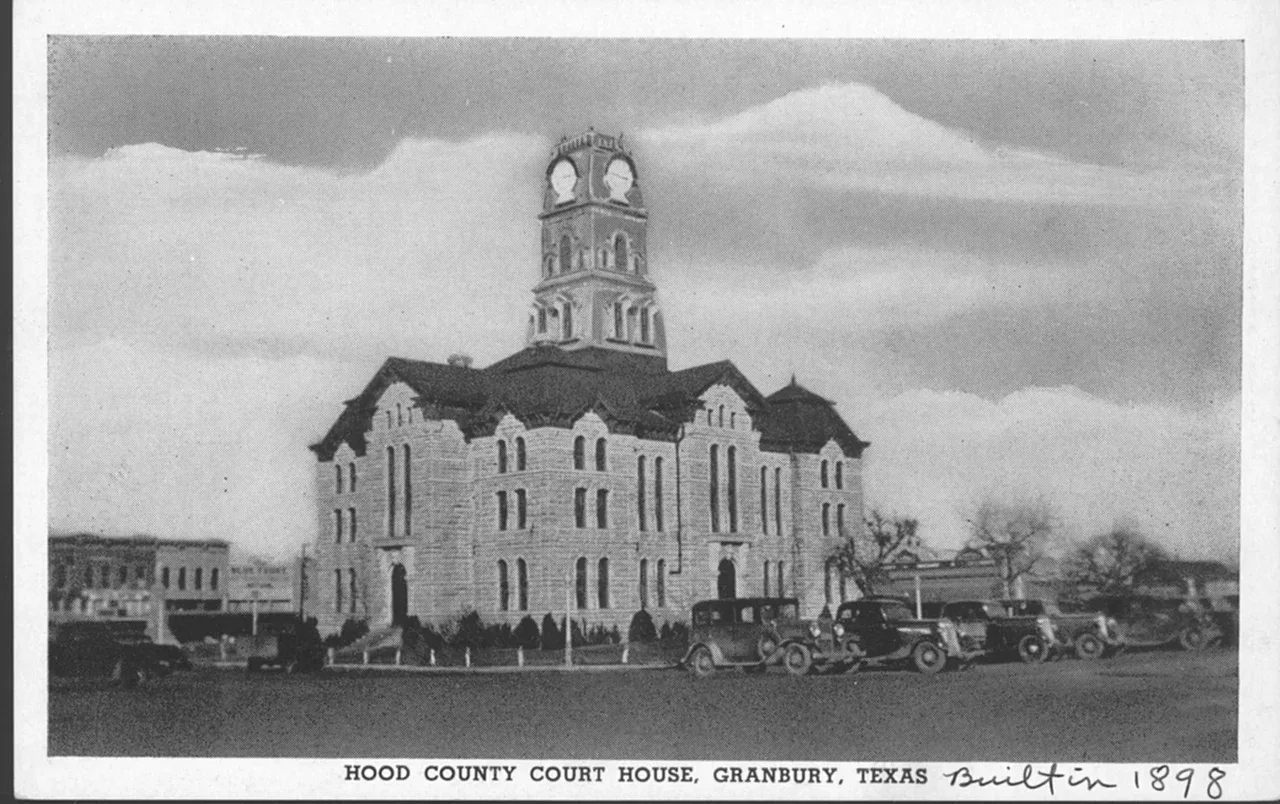
The Hood County Courthouse on a postcard published by Eagle Post Card View Co. of New York, dated about 1940 in its library record. The handwritten “Built in 1898” on the card is wrong: the National Register nomination dates the building to 1890–1891. Eagle Post Card View Co., Jenkins Garrett Texas Postcard Collection, University of Texas at Arlington Libraries; public domain, via Wikimedia Commons.
1872–1906: Churches, schools, saloons and the railroad
Merchants began building on the square in the late 1860s. At first they put up log buildings and frame structures of “rawhide” lumber from a local sawmill. A. P. Harbin taught the first public school in 1871, the same year the Methodists established the first church. W. L. Bond founded the first newspaper, the Vidette, in 1872. Before 1878 the only way across the Brazos was by ferry. That year five citizens paid for a six-hundred-foot wooden bridge, which the historical society says was the only wagon bridge on the Brazos north of Waco for eighteen years. [1] [9] [12]
Faith and schooling also grew up at Thorp Spring, five miles northwest. In 1873 brothers Addison and Randolph Clark opened Add-Ran College there. It passed to the Christian Church (Disciples of Christ) in 1890, moved to Waco in 1896 and in 1910 to Fort Worth, where it became Texas Christian University. Thorp Spring Christian College, founded in 1910 by members of the Church of Christ, took its place until 1930. Granbury had its own Granbury College north of the square. [2] [6] [12]
The town was often called wet, but the record is more complicated. The historical society describes a “wide open little frontier town” with four or five saloons and many “ten pin alleys.” It says Reconstruction-era law kept counties from banning liquor at a county seat. The nomination says Hood County had been a dry county beginning with its first election in 1876, that Granbury “often ignored this law” with as many as five saloons on the square, and that the town went dry in 1906. Andy Aston then turned his 1893 saloon building into a buggy and harness shop. When Carrie Nation came in 1905, the historical society says, the local story has her swinging her ax through the saloons. In fact most of the town met her at the depot, and the Granbury News wrote that “the curiosity of most people was satisfied by a sight of the notorious woman.” [9] [12]
The Fort Worth and Rio Grande was chartered in 1885 to build to Brownwood. Its tracks reached Granbury, forty miles out, in October 1887. The Handbook says that before then travelers had to ride thirty-five miles north to catch the Butterfield stages. The railroad set off a building boom, and limestone storefronts, mostly two stories, replaced the wooden ones in the 1880s and 1890s. The First National Bank building on the northwest corner was Granbury’s first bank building, and the bank was chartered as a national bank in 1887. The Nutt brothers, Jesse, Jake and David Lee, built their two-story stone grocery on the north side in 1893. Off the square, the 1885 jail was built with a projecting front for an indoor gallows. The nomination says no one was ever hanged there. [1] [5] [9]
Granbury became a trading center for pecans, peanuts, peaches, grain and cotton. Reunion Park, set up for Confederate veterans who met there each year into the twentieth century, also served as a livestock trading ground. In 1893, on the anniversary of the battle of Franklin, General Granbury’s remains were brought from Tennessee and reburied in the town cemetery. The Hood County entry says the county’s population passed 10,000 in 1910, when its farms reached their peak of 1,786. [1] [2] [4]
1886–1975: Kerr’s Hall goes dark, and comes back
The most elaborate building on the square went up on the south side in 1886. Its owner was Henry Kerr, and it was first called Kerr’s Hall. Carolyn Kemplin’s 1978 thesis on its history says the building opened in 1886 but did not formally book acts until 1891. The theater was on the second floor, above a saloon and a saddle shop. The Texas Historical Commission marker says vaudeville, plays and musical programs filled the upper floor until 1911. Later the roof collapsed and the building fell apart. The Hood County Genealogical/Historical Society calls what was left “a roofless shell of four Hood County stone walls.” [9] [11] [13] [14]
The Granbury Opera Association restored it with private money, and it reopened for live theater on June 19, 1975. [11] [13] [14]
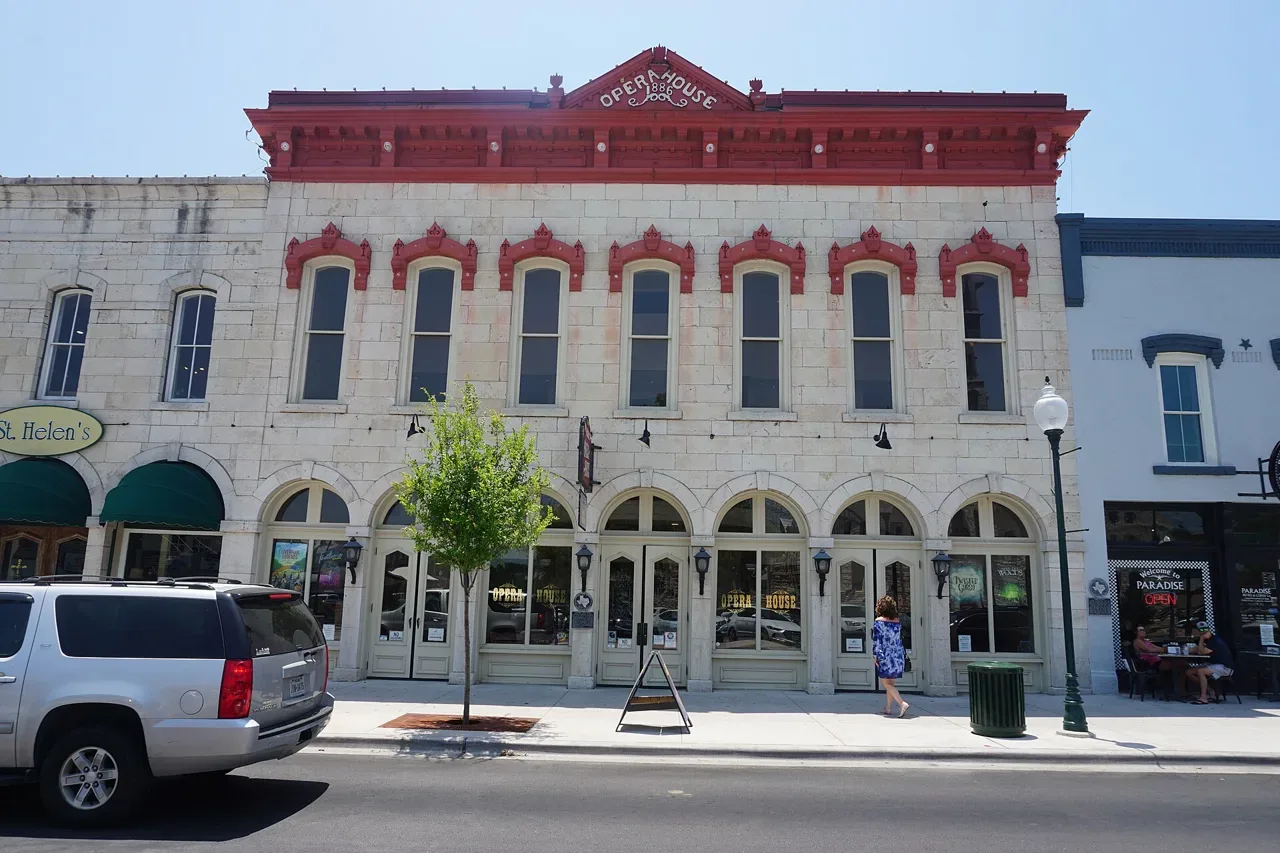
The Granbury Opera House on the square, photographed June 2, 2018. The stone building dates to 1886 and reopened as a theater in 1975. The sign at the far left reads “St. Helen’s,” a shop named for the John Wilkes Booth legend told in this article. Michael Barera, CC BY-SA 4.0, via Wikimedia Commons.
Legends: John St. Helen and J. Frank Dalton
Granbury is famous for two stories that most historians reject. The first is about John St. Helen, who the City of Granbury says lived in town in the 1870s and worked as a bartender in two saloons, one of them on the south side of the square. Local tradition says he was John Wilkes Booth, Abraham Lincoln’s assassin. The city’s own page states that “history says that John Wilkes Booth was shot and killed at Garrett’s farm in Virginia.” In the legend, St. Helen confessed when he thought he was dying, then recovered and left town. [16]
The second is about J. Frank Dalton. The Bridge Street History Center says he arrived by train on a stretcher in August 1951, claiming to be Jesse James, and died at a local family’s home on August 15 of that year. The sheriff examined the body and believed it was James. Dalton was buried in Granbury Cemetery on August 19. A stone set by Dalton’s supporters in 1984 reads “Jesse Woodson James” with the words “Supposedly killed in 1882.” Historical accounts say Bob Ford shot James on April 3, 1882, in St. Joseph, Missouri. The remains in James’s Missouri grave were exhumed in 1995, and mitochondrial DNA was found consistent with his mother’s family line. [17] [18] [19]
On May 30, 2000, a court-ordered team dug up the Granbury grave to test Dalton’s DNA. They got the wrong man. The coffin held a one-armed man, William Henry Holland, and Dalton had both arms. The researchers blamed a headstone that had shifted as souvenir hunters kept taking earlier markers. CBS News and the Associated Press said Holland died in 1927. The Deseret News account, from The Dallas Morning News, gave his dates as 1907–73. Holland was reburied. In January 2001 the Associated Press reported a new request to exhume the grave next to it. [18] [19] [20]
1969–today: The lake, the preservationists and the statue
The Brazos River Authority proposed a dam in Hood County in the late 1950s, and the H. B. Zachry Company began building De Cordova Bend Dam, about eight miles southeast of town, on December 15, 1966. The lake began filling on September 15, 1969. Lake Granbury holds 153,500 acre-feet and has 103 miles of shoreline. The Hood County entry says the county’s population tripled from 5,443 in 1960 to 17,714 in 1980, and that in the 1970s it ranked sixth among U.S. counties in growth rate. The Comanche Peak nuclear plant, built in Somervell County in the 1980s, brought thousands more workers. [1] [2] [7]
The same years brought a preservation movement. The historical society says it began in 1969 with the restoration of the courthouse, and that Mary Lou Nutt Watkins and Joe Nutt restored the Nutt building on the square in 1970. Their work encouraged other owners, and the city declared the whole square a historic district. The National Register listing followed on June 5, 1974. The historical society says the revived square became the model for the Texas Historic Preservation Main Street Program. [9] [10] [12]
A statue of General Granbury, given by the United Daughters of the Confederacy, has stood on the courthouse square since 1913. In July 2020, after the George Floyd protests, the Dallas Observer reported a Change.org petition with more than 2,700 signatures calling for its removal. The petition’s creator called it “a constant reminder of slavery, racial segregation, and violence.” A counter-petition to keep it had about 150 signatures. The Hood County commissioners’ office did not respond to the paper. The Hood County entry also records the county’s racial makeup: 96 percent of residents were White in 1870, and the Black population never passed 241 people, or 3 percent, which it reached in 1900. [2] [4] [21]
The town’s population figures depend on who is counting. The Handbook’s Granbury entry gives 4,045 for 1990, and its Hood County entry lists Granbury at 9,059. The Census Bureau’s 2020 base for the city is 10,957, and its July 2025 estimate is 13,263. The Texas Almanac lists 11,424 for 2021. We print the figures as published. [1] [2] [22] [23]
The complete story of Granbury
It is the story of Comanche country west of the Brazos, settled in 1854 by emigrants, mostly from Tennessee, on land the Handbook itself calls traditional Indian territory. It is the story of David Crockett’s widow, a capable businesswoman whose own biography records the enslaved girl her husband sold. It is a county seat named by the legislature for a Confederate general, placed after three elections and a split county. Its courthouses burned and fell down, and the fifth one has stood since 1891. The railroad built its stone storefronts. The saloons were illegal for years and stayed open anyway. Its opera house went dark for sixty-four years. It is a town that keeps an outlaw’s gravestone while saying plainly that the man under it was probably not the outlaw. And in 1974 it became the first square in Texas on the National Register. [1] [2] [3] [9] [12] [14]
That is the history of Granbury.
Questions people ask
Who is Granbury named for? Hiram Bronson Granbury, a Waco lawyer and Confederate brigadier general killed at the battle of Franklin, Tennessee, on November 30, 1864. The 1866 law creating Hood County named the county seat for him, and his remains were reburied in Granbury in 1893. [2] [4]
Did Elizabeth Crockett live in Granbury? Her Handbook biography says her 320 acres were a few miles north of Acton, “in present-day Granbury.” She died in 1860 and is buried at Acton State Historic Site. [3] [8]
Is Jesse James buried in Granbury? A stone in Granbury Cemetery says so, but historical accounts say James was killed in Missouri in 1882, and DNA from his Missouri grave matched his mother’s family line. A 2000 attempt to test the Granbury remains dug up the wrong man. [17] [18] [20]
Sources
Ted W. Mayborn, “Granbury, TX,” Handbook of Texas Online, Texas State Historical Association, revised October 4, 2023. Its bibliography includes Mary Estelle Gott Saltarelli, Historic Hood County: An Illustrated History (San Antonio: Historical Publishing Network, 2009). tshaonline.org/handbook/entries/granbury-tx.
Rhonda L. Callaway, “Hood County,” Handbook of Texas Online, Texas State Historical Association, revised November 9, 2020. Its bibliography includes Thomas T. Ewell, History of Hood County (Granbury: Gaston, 1895; rpt., Granbury Junior Woman’s Club, 1956), and C. L. Hightower, ed., Hood County in Picture and Story (Fort Worth: Historical Publishers, 1970). tshaonline.org/handbook/entries/hood-county.
Katherine Kuehler Walters and Heather Rodriguez, “Crockett, Elizabeth Patton,” Handbook of Texas Online, Texas State Historical Association, published August 22, 2023. tshaonline.org/handbook/entries/crockett-elizabeth-patton.
Palmer Bradley and Bob Kent, “Granbury, Hiram Bronson,” Handbook of Texas Online, Texas State Historical Association, revised September 23, 2025. tshaonline.org/handbook/entries/granbury-hiram-bronson.
Patricia L. Duncan, “Fort Worth and Rio Grande Railway,” Handbook of Texas Online, Texas State Historical Association, revised April 15, 2016. tshaonline.org/handbook/entries/fort-worth-and-rio-grande-railway.
David Minor, “Thorp Spring, TX,” Handbook of Texas Online, Texas State Historical Association, revised July 1, 1995. tshaonline.org/handbook/entries/thorp-spring-tx.
Laurie E. Jasinski, “Lake Granbury,” Handbook of Texas Online, Texas State Historical Association, published May 19, 2005. tshaonline.org/handbook/entries/lake-granbury.
Kristi Strickland, “Acton, TX,” Handbook of Texas Online, Texas State Historical Association, revised September 7, 2025. tshaonline.org/handbook/entries/acton-tx.
National Register of Historic Places inventory–nomination form, “Hood County Courthouse Historic District,” Courthouse Square, Granbury, listed June 5, 1974 (reference no. 74002080), Section 8, statement of significance. Texas Historical Commission Atlas. atlas.thc.texas.gov/NR/pdfs/74002080/74002080.pdf.
Texas Historical Commission, Texas Historic Sites Atlas, “Hood County Courthouse Historic District,” National Register listing, atlas no. 2074002080 (listed June 5, 1974; architect W. C. Dodson; Late Victorian and Second Empire). atlas.thc.texas.gov/Details/2074002080.
Texas Historical Commission, Texas Historic Sites Atlas, “Granbury Opera House,” Recorded Texas Historic Landmark marker no. 2245, 116 E. Pearl St., marker year 1977. atlas.thc.texas.gov/Details/5221002245.
Hood County Texas Historical Society, “Welcome to Historic Granbury” (self-guided walking tour introduction). hctxhs.org/articles/welcome.htm.
Carolyn Ann Kemplin, “The History of the Granbury Opera House: 1886–1978” (M.A. thesis, North Texas State University, August 1978), UNT Digital Library. digital.library.unt.edu/ark:/67531/metadc798234/.
Hood County Genealogical/Historical Society, “Granbury Opera House.” granburydepot.org.
Vircenoy B. Macatee, “Our Hero General Hiram Bronson Granbury,” address as president of the Gen. Hiram B. Granbury Chapter No. 683, United Daughters of the Confederacy, June 25, 1996, published by the Hood County Genealogical/Historical Society. granburydepot.org.
City of Granbury, “John Wilkes Booth: John Wilkes Booth Slept Here.” granbury.org/705/John-Wilkes-Booth.
Bridge Street History Center, “J. Frank Dalton claims to be Jesse James.” bshc-granbury.org.
CBSNews.com staff, “Jesse James Grave Mix-Up,” CBS News, June 30, 2000. cbsnews.com.
“Dig for Jesse James finds wrong body,” Deseret News (from The Dallas Morning News), July 1, 2000. deseret.com.
Associated Press, “Another legal attempt started to exhume grave some believe belongs to Jesse James,” News On 6, January 31, 2001. newson6.com.
Simone Carter, “Gainesville, Granbury and Waxahachie Are Latest to Consider Confederate Statues’ Fate,” Dallas Observer, July 8, 2020. dallasobserver.com.
U.S. Census Bureau, Population Estimates Program, “City and Town Population Totals: 2020–2025” (sub-est2025), row for Granbury city, Texas: April 1, 2020 estimates base 10,957; July 1 estimates 11,054 (2020), 11,693 (2021), 12,362 (2022), 12,641 (2023), 12,964 (2024), 13,263 (2025). www2.census.gov … sub-est2025.csv.
Texas Almanac, “Granbury,” Texas State Historical Association (population count 11,424 for 2021). texasalmanac.com/places/granbury.
Michael Barera, “Granbury June 2018 35 (Hood County Courthouse).jpg,” photographed June 2, 2018, CC BY-SA 4.0, Wikimedia Commons. commons.wikimedia.org.
Michael Barera, “Granbury June 2018 28 (Granbury Opera House).jpg,” photographed June 2, 2018, CC BY-SA 4.0, Wikimedia Commons. commons.wikimedia.org.
Eagle Post Card View Co. (New York), “Hood County Court House, Granbury, Texas,” postcard, circa 1940, Jenkins Garrett Texas Postcard Collection, University of Texas at Arlington Libraries; public domain (no copyright notice), via Wikimedia Commons. commons.wikimedia.org.