Giddings: A Railroad Town That Held the Lee County Seat
Giddings began in 1871 beside the Houston and Texas Central Railway and kept the Lee County seat after the first courthouse burned in November 1897, the county's own courthouse page says.
Giddings serves as Lee County's seat, at the meeting of U.S. 290 and U.S. 77, according to Miriam York's entry in the Handbook of Texas, originally published in 1952 and last revised Sept. 11, 2020. The official Lee County contact page lists the county offices at 200 South Main, Room 107, Giddings, Texas 78942, and gives the phone number 979-542-3178.
York wrote that the town began in 1871 after the Houston and Texas Central Railway pushed its tracks through the area, and that a settlement and post office were set up for nearby places the rails had skipped. The site first fell inside Stephen F. Austin's colony, then inside the Robertson colony. A 1971 Texas Historical Commission marker, “City of Giddings” at Main and E. Richmond streets, says the place was named for Jabez D. Giddings (1814-78) of Washington County, a railroad stockholder and one of four Pennsylvania-born brothers who became leaders in Texas transportation and trade. The Handbook does not treat the namesake as settled beyond doubt: it says the town is usually credited to Jabez Deming Giddings, though some sources name Dewitt C. Giddings. The official 1971 marker states Jabez D. Giddings without qualification, but this report does not discard the minority account the Handbook still records.
The Handbook records that a syndicate led by William Marsh Rice held title to the entire townsite and sold parcels to settlers, and that Rice Institute, now Rice University, later held and sold the property. Early residents included Jewish families and Wendish households from around Serbin, York wrote, and after the Civil War, freed people from nearby farms settled in town. The first church, in 1871, was Methodist. York wrote that more than fifty Black pupils met for lessons inside a church building in 1883, and that a public school for Black children opened in 1887.
When Lee County was created in 1874, the Handbook says, Giddings was named the seat. The official Lee County courthouse page is more precise: Lee County was organized April 14, 1874, taking land from Bastrop, Burleson, Fayette, and Washington counties, and its first courthouse opened in 1878 on a square immediately south of Giddings' business district. The county describes that building as two stories, with a mansard roof and a tower. It “burned to the ground in November of 1897.” After the fire, the county says, the nearby community of Lincoln asked that the new courthouse be built there; the vote, as the county records it, was 1,400 to 1,000, and Giddings kept the seat.
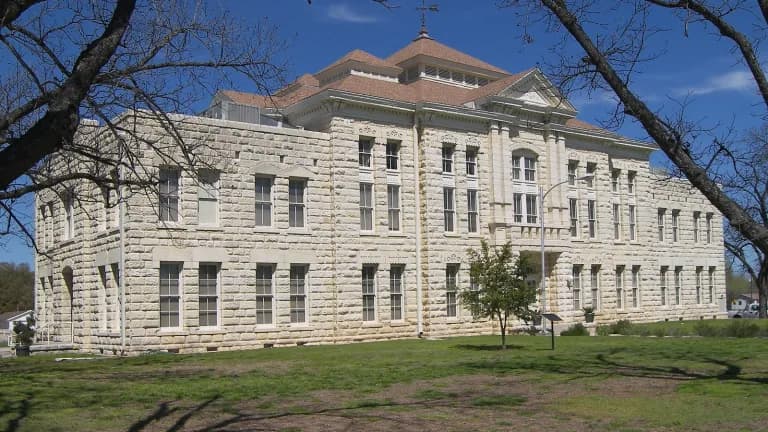
The courthouse standing on the square today dates to 1899. A 1968 Recorded Texas Historic Landmark marker on Main Street says J. R. Gordon designed it in the Richardsonian Romanesque style, “along lines similar to New York State Capitol and several buildings at Harvard University,” and that Sonnefield, Emmins and Abright of San Antonio built it, replacing the courthouse that burned in 1897. The marker also notes that the building stands on the crest of the divide between the Colorado and Brazos river basins. A separate Texas Historical Commission State Antiquities Landmark record, designated Jan. 1, 1981, lists the courthouse on the National Register of Historic Places and locates it on the public square bounded by Hempstead, Grimes, E. Richmond, and Main streets.
The 1971 city marker says a second railroad, the San Antonio and Aransas Pass, arrived in 1889, and a third, the Hearne and Brazos Valley, in 1913, and that the city adopted commission government in 1913. The Handbook also dates incorporation to 1913 and puts the population at 2,000 by 1914. By 1890, York wrote, Giddings sat in a rich cotton country, with cotton gins, an opera house, and papers that included the German-language Giddings Volksblatt, plus an estimated 1,000 residents; the First National Bank opened that year. Those late-nineteenth-century notes are historical, not a present-day directory.
The Handbook describes an oil boom in the early 1980s, when wells were drilled into the Austin chalk under the town and some 300 oil-related businesses came in, then a sharp drop later in that decade. The narrative gives a 1988 population of 5,178. The Handbook's census table, which this report uses for census years, lists 624 people in 1880, 1,650 in 1920, 1,835 in 1930, 2,166 in 1940, 2,532 in 1950, 2,821 in 1960, 2,783 in 1970, 3,950 in 1980, 4,093 in 1990, 5,105 in 2000, 4,881 in 2010, 4,969 in 2020, and 5,067 in 2021. The table does not include an 1890 or 1914 count; the 1,000 and 2,000 figures above are the narrative's estimates. The 2021 table figure is not a 2026 census.
Related: Junction: A Kimble County Seat at the Meeting of Two Rivers.