Coleman: A County Seat Raised Along the Western Trail
Coleman began in 1876 on land given for a county seat along the Western Trail. The courthouse standing today was built in 1884 and completely remodeled in 1952, the Texas Historical Commission record shows.
Coleman is Coleman County's seat, at the place where U.S. 84, U.S. 283, and Farm Road 53 come together near the county's center. Most of the history that follows comes from the Handbook of Texas entry by William R. Hunt, first published in 1952 and last revised Sept. 20, 2023.
The town takes its name from the county. The Handbook says the county honors Robert M. Coleman, who served as an aide to Sam Houston. Settlement began in 1876, after R. J. Clow gave a 160-acre tract on Hords Creek so the new county would have a seat. J. F. Gordon, working with R. S. Bowen, surveyed the ground, and lots went up for sale. Because the site sat on the Western Trail, the Handbook says, drovers headed for Dodge City, Kansas, soon used Coleman to buy supplies and spend a little time.
A first courthouse went up not long after the county government was formed, the Handbook says, built of lumber cut from elms along Jim Ned Creek. That building also held bachelor rooms and a store, and people used it for worship and gatherings. A second store was hauled in from Echo; the Handbook names the mover only as King. In front of that store, the entry records, a cowboy shooting left a man dead and marked the first burial in the town cemetery. A private school opened in 1879 with Anna Miles as teacher; a public school followed three years later.
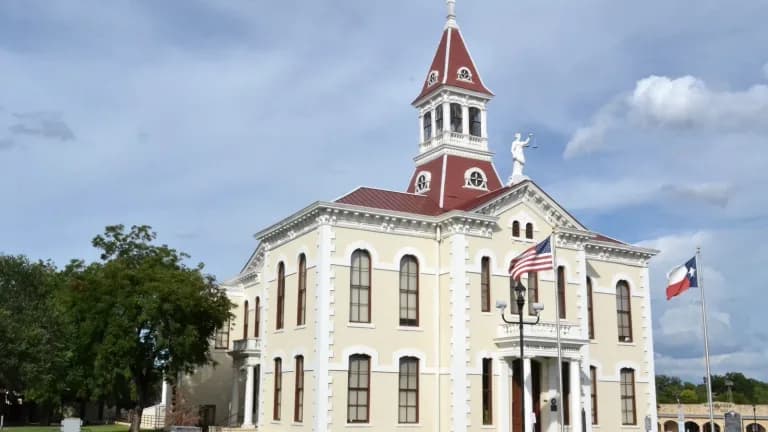
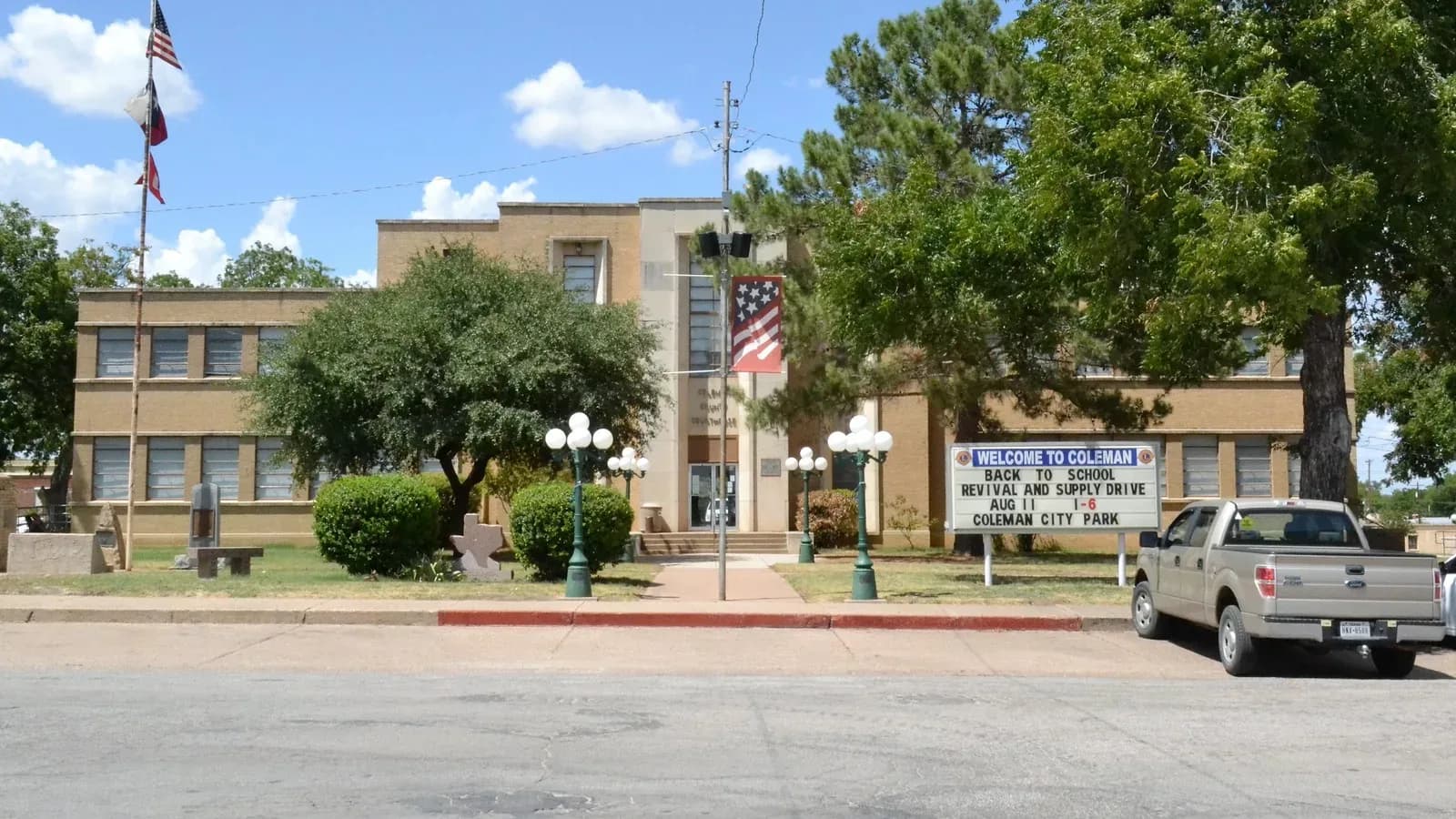
The courthouse standing today is a later building. The Texas Historical Commission's courthouse record lists the present Coleman County Courthouse at 102 W. Liveoak Street, Coleman, TX 76834, as an active county courthouse, constructed in 1884 to a Second Empire design by W. W. Dudley and then completely renovated in 1952 by architect Wyatt C. Hedrick. The commission describes the 1952 work as Modern, in beige brick and limestone, with tall limestone surrounds at the windows and a limestone panel at the center entry. Its record says that remodeling “completely conceals the original 1884 Second Empire design” and removed “all historic character.” The record names Smith & Butler as contractor for the earlier work and Quille Construction Company for the later work.
On the northeast corner of the same square, at Commerce and Walnut, a Texas Historical Commission marker erected in 1970 records the Coleman County Jail as a Recorded Texas Historic Landmark. The official marker text calls it the county's second jail, after a small 1879 building on the courthouse lawn, and dates the present structure to 1890. It describes the design as Victorian, with some Romanesque Revival traces and a distinctive belt at the first and second stories, living space for the jailer downstairs, and both maximum- and minimum-security cells upstairs. The marker states, “Only one person, a convicted murderer, was ever hanged here.”
Print came early and did not last in every case. The Handbook says a printer launched the Coleman Telegram in 1877, a paper that did not last. In 1881 J. J. Callan issued the Coleman Voice. From 1897 that paper competed with Will Hubert's Coleman Democrat, until the two journals combined under the name Democrat-Voice in 1906. Santa Fe's main line missed town by about five miles, the Handbook says, though a spur was in place by 1886. After 1900 the local economy turned toward cotton. The Great Depression, the entry says, pressed farm families so hard that many gave up their acres and moved into town. Hunt's narrative also sketches later meat-processing, wool, and manufacturing; those lines are not treated here as a current business directory.
Population figures in the narrative and in the table published with the entry do not always match. This account uses the table for census years. It lists 400 people in 1880, 906 in 1890, 1,362 in 1900, 3,046 in 1910, 2,868 in 1920, then 6,078 in 1930 and 6,530 in 1950. Later figures in the same table are 5,410 in 1990, 5,127 in 2000, 4,709 in 2010, 3,912 in 2020, and 3,917 in 2021. Those later counts are from the Handbook's table, not a 2026 census. The Handbook also notes a replica of Camp Colorado in the city park.
The City of Coleman's official contact page lists City Hall at 200 West Liveoak St., Coleman, Texas 76834, with a mailing address of P.O. Box 592, a main telephone number of (325) 625-4116, and weekday hours of 8:00 a.m. to 5:00 p.m. That address is City Hall, not the county courthouse a short walk down the same street at 102 W. Liveoak.
Related reading: Junction: A Kimble County Seat at the Meeting of Two Rivers.