Floresville: A Wilson County Seat Named for the Flores Family
The Handbook of Texas traces Floresville from a Canary Island ranch and the old Lodi settlement to the Wilson County seat, later nicknamed the Peanut Capital of Texas.
Floresville is the seat of Wilson County, where U.S. 181 meets State Highway 97, roughly 30 miles southeast of San Antonio, toward the center of the county. That geography, and most of the story below, comes from the Handbook of Texas entry by Claudia Hazlewood, first published in 1976 and last revised Sept. 22, 2023.
The Handbook traces the settlement to Don Francisco Flores de Abrego, a Canary Island immigrant who set up a ranch headquarters about six miles northwest of today's townsite in the 1700s. By 1833, the entry says, the ranch house, a chapel, and a burial ground formed the core of a place called Lodi. Lodi was the seat first from 1867 until March 1871, then again starting in July 1871 until 1873. Floresville itself took the Flores family name when it was laid out in 1867 on ground that included part of Lodi. A townsite was surveyed in the early 1870s. The Handbook credits Andrew G. Pickett, a rancher who already irrigated his land, with beginning peanut culture there, and says postal service began in 1872. County voters, that November of 1873, chose Floresville as the seat.
An 1884 courthouse, and a later peanut nickname
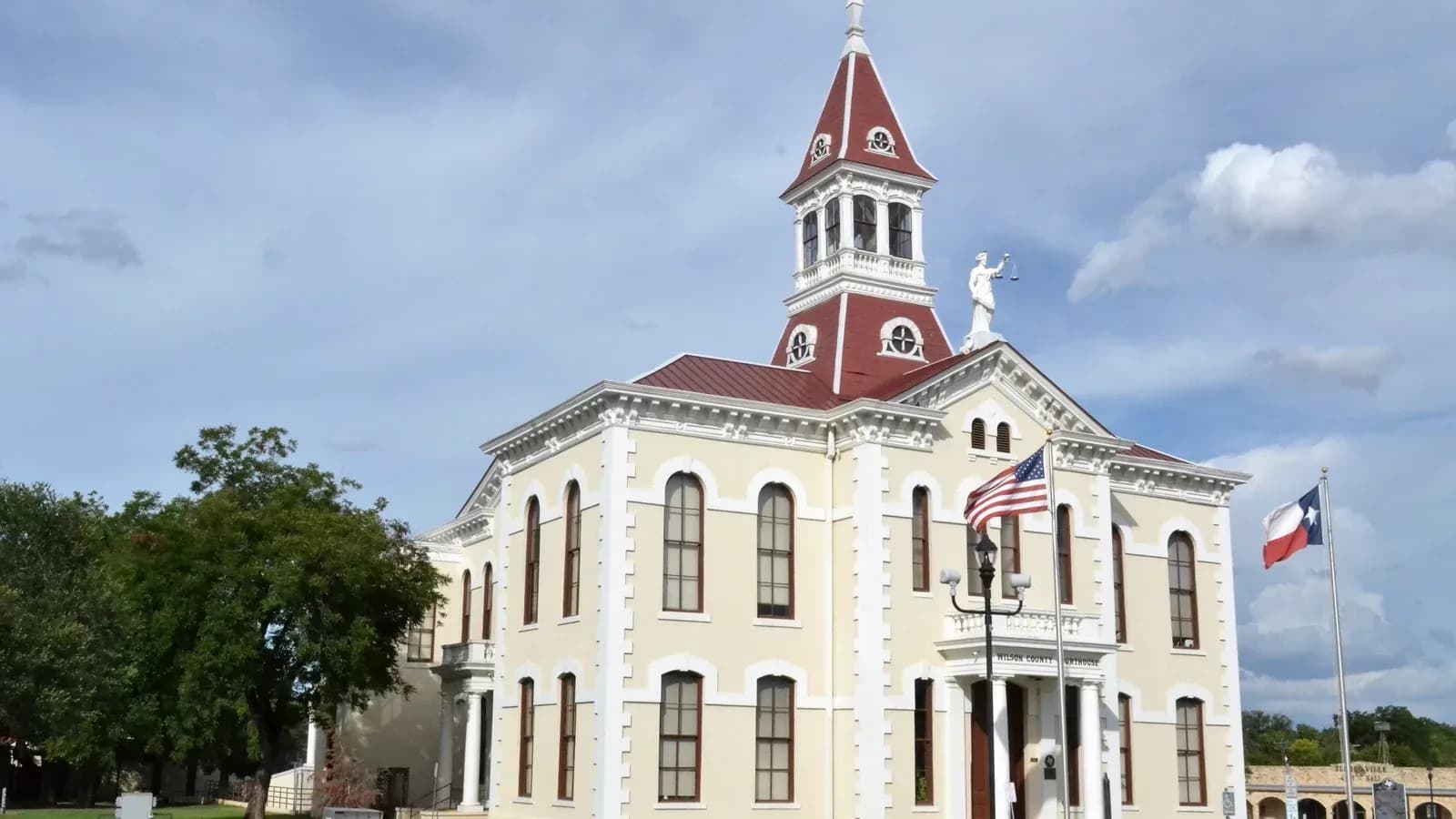
A Texas Historical Commission marker at 1420 Third Street, erected in 1984, says the courthouse still standing was built in 1884 and replaced an earlier one put up soon after Floresville was chosen county seat in 1871. The Handbook's dates for the seat are later: Lodi held the role in two stretches between 1867 and 1873, and the 1873 election settled it on Floresville. This account reports both as their sources state and does not try to settle the year. The official marker text credits San Antonio architect Alfred Giles, says the Italianate building was made of bricks from a local yard, and points to pavilions at the entries carried on Doric columns, a cornice with brackets at the roof edge, and a main tower topped by a steeple. The state designated it a Recorded Texas Historic Landmark in 1984.
The Handbook says growth sped up after 1883, after the San Antonio and Aransas Pass Railway disclosed plans for a route through the community. By 1885 Floresville had a couple of hotels, a handful of stores, a weekly paper named the Chronicle, two steam-powered cotton-gin and grist-mill plants, and a population of 400. It incorporated in 1890, and the population given for that year was 1,500. By 1896 a school with five teachers was running, enrolling 206 students. Cotton and livestock supported the town into the early 1900s; by 1910, the entry says, there were two banks and 1,800 residents. Peanuts became a cash crop around 1915, and residents later nicknamed the town the "Peanut Capital of Texas." The Handbook also records an annual Peanut Festival that began in 1938 and, in the 2023 revision, was described as drawing 10,000 to 15,000 visitors a year. That attendance range is the Handbook's figure, not a count independently confirmed for 2026.
Population figures in the narrative and in the table published with the entry do not always match. The table lists 1,581 in 1930, 1,949 in 1950, 5,247 in 1990, 5,868 in 2000, 6,448 in 2010, 7,203 in 2020, and 7,554 in 2021. The narrative gives 1,581 for 1931, 1,935 for 1952, 2,980 for 1965, and 5,414 for 1990. The table figures are used here for the census years. Those later counts are from the Handbook's table, not a 2026 census. The 2023 revision also calls Floresville a market town for peanuts, small grain, and cattle, and says many residents commute to San Antonio; those statements are not treated here as a fresh labor survey.
The city's official contact page lists City Hall at 1120 D Street, Floresville, TX 78114, telephone (830) 393-3105, and a fax number of (830) 393-1211, with hours Monday through Friday, 8 a.m. to 5 p.m. That address is City Hall, not the courthouse at 1420 Third Street.
Related reading: Carthage: A Panola County Seat Built at the County's Center.