Carthage: A Panola County Seat Built at the County's Center
The Handbook of Texas traces Carthage from an 1848 county-seat donation of 100 acres at Panola County’s center to a railroad and oil town that moved its courthouse off the old square in the 1950s.
Panola County’s seat sits at the crossing of U.S. highways 59 and 79, forty-two miles west of Shreveport, Louisiana, near the middle of the county. That setting, and most of the history that follows, comes from the Handbook of Texas entry by Leila B. LaGrone, first published in 1952 and last revised Sept. 20, 2023. The Handbook calls Carthage the county’s second seat.
The legislature created Panola County in 1846 and put the temporary seat at Pulaski, on the east bank of the Sabine River. Two years later, county commissioners chose a permanent location at the county’s geographic center. Jonathan Anderson, who owned the land, agreed to give 100 acres for a town. Spearman Holland is credited with naming it after Carthage, Mississippi. A post office followed in 1849.
Four courthouses, and a square that became a park
The first courthouse was built of peeled pine logs, paid for by selling town lots, and finished in August 1849, the Handbook says. It served until a brick building went up in 1853. By 1860 Carthage had a school, a church, and the Panola Male and Female Academy, founded by L. C. Libby. Crowding at the courthouse led to a third building, in the Gothic style, completed in 1885. By then T. E. Boren was publishing the Panola Watchman. A second weekly, the Panola Banner, issued by G. D. Guest and H. M. Knight, was running by 1890.
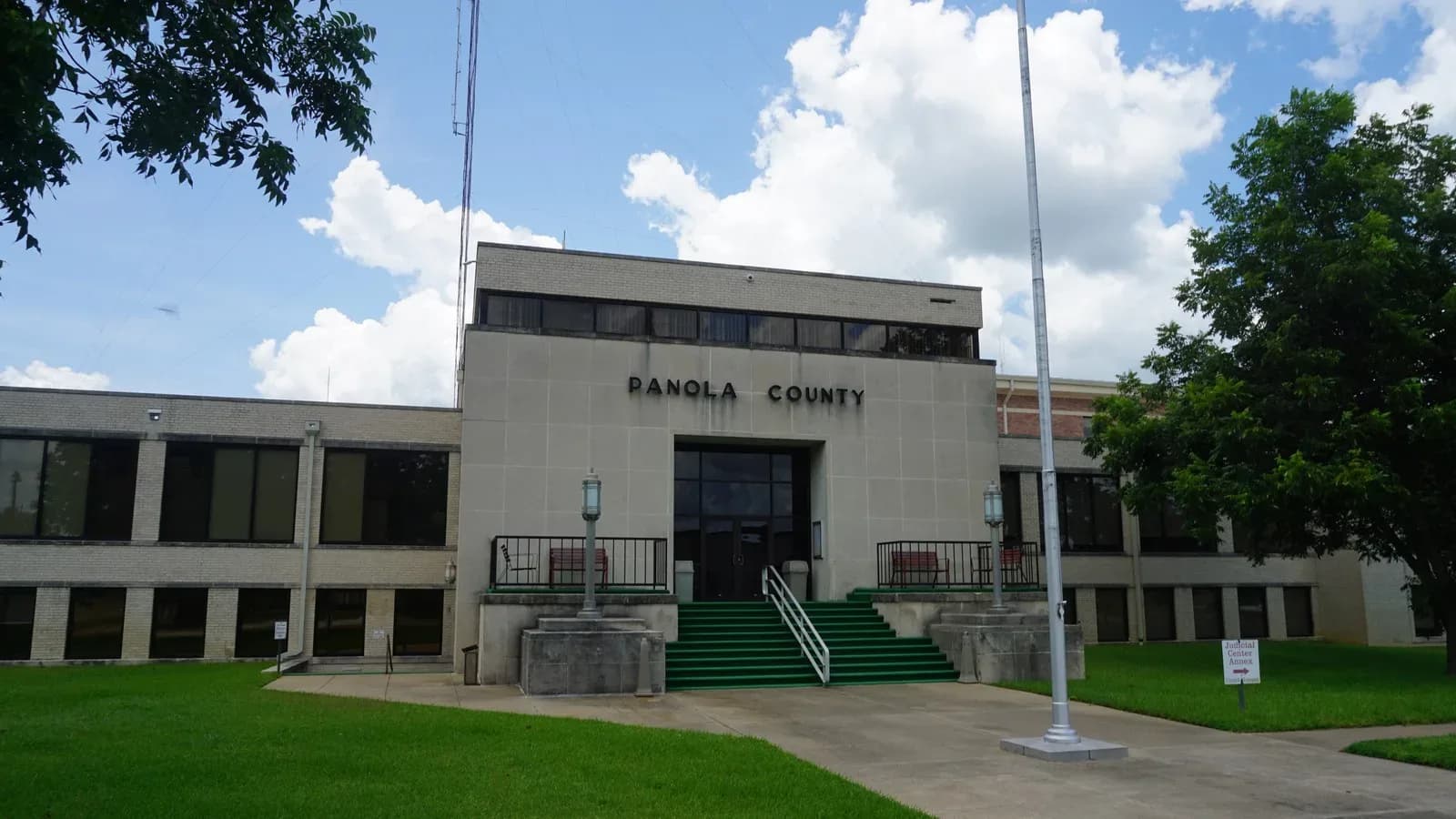
In 1953 a brick courthouse was dedicated on Sycamore Street, two blocks west of the old square. The Gothic building was auctioned, and in 1956 the square was cleared for a public park named for Jonathan Anderson. The photograph used with this account shows the mid-century courthouse on Sycamore Street as it appeared in 2017; it is not a picture of the 1885 building that was sold, and it is not City Hall.
A railroad, oil and gas, and a commission government
The Texas, Sabine Valley and Northwestern Railway reached Carthage in 1888. The Handbook says that line later became part of the Gulf, Colorado and Santa Fe and, in 1965, was conveyed to the Atchison, Topeka and Santa Fe.
The town incorporated in 1874, then soon fell back under the county court. It incorporated again in 1902 under a council form, then dissolved once more. In 1913 it adopted the commission form of government. The 2023 revision of the Handbook describes that arrangement as still in place, with a mayor, a city manager and city commissioners.
The Handbook gives the 1920 population as 1,366 and says growth after that was driven by oil and gas and by general commerce. The population table published with the entry lists 2,178 people in 1940, 6,447 in 1980, 6,664 in 2000, 6,569 in 2020, and 6,533 in 2021. The narrative text of the entry gives 6,477 for 1980; the table figure is used here. Those later counts are from the Handbook’s table, not a 2026 census. The entry’s late-twentieth-century sketch mentions a shopping mall, a renovated downtown, a cup company and a chicken-processing plant; those details are not treated here as a current business directory.
The city’s official Contact City Hall page lists City Hall at 812 W. Panola Street, Carthage, Texas 75633, phone 903-693-3868, fax 903-693-3882. Hours on that page are Monday through Thursday, 7:30 a.m. to 5:30 p.m., and Friday, 8 a.m. to 12 p.m. That address is City Hall, not the county courthouse on Sycamore Street.
Related reading: Borger: Oil Boomtown, Rangers and an All-American City.