Sweetwater: The Nolan County Seat Named for Its Water
The Handbook of Texas traces Sweetwater from a Kiowa watering place and the 1881 Nolan County seat to a railroad town that trained Women’s Airforce Service Pilots in 1943.
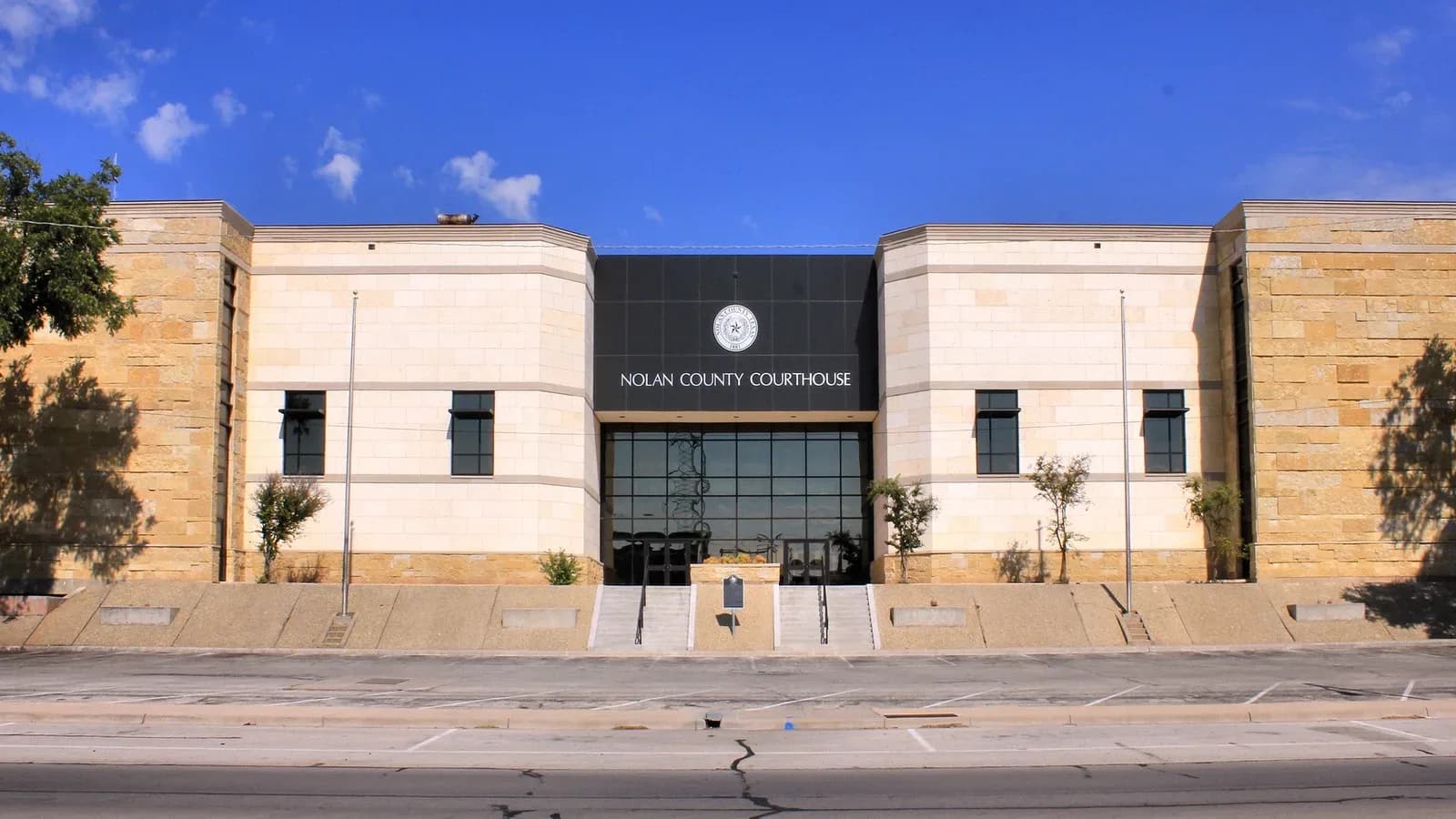
Nolan County’s seat is a West Texas railroad town forty-two miles west of Abilene, on Interstate 20. The name comes from the water. According to the Handbook of Texas entry by William R. Hunt, first published in 1952 and last revised Aug. 14, 2015, the Kiowa called the place “Mobeetie,” meaning sweet water, in a stretch of country where some streams ran sweet and others tasted of gypsum.
Hunt writes that Anglo settlement remained sparse here until after the Civil War, when buffalo hunters moved onto the plains. The Handbook traces the community’s beginnings to 1877, when Billie Knight kept a dugout store for those hunters. When Nolan County was organized in 1881 and this site was named the county seat, the Handbook says the place still had only a couple of tent stores and no permanent buildings.
A post office opened in 1879 under the two-word name Sweet Water; the spelling was not officially combined until 1918. Before that, the Handbook says, the office had been called Blue Goose, a name explained by a local story that a cowboy shot a great blue heron, thinking it was some kind of goose.
Rails, a saloon holdup, and a drought that cut the town in half
The Texas and Pacific Railway reached town in 1881. By 1883, Hunt wrote, five saloons and other businesses were operating. A store put up in 1881–82 for $8,755 doubled as jail and courthouse until a courthouse was built in 1891. Countywide grand-jury indictments from 1881 to 1883, the Handbook reports, included seventeen for murder, seventeen for assault to murder, and forty-five for gambling and carrying pistols — “but there is no indication that Sweetwater itself was an unruly community.”
The best-known early violence, Hunt wrote, was tied to the lack of a bank. Residents were said to leave cash at a saloon run by Chiflet and Gilliot, sometimes as much as $20,000. In February 1883 a raid on that saloon killed the owners and wounded a bystander, N. I. Dulaney. Eleven of those seventeen murder indictments came out of that robbery attempt, the Handbook says. The following month Thomas Trammell and others opened a bank. The Sweetwater Advance started in 1881. The town was incorporated in 1884, then again in 1897 and 1902.
A blizzard in 1885 killed 90 percent of the area’s livestock, and the drought of 1886–87 followed. By 1890, Hunt wrote, the population was half what it had been in 1884. The population table published with the entry lists 614 residents in 1890 and 670 in 1900, then a jump to 4,176 in 1910 after work began in 1903 on the Kansas City, Mexico and Orient Railway.
New lakes, wartime flying, and later census counts
Sweetwater built up its water supply to attract the railroads: a small town lake in 1898, then Lake Trammell in 1914, Lake Sweetwater in 1929–30, and Oak Creek Reservoir in 1950–52, according to the Handbook. Railroad shops furnished a steady payroll. A Gulf refinery ran from 1929 to 1954, and International Harvester had a factory from 1920 to 1950. Hunt wrote that the chief lines of business were cotton, oil and cattle.
During World War II the Army Air Force trained at Sweetwater’s airfield. Earlier the field had been used to train British military flying cadets. In 1943, the Handbook says, the Women’s Airforce Service Pilots trained there. The 2015 revision notes that the Rolling Plains campus of Texas State Technical Institute was established in 1970, four miles west of town. The entry’s population table lists 10,367 people in 1940, a high of 13,914 in 1960, 11,415 in 2000, 10,622 in 2020, and 10,513 in 2021. Those later figures are from the Handbook’s table, not a 2026 census.
The city’s official Contact Us page lists City Hall at 200 East 4th Street, Sweetwater, Texas 79556, phone 325-236-6313. Hours are given as Monday through Thursday, 7:30 a.m. to 5:30 p.m., and Friday, 8:00 a.m. to 12:00 p.m.
Related reading: Yoakum: Railroad Shops, Tomatoes and the Leather Tom-Tom.