Voyager 1 Is About to Become One Light-Day From Earth
Nearly 50 years after launch, NASA’s farthest spacecraft will cross a remarkable milestone: a radio signal from Earth will need a full day to reach it.
Humanity’s farthest traveler is about to put a full day of light between itself and home.
At 4:16:07 a.m. Central on Wednesday, Nov. 18, NASA’s Voyager 1 will be 16,094,799,096 miles from Earth—the distance light travels in 24 hours. No bell will ring aboard the spacecraft, and Voyager will not encounter a boundary in space. The milestone is a measurement of distance, but it offers a startling way to understand just how far the little probe has traveled.
A two-day conversation
Voyager 1 still communicates with Earth by radio through NASA’s Deep Space Network. Radio waves move at the speed of light, so once the spacecraft crosses the one-light-day mark, a command from Earth will need 24 hours to reach it. Even an immediate reply would need another 24 hours to come home.
In other words, saying “hello” and hearing back has become a two-day conversation.
That makes every bit of data an exercise in patience. The spacecraft is nearly 50 years old, its power supply continues to decline, and its engineers have spent years finding new ways to conserve energy and keep its science operating. NASA’s Jet Propulsion Laboratory reported in October that the probe briefly lost contact with Earth for 48 hours before its signal returned. The team is still investigating what happened.
The spacecraft that kept going
Voyager 1 launched from Cape Canaveral on Sept. 5, 1977, aboard a Titan IIIE-Centaur rocket. Although it launched after its twin, Voyager 2, its faster route carried it ahead.
Voyager 1 flew past Jupiter in 1979 and Saturn in 1980, returning discoveries and photographs that changed scientists’ understanding of the outer solar system. In 2012, it became the first human-made object to enter interstellar space beyond the Sun’s protective heliosphere. It is still moving at nearly 38,000 mph.
Voyager 2 followed a different course past Uranus and Neptune and entered interstellar space in 2018. NASA estimates that Voyager 2 will reach the one-light-day mark in November 2035.
A record of life on Earth
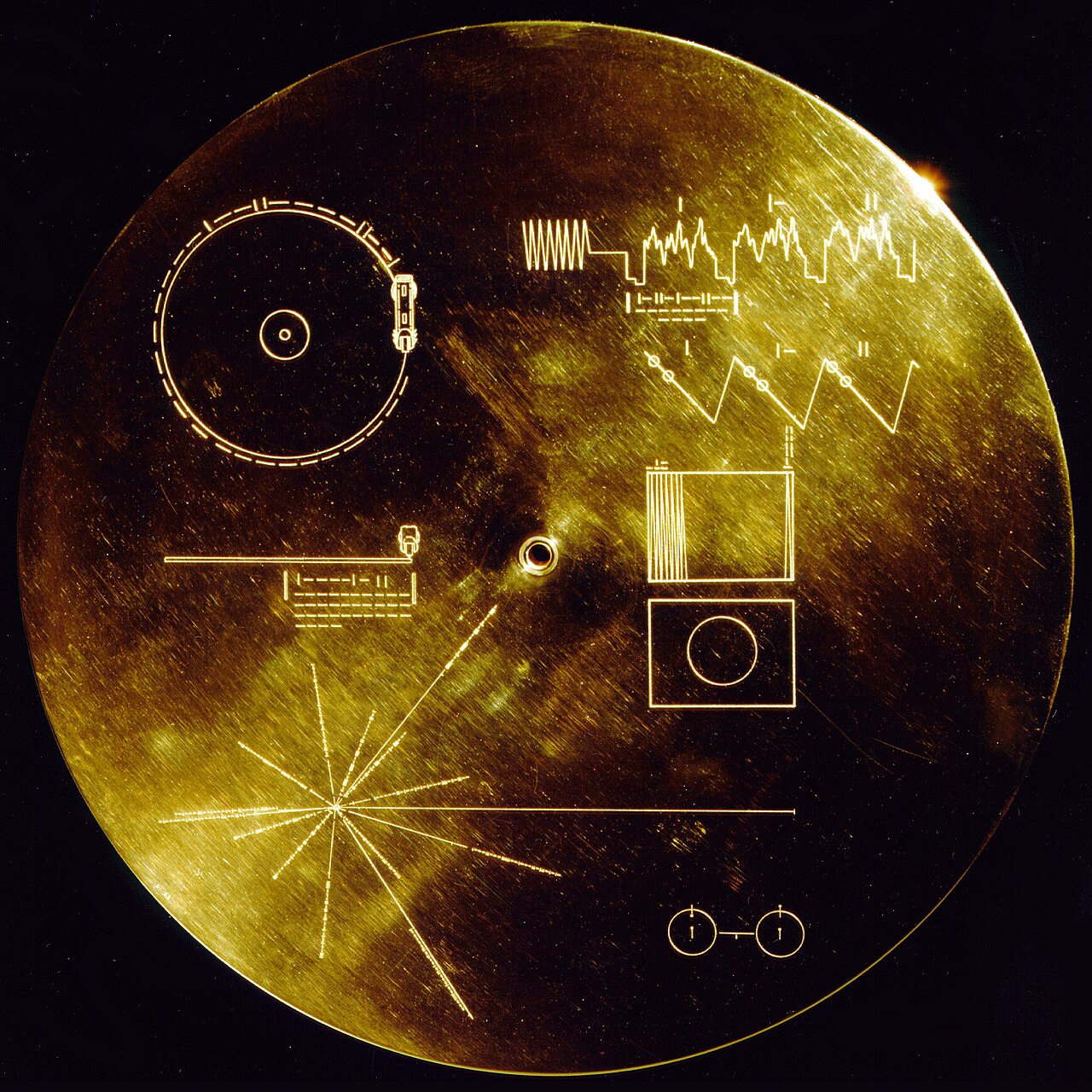
Both Voyager spacecraft carry a 12-inch, gold-plated copper phonograph record intended as a time capsule for any advanced civilization that might one day find it.
The Golden Record contains 115 images, natural sounds from Earth, 90 minutes of music and greetings in 55 languages. Instructions etched into its protective cover explain how to play the record and show Earth’s location relative to pulsars.
It is unlikely to be found anytime soon. Voyager 1 is traveling toward a star called Gliese 445 and is expected to pass within about 1.7 light-years of it—in roughly 40,000 years.
The last look home
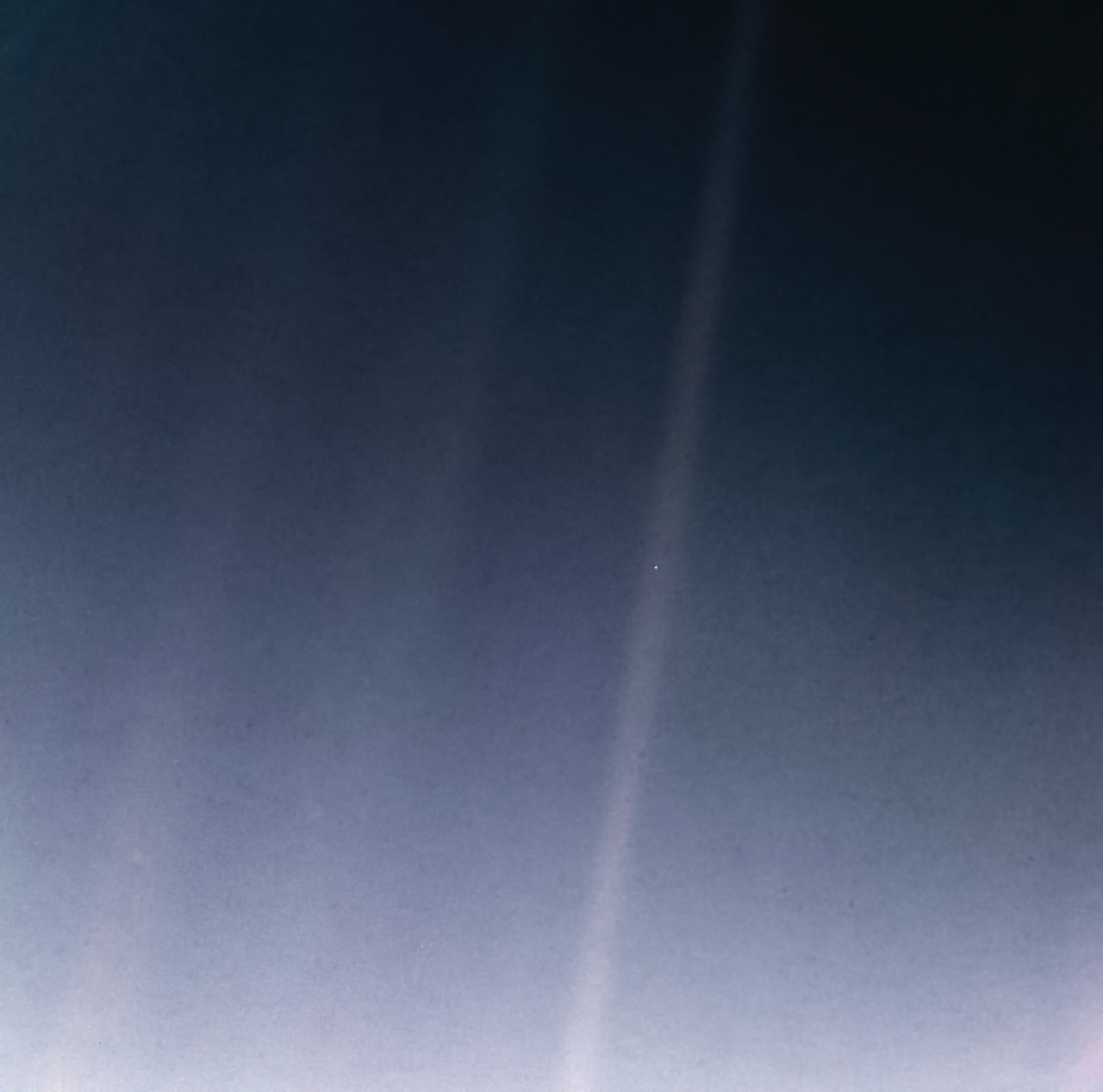
On Feb. 14, 1990, mission controllers told Voyager 1 to turn its cameras back toward the solar system before shutting them down to conserve power. From about 3.7 billion miles away, it photographed Earth as a tiny point of light suspended in a scattered sunbeam.
The image became known as the Pale Blue Dot. Earth occupied less than a single pixel. That photograph was taken when Voyager was only a fraction of its present distance from home.
How to join NASA’s salute
NASA is inviting people around the world to mark the milestone after sunset Tuesday, Nov. 17, by flashing Voyager’s call sign—V-G-R—in Morse code toward the sky. Participants can use a flashlight or NASA’s automated phone and tablet flasher.
The Morse-code pattern is V: •••—, G: ——•, and R: •—•.
The light will not reach or be detected by Voyager; NASA describes it as a symbolic worldwide wave of golden light honoring humanity’s farthest explorer. Instructions and the automated flasher are available on NASA’s Shine Bright for Voyager page.
NASA will also host a live Voyager discussion Thursday, Nov. 19, at 11 a.m. Central, featuring mission leaders and scientists. The program will stream on NASA Live.
Voyager 1 will not notice when the cosmic odometer rolls past one light-day. The moment is really for those of us still here—to look up, flash three letters into the dark and remember that a machine built in the 1970s is still carrying a small piece of Earth into the space between the stars.
Sources: NASA and NASA’s Jet Propulsion Laboratory. Facts checked Nov. 15, 2026.
Image credits: Voyager 1 launch — NASA, KSC-77P-232; Pale Blue Dot Revisited — NASA/JPL-Caltech; Voyager Golden Record cover — NASA/JPL.