Junction: A Kimble County Seat at the Meeting of Two Rivers
The Handbook of Texas traces Junction from an 1876 county-seat town at the meeting of the North and South Llano rivers to a 1929 courthouse later marked as a Recorded Texas Historic Landmark.
Junction serves as Kimble County's seat. It stands on U.S. Highway 83 about ninety-eight miles southeast of San Angelo, at the place where the North and South Llano rivers meet. That setting, and most of the history that follows, comes from the Handbook of Texas entry by Nolan Thompson, first published in 1952 and last revised Feb. 1, 1995.
The Handbook says the town got its start in spring 1876, once Kimble County had been organized in January of that same year. It was first called Denman, for its surveyor, then Junction City in 1877, and Junction in 1894. Junction City took the county seat from Kimbleville late in 1876, once the first session of county court had been held, the entry says, probably because Kimbleville was prone to floods. By 1879 the new seat already had a drugstore and a livery barn, a sawmill, and at least two general stores. Mail service, started in 1876, shifted in 1879 from someone's home onto the square. In 1882 the county's first paper, named the West Texan, appeared in town.
Fires, a 1929 courthouse, and water from the South Llano
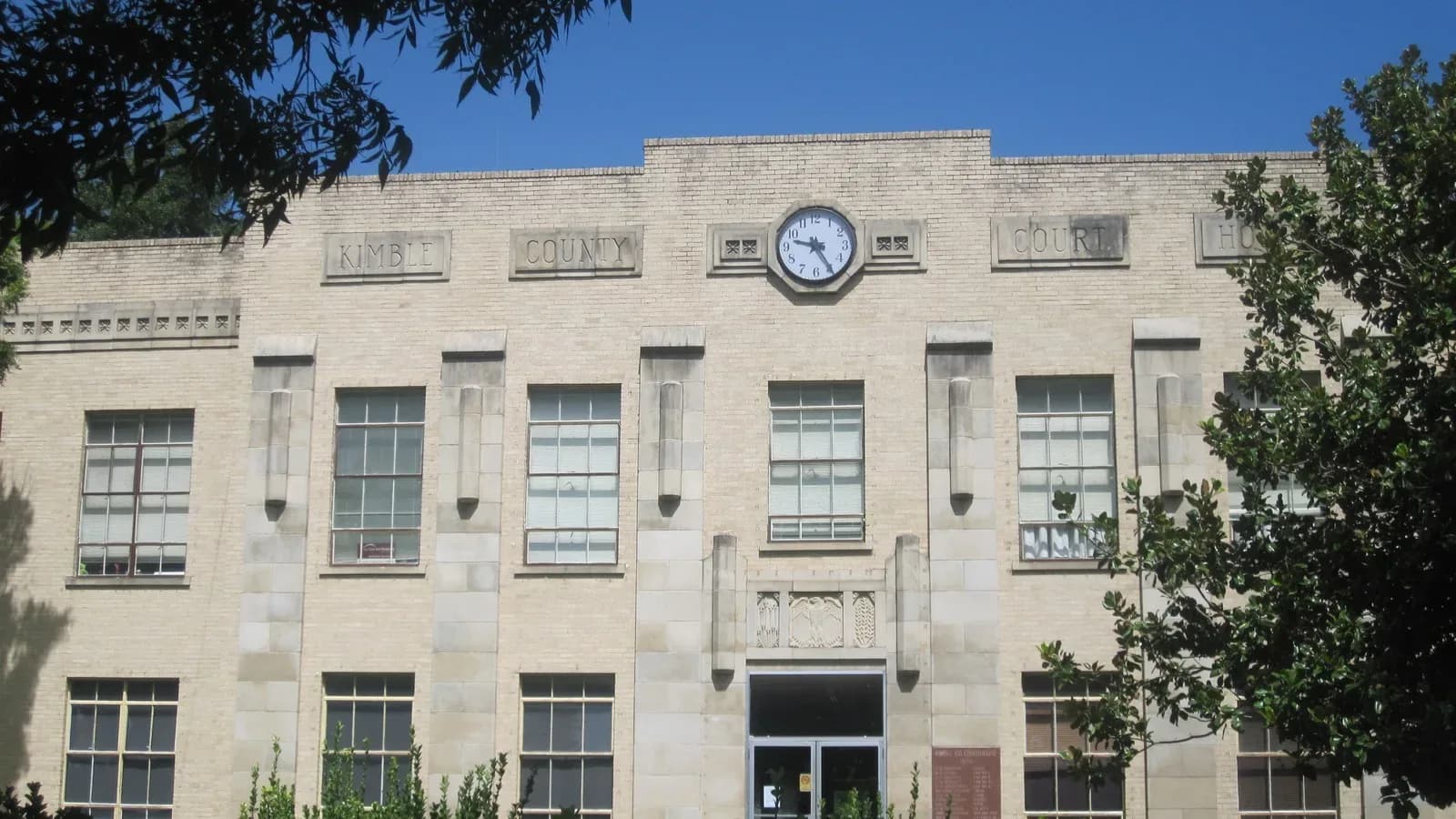
The Handbook records that the first courthouse, finished in 1878, burned six years later and the county's records were lost. A two-story stone building that followed was damaged by another fire in 1888, then patched and kept in service until the courthouse still standing was completed in 1929. A Texas Historical Commission marker erected in 2000, at 501 Main Street, calls this the third courthouse to serve Kimble County. The official marker text says San Antonio architect Henry Truman Phelps (1871-1944) designed it, after planning courthouses in more than ten Texas counties between 1904 and the early 1930s. Phelps started from Classical models, the marker says, but the finished building shows Art Moderne influence. The marker points to geometric ornament, pilasters in cast stone, a stepped parapet, and a belt course laid in a square pattern. The state listed the building as a Recorded Texas Historic Landmark in 2000.
Water came early. The Handbook credits businessman Ernest Holecamp with the town's first waterworks: a canal he had cut from the South Llano River into town in 1895. A dam on the South Llano in 1896 supplied power, water, and irrigation, and Four Mile Dam, a larger system, was finished in 1904.
The Handbook gives the 1900 population as 536, then 800 in 1910 and 1,250 by 1920. Automobiles reached town in the 1910s; filling stations opened around 1916 or 1917, the livery stable had closed by the early 1920s, and the streets were graveled and given electric lights. By the mid-1920s there were highway connections to San Angelo and Menard. Baptist, Christian, Episcopal, and Methodist Episcopal congregations were in place by 1881, when Methodist circuit rider Andrew Jackson Potter organized the Methodist Episcopal church, the entry says. By 1933, the Handbook also records a Catholic parish and a Church of Christ congregation. The town had incorporated by 1930, when the census counted 1,415 people. The population table published with the Handbook entry lists 2,654 in 1990, 2,618 in 2000, 2,451 in 2020, and 2,494 in 2021. Those later counts are from the Handbook's table, not a 2026 census. The 1995 narrative also sketches livestock, wool, mohair, pecans, hunting, tourism, and a cedar-oil plant; those details are not treated here as a current business directory.
The City of Junction's official contacts page lists City Hall at 730 Main Street, Junction, TX 76849, telephone (325) 446-2622, and a fax number of (325) 446-3003. That address is City Hall, not the county courthouse at 501 Main Street.
Related reading: Carthage: A Panola County Seat Built at the County's Center.