Hondo: A Railroad Town That Became Medina County's Seat
Hondo began as a Galveston, Harrisburg and San Antonio Railway town in 1881, took the Medina County seat from Castroville in 1892, and still uses its 1893 limestone courthouse.
Hondo is Medina County's seat, along U.S. 90 and what the Handbook of Texas calls the Southern Pacific line. The Handbook puts the town a little more than forty miles west of downtown San Antonio. Most of the history that follows comes from the Handbook entry by Martin O. Noonan, first published in 1952 and last revised Feb. 1, 1995, along with two Texas Historical Commission markers in town.
The Galveston, Harrisburg and San Antonio Railway entered Medina County from its eastern side during 1881, the Handbook says, and the first lot in the railroad's Hondo City survey changed hands on Oct. 1, 1881. A 1998 official state marker at 1600 Avenue M, whose text is dated 1999, adds that the railroad had looked at a busy village on Hondo Creek for a depot, then selected a 188-acre site five miles to the west of that older settlement, and that the first deeds were signed in 1881. A post office under the name Hondo City opened in 1882, both sources agree. In 1895 the post office name was shortened to Hondo, the Handbook says, and a court fight over the east side of the townsite stopped building work until the case ended in 1891.
Castroville had been the county seat. The Handbook says voters on Aug. 27, 1892, moved that role to Hondo. A 1984 Recorded Texas Historic Landmark marker for the Medina County Courthouse, at 1100 16th Street (FM 462, also called Avenue M, at 16th Street), also dates the change to an 1892 election and says commissioners immediately ordered a courthouse at the new seat. The Handbook says the building was finished in 1893 on a block the railroad's president had given a decade earlier. The 1998 town marker likewise records a railroad gift of courthouse land in 1883, made with the seat's possible move already in view, and the 1892 relocation to Hondo City.
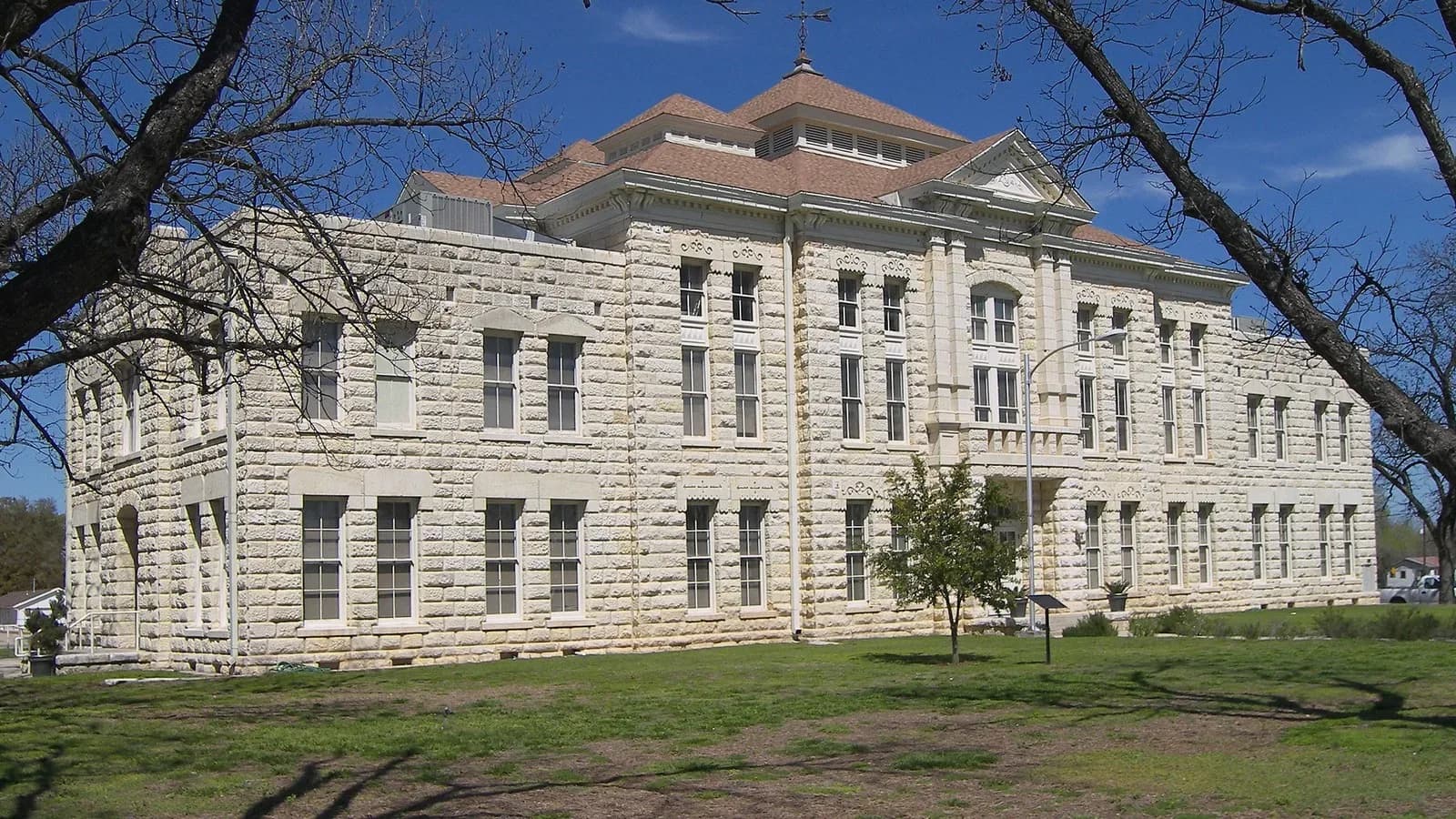
The 1984 courthouse marker gives the building's own details. Under County Judge B. Brucks, it says, the contract went to Martin, Byrne & Johnson, and stone of a slightly yellow tint came from Joe Decker's ranch, about six miles north of town. The courthouse, completed in 1893, housed the usual county officers — judge, tax assessor, treasurer, attorney, and the county and district clerk — and a large courtroom upstairs. Between 1939 and 1942, the marker says, two two-story wings were added, again using Decker Ranch limestone. It describes a Classical Revival building with some Italianate influence, rusticated walls, a portico at the entry, and, in the marker's words, “a broken triangular pediment, and stone hood molds with incised Eastlake designs.” The Handbook, covering those same years, records that two annexes were added around the end of the 1930s and the start of the 1940s, that plumbing was run indoors, and that, in the Handbook's words, “the distinctive tower was removed.” It also says a large interior remodeling finished by Feb. 28, 1988. Those points about the tower, plumbing, and 1988 work come from the Handbook, not from the 1984 marker.
The Handbook puts the 1884 population at 25, the 1892 count at 200, and the 1915 count at 2,500, and says the town soon became a trade and shipping point for farms and ranches. In the early 1900s, the entry says, most downtown business buildings went up, chiefly of D'Hanis brick. The 1998 marker also calls early-twentieth-century Hondo a place of trade and a cotton shipping point, notes that oil was found in the 1920s, and says the population “by 1940 it reached 2,500.” The Handbook's 1915 figure and the marker's 1940 figure are not the same claim, and this report does not treat them as one number.
The Handbook dates the town's incorporation to May 14, 1942. In that same year, it says, the army laid out Hondo Army Airfield on 3,675 acres inside the town. The 1998 marker says the population jumped in 1942 when a U.S. Army Air Corps field opened northwest of town, that the federal government provided school funds and a sewage system, and that the marker's peak estimate for Hondo is 12,000 people. Both the Handbook and the marker say operations at the base ended in 1946. The Handbook adds that civilian contract flight training and Air Force cadet screening continued, and that the town owns the base. The marker says civilian pilot training ran through the 1950s. The marker's remark that the 1998 population was more than 8,000 is left as a 1998 statement, not a current count.
Population figures in the 1995 narrative and in the table published with the Handbook entry do not always match. The narrative gives 6,081 for 1990; the table lists 6,018 for that census year. This account uses the table: 4,188 in 1950, 4,992 in 1960, 5,487 in 1970, 6,057 in 1980, 6,018 in 1990, 7,897 in 2000, 8,803 in 2010, 8,289 in 2020, and 8,387 in 2021. Those later figures are from that table, not a 2026 census.
The City of Hondo's official contact page lists the city office at 1600 Avenue M, Hondo, Texas 78861, telephone 830-426-3378, fax 830-426-5189. That is the same street address the 1998 town marker gives, not the courthouse at 1100 16th Street.
Related reading: Floresville: A Wilson County Seat Named for the Flores Family.