The History of Fredericksburg, Texas
Fredericksburg, Texas (ZIP 78624) was laid out in 1846 by German immigrants under John O. Meusebach, who made a treaty with Comanche chiefs on the San Saba the next spring. Its eight-sided Vereins-Kirche was torn down in 1897; the one in the market square is a 1936 replica.
Editor’s note. This is the twenty-sixth installment of “Texas Towns: The Stories Behind the Map.” The last one went to Goliad, on the San Antonio River, where Spain built a presidio and the Texas Revolution saw its worst day. This one goes up into the Hill Country, to a town German immigrants laid out in 1846, two years after Henri Castro’s colonists founded Castroville west of San Antonio. Fredericksburg had its own plan: one long main street, a town lot and ten acres for every family, and a treaty with the Comanches.
Fredericksburg, Texas, is the county seat of Gillespie County, about seventy miles west of Austin in the center of the county. U.S. Highway 87 runs through it on the way from San Antonio and Boerne toward Mason, U.S. Highway 290 crosses it between Johnson City and Junction, and State Highway 16 passes through between Llano and Kerrville. For almost thirty years it also had a railroad, a short line south to a junction in Kendall County; the last train ran in 1942. The mailing ZIP is 78624. [1] [16] [17] [18] [11]
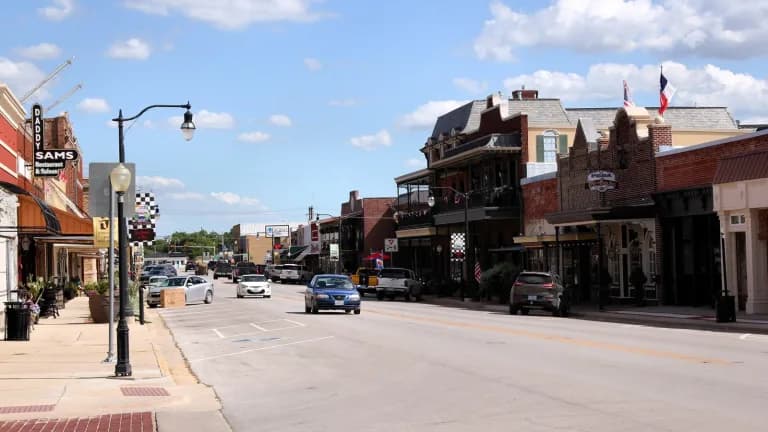
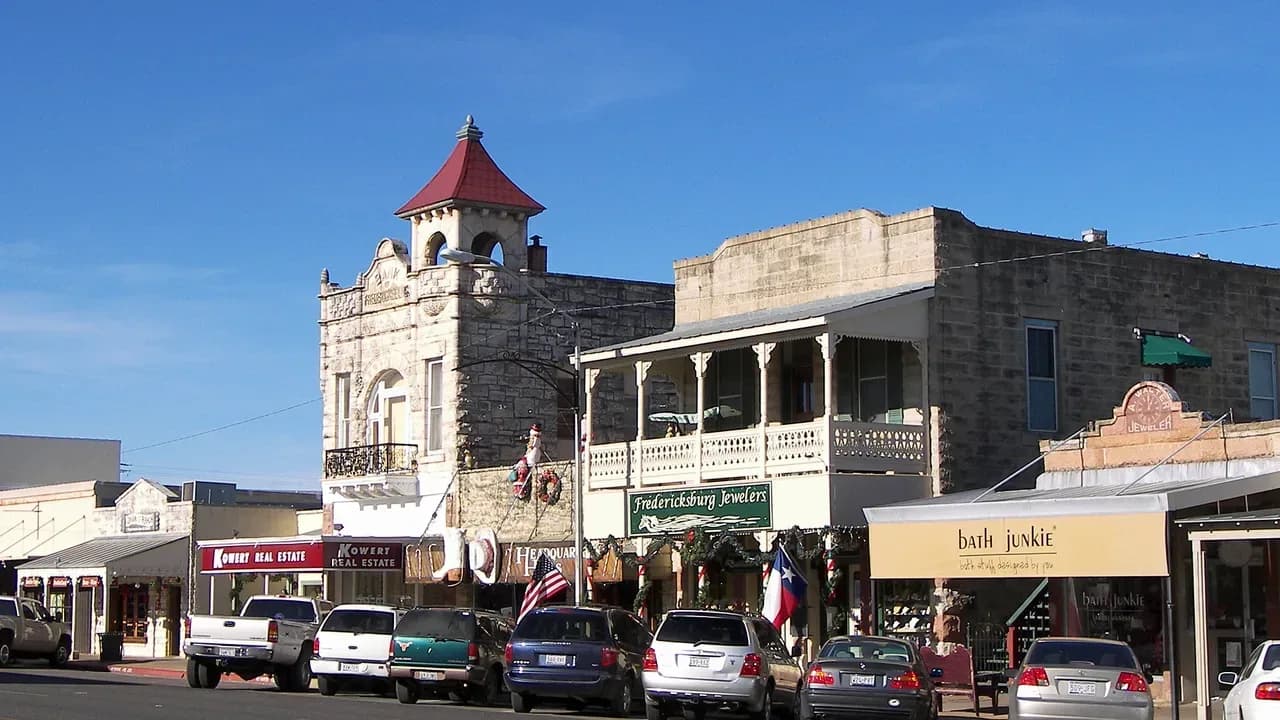
The 2020 Census counted 10,875 people in the city. A visitor today sees a wide Main Street lined with old limestone buildings, a small eight-sided church standing in the old market square, and a hotel built to look like a steamboat. Most of that has a documented history, and some of it is a reconstruction. This article tries to say which is which. [14] [6] [8]
Before 1846: Tonkawas, Comanches and the Pinta Trail
The first known residents of what became Gillespie County were Tonkawas. By the nineteenth century Comanches and Kiowas had moved into the area as well. The land between the Llano and Colorado rivers, north of the future town, was Comanche hunting ground. [2] [4]
A native path later called the Pinta Trail ran between the site of San Antonio and the country around present Fredericksburg. Spanish explorers used it after they founded San Antonio de Béxar in the early 1700s, but for the most part it went back to being a native pathway. When German immigrants pushed on from New Braunfels to found Fredericksburg, they used a trail that joined the Pinta above San Antonio and turned it into a road for settlers. After Boerne was founded in 1852, a new wagon road through Boerne and Sisterdale became the favored route, and by 1854 the lower Pinta Trail was virtually abandoned. [13]
1845–1846: Meusebach’s second colony
Fredericksburg was the second colony of the Adelsverein, the Society for the Protection of German Immigrants in Texas, organized in 1842 by twenty-one German noblemen, which had founded New Braunfels in 1845. Its new commissioner general was Baron Otfried Hans von Meusebach, a university-trained lawyer and Prussian administrator who set aside his title soon after he reached Texas and went by John O. Meusebach. The society meant its towns to be stepping stones from the coast to the Fisher-Miller Land Grant, the immigrants’ intended destination north of the Llano River. [5] [3] [1]
In August 1845 Meusebach left New Braunfels with a surveying party and chose a tract about sixty miles to the northwest, where two creeks met four miles above the Pedernales River. The creeks were later named Barons Creek, in Meusebach’s honor, and Town Creek. The Handbook’s town entry says he was impressed by the water, stone and timber and arranged to buy 10,000 acres on credit. Its entry on the Adelsverein says he bought “over 11,000 acres of headright land.” We print both figures. [1] [5]
The first wagon train of 120 settlers arrived from New Braunfels on May 8, 1846, after a sixteen-day trip, with an eight-man military escort supplied by the society. Surveyor Hermann Wilke laid out the town, and Meusebach named it Fredericksburg for Prince Frederick of Prussia, a member of the Adelsverein. Each settler received one town lot and ten acres of farmland nearby. The plan copied the villages along the Rhine that many of the colonists had left: one long, wide main street running roughly parallel to Town Creek. [1]
The first houses were simple, post oak logs set upright in the ground. They were soon replaced by Fachwerk houses, a frame of upright timbers with the spaces filled with rock and then plastered or whitewashed. More wagon trains came through the summer. So did disease. An epidemic that spread from Indianola and New Braunfels killed between 100 and 150 people in Fredericksburg in the summer and fall of 1846. Even so, the Handbook says, within two years the town had grown to almost 1,000 people. [1]
March–May 1847: the treaty with the Comanches
The society’s grant had to be at least partly settled and surveyed by the fall of 1847, and surveyors would not go into Comanche country without protection the state could not give. In January 1847 a mounted party of Germans, Mexicans and several American surveyors set out from Fredericksburg, and Meusebach joined them two days later. Gov. J. Pinckney Henderson sent a messenger to warn him of the consequences of entering Indian territory, but by then talks had already begun. [4] [3]
The final sessions were held March 1 and 2, 1847, on the lower San Saba River. The head chiefs included Buffalo Hump, Santa Anna and Mopechucope, or Old Owl. The Comanches called Meusebach El Sol Colorado, for his red beard. Under the treaty the settlers could go into Indian territory unharmed and the Comanches could come to the settlements; each side promised to report wrongdoing; and the San Saba lands could be surveyed. The Handbook’s treaty entry says the Indians were to be paid at least $1,000; its Meusebach biography says he promised presents worth $3,000. The two entries also describe the ending a little differently: one says the treaty was ratified in Fredericksburg two months later, the other that the chiefs came to Fredericksburg on May 9, 1847, to sign it and collect their gifts. [4] [3]
The treaty opened more than three million acres to settlement. The Handbook’s town entry says it effectively eliminated the threat of Indian attack on Fredericksburg. The Fort Martin Scott entry is more careful: the treaty lasted, it says, but the flood of settlers into the Pedernales valleys still led to skirmishes, and in 1850 the frontier came to the brink of open warfare before a council led by Indian agent John Rollins produced the Fort Martin Scott Treaty, which kept open hostilities from breaking out. The original treaty document was returned from Europe in 1970 by two of Meusebach’s granddaughters and given to the Texas State Library in 1972. [4] [1] [7]
1847–1853: a church in the street, a county, a fort
The first public building in town was the Vereins-Kirche, the Society Church, built by the first settlers in 1847 to a design by a Dr. Schubert of the Adelsverein. It was an octagon, eighteen feet to a side, with an eight-sided cupola, and it stood in the middle of Main Street. People called it the Kaffeemühle, the coffee mill. For fifty years it served as church, school, town hall and, when needed, fortress. [6] [1]
At first, the Handbook says, every congregation held services there. The Catholics, whose first services were led by Johann Leyendecker, used it until 1848, when they built their own church. The Methodists, organized in 1849, stayed until 1855; an orthodox Lutheran congregation organized in 1850 stayed until 1853; and the Lutherans led by the Rev. F. Basse and later the Rev. Gottlieb Burchard Dangers met there until 1886. In 1848 a German missionary, Father Menzel, put up a large wooden cross on Cross Mountain just north of town. The group that left the Evangelical Protestants in 1852 formed Zion’s Evangelical Lutheran Church, whose building, finished in 1853, was the first Lutheran church in the Hill Country. In 1860 the Catholics’ first church was replaced by the Marienkirche, old St. Mary’s. The Historic American Buildings Survey photographed it in 1934. [6] [1] [2] [21]
The Germans were serious about school as well as church. Leyendecker opened the first school in 1847, in the Vereins-Kirche. Jacob Brodbeck and then Dangers followed him, and Heinrich Ochs, who took over in 1852, remained a figure in the town until his death in 1897. The first public school, with August Siemering as teacher, and the first official Catholic school both opened in 1856. [1] [6]
On December 15, 1847, 150 settlers petitioned the legislature for a new county, which they suggested calling Pierdenales or Germania. The legislature created it on February 23, 1848, named it for Capt. Robert A. Gillespie, a hero of the Mexican War, and made Fredericksburg the county seat. [2]
On December 5, 1848, Capt. Seth Eastman of the First U.S. Infantry established Camp Houston two miles southeast of town on Barons Creek. It was renamed Fort Martin Scott in December 1849. The soldiers were the one steady source of hard cash for Fredericksburg’s merchants and laborers. By 1853 the frontier had moved west, and the army closed the post in December of that year. After the Mexican War the town also profited from being the last town before El Paso on the Upper El Paso Road. [7] [1] [2]
Nearby, in 1847, a group of Mormons under Lyman Wight, whom the Handbook calls a “renegade” Mormon leader, founded a settlement called Zodiac. The Handbook says the Germans’ tradition of religious tolerance helped persuade him to settle there. [2] [1]
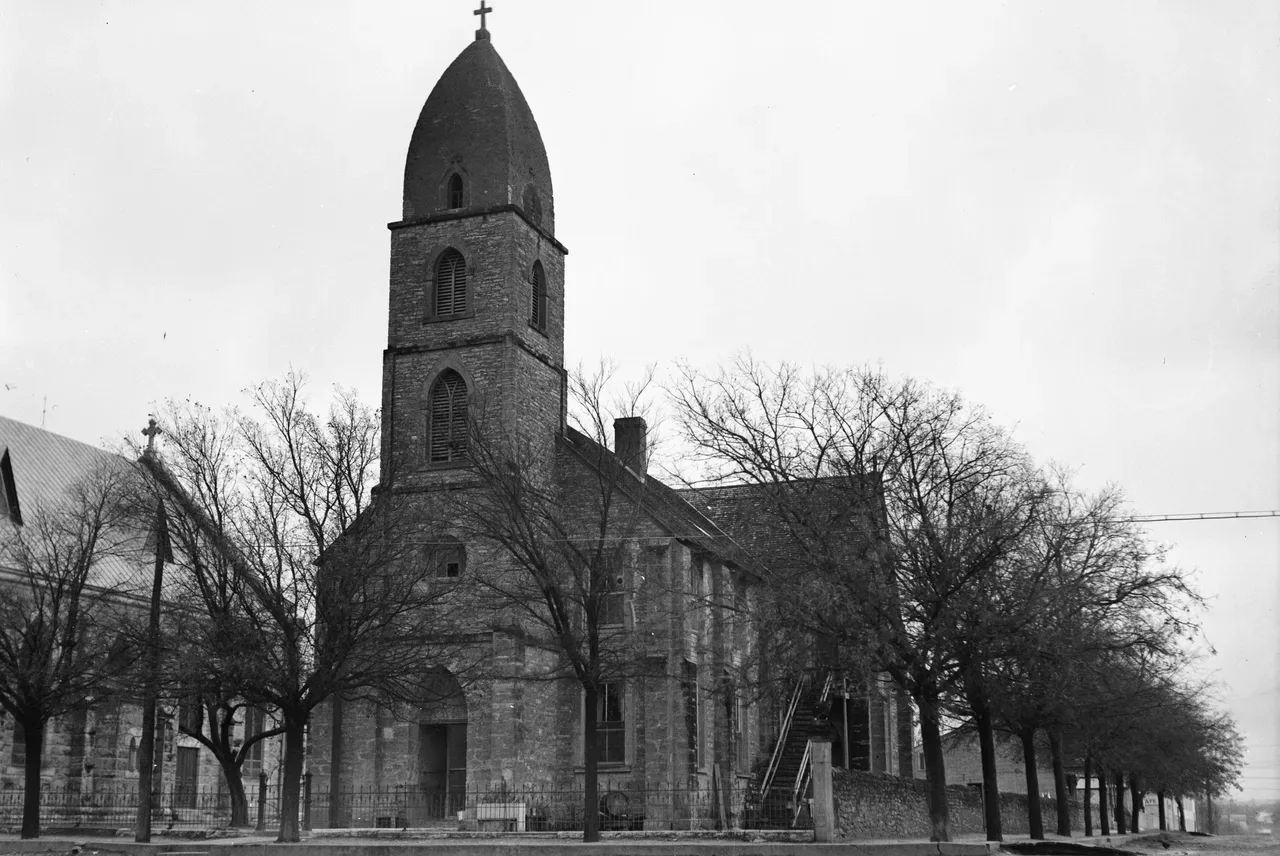
Old St. Mary’s Catholic Church on San Antonio Street, photographed for the Historic American Buildings Survey on January 17, 1934. The Handbook of Texas says the Catholics’ first church of 1848 was replaced in 1860 by the Marienkirche, or old St. Mary’s, and that a surviving cluster of Sunday houses stands nearby on West San Antonio Street. This is the church as it looked in 1934, not in 1860. Emil Niggli for the Historic American Buildings Survey, Library of Congress Prints and Photographs Division (HABS TEX,86-FREBU,5-2), public domain.
1860–1867: Union votes, martial law and the Nueces
Cotton did not do well in Gillespie County, and slaveholding was never an important part of its economy. But it existed. The census found five enslaved people in the county in 1850; a count in 1858 found ninety, and the 1860 census found thirty-three. The Handbook says many of Fredericksburg’s Germans opposed slavery and secession on principle. In 1860 the county’s voters rejected secession 400 to 17. [2] [1]
That did not make the town one-sided. Charles H. Nimitz, the hotel keeper, organized the Gillespie Rifles for the Confederate army and was later the enrolling officer for the frontier district. The Fredericksburg Southern Aid Society raised more than $5,000 in food and clothing for Confederate soldiers in 1861. By March 1862 fifty-four county men had joined the Confederate army, and about 300 more joined home-defense units to avoid conscription. [1] [2]
Pro-Confederate neighbors still distrusted the county. On May 30, 1862, Gen. Philemon T. Herbert put Central Texas under martial law, and a Confederate irregular named James Duff was put in charge of Gillespie and Kerr counties. A party of Hill Country Unionists, mostly Germans, set out for Mexico rather than swear allegiance. On the morning of August 10, 1862, Confederate troops attacked their camp on the Nueces River in Kinney County. [2] [10]
The two Handbook accounts of what followed do not agree on the numbers. The Gillespie County entry says Duff’s men killed thirty-five of the sixty-one fleeing Germans. The entry on the battle itself says sixty-one to sixty-eight Unionists were in the camp, that nineteen were killed in the fighting and nine wounded men were executed a few hours later, and that eight more were killed on October 18 while trying to cross into Mexico. Confederates called it a military action against insurrectionists; many German Hill Country families called it a massacre. The remains were later buried at Comfort, in Kendall County, under the Treue der Union monument, dedicated August 10, 1866. [2] [10]
The county entry says the killings shocked Gillespie County and that some 2,000 people took to the hills to escape Duff. Outlaws, some of them unofficial Southern partisans and some simply opportunists, robbed and killed through the rest of the war. One of the most notorious, James P. Waldrip, was shot by an unknown gunman under a live oak outside the Nimitz Hotel in 1867. [2] [1]
1847–1906: the steamboat hotel
The Handbook’s town entry lists the Nimitz Hotel among the things built in the colony’s first two years. Its entry on the hotel says only that the original building went up on Main Street in the late 1840s or early 1850s and that Charles H. Nimitz, a German immigrant and former seaman, acquired it in 1855. It had four rooms and a large fireplace. Nimitz rebuilt it of adobe and wood and eventually expanded it to fifty rooms, with a saloon, a brewery, a general store, a stagecoach stop behind a stone wall and a bathhouse that reportedly offered the only hot baths between San Antonio and El Paso. [1] [8]
The guest list the Handbook gives includes Robert E. Lee, Ulysses S. Grant, Philip H. Sheridan, James Longstreet, Rutherford B. Hayes and William Sydney Porter, the writer O. Henry. Sometime after 1888 Nimitz added the steamboat-shaped superstructure that gave the hotel its look. He deeded the hotel to his son in 1906 and lived there until his death on April 28, 1911. [8]
1877–1928: a German town, a fair and a railroad
The war hardened the Germans’ wish to stay out of state and national affairs. The Handbook says they held to their language: the county’s first newspaper, the German-language Fredericksburg Wochenblatt, began in 1877; a freighter who hauled from Austin in the 1880s said the sheriff was the only person in town who could interpret for him; and the public schools did not hire teachers who spoke only English until after 1900. In presidential elections from 1880 to 1992 the county voted Democratic only four times, and in 1887 it voted against prohibition 1,186 to 59. [1] [2]
For the town’s fiftieth anniversary in 1896, newspaperman Robert G. Penniger wrote a German-language jubilee history that the Handbook still calls the most authoritative history of early Fredericksburg. The Vereins-Kirche served as a pavilion for that celebration. The next year, fallen into disrepair and regarded as an obstruction to traffic on Main Street, it was torn down. [1] [6]
Fredericksburg, New Braunfels and Castroville were all laid out as farm villages on the European plan, with farmers expected to live in town and go out to their fields. Soon, though, families moved out onto their land, and the churches stayed in town. Many families built small weekend houses on their town lots, coming in Saturday to shop and spend the night and staying for church Sunday. These Sunday houses usually had one or two rooms, often of frame rather than rock, with an outside stair to an attic where the children slept, a lean-to kitchen and no running water. The Handbook says that in Texas they were almost entirely a Hill Country German custom, especially in Gillespie County. The custom began to die out in the 1920s with better roads and cars. The Historic American Buildings Survey recorded one of them, the Staudt house on West Creek Street, in 1934. [9] [20]
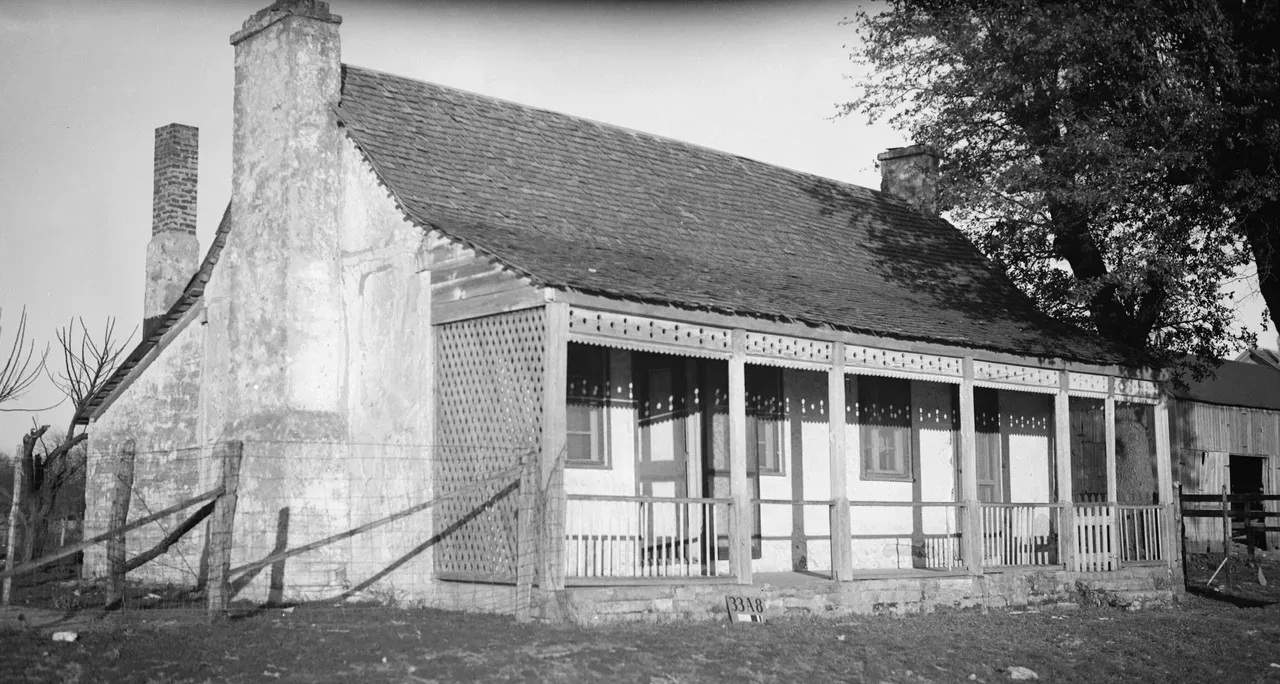
The Staudt Sunday house at 512 West Creek Street, photographed March 10, 1934, by Bartlett Cocke for the Historic American Buildings Survey. Sunday houses were the small town houses where farm families stayed for Saturday shopping and Sunday services. The photograph shows this one house in 1934; it is not a picture of how the street looked when the custom began. Bartlett Cocke for the Historic American Buildings Survey, Library of Congress Prints and Photographs Division (HABS TEX,86-FREBU,2-1), public domain.
The town was opening up anyway. The first Gillespie County Fair was held in 1881 at old Fort Martin Scott and moved into Fredericksburg in 1889; the Handbook says it was celebrated as the first in Texas. Electric lights came in 1896 and an ice factory in 1907, and the estimated population reached 1,632 by 1904. [1]
The first train of the San Antonio, Fredericksburg and Northern Railway arrived on November 17, 1913, and the town celebrated for three days. The line ran twenty-four miles south to Fredericksburg Junction on the San Antonio and Aransas Pass in Kendall County. It was sold at foreclosure in 1917 and reorganized as the Fredericksburg and Northern, which showed profits in the 1920s but could never carry the debt from its purchase. Better roads killed it. The town entry gives the last day as July 25, 1942; the railroad’s own entry gives July 27, 1942. [1] [11]
1885–1966: a grandson in the Pacific
Chester William Nimitz was born in Fredericksburg on February 24, 1885. His father died before he was born, and his grandfather, the hotel keeper, was the father figure he credited with shaping his character. He graduated from the Naval Academy in 1905 and became one of the navy’s leading submarine officers. [12]
He took command of the Pacific Fleet at Pearl Harbor on Christmas Day, 1941, less than three weeks after the Japanese attack, and he signed the surrender for the United States aboard the battleship Missouri in Tokyo Bay on September 2, 1945. He died on February 20, 1966, and is buried at Golden Gate National Cemetery in California, not in Texas. [12]
By then his grandfather’s hotel had closed. Local owners bought it in 1926, spent $125,000 remodeling it and took off the steamboat front. It closed in the fall of 1963, was sold in 1964 to a nonprofit naval museum and reopened as a museum on the admiral’s birthday in 1967. The steamboat appearance has since been reconstructed. Today it is part of the National Museum of the Pacific War, a Texas Historical Commission property operated by the Admiral Nimitz Foundation. [8] [19]
1928–2025: incorporation, a replica and a modern count
In the spring of 1928 Fredericksburg voted to incorporate. For eighty-two years it had refused, reasoning that the county government was enough and there was no sense in paying two sets of officials. At the time of the vote, the Handbook says, it was the largest unincorporated town in the United States. The 1930 census, the first in which Fredericksburg was included, found 2,416 people. The figures then rose steadily: 3,544 in 1940, 3,847 in 1950, 4,629 in 1960, 5,326 in 1970, 6,412 in 1980, 6,934 in 1990 and 8,911 in 2000. [1]
Through those years Fredericksburg was the county’s manufacturing center, at one time or another home to a furniture factory, a cement plant, granite and limestone quarries, a poultry-dressing plant, a peanut-oil plant, a mattress factory, a sewing factory and a tannery. As early as 1930 it was also becoming known as a resort town. [1] [2]
The Gillespie County Historical Society, founded in 1934, set out first to rebuild the Vereins-Kirche. With help from the Civil Works Administration, a replica was finished for the 1936 Texas Centennial in the old market square. It uses the original cornerstone and follows the original design, but its walls are stone rather than half-timbered Fachwerk. So the coffee mill a visitor sees today is the 1936 building, not the 1847 one, and it stands in the market square rather than in the middle of Main Street. [6] [1]
The 2020 Census counted 10,875 people in Fredericksburg, up from 10,530 in 2010. The Census Bureau’s estimates program starts from a slightly different 2020 base of 11,009 for the city and estimated 11,893 residents on July 1, 2025. A count and an estimate are different measures, and we print both rather than blend them. [14] [15]
The complete story of Fredericksburg
It is the story of 120 people who came up from New Braunfels in sixteen days in the spring of 1846 and laid out a Rhine village on a Texas creek, and of the 100 to 150 townspeople an epidemic killed before the first year was out. It is the story of a treaty made on the San Saba with Buffalo Hump, Santa Anna and Old Owl, and of an army post that came anyway. It is the story of an eight-sided church in the middle of the street, of Lutherans, Catholics and Methodists who shared it until each could build its own, and of farm families who kept small houses in town so they would never miss a Sunday. It is the story of a county that voted against secession and still held thirty-three people in slavery in 1860, of men killed on the Nueces, and of a hotel keeper who organized a Confederate company and a grandson who signed Japan’s surrender for the United States. The church in the square is a copy. The record behind it is not.
Questions people ask
Who founded Fredericksburg, Texas? John O. Meusebach, commissioner general of the Adelsverein, the Society for the Protection of German Immigrants in Texas. The first 120 settlers arrived May 8, 1846, and the town was named for Prince Frederick of Prussia. [1] [3]
Is it true the Meusebach-Comanche Treaty was never broken? The Handbook entries used here do not make that claim either way. They say the treaty, signed in 1847, opened more than three million acres to settlement and let settlers and Comanches travel into each other’s territory. The Fort Martin Scott entry adds that settlement still brought skirmishes and a near war in 1850. The original document is at the Texas State Library. [4] [7]
Is the Vereins-Kirche original? No. The 1847 building was torn down in 1897. The one in the market square is a stone replica finished in 1936, built with the original cornerstone. [6]
What is a Sunday house? A small second house in town, usually one or two rooms, where a farm or ranch family stayed for Saturday shopping and Sunday church. The Handbook says a cluster survives on West San Antonio Street near St. Mary’s, and others stand on West Main and South Milam streets. [9]
What is Fredericksburg’s ZIP code? 78624. Fredericksburg is the county seat of Gillespie County, on U.S. 87, U.S. 290 and State Highway 16. [2] [16] [17] [18]
Sources
Martin Donell Kohout, “Fredericksburg, TX,” Handbook of Texas Online, Texas State Historical Association, revised September 27, 2023. tshaonline.org/handbook/entries/fredericksburg-tx. The entry’s bibliography includes Don Hampton Biggers, German Pioneers in Texas (1925); Gillespie County Historical Society, Pioneers in God’s Hills (2 vols., 1960, 1974); and Sarah Sam Gray, The German-American Community of Fredericksburg, Texas and Its Assimilation (M.A. thesis, University of Texas, 1929).
Martin Donell Kohout, “Gillespie County,” Handbook of Texas Online, revised October 22, 2026. tshaonline.org/handbook/entries/gillespie-county. Its bibliography includes Rudolph L. Biesele, The History of the German Settlements in Texas, 1831–1861 (1930) and Sara Kay Curtis, A History of Gillespie County, Texas, 1846–1900 (M.A. thesis, University of Texas, 1943).
Cornelia Marschall Smith and Otto W. Tetzlaff, “Meusebach, John O.,” Handbook of Texas Online, revised May 28, 2020. tshaonline.org/handbook/entries/meusebach-john-o.
Otto W. Tetzlaff, “Meusebach-Comanche Treaty,” Handbook of Texas Online, revised December 8, 2020. tshaonline.org/handbook/entries/meusebach-comanche-treaty. Its bibliography includes Irene M. King, John O. Meusebach, German Colonizer in Texas (University of Texas Press, 1967).
Louis E. Brister, “Adelsverein,” Handbook of Texas Online, revised August 25, 2018. tshaonline.org/handbook/entries/adelsverein.
Martin Donell Kohout, “Vereins-Kirche,” Handbook of Texas Online, revised May 5, 2016. tshaonline.org/handbook/entries/vereins-kirche.
Paul R. M. Brooks Jr., “Fort Martin Scott,” Handbook of Texas Online, revised October 22, 2020. tshaonline.org/handbook/entries/fort-martin-scott.
Martin Donell Kohout, “Nimitz Hotel,” Handbook of Texas Online, revised August 23, 2016. tshaonline.org/handbook/entries/nimitz-hotel. Its bibliography includes Elise Kowert, Old Homes and Buildings of Fredericksburg (1977).
Terry G. Jordan, “Sunday Houses,” Handbook of Texas Online, revised May 4, 2016. tshaonline.org/handbook/entries/sunday-houses. Its bibliography includes Esther Mueller, “Sunday Houses of Fredericksburg,” Texas Monthly, April 1930.
“Nueces, Battle of the,” Handbook of Texas Online, revised August 8, 2025. tshaonline.org/handbook/entries/nueces-battle-of-the. Its bibliography includes Rodman L. Underwood, Death on the Nueces: German Texans Treue der Union (Eakin Press, 2002).
Victoria S. Murphy, “Fredericksburg and Northern Railway,” Handbook of Texas Online, revised September 1, 1995. tshaonline.org/handbook/entries/fredericksburg-and-northern-railway.
Robert S. Weddle, “Nimitz, Chester William,” Handbook of Texas Online, revised January 25, 2017. tshaonline.org/handbook/entries/nimitz-chester-william. Its bibliography includes E. B. Potter, Nimitz (Naval Institute Press, 1976).
Jefferson Morgenthaler, “Pinta Trail,” Handbook of Texas Online, revised August 15, 2014. tshaonline.org/handbook/entries/pinta-trail.
U.S. Census Bureau, QuickFacts, Fredericksburg city, Texas (Census 2020: 10,875; Census 2010: 10,530). census.gov/quickfacts/fact/table/fredericksburgcitytexas.
U.S. Census Bureau, Population Estimates Program, “City and Town Population Totals: 2020–2025” (sub-est2025.csv), Fredericksburg city, Texas: April 1, 2020, estimates base 11,009; July 1, 2025, estimate 11,893. census.gov sub-est2025.csv.
Texas Department of Transportation, Highway Designation File, U.S. Highway 87. dot.state.tx.us/tpp/hwy/us/us0087.htm.
Texas Department of Transportation, Highway Designation File, U.S. Highway 290. dot.state.tx.us/tpp/hwy/us/us0290.htm.
Texas Department of Transportation, Highway Designation File, State Highway 16. dot.state.tx.us/tpp/hwy/sh/sh0016.htm.
Texas Historical Commission, “National Museum of the Pacific War.” thc.texas.gov/historic-sites/national-museum-pacific-war.
Historic American Buildings Survey, Sunday Staudt House, 512 West Creek Street, Fredericksburg, Gillespie County, TX (HABS TX-33-A-8; photograph by Bartlett Cocke, March 10, 1934), Library of Congress Prints and Photographs Division. loc.gov/pictures/item/tx0333.photos.157404p.
Historic American Buildings Survey, Old St. Mary’s Catholic Church, San Antonio Street, Fredericksburg, Gillespie County, TX (HABS TX-33-C-2; photograph by Emil Niggli, January 17, 1934), Library of Congress Prints and Photographs Division. loc.gov/pictures/item/tx0208.photos.154624p.