The History of Castroville, Texas
Castroville, Texas (ZIP 78009) was founded in September 1844 by Henri Castro’s Alsatian colonists on a bend of the Medina River. The town refused to pay for the railroad and lost the Medina County seat to Hondo in 1892.
Editor’s note. This is the nineteenth installment of “Texas Towns: The Stories Behind the Map.” The series has spent most of its time in Montgomery and Grimes counties, where Anderson told a railroad no and Montgomery lost its courthouse to a railroad town. This time the story moves west of San Antonio, to a town that did both. Castroville turned down the railroad in the 1880s and watched the county seat leave in 1892. It is still standing, and so are many of the stone houses its first settlers built.
Castroville, Texas, sits on the Medina River and U.S. Highway 90, twenty-five miles west of San Antonio in eastern Medina County. The mailing ZIP is 78009. A driver on the highway passes stone buildings with steep roofs and plastered walls that look more like a village in eastern France than a Texas county town. The Handbook of Texas calls it the “little Alsace” of Texas. The railroad runs well to the south, because in 1880 or 1881, depending on which Handbook entry you read, the town would not pay for it. [1]
1842: a Paris banker’s contract
The town is named for Henri Castro, and Castro’s own story is not a frontier story. The Handbook says he was born in the department of Landes, France, in July 1786, to a family descended from Portuguese Jews who had fled to France after the Spanish Inquisition began. He served in Napoleon’s guard of honor in 1806, became a naturalized American citizen in 1827, and returned to France in 1838 as a partner in the banking house of Lafitte and Company. While trying to arrange a loan for the Republic of Texas he became interested in the young republic, and Sam Houston appointed him consul general for Texas at Paris. [2]
In 1842 the Republic gave Castro an empresario contract to settle a colony west of San Antonio. The Handbook does not agree with itself on the date. The Castroville entry says January 15, 1842. The entries for Castro’s Colony and for Medina County say February 15, 1842. This article prints both. [1] [3] [4]
The Republic had a reason. The Medina County entry says the government believed that settling this block of land would put a protective zone between San Antonio and any force approaching from the south and west, and it says Lipan Apache and Comanche raiders had crossed the region for most of the 1700s. Castro’s grant began four miles west of the Medina River, so he bought the sixteen leagues between his grant and the river from John McMullen of San Antonio. He wanted his first town on the river. [4] [1]
September 1844: a bend in the Medina
Castro recruited his colonists in France, and particularly in Alsace, the German-speaking province on the Rhine. Most were Catholic farmers. They landed on the Texas coast and were brought overland to San Antonio. [3] [1]
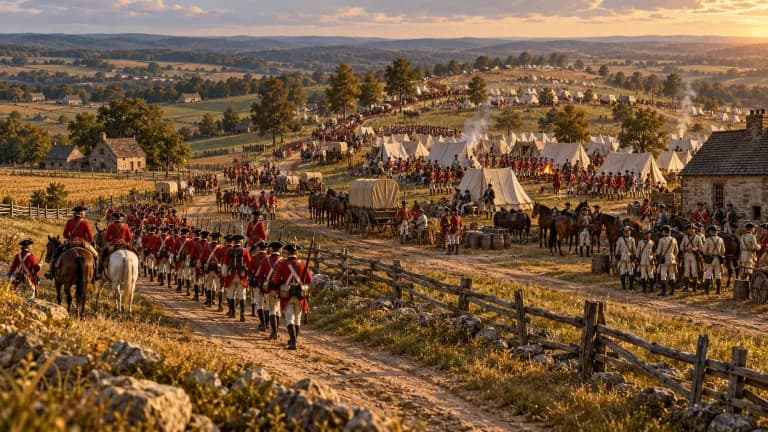
The Castro’s Colony entry says Castro left San Antonio on September 1, 1844, with his first thirty-five colonists. The Castroville and Medina County entries say September 2, and they add that Texas Ranger John Coffee “Jack” Hays and five of his rangers rode with them. All three agree on what happened next. On September 3 the party reached a level, park-like stretch covered with pecan trees near a sharp bend of the river and began building homes. Castro wrote in his memoirs that after they crossed the river, members of the party killed two deer, three bears, and one alligator and caught a great many fish. On September 12 the settlers elected two justices of the peace and a constable and adopted the name Castroville. The Medina County entry calls it the westernmost settlement in Texas. [3] [1] [4]
Castro laid the town out the way villages were laid out at home: small town lots in the center, individual farm plots around them. Settlers lived in town and walked out to their fields. John James surveyed the streets, and Castro named them for his relatives and friends and for the capitals of Europe. [1] [4]
The numbers for the whole colony are large and not perfectly consistent. The Castro entry says that between 1843 and 1847 he chartered twenty-seven ships and brought 485 families and 457 single men to Texas. The Castro’s Colony entry gives the same 485 families and 457 single men, a total of 2,134 settlers, but says they were introduced during the colony’s first year. The Handbook says Castro spent more than $200,000 of his own money supplying them. From Castroville the colony spread to Quihi in 1845, Vandenburg in 1846, and D’Hanis in 1847. [2] [3]
1844–1849: raids, drought, locusts, and cholera
The founding was the easy part. The Handbook lists what came after in one sentence: raids by Comanches and by Mexicans, droughts in 1848 and 1849, an invasion of locusts, and a cholera epidemic in 1849. It does not give a death toll, and this article does not invent one. [1]
The Medina County entry adds a fact that is easy to skip. Much of the labor needed to clear the land for homes and farms, it says, was done by Mexican laborers. Most settlers ran subsistence farms and lived on corn-meal mush, garden vegetables, and wild game while they learned that stock raising suited the country better. [4]
1846–1870: three churches named for St. Louis
Faith came with the colonists, and the record of it is unusually full. The Castroville entry says the citizens built St. Louis Catholic Church, the first church in Medina County, in 1844. The Medina County entry says the church was completed in November 1846. The Society of Architectural Historians’ survey of Texas buildings says the first St. Louis church, a simple one-story limestone building, was dedicated on November 9, 1846. The sources do not all separate the founding of the parish from the finishing of the building. [1] [4] [6]
The early parish was not easy to staff. A 1972 Sam Houston State University thesis on the church says the first parish priest, John Gregory Pfanner, was relieved of his duties for misconduct in 1845, and that the Rev. Claude Marie Dubuis replaced him in 1847. Dubuis built a second, larger church in 1850 with his assistant, the Rev. Emmanuel Domenech. Conventual Franciscans served the parish from 1852 to 1858 and Benedictines from 1858 to 1868. The thesis says both orders were withdrawn from the Texas missions because so many of their priests died in a climate they were not used to. [7]
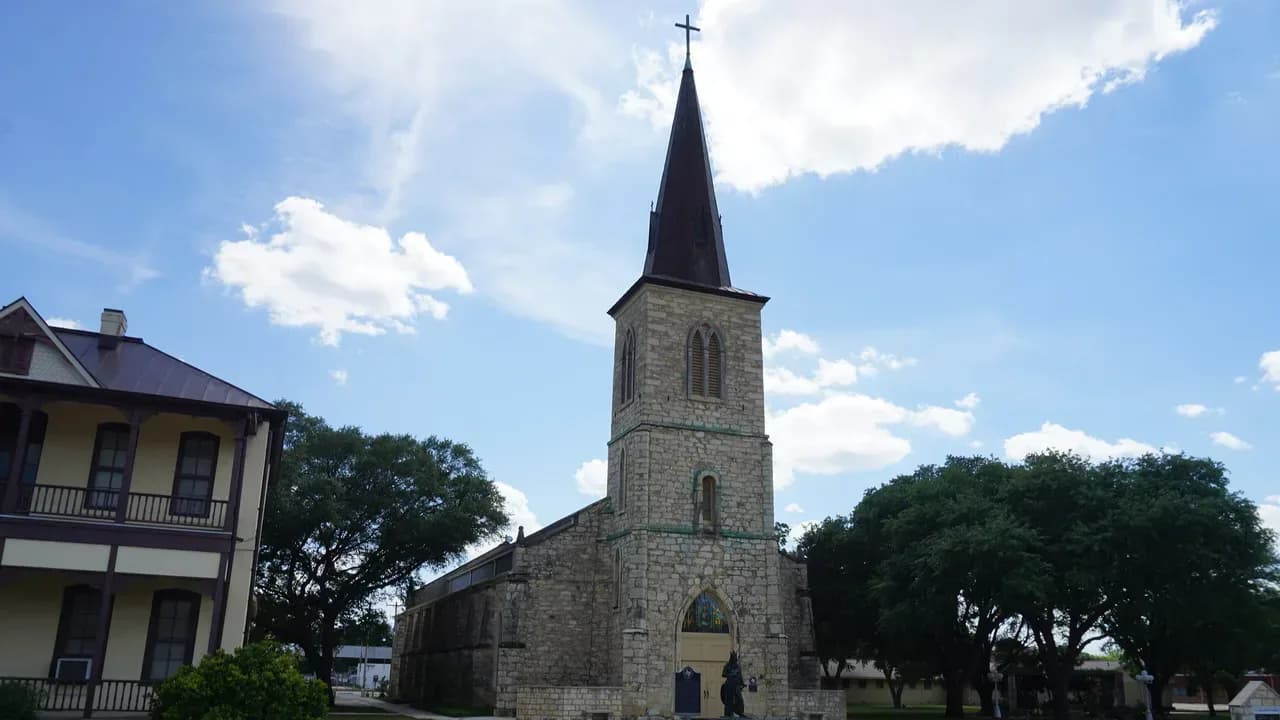
The church that stands on Houston Square now is the third. The state historical marker says Dubuis, the parish’s first resident pastor from 1847 to 1851, came back as Bishop of Texas to lay its cornerstone on July 2, 1868. The building was raised with locally quarried limestone and the labor of the men of the parish, and the Rev. Peter Richard said the first Mass in it on August 25, 1870, the feast of St. Louis. The architectural survey adds that the spire dates from 1908. In 1868 two Sisters of Divine Providence, whose motherhouse was in Alsace-Lorraine, opened a school in Castroville; their order kept its Texas motherhouse in the town until it moved to San Antonio in 1895. [5] [6] [7]
The Handbook says Zion Lutheran Church was built in 1853, and that the first public school classes in Medina County were held in that church in 1854. The Medina County entry dates the Lutheran congregation itself to 1852 and says the Catholic church had started a school in Castroville in 1845. [1] [4]
1847–1860: county seat, mill, and inn
The first post office in Medina County opened in Castroville in 1847, with M. Laroch as postmaster; the Medina County entry gives the date as January 12, 1847. In 1848 the legislature created Medina County out of Bexar County and named Castroville the county seat. Castro donated two lots for a courthouse in 1853, and the building was finished in 1855. [1] [4]
The town built in stone: rough-cut stone, or stone and timber, smoothed over with lime plaster, and without the broad front porches common in the South. A visitor in the 1850s called the place quite “un-Texan,” with “steep thatched roofs and narrow lanes” and an inn whose interior suggested “Europe rather than the frontier.” By 1856 Castroville had three large stores, a brewery, and a water-powered gristmill. [1]
That inn still stands. In 1849 César Monod, a Frenchman who became mayor of Castroville in 1852, bought a town lot from Castro and built a one-story house and dry-goods store. The Irish merchant John Vance bought the property on February 23, 1853, added a second story and galleries, and made it the Vance Hotel. In 1854 George L. Haass and Laurent Quintle built a dam and a two-story stone gristmill on river frontage Vance sold them. During the Civil War a two-story bathhouse went up in the courtyard; the Handbook calls it the only man-made bath between San Antonio and Eagle Pass. [8]
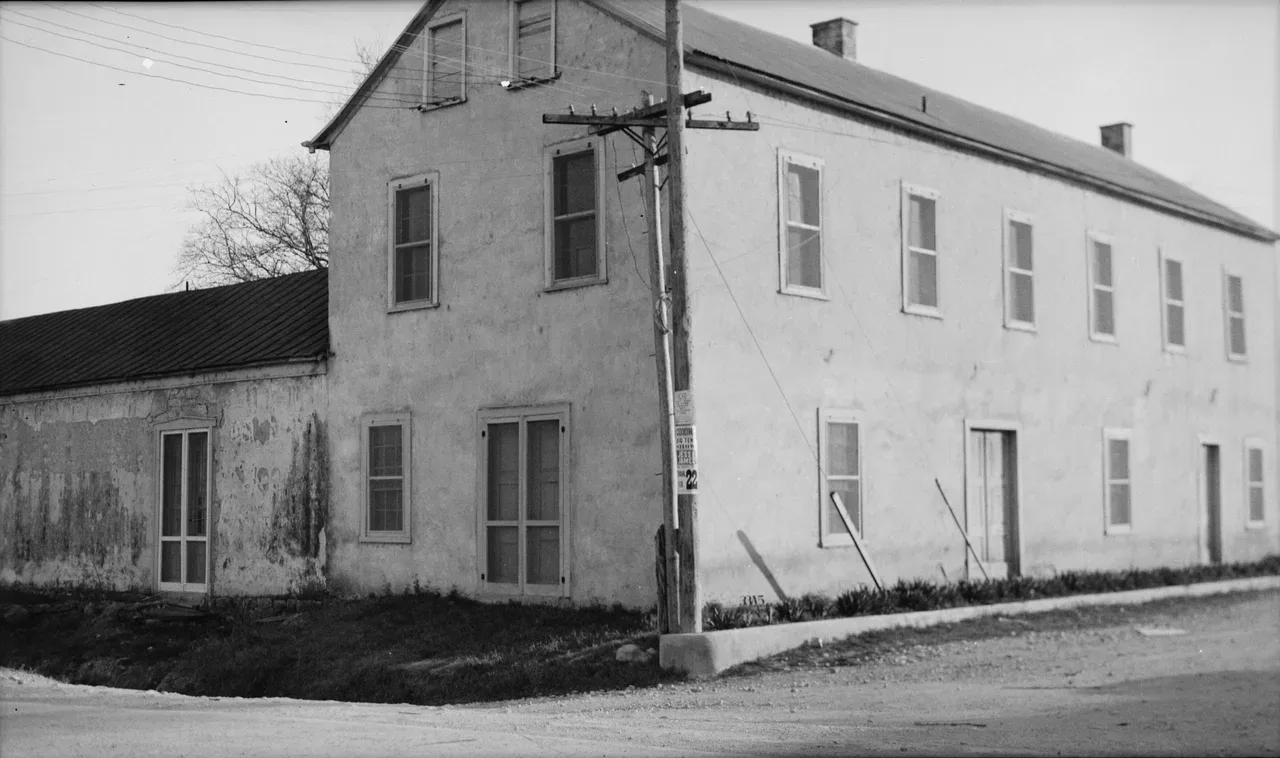
The Vance Hotel from the street front, photographed March 10, 1934, for the Historic American Buildings Survey. This is the building that was renamed the Landmark Inn around World War II and is now a state historic site. It shows the inn eighty years after John Vance bought it, not as it looked in the 1850s. Max C. Frederick, Historic American Buildings Survey, Library of Congress. Public domain.
Joseph Courand bought the mill in 1876, and that year the first issue of the Castroville Era, the county’s first newspaper, was printed in the Vance Hotel. Jordan T. Lawler bought the inn, mill, and outbuildings in 1925 and turned the mill into the plant that gave Castroville its first electric power. Renamed the Landmark Inn around World War II, it was donated to the state in 1974, opened as a historic site in 1981, and has been run by the Texas Historical Commission since 2008. [8] [9]
1861: a county that voted no
Slavery was present here, though on a smaller scale than in East Texas. The Medina County entry counts twenty-eight enslaved people among an estimated 909 residents in 1850, 104 among about 1,300 in 1858, and 108 in 1860. It gives two reasons the number stayed low: Mexico was close enough to offer refuge to people escaping slavery, and the European settlers, the entry says, generally held Unionist views that disfavored the institution. [4]
In February 1861 Medina County voted 140 for secession and 207 against. The vote did not keep the county out of the war. The entry says August Santleben, a Union sympathizer, was one of many residents who fled to Mexico rather than face reprisals, and it names Charles DeMontel, the Confederate provost marshal, as the man responsible for catching those who tried to escape Confederate service. [4]
Castroville itself did well. Freight wagons bound for Mexico stopped there overnight, and the town thrived. The Castroville entry says that by the mid-1860s it was the twelfth largest city in Texas. The Medina County entry puts that ranking earlier, in 1850, with a population of 366. The two entries do not reconcile the dates. [1] [4]
1880–1892: the railroad goes south, and the courthouse follows
In 1884 Castroville had about 1,000 people, a weekly newspaper, a steam gristmill and cotton gin, a brewery, Catholic and Lutheran churches, a convent, and a public school. [1]
The Castroville entry says that in 1880 the Southern Pacific, building west, passed south of town because Castroville refused to grant the railroad a bonus. The Medina County entry names the line as the Galveston, Harrisburg and San Antonio, dates its construction through the county to 1881, and says Castroville’s citizens, offered the route, voted against issuing the bonds it required. The two accounts describe the same refusal from slightly different angles. Hondo, La Coste, Dunlay, and New D’Hanis grew up on the tracks instead. [1] [4]
The rest followed the pattern this series has seen before. After several failed attempts in the 1880s, the county seat moved to Hondo in 1892 by a vote of 767 to 687. That same year Castroville’s citizens voted to disincorporate their town. It stayed unincorporated until 1948. [4] [1]
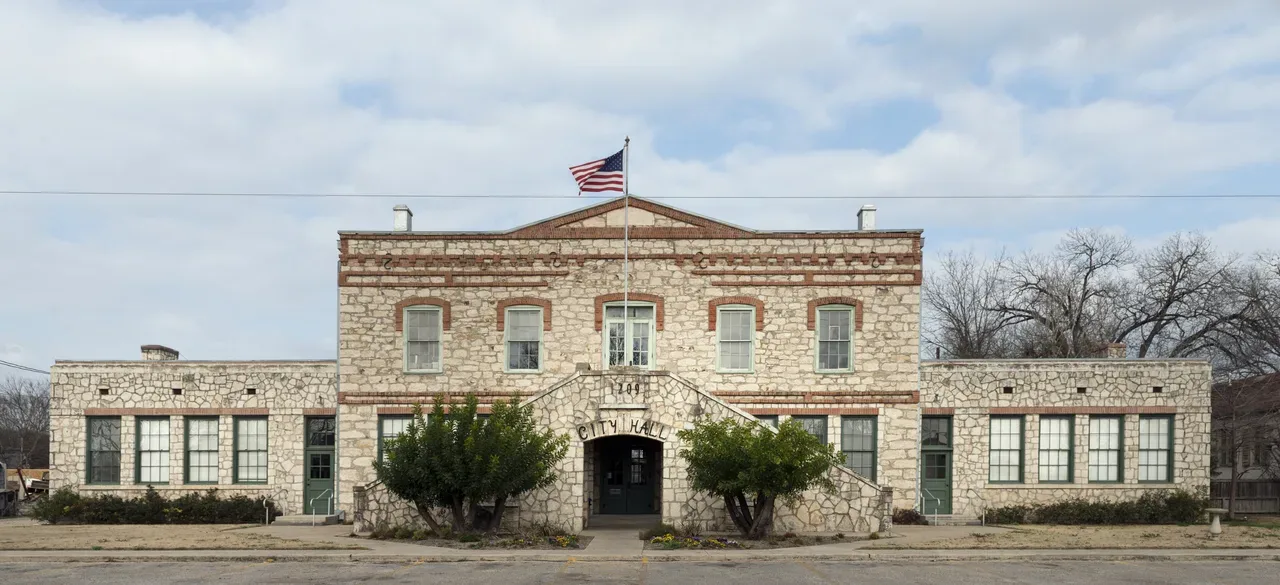
Castroville City Hall in 2014. The Library of Congress record for this photograph says the building was Medina County’s first permanent courthouse, then a school, then city hall. The Handbook says the courthouse was finished in 1855 and converted into a school in 1915. This is the building as it stands now, not as it looked in 1855. Carol M. Highsmith, Library of Congress. Public domain.
1892–1948: a small town without a city charter
The town kept going without a courthouse. It marketed pecans and had a telephone system by 1890. A bank opened by 1896, when the population was 750. In 1908 the Castroville school had 172 white students, twelve Black students, and four teachers; the Handbook gives the counts and nothing more. In 1915 the old courthouse was turned into a school with three large classrooms. [1]
The population was 700 in 1914 and dropped to 500 during Prohibition. By 1931 it was down to 325 people and nineteen businesses. The count in 1936 was 787, and the Handbook breaks it down: 65 percent German, 15 percent Mexican American, and 20 percent French or American. Most farmers still lived in town and farmed their tracts outside it, as Castro had planned in 1844. [1]
1948 to now: Little Alsace on the map
Castroville incorporated again in 1948. The population was 992 in 1953 and 1,508 in 1962, and in 1963 the Castroville Public Library opened as the first public library in Medina County. [1] [4]
The town is a national and a Texas historic district. The Handbook counts ninety-seven buildings recorded by the Historic American Buildings Survey and lists the Landmark Inn, St. Louis and Zion Lutheran churches, the Moye Formation Center, the Tarde Hotel, and Henri Castro’s original homestead among the places on its walking tour. St. Louis Day is celebrated every August 22. [1]
The 2020 Census counted 2,954 people in the city of Castroville, and the Handbook’s population table prints the same figure. The Medina County entry gives Castroville 2,925 in a passage that also cites 2014 county figures, and the Handbook table lists an estimate of 3,005 for 2021. Those are a census count and two estimates. This article prints all three and does not average them. [10] [1] [4]
The complete story of Castroville
Castroville’s history is the story of a Paris banker of Portuguese Jewish descent who signed a contract with a young republic and spent his own fortune keeping its colonists alive. It is the story of Alsatian farmers who set out from San Antonio with Texas Rangers in September 1844 and laid out a European village on a bend of the Medina. It is the story of drought, locusts, cholera, and raids; of Mexican laborers who did much of the clearing; of enslaved people in a county that voted against secession; and of Unionists who fled to Mexico. It is the story of three churches built on the same faith, the last one with the parish’s own hands and stone. It is the story of a town that would not pay for a railroad, lost its courthouse to the town that got one, and gave up its own charter for more than half a century.
The railroad went south. The county seat went to Hondo. The stone houses stayed where they were.
Questions people ask
Who founded Castroville? Henri Castro, a French empresario and banker who held a colonization contract from the Republic of Texas. He arrived with his first colonists on September 3, 1844, and the town took his name at an election on September 12. [3]
Did Castroville really turn down the railroad? Yes, by both Handbook accounts. One says the town refused the Southern Pacific a bonus in 1880. The other says voters rejected the bonds the Galveston, Harrisburg and San Antonio needed in 1881. [1] [4]
When did Castroville stop being the county seat? In 1892, when Medina County voters chose Hondo, 767 to 687. [4]
When did Henri Castro die? In 1865, at Monterrey, Nuevo León, on his way back to France. The Handbook prints the date as “November 31,” a day the calendar does not have, so this article gives only the month and year. He was buried in Monterrey. Castro County in the Panhandle is named for him. [2]
Sources
Ruben E. Ochoa, “Castroville, TX,” Handbook of Texas Online, Texas State Historical Association, revised September 20, 2023. tshaonline.org/handbook/entries/castroville-tx. The entry’s bibliography includes the Castro Colonies Heritage Association, The History of Medina County, Texas (1983), and Bobby D. Weaver, Castro’s Colony: Empresario Development in Texas, 1842–1865 (Texas A&M University Press, 1985).
Amelia W. Williams, “Castro, Henri,” Handbook of Texas Online, revised February 23, 2016. tshaonline.org/handbook/entries/castro-henri.
Curtis Bishop, “Castro’s Colony,” Handbook of Texas Online, revised June 1, 1995. tshaonline.org/handbook/entries/castros-colony.
Ruben E. Ochoa, “Medina County,” Handbook of Texas Online, revised September 17, 2020. tshaonline.org/handbook/entries/medina-county.
Texas Historical Commission, Atlas, “St. Louis Catholic Church,” marker 5051, Recorded Texas Historic Landmark, 1970. atlas.thc.texas.gov/Details/5325005051.
Gerald Moorhead et al., “St. Louis Catholic Church,” SAH Archipedia, Society of Architectural Historians; from Buildings of Texas: Central, South, and Gulf Coast (University of Virginia Press, 2013). sah-archipedia.org/buildings/TX-01-CJ6.
Theodore D. Gittinger, A History of St. Louis Catholic Church of Castroville, Texas (M.A. thesis, Sam Houston State University, 1972). shsu-ir.tdl.org.
Ruben E. Ochoa, “Landmark Inn State Historic Site,” Handbook of Texas Online, revised September 3, 2016. tshaonline.org/handbook/entries/landmark-inn-state-historic-site.
Texas Historical Commission, “Landmark Inn State Historic Site,” 402 Florence St., Castroville. thc.texas.gov/historic-sites/landmark-inn.
U.S. Census Bureau, 2020 Census demographic profile, City of Castroville, Texas, as posted by the City of Castroville. castrovilletx.gov. See also U.S. Census Bureau QuickFacts, Castroville city, Texas: census.gov/quickfacts.
Historic American Buildings Survey, Vance Hotel, Florence and Fiorella Streets, Castroville, Medina County, TX (HABS TEX,163-CAST,1-), photographs by Max C. Frederick, March 1934. Library of Congress. loc.gov/pictures/item/tx0440.
Carol M. Highsmith, “City hall in Castroville, Texas,” photograph, Library of Congress Prints and Photographs Division, no known restrictions on publication. lccn.loc.gov/2014631314.