Texas Towns: The Stories Behind the Map
The History of Montgomery, Texas
The first county seat, before the railroad moved power east
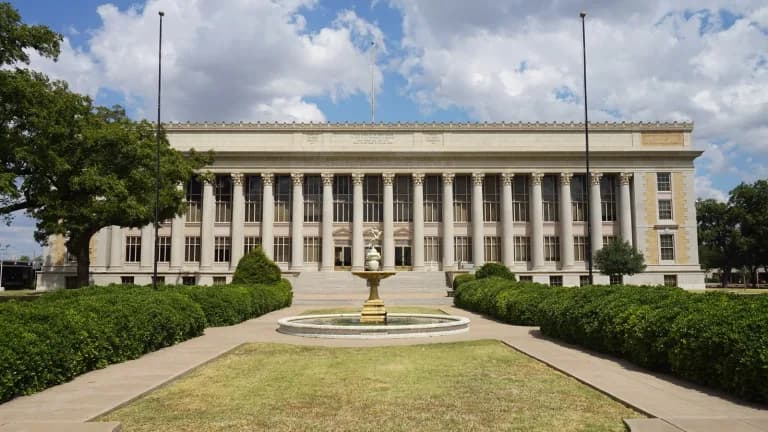
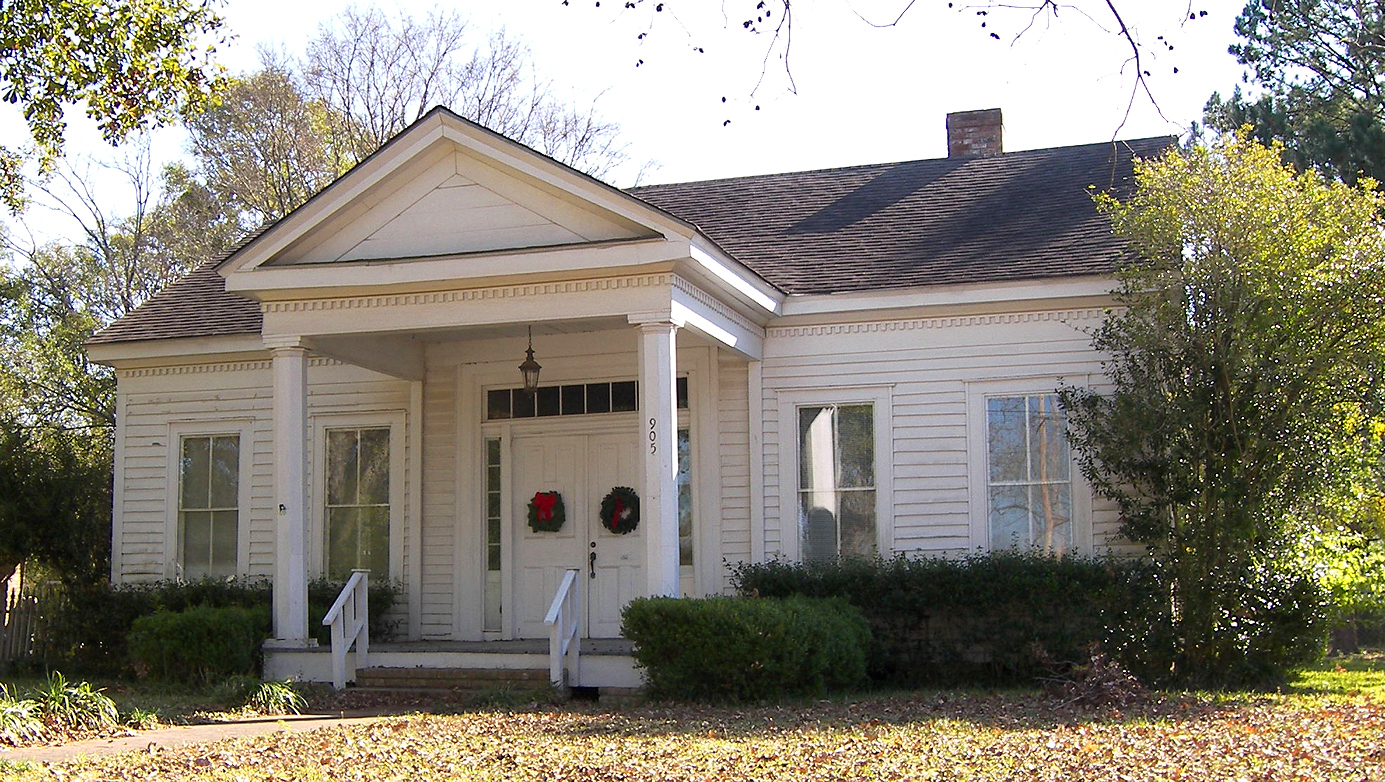
Montgomery’s business district still occupies the ground that was, for fifty years, the seat of a county larger than some states. — Stedil, CC BY-SA 4.0, Wikimedia Commons
Montgomery, Texas (ZIP 77356) is older than the county that took its name. It began as the Lake Creek Settlement, became the first county seat of a territory larger than Delaware, then lost the courthouse when the railroad built Conroe.
- ZIP
- 77356
- Founded
- July 1837
- County seat
- 1837–1889
- Incorporated
- 1848
Editor’s note. This is the second installment of “Texas Towns: The Stories Behind the Map.” Each story uses the documented record. Where the record is uncertain, we say so.
Drive into Montgomery, Texas, today and ZIP 77356 looks like a small historic town that happened to sit beside later lake-and-subdivision growth. The older fact is sharper. Montgomery is the oldest town in present-day Montgomery County. For more than fifty years it was the county seat. The county is named for the town, not the other way around. [1]
Then the railroad missed it. Power moved east to a sawmill switch called Conroe, and Montgomery had to become something else: a market town, a preserved streetscape, and a place that kept telling its founding story after the courthouse left.
Lake Creek before the town
Montgomery’s municipal history begins in 1837. The settlement history begins earlier.
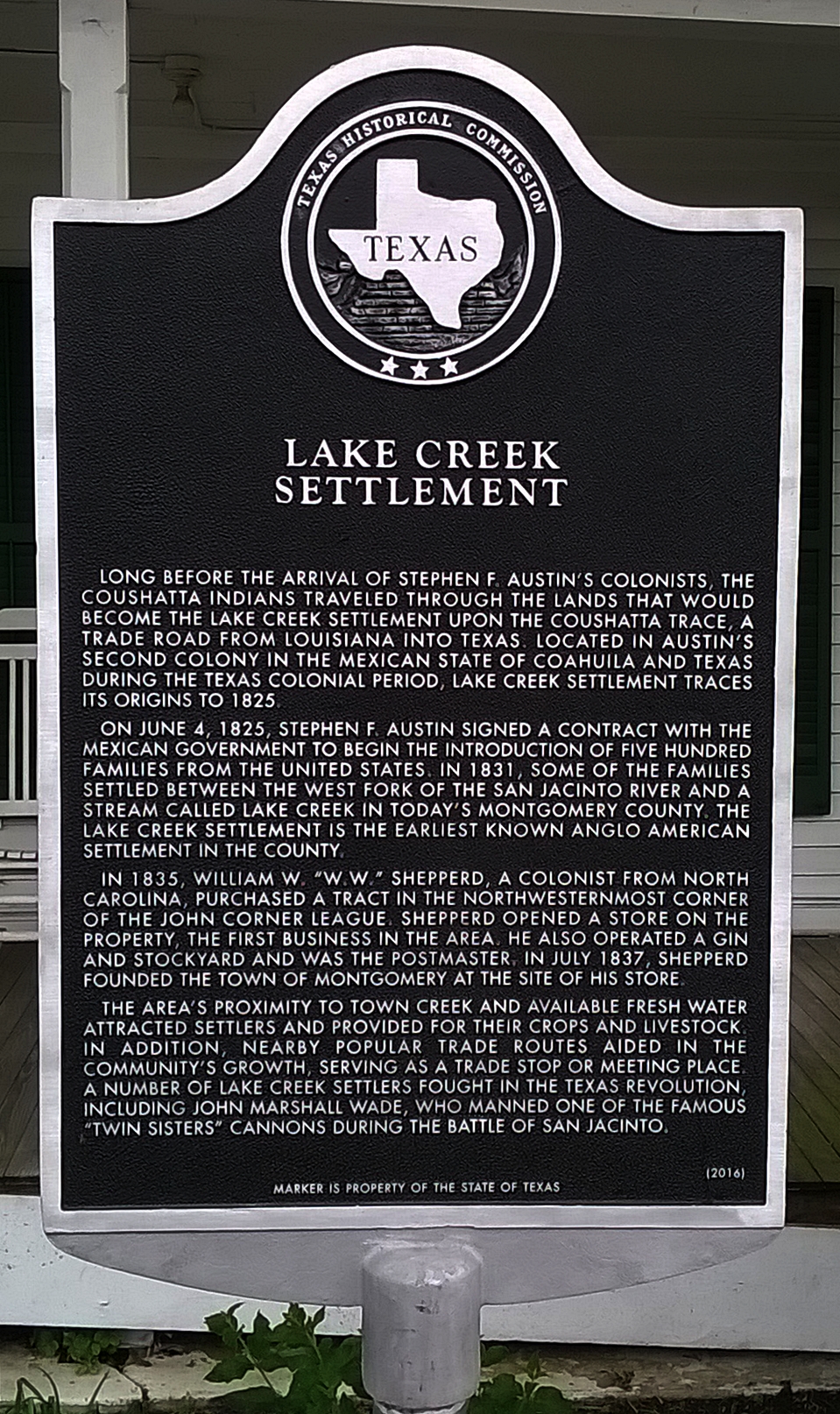
On June 4, 1825, Stephen F. Austin signed a second empresario contract with the Mexican state of Coahuila and Texas. Under that contract, Austin granted land in 1831 to sixteen colonists between the West Fork of the San Jacinto River and Lake Creek. One of them was John Corner, who received a league — 4,428.4 acres — on May 10, 1831. Within two years the neighborhood was known as the Lake Creek Settlement, the earliest Anglo-American settlement in what is now Montgomery County. [1]
People lived on this land long before Austin’s colonists. Across the future county, archaeological evidence points to more than 10,000 years of human presence. When Europeans arrived, the region was associated with Atakapan-speaking peoples, including the Arkokisa and Bidai. [2]
Anglo settlement here was not empty-land pioneering. It was a second layer placed on country already used, named, and traveled.
W. W. Shepperd’s store on the mail route
In 1835 William W. Shepperd, a colonist from Surry County, North Carolina, bought a 200-acre tract in the northwestern corner of the John Corner League for $100. He built homes there with his wife, Mary Steptoe Shepperd, their children, and the people they enslaved. He also built the first store in the Lake Creek Settlement. A mill and a cotton gin followed. [1]
Three men living with the Shepperds fought in the Texas Revolution: Jacob H. Shepperd, who served at Concepción and the siege of Bexar; John Bricker, killed defending the Brazos crossing at San Felipe; and John Marshall Wade, who fought at San Jacinto. [1]
On May 17, 1837, W. W. Shepperd became the first postmaster, and his store became the first post office in the Lake Creek Settlement. The location sat on Republic of Texas mail routes No. 1 and No. 14 — Houston to Cincinnati by way of Shepperd’s store, and from the store west toward the La Bahía Crossing via Fanthorp Inn, Washington-on-the-Brazos, and Independence. [1]
A town that begins as a store on two republic mail routes is already telling you what it intends to be: a place where other people’s travel becomes local power.
Founding a town to found a county
In July 1837 Shepperd founded the town of Montgomery at the site of his home and store. On July 8 the Telegraph and Texas Register published an advertisement submitted by Shepperd and his associate John Wyatt Moody, the first auditor of the Republic of Texas. Shepperd supplied the land. Moody supplied political influence aimed at creating a new county with Montgomery as its seat. [1]
It worked. Montgomery was the first town founded in the Lake Creek Settlement and remains the oldest town in the present county. Five months later, Montgomery County was created, named after the town, and Montgomery became the first county seat. Chief Justice Jesse Grimes held open court there, and County Clerk Gwynn Morrison recorded documents as early as February 1838. [1]
The exact source of the town’s name is still not known with certainty. The Handbook of Texas says the most likely explanation is that Shepperd and Moody named it after Montgomery County, Alabama, itself named for Maj. Lemuel P. Montgomery. [1]
Melinda Rankin later wrote that Montgomery had been the local seat of government for a territory larger than Delaware — from the San Antonio Road on the north to Spring Creek on the south, and from the Brazos to the Trinity. That territory later became Grimes, Walker, and Montgomery counties. [1]
The courthouse moves a few hundred acres, then the town is sold
On February 26, 1838, Shepperd bought another 212 acres due south of his original tract. At the first commissioners’ court meeting on March 1, 1838, he donated, through his agent Charles B. Stewart, an equal half undivided interest in 200 of those acres to the county. Commissioners voted to move “the place of the town” onto that land. A house owned by Shepperd was leased as the first Montgomery County courthouse. [1]
In October 1839 Shepperd sold his interest in the town to James McCown, including the house then used as the courthouse. Local documentary work associated with the Handbook bibliography records that the sale involved enslaved people. The founding of Montgomery cannot be told as a story of stores and mail routes alone. It was also a slaveholding settlement, and the townsite itself changed hands in that economy. [1]
A county-seat town takes shape
Montgomery flourished as county seat for more than five decades. In 1845 John Marshall Wade established the Montgomery Patriot, the first newspaper in the town and county. The July 2, 1845, issue advertised general merchandise, a tailor, a cabinetmaker, dry goods, a printing office, and three physicians. [1]
Methodist circuit riders were assigned to a “Montgomery Circuit” as early as 1838, covering territory between the Brazos and Trinity. On July 20, 1851, the first church building in town — Alexander Chapel — was dedicated on land James McCown sold to the Methodist Episcopal Church for $10. It was named for missionary Robert Alexander. A Baptist congregation had already been organized; its building came later. [1]
On February 26, 1848, the Second Legislature of the State of Texas incorporated Montgomery. Nathaniel Hart Davis was the first mayor. [1]
The railroad chooses another town
Civil War and Reconstruction shifted political and economic power away from Montgomery. The decisive blow was transportation. When the Houston and Great Northern Railroad laid track through the center of the county in 1870, Conroe was established at a sawmill switch. In 1889 Conroe became the new county seat. [1] [5]
Montgomery’s population dropped from 1,000 in 1890 to 600 two years later. Cotton gins, sawmills, and two hotels remained, but the courthouse — the institution that had organized the town’s importance — was gone. The population fell to 350 by 1925, revived to 750 in 1950, then slipped below 300 in the 1980s even as some 10,000 people lived within a seven-mile radius. [1]
The Handbook of Texas recorded 356 residents in 1990, 489 in 2000, 621 in 2010, and 1,948 in 2020. Growth returned, much of it tied to Lake Conroe, ranching, real estate, and oil. The town that lost the courthouse did not disappear. It waited, then filled in around the older streets. [1]
What the houses still hold
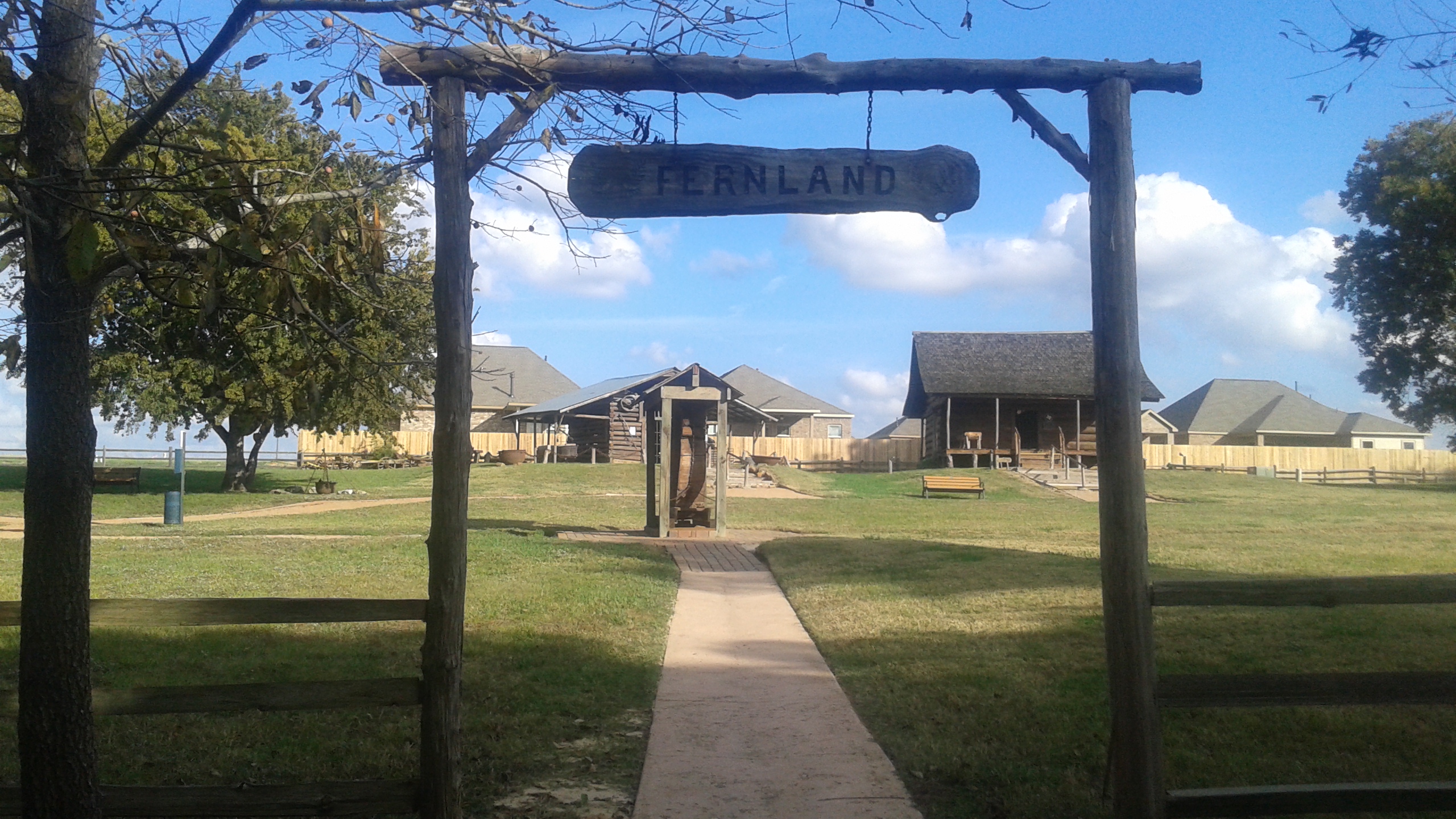
The Montgomery Historical Society preserved houses that would otherwise have been treated as leftovers. The homes of Judge Nathaniel Hart Davis and Dr. E. J. Arnold have been maintained as museums. The Arnold house, now called the Arnold-Simonton House and located in Fernland Historical Park, was constructed in 1845. It is one of the oldest houses in Montgomery County and is listed on the National Register of Historic Places. [1]
These buildings are not decorations. They are what remains of a county seat after the county moved.
The flag claim, and what the legislature later said
Montgomery claims the title “Birthplace of the Texas Flag” and attributes the 1839 Lone Star Flag to early resident Charles B. Stewart. [1]
Stewart’s public record is not thin. He signed the Texas Declaration of Independence, served in effect as the republic’s first secretary of state, moved to Montgomery in 1837, and in 1839 sat on the committee appointed by the Third Congress to design a new flag. His biographical entry says he is credited with drawing the original draft of the Lone Star Flag. [3]
That is not the same as proving he designed it. In 1989 the legislature celebrated the flag’s sesquicentennial by incorrectly recognizing Stewart as the designer. In 1992 it corrected the record and acknowledged that the actual designer is unknown. [4]
A hometown may honor a resident who served on the committee. History still has to say when the state later withdrew the certainty. The slogan is a claim. The committee service is documented. The designer’s identity is not settled.
The complete story of Montgomery
Montgomery’s history is the story of a store on republic mail routes, a town invented to become a county seat, and a county named for that town.
It is the story of colonists on John Corner’s league, and of Native peoples who used this country first.
It is the story of a slaveholding founder who sold the townsite, of churches and a newspaper, and of a courthouse that eventually left for the railroad.
It is the story of a flag committee and a slogan that outran the evidence.
The oldest town in the county is not the largest. It is the one that had to learn how to remain after the map moved.
Quick answers
Montgomery history FAQ
When was Montgomery, Texas founded?
W. W. Shepperd founded the town of Montgomery in July 1837 at the site of his home and store on the John Corner League. The Telegraph and Texas Register advertised the new town on July 8, 1837.
Why is Montgomery County named Montgomery?
The county was named after the town. The town’s own name is less certain. The Handbook of Texas says the most likely explanation is that Shepperd and John Wyatt Moody named it after Montgomery County, Alabama, which honored Maj. Lemuel P. Montgomery.
Was Montgomery the original Montgomery County seat?
Yes. Montgomery County was created in December 1837, five months after the town was founded, and Montgomery was the first county seat. In 1889 the seat moved to Conroe after the Houston and Great Northern Railroad crossed the center of the county.
Is Montgomery the birthplace of the Texas flag?
The town claims that title and attributes the 1839 Lone Star Flag design to resident Charles B. Stewart. Stewart served on the republic’s flag committee and is credited with drawing a draft. The Texas legislature later said the actual designer is unknown. Treat the slogan as a local claim, not a settled fact.
Sources
Notes and credits
- [1]Texas State Historical Association, “Montgomery, TX”
- [2]Texas State Historical Association, “Montgomery County”
- [3]Texas State Historical Association, “Stewart, Charles Bellinger Tate”
- [4]Texas State Historical Association, “Flags of Texas”
- [5]Texas State Historical Association, “Conroe, TX”
Numbered citations in the story are live links. Source language is paraphrased except where quotation marks identify a short title or documented phrase.