The History of Jefferson, Texas
Once the leading inland port of Texas, Jefferson lost its river trade and its railroad. It kept its houses, its churches and its stories.
For a few years after the Civil War, a town of a few thousand people on a bayou in Northeast Texas did more business than almost anywhere in the state. Only Galveston outranked it. Then the water dropped and the railroad passed it by. Jefferson never got its trade back, but it kept something else: its old houses, its stories, and its stubborn pride.
This history is drawn from the Texas State Historical Association's Handbook of Texas entry on Jefferson by Christopher Long, with additional detail from the Society of Architectural Historians' SAH Archipedia essay on Jefferson.
A town laid out along the water
Jefferson was founded in the early 1840s by Allen Urquhart and Daniel Alley and named for Thomas Jefferson. Urquhart, who came to Texas from North Carolina, received a headright on a bend in Big Cypress Creek and laid out a townsite around 1842. Alley laid out additional streets on an adjoining 586-acre parcel.
Most town planners of the day built around a courthouse square. Urquhart ran his streets at right angles to the bayou, while Alley's followed the compass. Where the two plans met, the town took on the V-shaped layout it still has.
Churches came early. A Methodist congregation organized in 1844, a Presbyterian church between 1846 and 1850, and a Baptist church in 1855. The Jefferson Democrat began printing in 1847, and in 1848 the Jimplecute appeared and became the town's longest-running and most influential newspaper.
The inland port of Texas
As the westernmost point of navigation on the Red River system, Jefferson grew into a riverport. The first steamboat, the Llama, arrived in late 1843 or early 1844. By the late 1840s, boats regularly ran to Shreveport and New Orleans, carrying cotton down and bringing back supplies, manufactured goods and furnishings for the town's new homes. Jefferson became the leading commercial center of Northeast Texas and the state's leading inland port.
The town was incorporated in 1848. In 1860 it became the seat of the newly created Marion County. A fire destroyed nearly the entire business district in 1866, but it was rebuilt within a few years. In 1867 Jefferson became the first town in Texas to use natural gas for artificial lighting, and in 1868 ice was first manufactured there on a commercial scale.
The numbers from those years are remarkable. Trade grew from $3 million to $8 million between 1867 and 1870, and in the late 1860s more than 75,000 bales of cotton shipped out each year. By 1870, with 4,180 people, Jefferson was the sixth-largest city in Texas. A supplementary census in 1872 counted 7,297.
The year it turned
In 1873 two things happened. In November, crews used nitroglycerin to remove the last of the Red River Raft, a vast natural logjam above Shreveport. Clearing it reopened the main river channel but lowered the water in the lakes and streams that had carried boats to Jefferson. In dry seasons the trip became hard. The Society of Architectural Historians notes that the logjam had backed water up Big Cypress Bayou high enough for sternwheelers from the Mississippi, and that its removal left Jefferson beyond the reach of river traffic.
That same year the Texas and Pacific Railway was completed from Texarkana to Marshall, and it bypassed Jefferson. Another T&P line reached the town the next year, but the trade had already begun moving to rail cities like Marshall and Dallas. By 1885, the population had fallen to about 3,500.
Setting the record straight
Two stories about Jefferson are told more often than they are true, according to the Handbook.
The first is that the town's leaders turned up their noses at the railroads. In fact, they tried to build one, and construction began in 1860 on a line toward Shreveport and Marshall. Only 45 miles were finished before the Civil War.
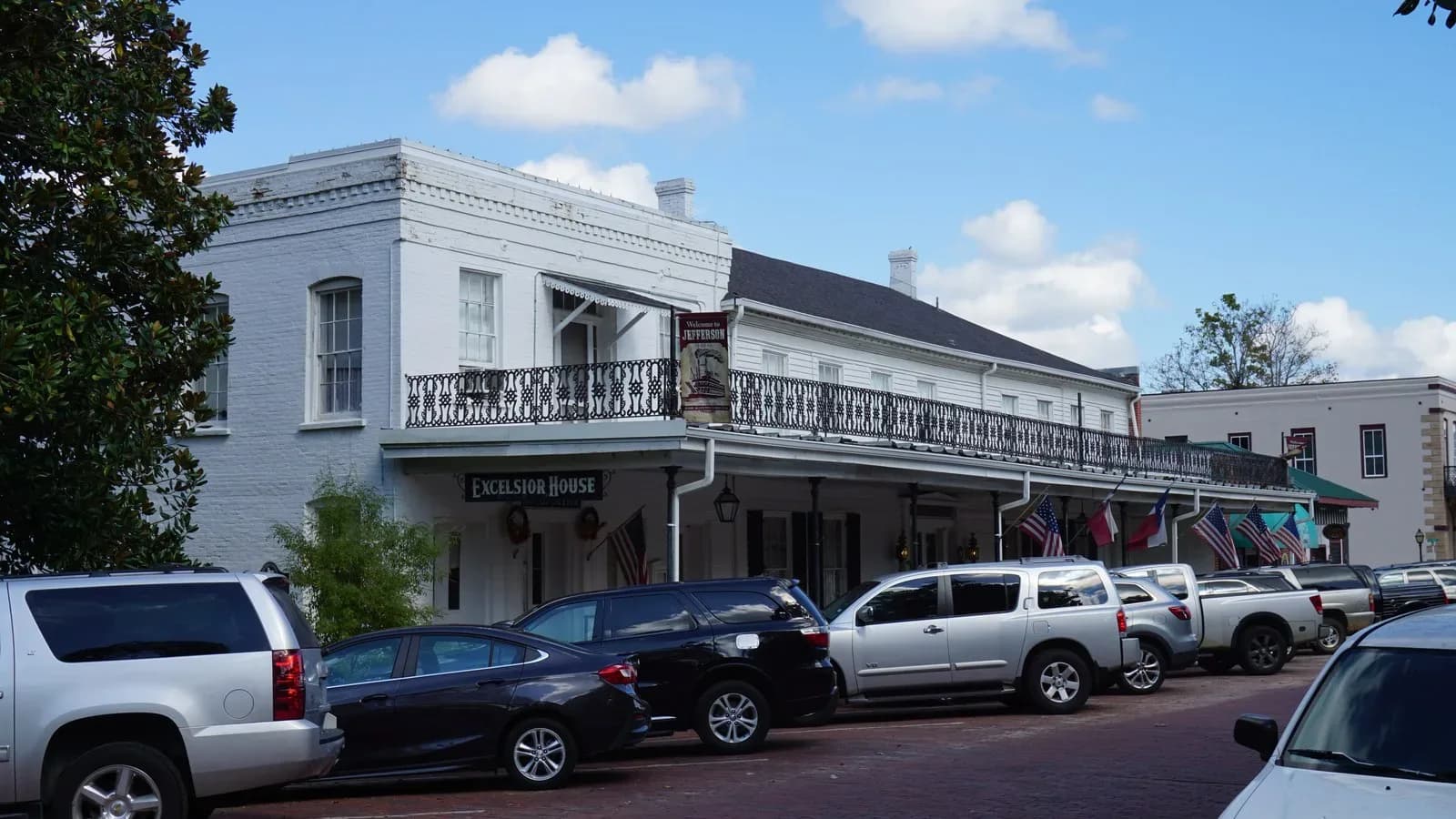
The second is that railroad baron Jay Gould, angry at the town, wrote "the end of Jefferson" in the register of the Excelsior Hotel and cursed it. The Handbook calls those reports "completely unfounded." Gould did not acquire the Texas and Pacific until the early 1880s and only visited Jefferson much later.
There is a lesson in that. A town in decline is tempted to blame a villain. The harder truth is usually that the world changed and the town could not change with it.
What remains
Oil brought a brief rebound in the late 1930s, and by 1940 Jefferson had about 3,800 residents and 150 businesses. The slow decline resumed afterward. By 2000, the population was 2,024.
But Jefferson found another way to live. In 1971 a roughly 47-block area with 56 historic structures was listed on the National Register of Historic Places, along with about 10 other buildings, including the antebellum Excelsior Hotel and the Planters Bank and Warehouse. The town hosts a spring historic pilgrimage each year, and since 1955 it has included a reenactment of the 1877 Diamond Bessie murder trial.
Today the Jefferson Historical Society & Museum, housed in the 1888 federal courthouse and post office, keeps that history on display. The SAH calls the town "a well-preserved architectural museum."
Jefferson's story is a reminder that a town is more than its trade. The boats and the cotton left. The churches, the houses, and the people who cared for them stayed.
Dock Line has told the stories of other Texas towns, including Huntsville and Conroe.
Hero photo: Michael Barera via Wikimedia Commons, CC BY-SA 4.0, cropped and resized.