Texas Towns: The Stories Behind the Map
The History of Splendora, Texas
Cox’s Switch, renamed for the flowers
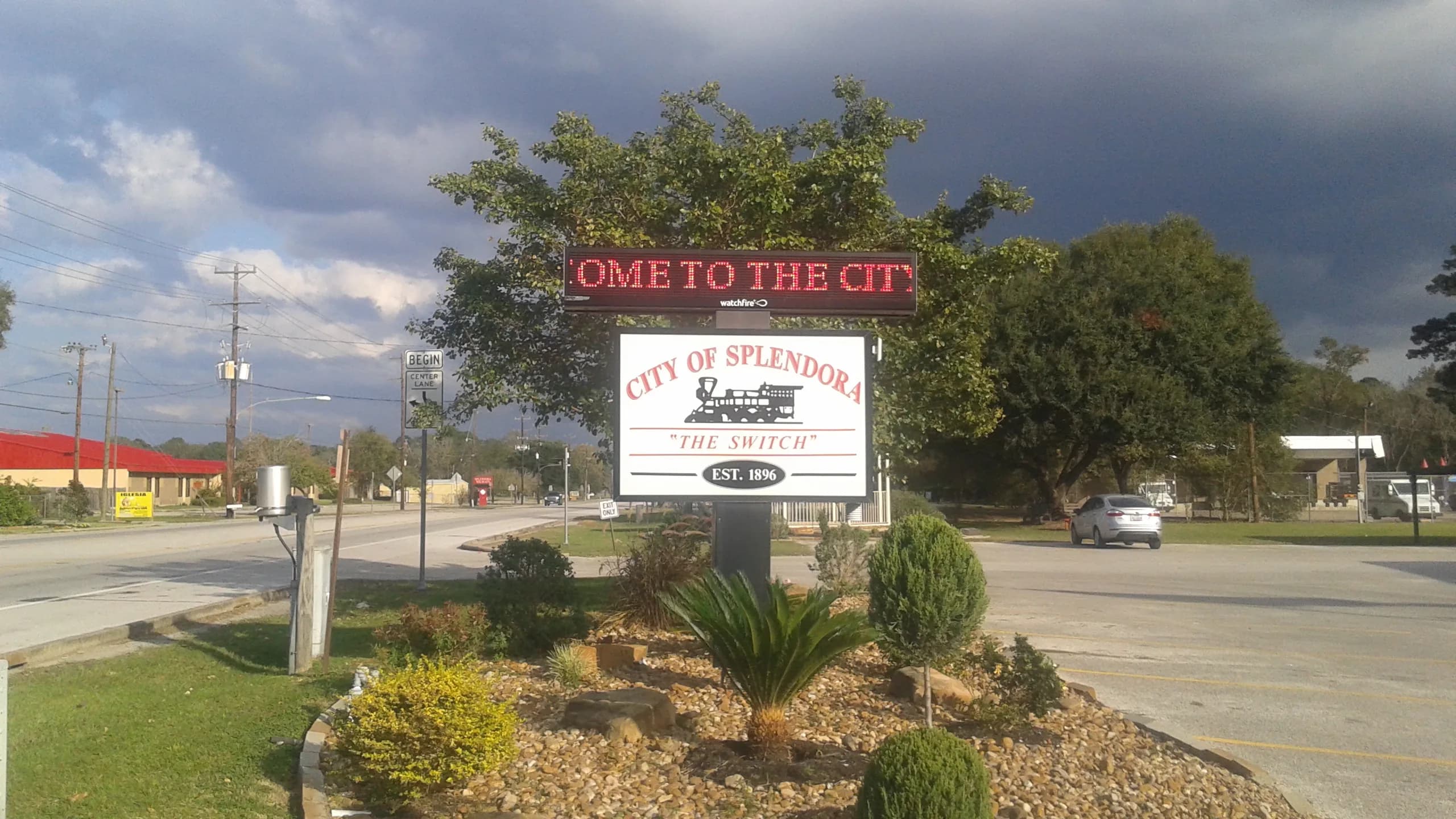
The welcome sign at city hall. The name is 1896. The switch is older. The flowers were the argument for the post office. — Stedil, CC BY-SA 4.0, Wikimedia Commons
Splendora, Texas (ZIP 77372) began as Cox’s Switch, a Houston, East and West Texas spur Charles Cox helped bring in for crossties and lumber. In 1896 the first postmaster named it for the “splendor of its floral environment.”
- ZIP
- 77372
- Earlier name
- Cox’s Switch
- Renamed
- 1896
- Incorporated
- December 1966
Editor’s note. This is the eighth installment of “Texas Towns: The Stories Behind the Map.” Splendora is six miles north of New Caney on the same East County railroad. The name is floral. The work was crossties.
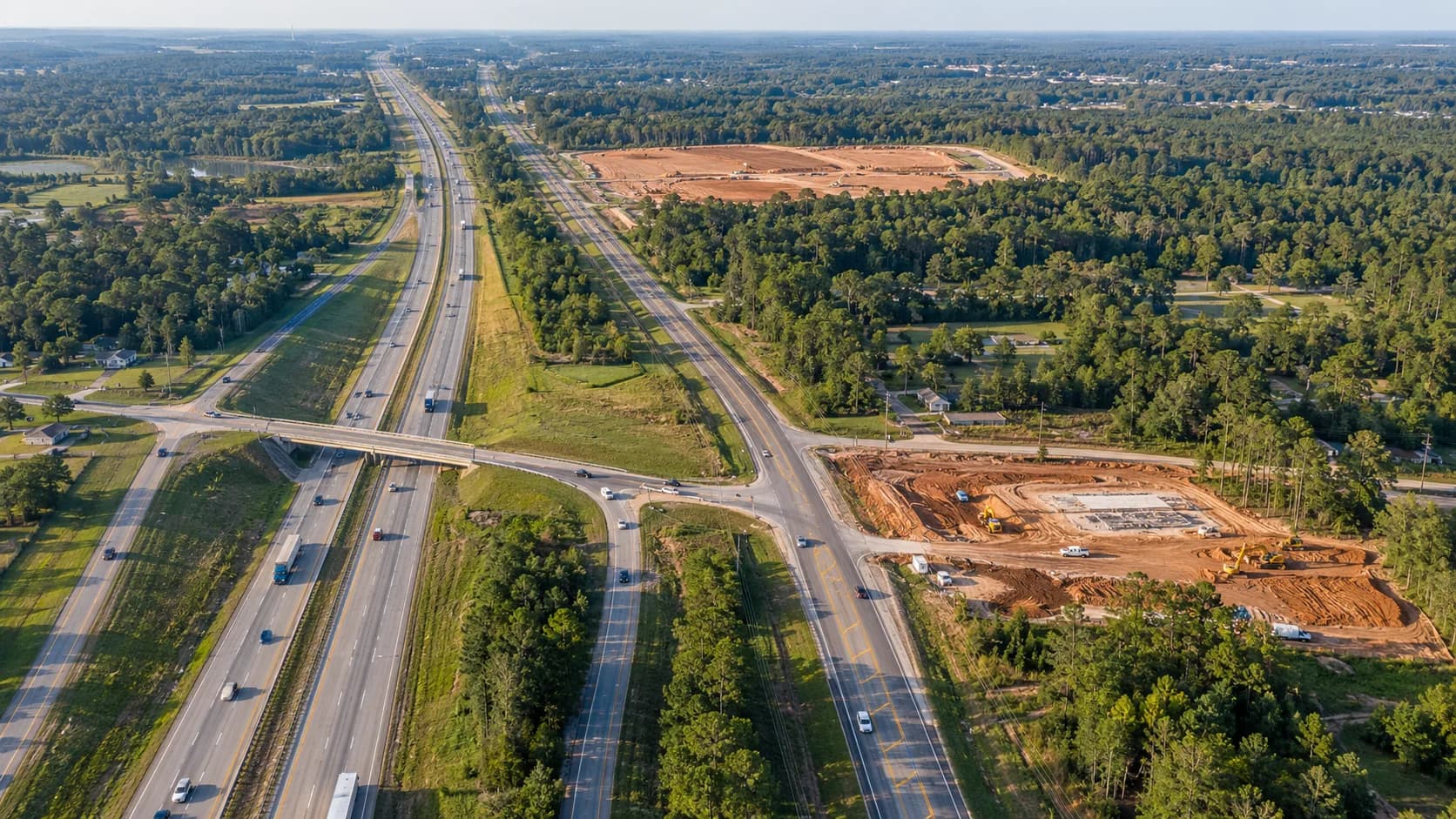
Splendora, Texas, sits at U.S. Highway 59 and Farm Road 2090, on the Southern Pacific — once the Houston, East and West Texas — six miles north of New Caney and twenty-two miles from Conroe in eastern Montgomery County, ZIP 77372. The name suggests a garden. The first name was a man’s switch. [1]
Charles Cox helped bring a narrow-gauge spur from Houston for crossties and lumber. The town that grew beside that spur later asked for a prettier word on the envelope.
Cox’s Switch
In the late 1880s the place was known as Cox’s Switch. Charles Cox was instrumental in getting the Houston, East and West Texas Railway to extend a narrow-gauge spur from Houston for crossties and lumber. The jobs were logging, farming, sawmill work, cutting firewood for steam engines, and making crossties that paid three to ten cents apiece. [1] [2] [4]
W. W. Burrow moved here in 1883 and built the first general store shortly after the track was completed from Houston. He started with staples in his home. Word spread that flour or sugar could be had from Burrow. The train, the store, and the railroad jobs pulled in families the city’s history lists by name: Richardson, Flowers, Patton, Sallee, Pridgen, Duke, Lucas, Stokely, Gray, Hendley, Harrington, Tullis. [2]
The main street of Splendora was the railroad track. People walked, rode, and drove wagons along it. On Sundays the town met the train at the depot — mail, packages, payroll, and visitors. [2]
The flowers on the envelope
The name changed to Splendora in 1896, when Cox asked the first postmaster, Milton Z. King, to rename the town. King chose Splendora because of the “splendor of its floral environment.” The city’s history adds a domestic reason: Cox, who had come at forty-five “planning to die,” had married Ruth Hall and had children who might not want to live in a place called Cox’s Switch. [1] [2]
A postmaster naming a sawmill spur for flowers is still a documented origin. It is also an admission that “Switch” was not the word they wanted on a letter.
Schoolhouse, fire, independent district
In 1895 the Greenleaf Church building was used as a schoolhouse. Some of the first teachers, the city says, were Professor Ezell, Mr. Pirtle, Molly Patton, and her colleagues in a building near the cemetery. In 1913 a new two-room school had fifty students, on land Charles Cox donated — the site of the later intermediate school. Enrollment was sixty-five in 1925 and 170 in 1932–33. [1] [2]
On October 27, 1936, the school was partially burned. The next year a new brick building was finished; in 1981 it was still serving as a junior high. Splendora became an independent school district in the 1940s, then added a high school in 1959, an elementary in 1966, and a junior high in 1978. The school district, not the depot, became the institution that organized the later town. [1]
A slow count, then a city
The town grew slowly. The Handbook gives 100 residents in 1925, 180 in 1949, and a peak of 1,000 in the early 1970s. Splendora incorporated in December 1966. In 1989 it had 722 people, three churches, two cemeteries, and thirty-seven businesses. The count was 745 in 1990 and 1,275 in 2000. Later almanac figures in the Handbook file reach 1,683 in 2020. [1]
U.S. 59 turned the old HE&WT corridor into a Houston commute. The floral name stayed on the water tower and the school district. The work that built Cox’s Switch was timber and a spur. [3]
The complete story of Splendora
Splendora’s history is the story of a dying man who lived long enough to want a better name than his own switch.
It is the story of crossties at three to ten cents, a store that started in a house, and a main street that was the track.
It is the story of a school that burned in 1936 and a city that incorporated in 1966 — late, like Magnolia, after the railroad had already decided where people would live.
King supplied the flowers in the name. Cox supplied the switch. The railroad supplied the place.
Quick answers
Splendora history FAQ
What was Splendora, Texas called before Splendora?
In the late 1800s the place was Cox’s Switch, for Charles Cox, who helped get the Houston, East and West Texas Railway to extend a narrow-gauge spur there for crossties and lumber.
How did Splendora get its name?
In 1896 Cox asked the first postmaster, Milton Z. King, to rename the town. King chose Splendora because of the “splendor of its floral environment.”
When did Splendora incorporate?
Splendora was incorporated in December 1966. The railroad switch and the 1896 post-office name are older than the city.
Is Splendora the same as New Caney?
No. Splendora is six miles north of New Caney on the same Southern Pacific / HE&WT line, at U.S. 59 and Farm Road 2090. They share a railroad corridor, not a founding.
Sources
Notes and credits
- [1]Texas State Historical Association, “Splendora, TX”
- [2]City of Splendora, “About Us”
- [3]Texas State Historical Association, “Montgomery County”
- [4]Texas State Historical Association, “Houston, East and West Texas Railway”
Numbered citations in the story are live links. Source language is paraphrased except where quotation marks identify a short title or documented phrase.