The History of Anderson, Texas
Anderson, Texas (ZIP 77830) is the Grimes County seat, named for Kenneth L. Anderson after he died at the Fanthorp Inn. Landowners refused the Houston and Texas Central a right-of-way in 1857. The Handbook’s 1990 counts do not match.
Editor’s note. This is the seventeenth installment of “Texas Towns: The Stories Behind the Map.” Plantersville sits up Farm Road 1774 from this courthouse. Anderson is the seat of Grimes County, and it is the town that told a railroad no. There is an Anderson County in Texas. Its seat is Palestine. This is not that county, and this is not that town.
Anderson, Texas, is on State Highway 90 and Farm Roads 149 and 1774, ten miles northeast of Navasota, in central Grimes County. The mailing ZIP is 77830. The Handbook of Texas lists the associated names Alta Mira, Fanthorp’s, and Randolph. Its place fields mark the town incorporated and still list a post office. The prose on the same page is less tidy than those fields, and the untidiness is the story. [1]
A league, a quarter of it, and an inn
Bidai, Coushatta, and Kickapoo people were on this ground before Stephen F. Austin’s colonists. Francis Holland, one of the first settlers in the area, received his deed to a league of land from Austin on August 10, 1824. In 1833 Henry Fanthorp bought the east quarter of Holland’s league for twenty-five cents an acre. He built a corn-storage building that also served as a dwelling and a grain market. In 1834 he built a larger dog-run house to live in. To take advantage of the stage lines, he enlarged that house into a tavern, the Fanthorp Inn. [1]
Mail was delivered there weekly, starting in 1835. The Handbook calls the inn the first post office in what was to be Grimes County. Grimes County did not exist yet. The mail did. The Texas Historical Commission now keeps the Fanthorp Inn as a historic site. This article uses the Handbook for the inn’s nineteenth-century record and the commission’s page only as the modern site. [1] [2]
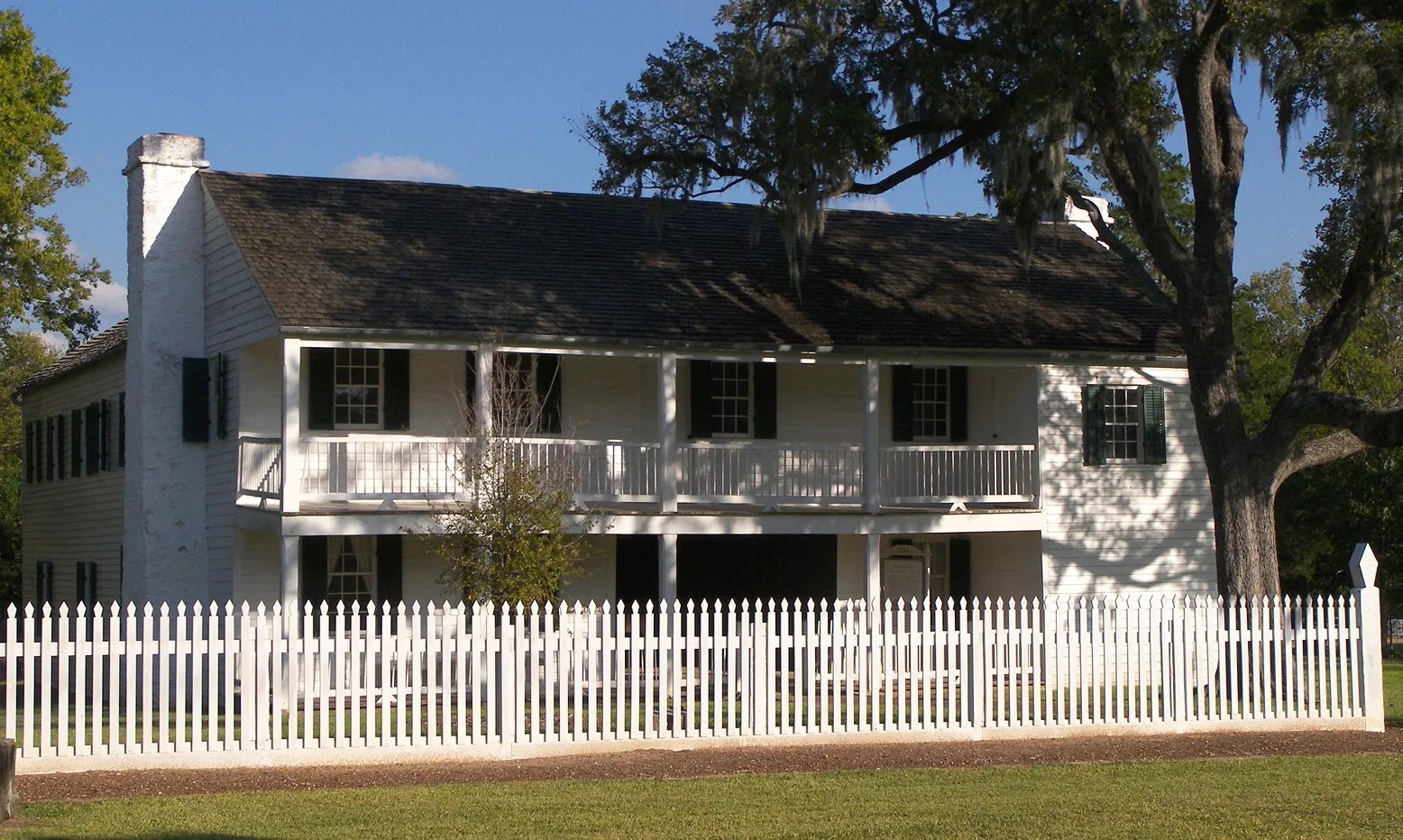
The Fanthorp Inn in Anderson, photographed in 2008. The Handbook says weekly mail was delivered here starting in 1835. Larry D. Moore, CC BY 4.0, via Wikimedia Commons.
1846: a courthouse between two older places
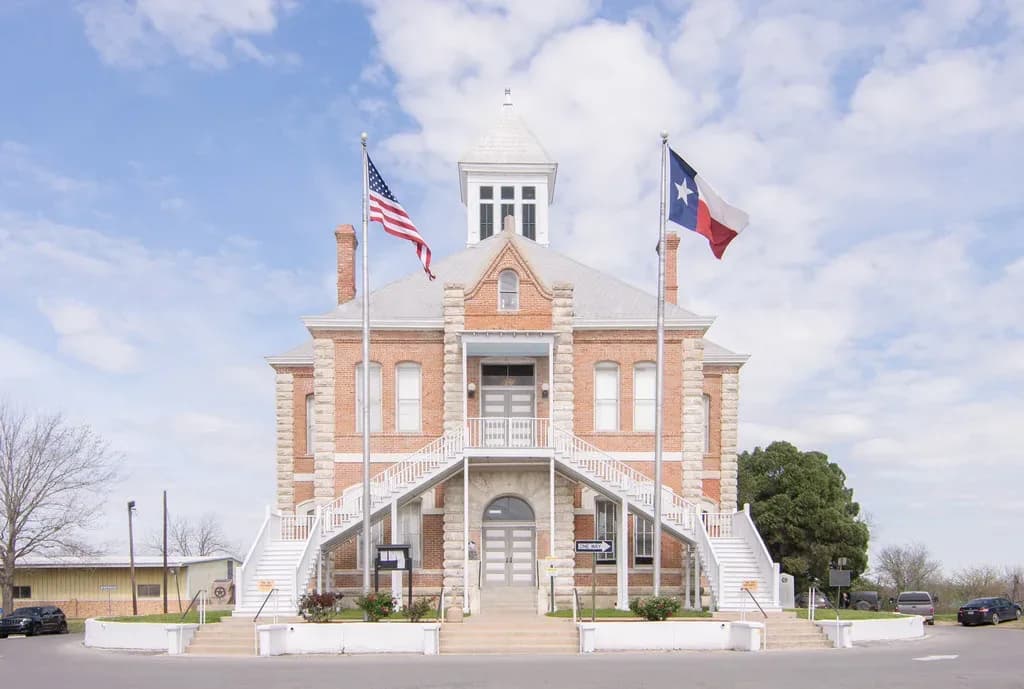
Grimes County was organized in 1846, and Fanthorp offered land for the county seat. The election that followed chose a site between Alto Mira and Randolph. The new seat was named Anderson, for Kenneth L. Anderson, last vice president of the Republic of Texas, who had recently died at the Fanthorp Inn. In time the community took in Alto Mira, Randolph, and the inn. [1]
The Handbook’s narrative spells the older place Alto Mira. Its list of associated names spells it Alta Mira. Both spellings are on the same entry. This article does not correct one into the other. Fanthorp’s and Randolph are on that associated-name list because the town, by the Handbook’s account, grew until it included them. [1]
Good soil, good crops, a good water supply, and stagecoach routes across the county fed the growth. Lawyers, teachers, preachers, physicians, and political leaders from the southern United States came, along with skilled farmers of German and Polish descent. The Masons opened Masonic Collegiate Institute, also known as Patrick Academy, in 1846. Other schools followed: St. Paul’s Episcopal College in 1852, a Lutheran school in 1882, a Catholic school in 1890, and the school of the Anderson Independent Free District in 1893. [1]
The boom the Handbook describes, and the rank it claims
The Handbook says the town boomed from 1846 to 1885. The inventory it gives is two steam sawmills, six cotton gins, five hotels, a drugstore, a mercantile house, a hardware store, a tailor, a blacksmith, a pistol factory that provided handguns for the Confederacy, and a population of 3,000. At least six different Anderson newspapers were published between 1854 and 1900. The pistol factory is a cross-reference. The Handbook points readers to its entry on the Dance brothers and does not, in the Anderson article, give a production count. This article does not add one. [1] [3]
Later on the same page the Handbook says Anderson was once the fourth largest town in Texas. That claim sits next to the figure of 3,000. The entry does not include a census table that ranks Texas towns, and it does not show the arithmetic. We attribute both the 3,000 and the fourth-largest description to the Handbook’s account of the boom. We do not treat either one as a modern census result. The counts the same page prints for the late twentieth century are a few hundred people. [1]
1857: the right-of-way they would not give
For all of its promise in the stagecoach years, the Handbook says, no major road or rail line was built through Anderson. Local landowners refused to give a right-of-way to the Houston and Texas Central in 1857. That refusal is the turn in the story. A county seat on the stage network declined the railroad that was about to reorganize East Texas. Richards, farther up the county, would be founded in 1907 by people who moved to a railroad. Anderson had already said no to one. [1]
In 1903 the landowners agreed to a different line: the Madisonville Branch of the Missouri Pacific, from Navasota to Madisonville. The Handbook says that line was discontinued in 1944, leaving Anderson without a public carrier. The first highway through the town was not begun until 1930. Stagecoach roads had made the place. A numbered highway waited until the twentieth century was a generation old. [1]
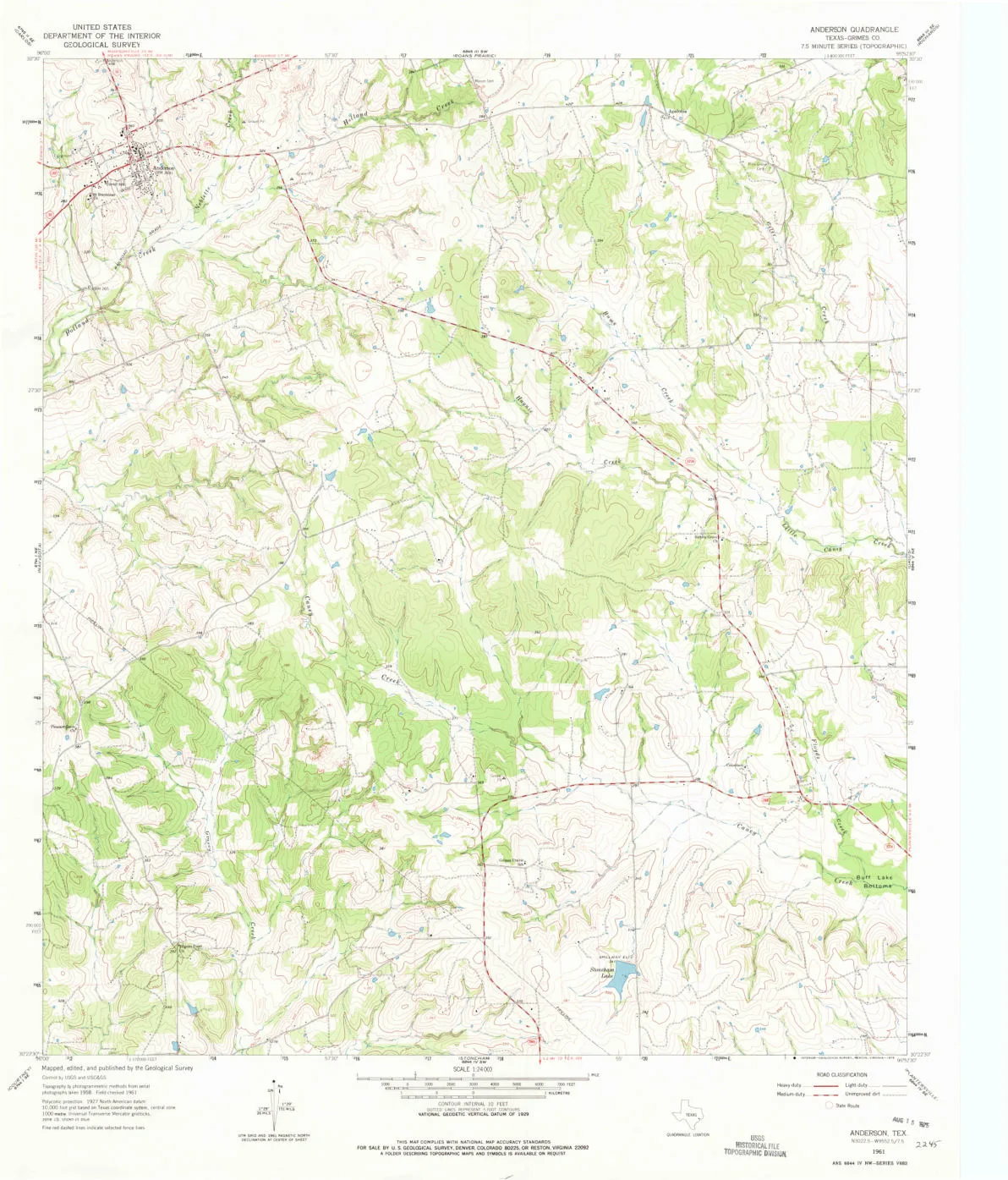
The 1961 Anderson quadrangle. The town sits in the northwest of the sheet, where a railroad enters from the west and the highway runs through. The Handbook says the Madisonville Branch was discontinued in 1944. A line drawn on a 1961 map is not, by itself, proof that a train was still stopping. U.S. Geological Survey. Public domain.
A city government the voters would not revive
The Handbook says growth was also held back by the lack of city government. The town was incorporated, but the records the entry cites show elected officials only for 1867 and 1875. In 1983 a movement to revive city government was defeated at the polls. The place fields on the same page still say the town is incorporated. [1]
Those statements can stand together only if “incorporated” is read as a legal label and not as a description of a working city hall. Elected officials on record for two years in the nineteenth century, and a 1983 vote against reviving a city government, are the Handbook’s own limit on the label. Anderson remained the county seat. County offices are not the same thing as a municipal government. [1]
370, and also 259
The narrative says that although Anderson is the county seat and was once the fourth largest town in Texas, its population in 1990 was only 370, composed of the residents within a half-mile radius of the historic county courthouse. It mentions historic homes, and a calendar of events: Texas Trek in April, a county fair and Juneteenth celebration in June, Texan Days in September, plus church festivals and the activities of fraternal organizations. By 1990, it says, a dozen or more commercial businesses and offices, a post office, the bank, the school, law enforcement offices, and the county jail stood within a three-block radius of the courthouse. Livestock, dairy farming, hay, and honeybees supported the surrounding community. Many residents worked out of town. By 2000, the same narrative says, the population had dropped to 257, with fifty-eight businesses. [1]
A table on that same entry gives a different 1990 number, and then keeps going. It lists 259 people in 1990, 257 in 2000, 222 in 2010, 240 in 2019, 193 in 2020, and 195 in 2021. The 2000 figure, 257, matches the prose. The 1990 figure does not. The prose says 370, and it says those 370 lived within a half-mile of the courthouse. The table says 259, and it does not say what boundary it used. [1]
We print both. We do not average 370 and 259. They may be different geographies, and the Handbook does not say so in a sentence a reader can check. Anyone who quotes “about 300” has invented a third number that appears nowhere on the page. The later table is a decline with one bump, from 222 in 2010 to 240 in 2019, then 193 in 2020 and 195 in 2021. That bump is an estimate sitting next to census years. We do not smooth it into a story the entry does not tell. [1]
The complete story of Anderson
Anderson is the county seat of Grimes County. It began as Henry Fanthorp’s stage stop on the east quarter of Francis Holland’s 1824 league, with weekly mail from 1835. In 1846 an election placed the courthouse between Alto Mira and Randolph and named the seat for Kenneth L. Anderson, the Republic’s last vice president, who had died at the inn.
From 1846 to 1885 the Handbook describes a boom, a population of 3,000, and a town it calls once the fourth largest in Texas. In 1857 local landowners refused the Houston and Texas Central a right-of-way. The branch line they did accept, in 1903, was gone by 1944. The first highway was not begun until 1930. A vote in 1983 declined to revive city government.
The fourth-largest claim belongs to the Handbook’s description of that boom. The counts on the same page, a century and a half later, are a few hundred people, and the two counts for 1990 do not match.
Questions people ask
Is this Anderson County? No. Anderson is the county seat of Grimes County, ZIP 77830, ten miles northeast of Navasota. Anderson County is a different county. Its seat is Palestine. [1]
Who was the town named for? Kenneth L. Anderson, last vice president of the Republic of Texas, who had recently died at the Fanthorp Inn when the county seat was named in 1846. The Handbook does not, in this entry, give the date of his death. [1]
Did Anderson refuse the railroad? The Handbook says local landowners refused a right-of-way to the Houston and Texas Central in 1857. In 1903 they agreed to the Madisonville Branch of the Missouri Pacific, from Navasota to Madisonville. That line was discontinued in 1944. [1]
Why do the 1990 populations disagree? The narrative says 370 residents within a half-mile of the courthouse. The table on the same entry says 259 for 1990, then 257 for 2000. The 2000 numbers match each other. The 1990 numbers do not. We print both and do not average them. [1]
Sources
Jan M. Hennigar, “Anderson, TX,” Handbook of Texas Online, Texas State Historical Association. tshaonline.org/handbook/entries/anderson-tx. The entry’s bibliography includes Irene Taylor Allen, Saga of Anderson (New York: Greenwich, 1957); E. L. Blair, Early History of Grimes County (Austin, 1930); the Grimes County Historical Commission’s county history (Dallas: Taylor, 1982); and vertical files at the Dolph Briscoe Center for American History.
Texas Historical Commission, Fanthorp Inn historic site. thc.texas.gov/historic-sites/fanthorp-inn.
Handbook of Texas Online, “Dance Brothers,” the cross-reference in the Anderson entry for the Confederate pistol factory. tshaonline.org/handbook/entries/dance-brothers.
U.S. Geological Survey, Anderson quadrangle, Texas, 1:24,000, 1961. Public domain. TX_Anderson_105682_1961_24000_geo.pdf.