Texas Towns: The Stories Behind the Map
The History of Willis, Texas
A railroad gift that became Texas’s cigar town
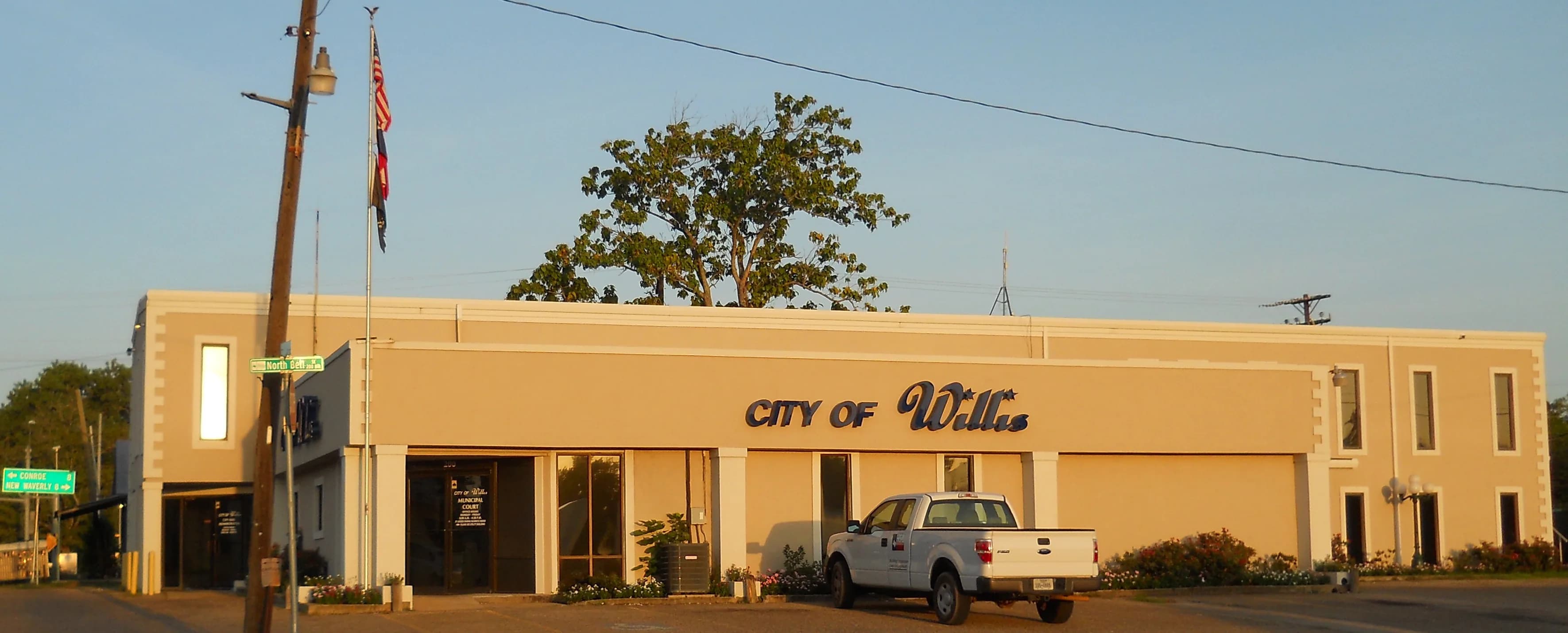
City Hall on North Bell Street. Willis is here because two Galveston merchants gave the railroad a townsite in 1870 — and because Danville, Montgomery, and Old Waverly followed the tracks. — HIM Nguyen, CC BY-SA 3.0, Wikimedia Commons
Willis, Texas (ZIP 77318) began when the Willis brothers donated a townsite to the Houston and Great Northern Railroad in 1870. It tried to steal the county seat, then grew 90 percent of Texas’s tobacco.
- ZIP
- 77318
- Townsite donated
- 1870
- Post office
- 1872
- Cigar factories
- As many as seven
Editor’s note. This is the fifth installment of “Texas Towns: The Stories Behind the Map.” Willis is eight miles north of Conroe on the old railroad grade that emptied older towns. We stay with the Montgomery County record.
Willis, Texas, sits on the Missouri Pacific line — once the Houston and Great Northern — eight miles north of Conroe in north central Montgomery County, ZIP 77318. Drive it today and Interstate 45 makes the town look like an exit. The older fact is sharper. Willis is a railroad invention. Two Galveston merchants donated the townsite. Older settlements packed up and moved to the tracks. [1]
Then Willis tried to take the courthouse. Then it grew cigars. Then the tariff changed, the Depression hit, oil and a highway arrived, and Lake Conroe filled five miles west. The name stayed. The economy kept changing underneath it.
A townsite for the first railroad
In 1870 the Houston and Great Northern Railroad began surveying Montgomery County’s first rail line. Galveston merchants Peter J. and Richard S. Willis, already landholders in the county, donated a townsite along the proposed route. That is the founding: not a creek crossing that slowly thickened, but a gift of ground to a grade. [1] [5]
Black farmers in the vicinity had already organized a Methodist congregation, which became the first church in Willis. By 1872 the rail line had reached the town. Most of the businesses and residents of Danville, Montgomery, and Old Waverly began moving to the new stop. A post office opened that same year. A White Baptist congregation organized. The pattern is the same one that later emptied Mink and built Magnolia: commerce followed the rails. [1]
The county-seat fight Willis almost won
In 1874 citizens of the new town launched a prolonged struggle to transfer the county seat from rival Montgomery to Willis. They won a vote. They did not keep the courthouse. After the Houston and Texas Central was built through Montgomery, the seat moved back there in 1880. In 1889 it moved again — to Conroe, the junction of the International-Great Northern and the Gulf, Colorado and Santa Fe. [2]
Willis had the first railroad. Conroe had two. The county seat followed the junction, not the first depot.
A weekly newspaper, the Willis Observer, began as early as 1875. By the late 1870s Willis was a shipping point for timber and farm commodities and a center for lumber products, wagons, and agricultural implements. The first White Methodist church went up in 1879. [1]
Willis Male and Female College
Citizens contracted for a college building in 1881. The contractor held the keys for three years until final payments were made. Title passed to Rev. and Mrs. S. N. Barker, Methodists, who opened Willis Male and Female College in September 1885. The school changed hands — to F. P. Crow and C. H. Stovall in 1890, then to Cyril M. Jansky and Marion Kline, then back to Crow — until it was sold to the public schools in 1900 or 1901. Until then it functioned as a semi-private boarding school from elementary grades through college. [3] [1]
A three-story college in a railroad town of a few hundred people is not decoration. It is what Willis thought it was becoming.
Texas’s cigar town
By 1884 Willis had steam-powered saw and grist mills, two cotton gins, a brickyard, a saloon and gambling house, a Grange hall, grocery and dry-goods stores, and a population of 600. By 1890 the count was 700, with three hotels and a second weekly, the Willis Index. [1]
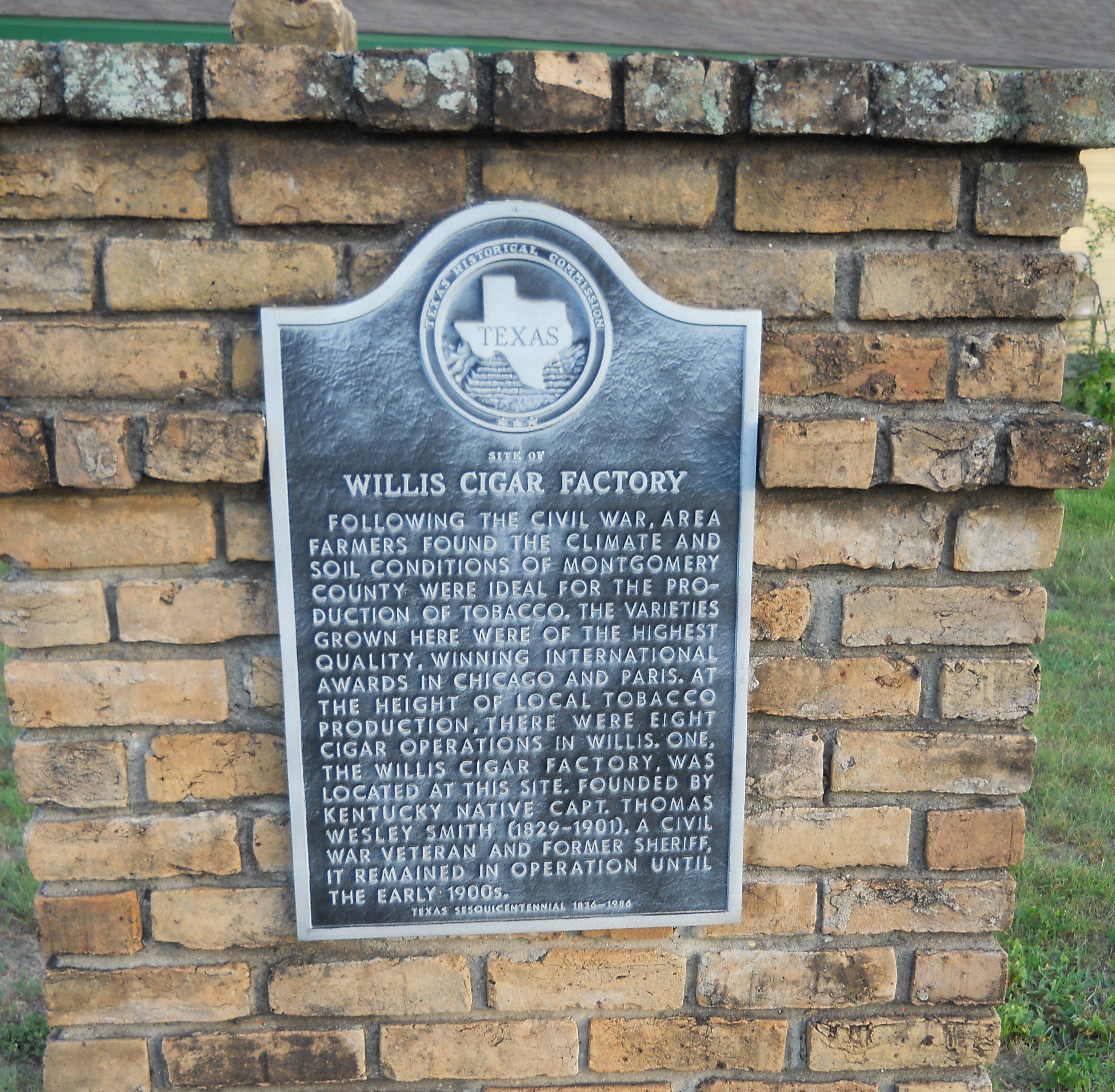
The late nineteenth century made Willis the leading tobacco-growing region in Texas. After the Civil War, farmers found Montgomery County climate and soil right for high-quality leaf that won awards in Chicago and Paris. At the height of the boom Willis supported as many as seven cigar factories. One, the Willis Cigar Factory, was founded by Kentucky native Capt. Thomas Wesley Smith, a Civil War veteran and former sheriff, and stayed in operation until the early 1900s. [1] [4]
The boom died when the tariff on Cuban tobacco was lifted in the early twentieth century. Timber and other crops kept the town from collapsing. Population dipped to an estimated 500 in 1892, then rose to about 832 by 1904. The Willis State Bank opened in 1911. By 1914 the Willis Star was publishing and a telephone exchange was working. [1]
Depression, oil, Interstate 45, the lake
The Great Depression and a slump in timber halted growth. From an estimated 900 in 1929, population fell to about 750 by 1931. Then the Conroe oil boom that began southeast of town in 1931 spread its effects north. U.S. Highway 75 came through in the early 1930s. World War II revived lumber and farms. The count climbed back to about 900 in 1933 and stayed near there for more than three decades — 891 in 1968. [1]
Interstate 45 through Willis in the early 1960s tied the town to Houston and Conroe. Construction of Lake Conroe, five miles west on the West Fork of the San Jacinto, started the next jump: about 1,457 in 1970, 1,674 in 1986, 2,110 in 1990, 2,764 by 1992, and 3,985 in 2000. The Handbook’s later almanac figures reach 6,431 in 2020. The economy, the Handbook still said in the late twentieth century, remained based on lumbering and agriculture even as the interstate and the lake changed who lived here. [1]
The complete story of Willis
Willis’s history is the story of a donated townsite that pulled Danville, Montgomery, and Old Waverly onto the first railroad in the county.
It is the story of a county-seat vote Willis won and could not keep.
It is the story of seven cigar factories in a Piney Woods town, killed by a change in the Cuban tariff, and of a college that became the public school.
The interstate and the lake supplied the later growth. The Willis brothers supplied the name. The railroad supplied the place.
Quick answers
Willis history FAQ
When was Willis, Texas founded?
In 1870 Galveston merchants Peter J. and Richard S. Willis donated a townsite to the Houston and Great Northern Railroad as it surveyed Montgomery County’s first rail line. A post office opened in 1872.
Why is Willis named Willis?
The town is named for the Willis brothers, landholders in Montgomery County who gave the railroad the ground. The tracks created the town. The brothers supplied the name.
Was Willis ever the Montgomery County seat?
Almost. In 1874 Willis voted the county seat away from Montgomery, then lost it back in 1880 after the Houston and Texas Central reached Montgomery. In 1889 the seat moved to Conroe.
Why was Willis famous for cigars?
After the Civil War, Montgomery County soil grew high-grade tobacco. Willis became the leading tobacco region in Texas and supported as many as seven cigar factories until the tariff on Cuban tobacco was lifted and the boom died.
Sources
Notes and credits
- [1]Texas State Historical Association, “Willis, TX”
- [2]Texas State Historical Association, “Montgomery County”
- [3]Texas State Historical Association, “Willis Male and Female College”
- [4]Texas Historical Commission, “Site of Willis Cigar Factory”
- [5]City of Willis, “Willis History”
Numbered citations in the story are live links. Source language is paraphrased except where quotation marks identify a short title or documented phrase.