Texas Towns: The Stories Behind the Map
The History of Magnolia, Texas
Mink Prairie moved to the tracks and took a new name
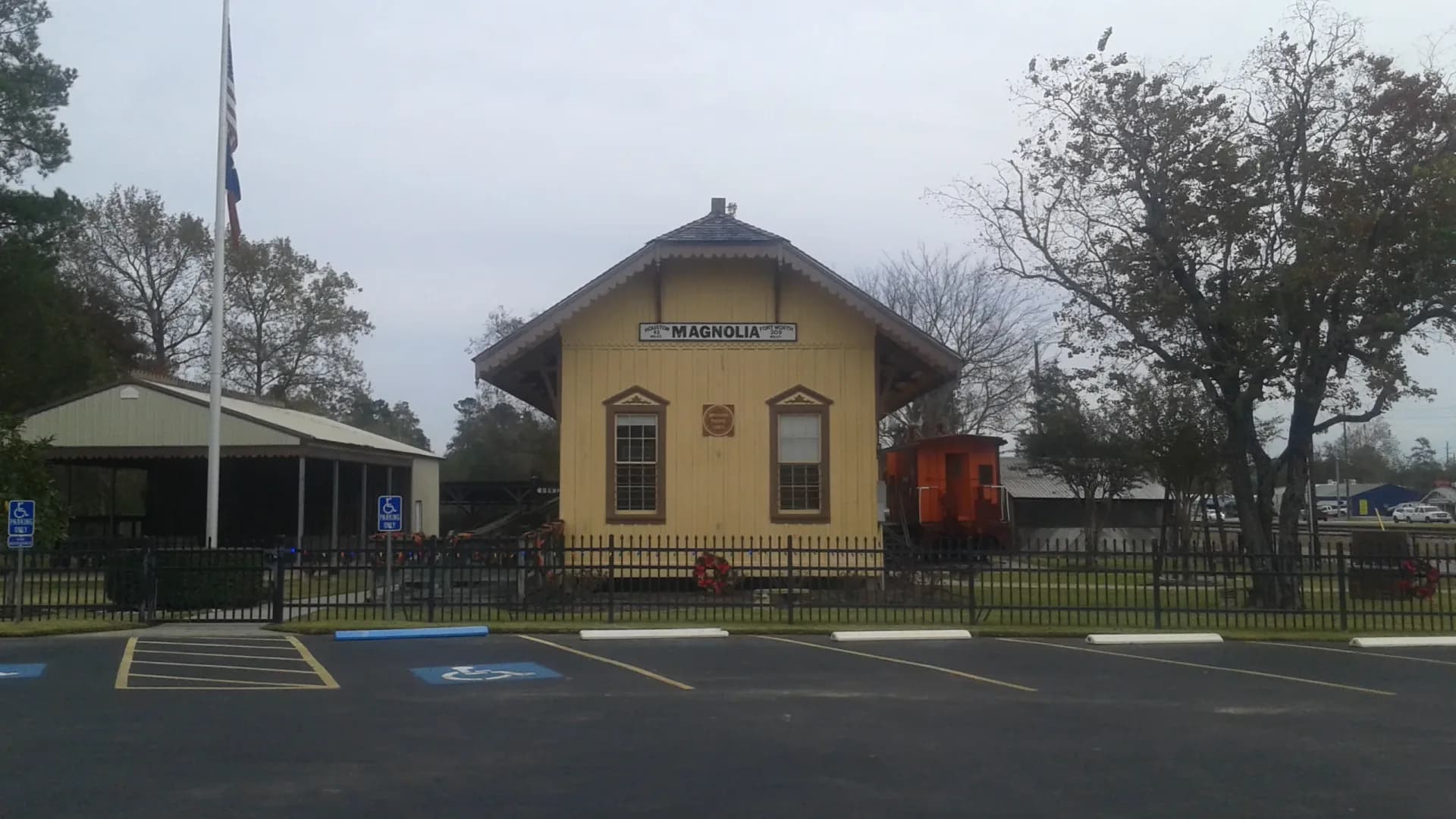
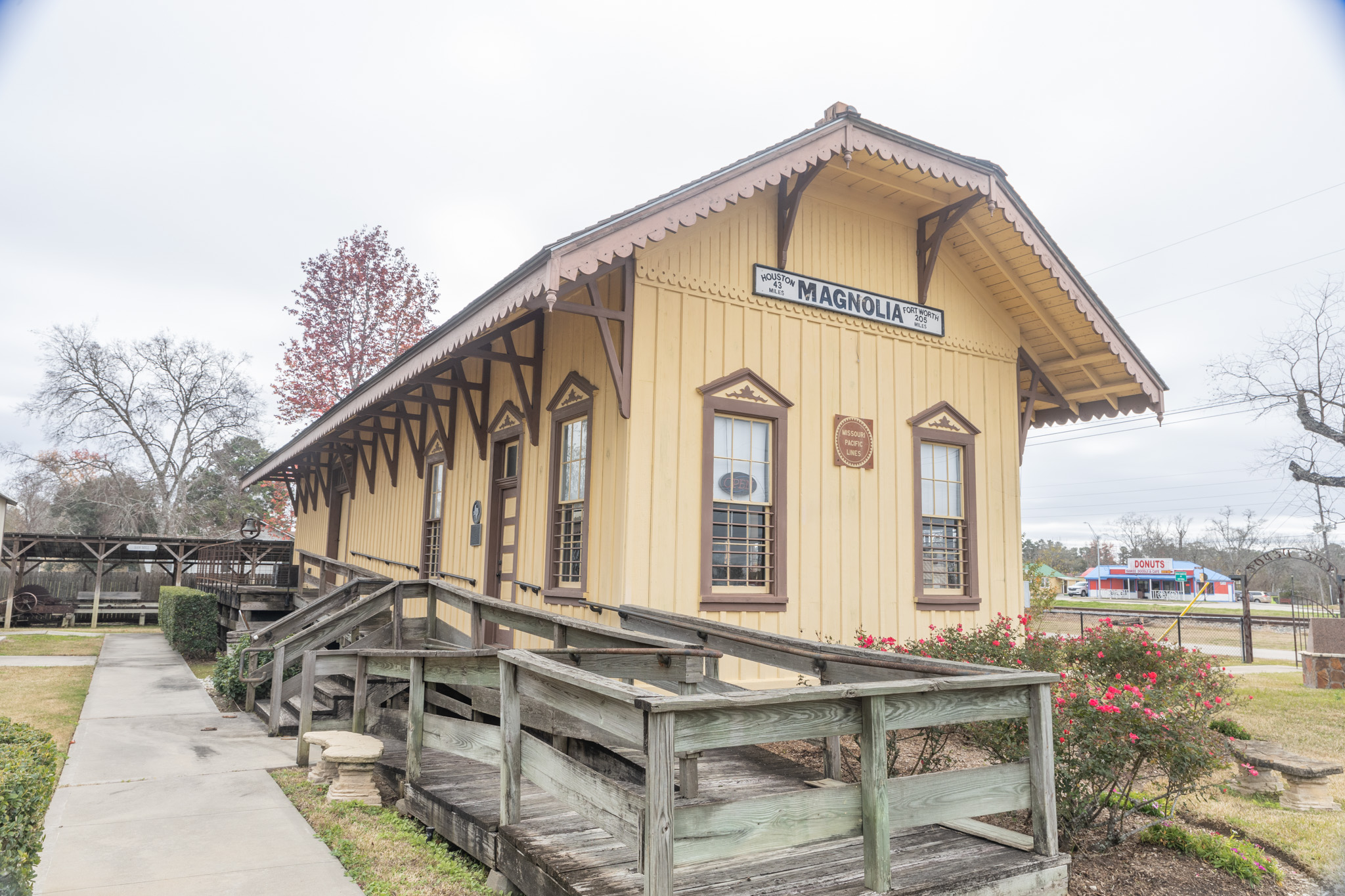
Magnolia’s historic depot. The town is here because the International-Great Northern Railroad was here — and because Mink, two miles southwest, was not. — Stedil, CC BY-SA 4.0, Wikimedia Commons
Magnolia, Texas (ZIP 77354) did not begin as Magnolia. It began as Mink’s Prairie, moved two miles to the International-Great Northern Railroad in 1902, tried the name Melton, and then took the magnolia trees along Mill Creek.
- ZIP
- 77354
- Earlier name
- Mink’s Prairie
- Moved to rails
- 1902
- Incorporated
- September 28, 1968
Editor’s note. This is the fourth installment of “Texas Towns: The Stories Behind the Map.” Magnolia’s incorporated city is young. The settlement underneath it is not. We stay with the Montgomery County record and do not borrow another Magnolia’s history.
Magnolia, Texas, now sits at Farm Roads 1774 and 1488, about twenty miles southwest of Conroe, ZIP 77354. The name suggests shade trees and a planned town. The record says otherwise. Magnolia is a railroad relocation. The people were already here. The tracks were not. [1]
Before Magnolia there was Mink. Before Mink there was Mink’s Prairie. The present downtown is what remained after a community picked up and moved two miles to keep from being left behind.
Mink’s Prairie
Settlement in this corner of Montgomery County began in the late 1840s. The Handbook’s Magnolia entry says the place was named Mink’s Prairie for an early settler; by 1850 the name had been shortened to Mink. A post office opened at Mink on September 3, 1885, with John F. Dobbs as postmaster. [1]
The Mink entry is more specific. A man named Mink took up farming about 1845. A gristmill rose near his homestead. A blacksmith shop was there by the early 1850s. After the Civil War, settlers from Tennessee and Kentucky accelerated growth. In the 1870s a Grange hall doubled as interdenominational church, school, and civic center. A cotton gin and a Methodist church followed. [2]
By 1896 Mink had a general store, two churches, two flour mills, and about 300 residents. By 1900 the Magnolia entry gives Mink a population of twenty-five — a reminder that handbook figures sometimes describe different counts of the same countryside. What is not in doubt is the next fact: the railroad missed Mink. [1] [2]
The tracks two miles away
In 1902 the International-Great Northern Railroad built its Spring-to-Navasota branch through southwestern Montgomery County and bypassed Mink to the north. Residents and businesses moved rapidly onto the new line, about two miles northeast. The Mink post office closed in 1903. Within a few years the older community had been abandoned. [2] [4]
This is the same railroad logic that emptied other Texas towns. Commerce followed the grade. A settlement that could not reach a depot became a name on older maps.
Melton, then Magnolia
The railroad named the new town Melton, for Jim Melton, a large landowner in the county. The United States Post Office confused the name with Milton. The town was renamed Magnolia for the magnolia trees in the bottoms of adjacent Mill Creek and received a post office in 1903. [1]
A town that changes names twice in a year is not inventing a mythic origin. It is solving a postal problem and borrowing the nearest landmark that will print clearly on an envelope.
By 1915 Magnolia had about 150 residents, telephone service, a sawmill, Baptist and Methodist churches, two general stores, a physician, a railroad and express agent, a hotel, a livery and real estate office, a cattle dealer, a druggist, a confectionery, a cotton gin, and a blacksmith. That is a complete small railroad town: timber, cotton, cattle, and the depot. [1]
Lumber camp, landing field, Missouri Pacific
By the 1940s an airfield had been established a mile from town. Magnolia still had an I-GN station, a post office, a cemetery, two churches, two schools, ten businesses, and a lumber camp two miles southeast. By 1962 the Missouri Pacific had taken over the line. The Handbook then described two high schools, a church, a landing field, and a small collection of dwellings near the center. [1]
The countryside around Magnolia remained Piney Woods Montgomery County: timber, creeks, and later the westward push of Houston-area settlement. [3]
A city on paper in 1968
Magnolia incorporated on September 28, 1968. The municipal city is therefore younger than many of the houses and much younger than Mink. Population, as the Handbook records it, rose in the 1960s and early 1970s to 1,150 by 1971, fell to 867 in 1980, reached 1,132 by 1989, declined to 940 in 1990, and stood at 1,111 in 2000, with 640 businesses. [1]
Those are the last handbook figures used here. Later estimates exist elsewhere. This series stays with sources that can be read and checked without a broken government lookup.
What the numbers do show is a town that grew, shrank, and grew again as the county around it suburbanized — still a railroad town in its bones, then a school-district town, then a place people meant when they said they lived “out Magnolia.”
What the name hides
Texas has had more than one Magnolia. Anderson County’s Magnolia was a Trinity River cotton port that died after the railroad bypassed it. San Jacinto County and Montague County have used the name too. Montgomery County’s Magnolia is the incorporated city on 1774 and 1488. Mixing those records is how local history gets sloppy. [1]
This Magnolia’s honest origin is plainer than the blossom in the name: a farmer called Mink, a Grange hall, a missed railroad, a postal mix-up, and a depot.
The complete story of Magnolia
Magnolia’s history is the story of Mink’s Prairie deciding, in 1902, that a town without tracks would not remain a town.
It is the story of Melton, Milton, and Magnolia — three names for one move.
It is the story of a sawmill-and-cotton depot that incorporated late, kept its station after the line changed hands, and then found itself on the western edge of Houston’s growth.
The trees along Mill Creek supplied the name. The railroad supplied the place.
Quick answers
Magnolia history FAQ
What was Magnolia, Texas called before Magnolia?
The community was first known as Mink’s Prairie, then Mink. When the railroad arrived in 1902 the new townsite was called Melton, for landowner Jim Melton. The post office confused it with Milton, so the town was renamed Magnolia in 1903 for trees along Mill Creek.
Why did Magnolia move?
In 1902 the International-Great Northern Railroad built its Spring-to-Navasota branch through southwestern Montgomery County and bypassed Mink to the north. Residents and businesses moved about two miles onto the tracks.
When did Magnolia incorporate?
Magnolia was incorporated on September 28, 1968. The railroad town is older. The municipal city is not.
Is this the same Magnolia as other Texas towns with that name?
No. The Handbook of Texas also records Magnolia communities in San Jacinto, Anderson, and Montague counties. This series installment is Magnolia in Montgomery County, ZIP 77354.
Sources
Notes and credits
- [1]Texas State Historical Association, “Magnolia, TX (Montgomery County)”
- [2]Texas State Historical Association, “Mink, TX”
- [3]Texas State Historical Association, “Montgomery County”
- [4]Texas State Historical Association, “International-Great Northern Railroad”
Numbered citations in the story are live links. Source language is paraphrased except where quotation marks identify a short title or documented phrase.