

Texas Towns: The Stories Behind the Map
The History of Tomball, Texas
Peck became Oil Town U.S.A.
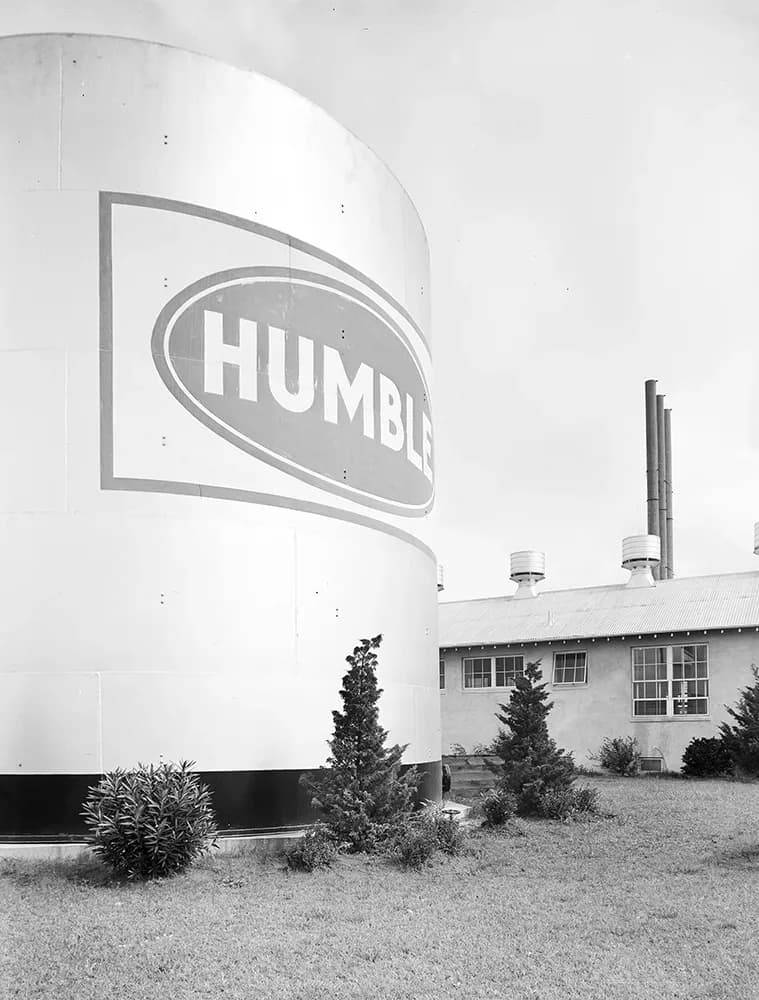
Humble’s Tomball works, June 1940. Seven years after the Kob well, the farming depot was an oil town with company camps and a ninety-year bargain for free gas and water. — Robert Yarnall Richie / SMU Central University Libraries, no known copyright restrictions
Tomball, Texas (ZIP 77375) began as Peck, a railroad stop. On December 2, 1907, it was renamed for Congressman Thomas Henry Ball. On May 27, 1933, drillers struck oil on J. F. W. Kob’s land and the farming town became Oil Town U.S.A.
- ZIP
- 77375
- Renamed
- December 2, 1907
- Oil struck
- May 27, 1933
- Incorporated
- July 6, 1933
Editor’s note. This is the ninth installment of “Texas Towns: The Stories Behind the Map.” Tomball is in Harris County, on the south edge of the Montgomery County map this series has been walking. The railroad and the oil field are the same regional story.
Tomball, Texas, sits about thirty miles north of Houston in northwestern Harris County, ZIP 77375. Searchers want two facts. The town used to be Peck. Then it became Oil Town U.S.A. Both are documented. [1] [3]
Between those names is a congressman who pushed a railroad and a ship channel, a 1907 depot that still stands, and a 1935 bargain with Humble that made Ripley’s notice a city with free gas, free water, and no cemetery.
Peck, a railroad stop
The settlement that became Tomball was a railroad point with the facilities that make a farm town: two section houses, stock pens with water and chutes, and a five-stall roundhouse. Those tools made Peck an agricultural trade center. Cotton, tomatoes, dairy, and lumber moved toward Houston on the Texas and New Orleans / Southern Pacific line. [1] [5]
Local memory, recorded in later depot tours, says Peck was named for a train engineer. The Handbook’s day-by-day entry is content to call the place Peck and then record the rename. [3]
December 2, 1907: Tom Ball’s town
On December 2, 1907, Peck was renamed Tomball in honor of Thomas Henry Ball, who had been instrumental in routing the railroad to the community. Ball was born in Huntsville on January 14, 1859, practiced law there, served as mayor, and sat in Congress from 1897 until he resigned in 1903. On the Rivers and Harbors Committee he secured the first federal aid for the Houston Ship Channel in 1899. His later Houston practice represented railroads and corporations. In 1907 the depot town took the name people still use. [2] [3] [4]
A post office opened in 1908. The first school opened that year. Electric lights and telephone service arrived in 1913. In 1914 Tomball had 350 people, a bank, a blacksmith, several stores, six hotels, and two cotton gins. Charles F. Hoffman ran the first general store. J. J. Trichel was postmaster. From 1907 to 1933 the work was farming and ranching. [1]
May 27, 1933: the Kob well
On May 27, 1933, drillers struck oil west of town on the property of J. F. W. Kob. Tomball became a boomtown. It incorporated on July 6, 1933, with a population of 665, then tripled as twenty-five to thirty oil and gas companies produced within a five-mile radius. Humble Oil and Refining Company built camps, housing, and recreation for its workers. The popular name was Oil Town U.S.A. [1] [3]
In 1935 the original contract between Tomball and Humble — later Exxon — gave free water and natural gas to residents for ninety years in exchange for drilling rights inside the city limits. Ripley’s Believe It or Not featured Tomball as the only city with free gas and water and no cemetery. The Handbook records that claim as part of the town’s public image, not as a joke invented later. [1]
After the boom
The Handbook gives 1,173 residents in 1960 and about 5,000 by 1984. Light industry supported oil and gas, agriculture, and the building trades. A community college, Tomball College, opened in 1988. The 1990 population was 6,370. Passenger trains ended in the 1960s. The 1907 depot closed in 1973; the city bought it in 1992 and restored it. The depot museum now sits at 201 South Elm Street. [1] [5]
Tomball is the Harris County chapter of the same story Conroe already told: a railroad stop that waited for oil, then grew into Houston’s northern edge without dropping the older name.
The complete story of Tomball
Tomball’s history is the story of Peck, a roundhouse and stock pens, renamed for a congressman who wanted a railroad and a deep-water port.
It is the story of a farming town that incorporated in the same summer it struck oil.
It is the story of a ninety-year Humble contract, a Ripley’s caption, and a 1907 depot that outlasted the passenger trains.
Ball supplied the name. Kob’s well supplied the boom. The railroad supplied the place.
Quick answers
Tomball history FAQ
What was Tomball, Texas called before Tomball?
The railroad settlement was Peck, named for a local train engineer. On December 2, 1907, it was renamed Tomball for Thomas Henry Ball, who had helped route the railroad to the community.
Who was Thomas Henry Ball?
Thomas H. Ball (1859–1944) was a Huntsville-born lawyer, mayor of Huntsville, and U.S. congressman (1897–1903). On the Rivers and Harbors Committee he secured the first federal aid for the Houston Ship Channel in 1899. Peck took his name in 1907.
When did Tomball strike oil?
On May 27, 1933, drillers struck oil west of town on the property of J. F. W. Kob. Tomball incorporated on July 6, 1933, as Oil Town U.S.A. Twenty-five to thirty companies were soon producing within five miles.
Why did Tomball have free gas and water?
In 1935 Tomball’s contract with Humble Oil and Refining Company (later Exxon) gave residents free water and natural gas for ninety years in exchange for drilling rights inside the city limits. Ripley’s Believe It or Not called it the only city with free gas and water and no cemetery.
Sources
Notes and credits
- [1]Texas State Historical Association, “Tomball, TX”
- [2]Texas State Historical Association, “Ball, Thomas Henry”
- [3]Texas State Historical Association, “From Peck to Tomball to Oil Town U.S.A.”
- [4]U.S. House of Representatives, “BALL, Thomas Henry”
- [5]City of Tomball, “Railroad Depot”
Numbered citations in the story are live links. Source language is paraphrased except where quotation marks identify a short title or documented phrase.
More from Tomball
 Yesterday
Floods Tear Through Southwest Colorado. Polis Declares a 12-County Emergency as Rescuers Pull People From the Water.
 Last Week
The Small Towns Didn’t Disappear. Their Residents Just Stopped Going Into Them.
 Last Week