The History of Bedias, Texas
Bedias, Texas (ZIP 77831) was named for the Bidai. The Handbook gives the post office three possible years and says Sarah Bradley Dodson reportedly designed the first Lone Star flag. Bediasites are glass named for the town, not glass the town made.
Editor’s note. This is the eighteenth installment of “Texas Towns: The Stories Behind the Map.” Anderson is the Grimes County seat, ten miles northeast of Navasota. Bedias is the same State Highway 90, farther up the county. The town was named for the Bidai. The glass called bediasite was named for the town. Readers who start with the glass have the order backward.
Bedias, Texas, is at the intersection of State Highway 90 and Farm Roads 1696 and 2620, twenty-nine miles northeast of Navasota, in northeast Grimes County. The mailing ZIP is 77831. The Handbook of Texas marks the place incorporated and still lists a post office. The associated names it prints, and does not explain, are Bedi, Cottage Home, and Plasterville. [1]
A Caddo word, then a plantation west of town
The community was named for the Bidai Indians. The Handbook says their Caddo name means “brushwood.” That is the translation the entry gives. This article does not improve it, and it does not treat the name as a description of the woods a driver sees now. [1]
Settlement, by the Handbook’s account, began in 1835, when Thomas Phiney Plaster established a plantation a few miles west of the present townsite. The earliest reports call the community Plasterville. The plantation and the later town are not the same dot on the map. Plasterville is the early name, and it survives on the Handbook’s list of associated names. The entry does not define Cottage Home or Bedi. They are printed. They are not explained. Inventing a church, a mill, or a family for either name would be a guess. [1]
1844: a flag story the Handbook will not swear to
In 1844 Archelaus B. Dodson took up residence on the northern edge of the settlement. His wife, Sarah Bradley Dodson, reportedly designed the first Lone Star flag. The word that matters is “reportedly.” The Handbook uses it. Texas has more than one story in circulation about a first Lone Star flag. This article does not decide which cloth was first, and it does not promote the Handbook’s adverb into a fact. [1]
The entry’s bibliography includes Adele B. Looscan, “Harris County, 1822–1845,” in the Southwestern Historical Quarterly (1914–1915), beside the Grimes County historical commission’s county history. Looscan is a cited source for the entry. She is not, in the sentence about the flag, quoted. The sentence the Handbook is willing to print is the one with “reportedly” in it. [1]
A post office in 1846, or 1847, or 1867
A post office was established at Bedias in 1846, 1847, or 1867, according to various sources. That is the whole of the Handbook’s finding. It lists three years and does not choose. A town history that picks 1846 because it is the earliest has invented a confidence the source refused to have. A town history that picks 1867 because it is the latest has done the same thing. The honest line is the one the Handbook already wrote: the year is disputed. [1]
A Baptist church was organized in 1848. The first Methodist congregation was formed by a circuit rider from Palestine in 1871. Palestine is the seat of Anderson County. It is not the Grimes County seat named Anderson, ten miles northeast of Navasota. The circuit rider came from the other Anderson’s county. [1]
By 1885 the population had grown to 300. Those residents supported four gristmill-gins, three churches, and four privately operated schools. [1]
1903: the railroad, and a fire the Handbook does not explain
In 1903 the International-Great Northern Railroad reached Bedias. By 1907 the town had five general stores, two banks, two hotels, two gins, and other businesses the Handbook lumps as “sundry.” By 1915 the reported population was 500. [1]
Most of the business section burned in 1927 and was soon restored. The Handbook does not name the street, the hour, or the cause. Adding a spark, a drunk, or a lightning strike would be fiction. What the entry supports is a commercial street that was destroyed and rebuilt, and a town that was still there to be counted afterward. [1]
In 1936 Bedias reported twenty-five rated businesses and an estimated population of 500, the same population figure the entry gives for 1915. The community’s fortunes declined in the 1960s. By 1967 the population was an estimated 290 and the businesses had fallen to five. In 1990 the population was 301, with six rated businesses. In 2000 the population was unchanged and the business count had grown to thirty-eight. [1]
A table on the same entry starts later, and it does not continue the 301. It lists 443 people in 2010, 485 in 2019, 361 in 2020, and 370 in 2021. The narrative had stopped at a 2000 population that had not moved off 301, while businesses jumped from six to thirty-eight. The table is a different set of numbers. The 2019 estimate of 485 and the 2020 count of 361 are not a smooth line, and the difference is 124 people. We print the figures. We do not invent a closing, a boom, or a bad count to explain them. An estimate and a census are not the same instrument, and the Handbook does not say which boundary each one used. [1]
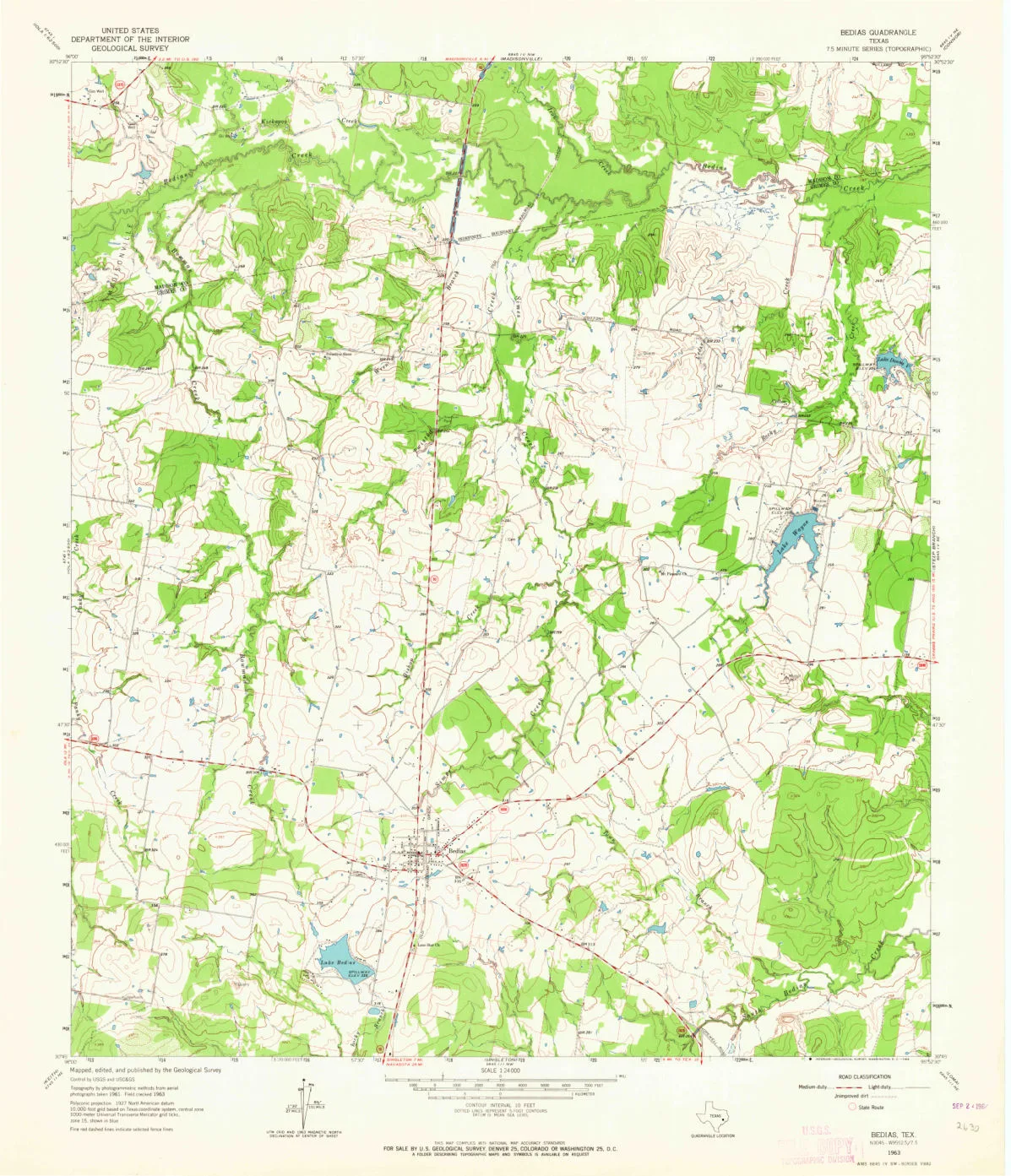
The 1963 Bedias quadrangle. The town is labeled in the lower center of the sheet, at the highway and the railroad, with Lake Bedias to the south. U.S. Geological Survey. Public domain.
The glass was named for the town
The town entry says Bedias gave its name to the distinctive tektites called bediasites, most of which have been found in Grimes County. That sentence is the local claim. The Handbook’s separate entry on tektites is the one to use for the glass, because it says where the glass came from and where else it fell. [1] [2]
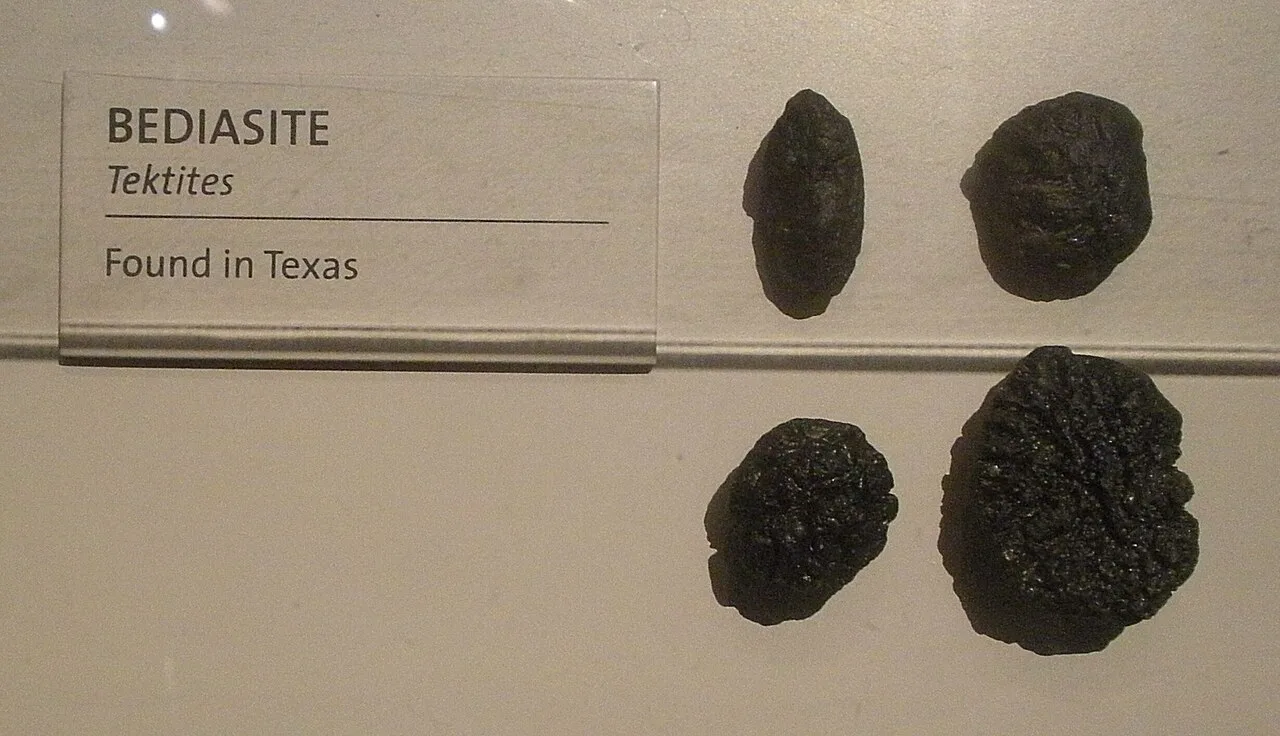
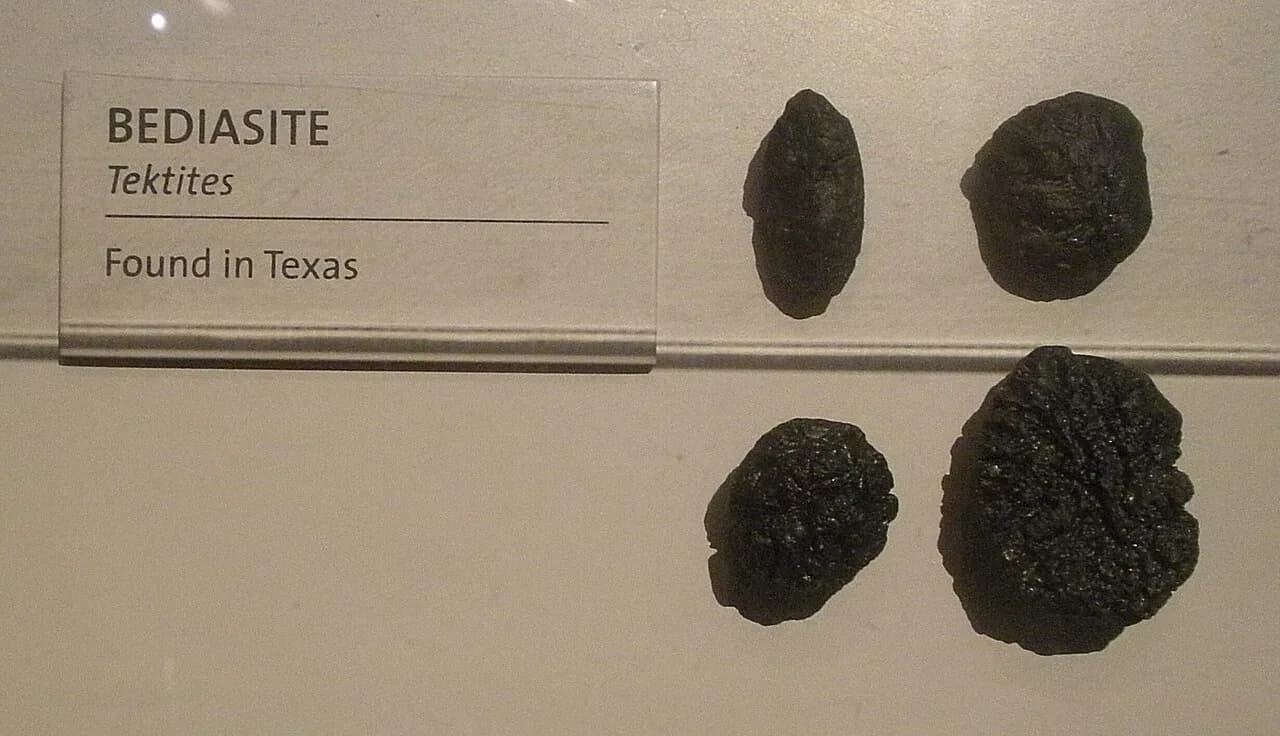
Bediasites at Griffith Observatory. The label says “Found in Texas.” It does not say they were picked up on the square in Bedias. Ixfd64, CC BY-SA 4.0, via Wikimedia Commons.
Tektites, that entry says, are bits of natural glass formed on earth by the impact of meteorites or comets. They are mostly black. Some are green or yellow. Most weigh less than 300 grams. Their shapes are the splash forms of something that was molten: spheres, teardrops, dumbbells, disks, and rods, and also layered forms. The layered pieces formed as puddles of melt. Unlike meteorites, which are found worldwide, tektites occur in limited areas called strewn fields. They were first described in the scientific literature in 1788. [2]
They were first recognized in North America from Grimes County. They were named bediasites after the Bedias Indians, who formerly roamed the area. The same event, around 35 million years ago, left tektites in Georgia, Barbados, and Martha’s Vineyard, the last of those a single specimen, and left microtektites as far away as the western Pacific and Indian Oceans. The Handbook now includes the Texas glass in the North American strewn field. The impact point it cites is beneath Chesapeake Bay, in Eocene rocks under younger sedimentary rock. That finding followed a drill core off the New Jersey coast that brought up tektites, microtektites, and impact debris. [2]
The Texas finds are not confined to the Bedias town square. The entry says tektites have also been found in Walker, Brazos, Burleson, Lee, Fayette, Lavaca, Gonzales, and DeWitt counties, in a strip five miles wide and 140 miles long, roughly parallel to the Gulf of Mexico, coinciding with the upper part of the Jackson Formation of late Eocene age. The name traveled from the Bidai, to the town, to the glass. The impact that made the glass, on the Handbook’s account, is under a bay in Virginia and Maryland, about 35 million years before Thomas Phiney Plaster’s plantation. [2]
A second name on the same rocks is easy to mix up with the glass, and it is a different thing. The U.S. Geological Survey’s geologic names record lists a Bedias Sandstone Member of the Wellborn Formation of the Jackson Group, of late Eocene age, “named from town of Bedias, Grimes County.” That is a sandstone. A bediasite is impact glass. The tektite entry says the Texas glass coincides with the upper Jackson Formation. The sandstone is a layer in that group of rocks, named from the town. It is not the glass, and a reader who pockets a pebble of sandstone has not pocketed a bediasite. [3]
The complete story of Bedias
Bedias is a community named for the Bidai, whose Caddo name the Handbook translates as brushwood. It began, in the written record the Handbook uses, as Thomas Phiney Plaster’s 1835 plantation a few miles west of the present site, called Plasterville. In 1844 Archelaus B. Dodson settled on the northern edge. The Handbook says his wife, Sarah Bradley Dodson, reportedly designed the first Lone Star flag, and it gives the post office three possible years: 1846, 1847, or 1867.
The International-Great Northern arrived in 1903. Most of the business section burned in 1927 and was soon rebuilt. The population the narrative is willing to hold still is 301 in both 1990 and 2000, while the businesses went from six to thirty-eight. The table on the same page then lists 443, 485, 361, and 370. Both sets are the Handbook’s. This article does not average them.
The glass came later, as a name. The sandstone came later, as a different name. The town was already here.
Questions people ask
What does Bedias mean? The Handbook says the community was named for the Bidai Indians, whose Caddo name means “brushwood.” [1]
When did the post office open? The Handbook says 1846, 1847, or 1867, according to various sources. It does not choose. Neither does this article. [1]
Did Sarah Bradley Dodson design the first Lone Star flag? The Handbook says she reportedly did. The adverb stays. Other Texas flag stories exist, and this entry does not settle them. [1]
Are bediasites from the town of Bedias? They were first recognized in North America from Grimes County and named for the Bedias Indians. The Handbook’s tektites entry places the impact under Chesapeake Bay, about 35 million years ago, and finds the same glass in a strip of Texas counties along the upper Jackson Formation. The town gave the glass a name. It did not make the glass. [2]
Is the Bedias Sandstone the same thing as a bediasite? No. The Geological Survey lists a Bedias Sandstone Member of the Wellborn Formation, named from the town of Bedias. That is a late Eocene rock unit. Bediasites are natural glass from an impact. [3]
Sources
Charles Christopher Jackson, “Bedias, TX,” Handbook of Texas Online, Texas State Historical Association, revised September 20, 2023. tshaonline.org/handbook/entries/bedias-tx. The entry’s bibliography is the Grimes County Historical Commission’s county history (Dallas: Taylor, 1982) and Adele B. Looscan, “Harris County, 1822–1845,” Southwestern Historical Quarterly 18–19 (October 1914–July 1915).
Virgil E. Barnes, “Tektites,” Handbook of Texas Online, revised January 1, 1996. tshaonline.org/handbook/entries/tektites.
U.S. Geological Survey, Geolex, Bedias Sandstone Member of the Wellborn Formation of the Jackson Group, late Eocene, “named from town of Bedias, Grimes County.” ngmdb.usgs.gov/Geolex/Units/Bedias_6780.html.
U.S. Geological Survey, Bedias quadrangle, Texas, 1:24,000, 1963. Public domain. TX_Bedias_105818_1963_24000_geo.pdf.