Before Conroe Was a City Isaac Conroe Had Already Lived Three Lives
Historian Andrew V. Rapoza’s new 225-page biography reconstructs the remarkable and complicated life of Isaac Conroe, from Chicago politics and Gettysburg to the sawmill settlement that became Montgomery County’s seat.
Before Conroe was a city, Isaac Conroe had already been arrested in a Chicago post-office case, reported killed at Gettysburg and shot through the mouth. After the war, he lost an 85-foot lumber barge, watched a hurricane flatten his sawmill, suffered a badly broken leg in a boiler explosion and later saw another mill destroyed by fire.
He kept rebuilding.
Eventually, what grew from that stubbornness was no longer merely a lumber business. It was the town carrying his name.
Historian Andrew V. Rapoza spent years reconstructing that life for Isaac Conroe: Visionary, Trailblazer & Founder of Conroe, Texas. The 225-page biography was added this month to the University of North Texas Libraries’ Portal to Texas History, where the entire book can be read online at no charge.
The familiar version of the story is true: Isaac Conroe operated a sawmill, the railroad stop became known as Conroe’s Switch and a town developed around it. Rapoza’s research shows how much life had already happened before that simple summary begins.
A Chicago Post Office Built on Politics
Conroe grew up in New Jersey and reached Chicago during a period when the city was swelling with people, money and political ambition. In March 1858, at about 23 years old, he began working in the Chicago Post Office under his uncle, Postmaster Isaac Cook.
Cook was a wealthy Democratic power broker whose federal appointment gave him influence over scores of postal jobs. The office had already been accused of poor management, political interference and theft by employees. Cook placed relatives and political supporters on the payroll, and Conroe benefited from that system.
Conroe advanced to chief clerk in the box-delivery department and publicly supported Southern Democratic presidential candidate John C. Breckinridge during the 1860 election. On Aug. 9, 1860, a postal inspector arrested him on a charge of opening letters that were not addressed to him.
The surviving account does not accuse Conroe of taking money, and the final disposition of the case has not been located. He received special bail, and the matter did not prevent him from entering the Army several months later. That distinction matters. The arrest belongs in his story; a conviction should not be invented where the record does not establish one.
Reported Dead at Gettysburg
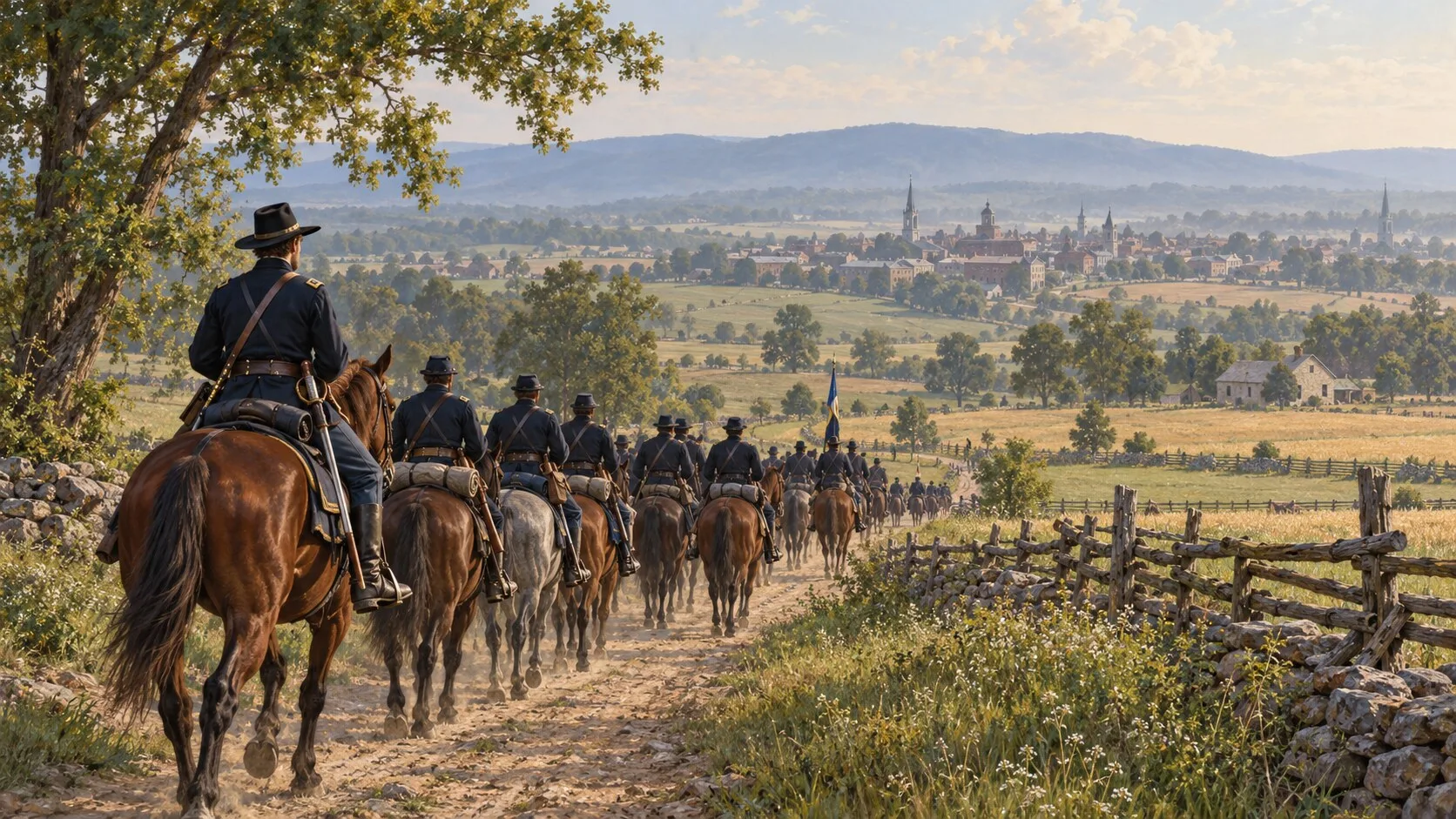
When the Civil War began, Conroe enlisted with the McClellan Dragoons, which became part of the 12th Illinois Cavalry. He advanced from private to first sergeant and then second lieutenant.
On July 1, 1863, at Gettysburg, a casualty sheet listed Lieutenant Isaac Conroe as killed in action.
He was still alive, although the mistake is understandable. A bullet entered his face beside the corner of his mouth, destroyed teeth in his upper right jaw, crossed his tongue, shattered more teeth in the lower left jaw and exited below his left ear. It missed his carotid artery by a narrow margin.
Conroe spent about 10 days in a Gettysburg field hospital and another 12 days in an officers’ hospital in Georgetown. After a short furlough, he returned to duty on Aug. 17.
He continued serving through the war, received several promotions and became captain of Company A. In August 1865, his unit joined Gen. George Armstrong Custer’s difficult expedition across the pine forests of East Texas. Other members of the expedition complained about the heat, insects, snakes and seemingly endless trees. Rapoza makes a persuasive case that Conroe saw something else: timber, transportation and opportunity.
A Barge Named Rowena
Conroe left military service in Houston on May 29, 1866. He and Army surgeon Asa Morgan purchased more than 523 acres along Cedar Bayou, then divided the property. That September, Conroe returned to Washington, D.C., to marry Margaret Kesiah Richardson, whom he had met during the war.
His first Texas business was freight, not sawmilling. Conroe and Morgan commissioned a flat-decked barge measuring nearly 85 feet long and 24 feet wide. They named it Rowena after Morgan’s wife. When Isaac and Margaret’s first daughter was born in 1867, they named her Rowena too.
The barge hauled lumber through the Houston-area bayous. Moving the heavy vessel through narrow water cluttered with vegetation, submerged logs and wartime wreckage was difficult work. At an unknown date, the Rowena was lost, probably after its hull was breached.
That failure led to the encounter that changed Conroe’s direction. At Houston lumberman Sylvester Munger’s yard, a missing clerk had left a load of lumber waiting to be checked. Conroe said he could do the job and completed it well enough that Munger hired him. He learned the lumber business from inventory and sales to milling and transportation.
Hurricane Fire and an Exploding Boiler
Conroe eventually opened sawmills near Egypt and Haltom in Montgomery County. The business was never an easy climb.
In September 1875, the Indianola hurricane tore inland and blew down the Conroe Harris and Company mill house. In August 1877, the mill’s steam boiler exploded while it was running. Three men were injured, and Conroe’s leg was badly broken below the knee. A court action involving the landowners also cost the company its mill site and possibly some equipment.
Conroe moved and began again near Haltom. In 1881, he made a larger commitment. He purchased 1,092 acres in the Joshua G. Smith land grant, adding timber rights on surrounding acreage, and moved his mill operation into the forest east of the railroad.
Fire destroyed his mill around June 1888. He rebuilt so quickly that later reports concentrated on the improved operation rather than the loss.
The pattern is difficult to miss. The barge sank. A hurricane knocked down a mill. A boiler exploded. A court forced another move. Fire took another plant. Conroe repeatedly answered by building again.
The Settlement That Took His Name
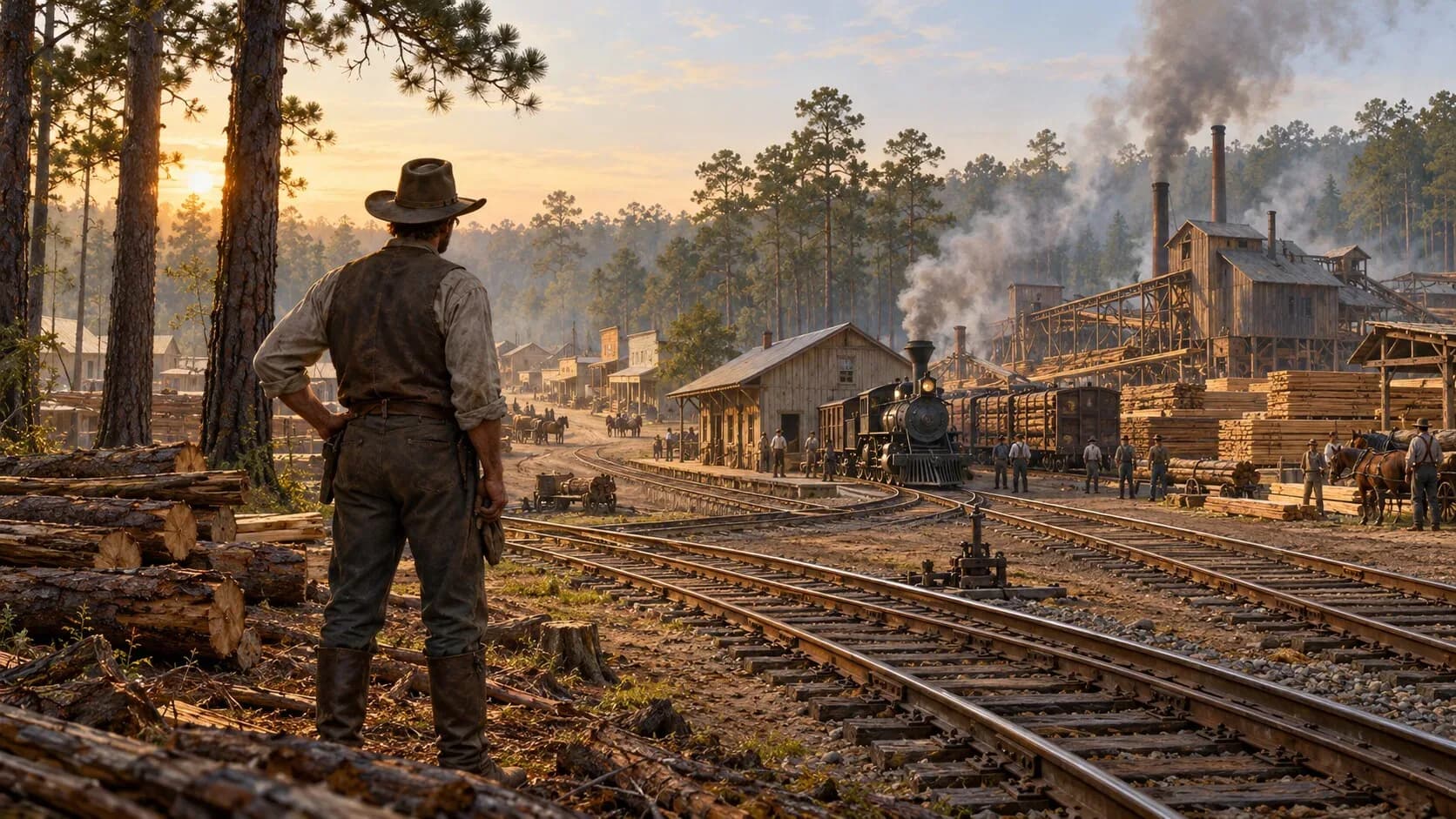
The International and Great Northern Railroad established a switch to serve Conroe’s lumber operation. The stop appeared as Conroe or Conroe’s, and the settlement grew around the rail connection, planing mill, commissary and lumber yard.
In November 1883, Conroe applied for a post office. His hand-drawn map estimated that 150 people lived in the immediate settlement and another 150 in surrounding communities would use it. The federal government approved the post office the following month and appointed him the settlement’s first postmaster.
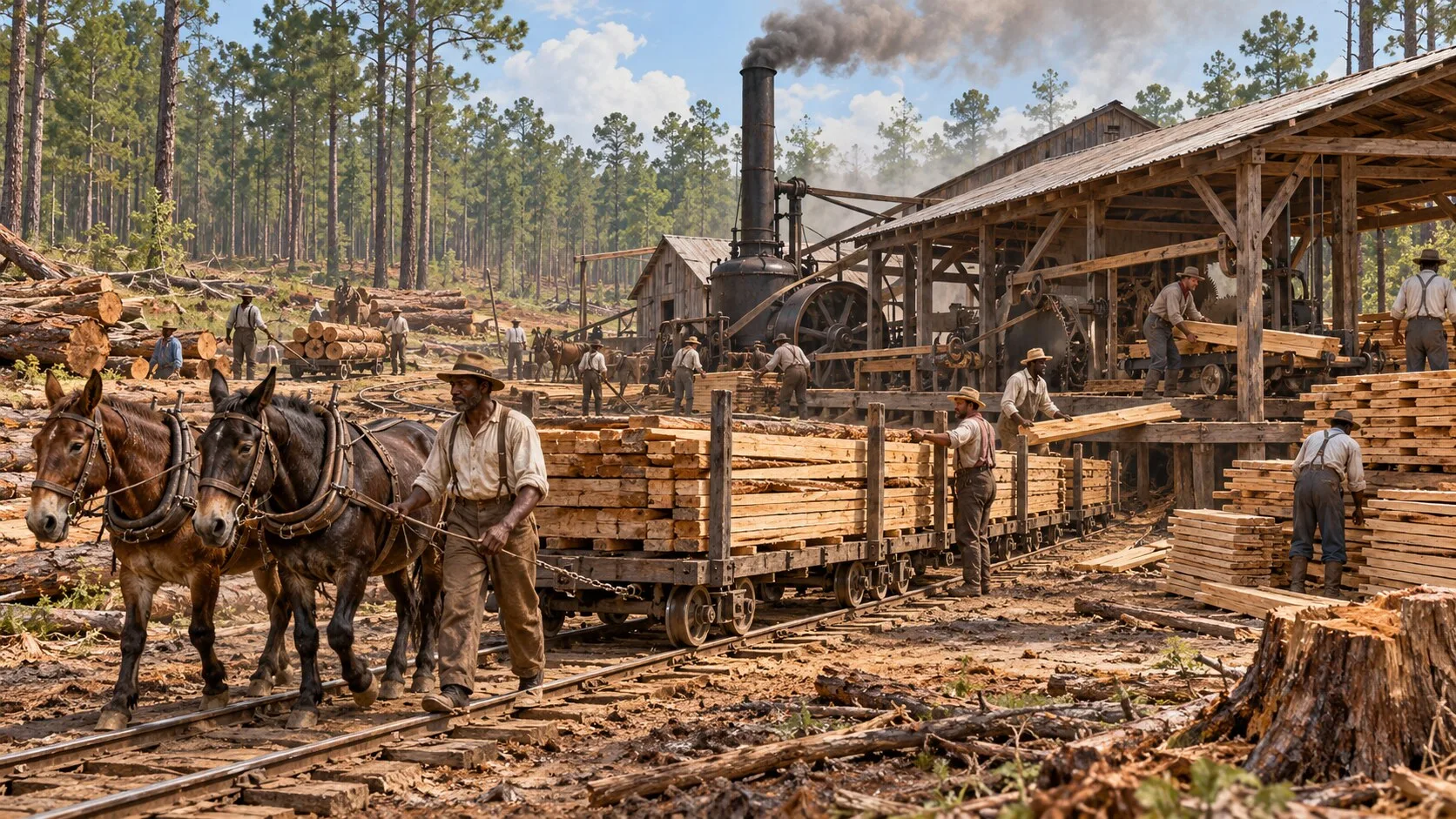
The early population was more diverse than the traditional founder story sometimes suggests. Black workers formed a large part of the East Texas sawmill labor force and likely a substantial share of Conroe’s workforce. They performed dangerous work in the mill, logging crews, tram lines and rail operations while living under the unequal conditions of segregation.
The new town physically reflected that division. White residents and businesses clustered in much of the Ralston Plat. Many Black families lived east of it in the Madeley Quarter, built homes and churches from the materials they could obtain, and established their own school. One Black sawmill worker, Major Somerville, purchased property only two lots from Isaac Conroe’s home, an uncommon act by both men in that time and place.
Including that history gives credit to the people whose work made the town possible.
When Conroe Became the County Seat
In April 1889, voters chose Conroe over Montgomery as the county seat by 1,161 votes to 1,099. The 62-vote margin left little time for celebration. County officials wanted the records, offices and courts operating in Conroe before opponents could undo the result.
Isaac Conroe offered his Avenue A house and agreed to construct a 40-foot-square courtroom behind it. Seventeen days after the contract, the county records reached the temporary courthouse. Offices occupied the first floor of his home, the upstairs served as a grand-jury room, and Conroe’s son William later recalled serving on a jury in the family parlor.
With no permanent jail ready, the county also paid Conroe to help guard prisoners. Once a temporary jail had been assembled, every prisoner escaped one October night even though the door was found locked and the building appeared undamaged. History did not record the trick.
Conroe and fellow lumberman J.K. Ayres then fought over where the permanent courthouse should stand. Conroe favored the established Ralston Plat. Ayres offered free land west of the tracks, and the commissioners chose it. Conroe challenged the decision but lost. The courthouse opened in 1891, built in part with lumber from Conroe’s mill.
Their rivalry ultimately helped create a stronger town on both sides of the railroad.
The Train Carried Him Away
By the 1890s, Conroe’s operation was far removed from a temporary backwoods mill. It employed about 70 men in 1889, produced roughly 40,000 board feet of lumber a day and later grew to a stated capacity of 60,000. Its equipment included a locomotive, logging cars, narrow-gauge track, planing machinery, dry kilns, a cotton gin and a grist mill.
Conroe had flaws, and the town he helped build was deeply unequal by race. The surviving record also shows him helping churches, schools, workers and neighbors. During the depression of the 1890s, his store advertised lower Hard Time Prices. After Black railroad worker Charles Stoneham was killed by a train in 1895, Conroe became guardian of Stoneham’s two small sons and helped their widowed mother pursue a claim against the railroad, even though Conroe served on its board.
Isaac Conroe died at his Avenue A home on Aug. 2, 1897, after becoming seriously ill at his mill three days earlier. He was 62. The precise cause remains uncertain.
The following day, the Masonic lodge escorted his body from the house to the railroad depot. Every business in Conroe closed. About 200 people from the sawmill followed the procession to the train that would carry him to Houston for burial beside Margaret.
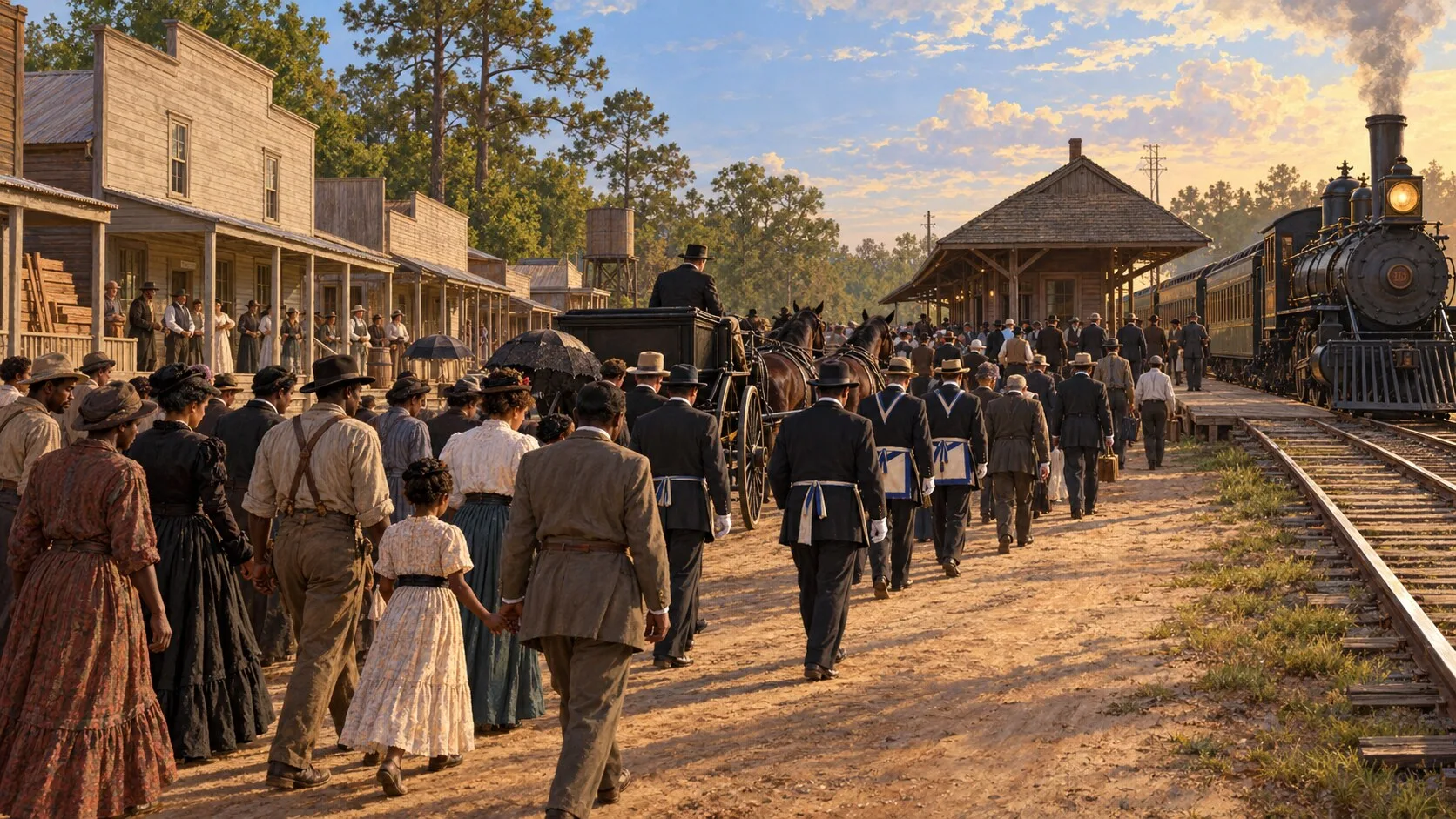
The railroad had carried Isaac Conroe into the forest, carried his lumber to distant markets and helped turn his name into a place on the map. At the end, it carried him away while the town he built stood still.
Sources and Further Reading
Isaac Conroe: Visionary, Trailblazer & Founder of Conroe, Texas, by Andrew V. Rapoza — University of North Texas Libraries
The Isaac Conroe Property — Texas Historical Commission
Conroe historical marker — Texas Historical Commission
Montgomery County Courthouses — Texas Historical Commission
12th Regiment Illinois Cavalry unit history — National Park Service
Isaac Conroe’s 1864 diary and transcription — University of North Texas Libraries