It's August and Everybody is Already Talking About Winter...
From artificial-intelligence weather models to two centuries of almanac tradition, the winter forecast season now begins while much of America is still trying to stay cool.
From artificial-intelligence weather models to two centuries of almanac tradition, the winter forecast season now begins while much of America is still trying to stay cool.
It is August. In Texas, the steering wheel can still feel like a branding iron, the air conditioner is working overtime, and winter coats are exactly where they belong—in the back of the closet.
And yet people are already talking about winter.
Long-range outlooks are showing up in weather stories. El Niño is back in the conversation. Almanacs are beginning their annual ritual of looking months down the road. Meanwhile, some of the most sophisticated forecasting centers in the world are now running artificial-intelligence models beside the physics-based computer systems meteorologists have used for decades.
It is a curious picture: a farmer’s almanac on one side of the kitchen table and an AI weather model on the other, both staring toward a season that has not arrived.
“A faster computer does not turn August into January.”
The interesting part is not which one can tell us whether it will snow on a particular Tuesday in January. Neither can do that reliably from August. The interesting part is how early clues, old traditions, new technology and a very human desire to know what comes next all meet at the beginning of winter-forecast season.
The Pacific Is Already Sending a Signal
This year there is a legitimate reason for winter to be getting attention early: El Niño is already underway and strengthening.
In its July 9 update, NOAA’s Climate Prediction Center said El Niño had strengthened and was expected to continue through early spring 2027. The agency placed the chance of a very strong El Niño during October through December at 81 percent. That does not tell anyone how much snow will fall in Dallas, whether Houston will freeze, or what the temperature will be on Christmas morning. It does, however, change the odds for broad winter patterns across North America.
El Niño begins thousands of miles away in the tropical Pacific, where unusually warm ocean water and changes in the atmosphere can influence the jet stream. During stronger El Niño winters, the southern tier of the United States often leans cooler and wetter, while parts of the northern tier often lean warmer. NOAA is careful with that word: often. Even a very strong El Niño does not produce the textbook pattern everywhere.
Texas has good reason to watch. A late-July drought update for the Southern Plains noted that El Niño is historically associated with a cooler, wetter late fall and winter in Texas. National Weather Service offices also emphasize that other atmospheric patterns can strengthen, weaken or redirect that signal as the season unfolds.
In other words, El Niño loads the dice. It does not roll them for us.
What the Machines Are Seeing
The technology behind modern forecasting is changing almost as quickly as the weather maps on television.

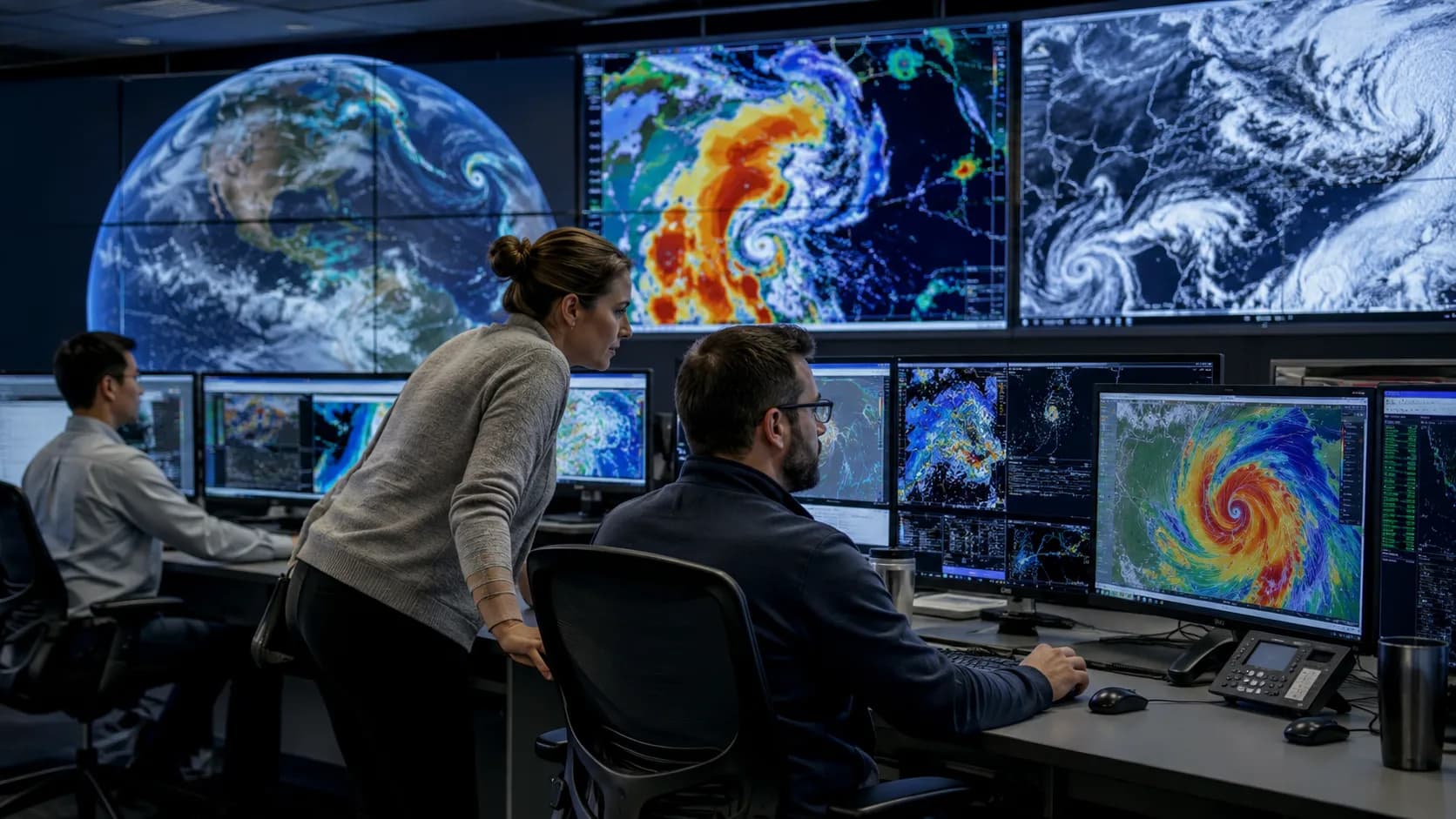
NOAA has moved artificial intelligence into operational global weather prediction. Its new AI-driven systems include an Artificial Intelligence Global Forecast System and an AI ensemble system designed to generate many possible forecast outcomes more quickly and with far less computing demand than traditional approaches. NOAA is also using hybrid systems that combine AI with physics-based forecasting.
Across the Atlantic, the European Centre for Medium-Range Weather Forecasts is doing something similar. Its Artificial Intelligence Forecasting System has been operational since 2025 and was upgraded again in May 2026. The center runs AI forecasts alongside its traditional Integrated Forecasting System rather than treating one as a magic replacement for the other.
That is an important distinction. AI can recognize patterns in enormous amounts of historical weather data and produce forecasts with remarkable speed. Ensemble systems can run many versions of the future and show forecasters a range of possibilities instead of one neat line on a map. But the atmosphere remains chaotic, observations remain incomplete, and uncertainty grows with time.
A faster computer does not turn August into January.
For day-to-day weather, the forecast process combines observations, numerical models, statistics and the judgment of human meteorologists. Seasonal outlooks work differently. They are generally expressed as probabilities—greater chances of above-, near- or below-normal temperature and precipitation over a region. They are useful for identifying a tilt in the season, not for telling us that school will be closed for snow four months from now.
Then There Is the Almanac
Long before satellites, supercomputers and machine learning, Americans were trying to read the seasons ahead.

There are actually two famous publications that are often mixed together in conversation. The Old Farmer’s Almanac dates to 1792. The Farmers’ Almanac began in 1818. They are separate publications, but both became part weather guide, part calendar and part American tradition.
The Old Farmer’s Almanac says it is already watching El Niño, ocean patterns, solar activity, upper-atmosphere winds and the polar vortex as it prepares its official winter 2026–2027 outlook. The Farmers’ Almanac describes a long-range formula involving such ingredients as sunspot cycles, lunar position, tidal pull and historical patterns, with parts of the method kept proprietary.
Then there is the wonderfully old-fashioned weather lore that survives right beside all that forecasting: count the foggy mornings in August and you may hear that each one means a snowfall in winter. The Farmers’ Almanac still preserves that saying, while also noting that the folklore is not part of its mathematical long-range forecast.
That little distinction may explain why the almanacs have lasted. People do not open them only to obtain a number. They open them because weather is part science, part memory and part storytelling. Every family seems to have somebody who remembers the winter the pipes froze, the year it snowed on Christmas Eve, or the summer when the cows supposedly knew a storm was coming before the television did.
Old Tools, New Tools, Same Question
Putting an almanac beside an AI model can sound like a contest, but it may be more interesting as a measure of how long humans have been asking the same question: What is coming next?
The modern forecasting system has advantages that would have been unimaginable to an almanac editor two centuries ago. Satellites observe the planet continuously. Ocean buoys measure conditions far from shore. Radar tracks storms. Weather balloons sample the atmosphere. Supercomputers solve equations representing the behavior of the atmosphere and oceans. AI systems can now learn from decades of data and generate guidance at extraordinary speed.
But the desire behind all of it is very old.
Farmers want to know what kind of season may affect planting and livestock. Utilities think about energy demand. Cities think about water and emergency planning. Travelers think about roads and airports. Families simply want to know whether the kids might see snow.
And Texans, after enough winters that arrived with very different personalities, have learned that the phrase “mild winter” should never be treated as a legally binding contract.
What We Actually Know in August
So what can anyone responsibly say right now?

We know El Niño is active, it is expected to strengthen, and current federal outlooks give it a high probability of lasting through the coming winter. That makes the historical El Niño pattern worth watching, particularly across the southern United States. We know forecasting technology is improving rapidly, with AI now operating inside major national and international weather centers. We also know that the most precise claims about individual winter storms are the claims that deserve the most skepticism this far in advance.
A seasonal forecast is a map of probabilities, not a reservation for a snow day.
By November and December, forecasters will have far more information about the atmosphere actually taking shape over North America. By the time a specific winter storm is within range, the modern forecast system—satellites, radar, physics models, AI models, ensembles and experienced meteorologists—will become much more useful for the decisions that matter.
Until then, there is nothing wrong with enjoying the speculation.
Check NOAA’s outlook. Read the almanac. Count the fogs in August if you feel like it. Argue with your neighbor who says his knee can predict a cold front. Just remember that all of them are looking across a distance the atmosphere has not finished traveling yet.
Winter Can Wait a Little Longer
Maybe that is why winter talk begins so early. Weather is one of the few things every person shares and nobody controls. We plan around it, complain about it, remember it and try endlessly to outguess it.
The tools have changed enormously. A prediction that once might have come from a handwritten table, a weather vane and generations of observation can now be compared with satellites, oceans of digital data and artificial intelligence running thousands of calculations in the time it takes to pour another cup of coffee.
And still, in August, the honest answer is wonderfully familiar:
We have some clues.
We will know more when winter gets here.
EDITORIAL NOTE: Seasonal outlooks describe probabilities and broad patterns. They are not forecasts of specific winter storms months in advance.