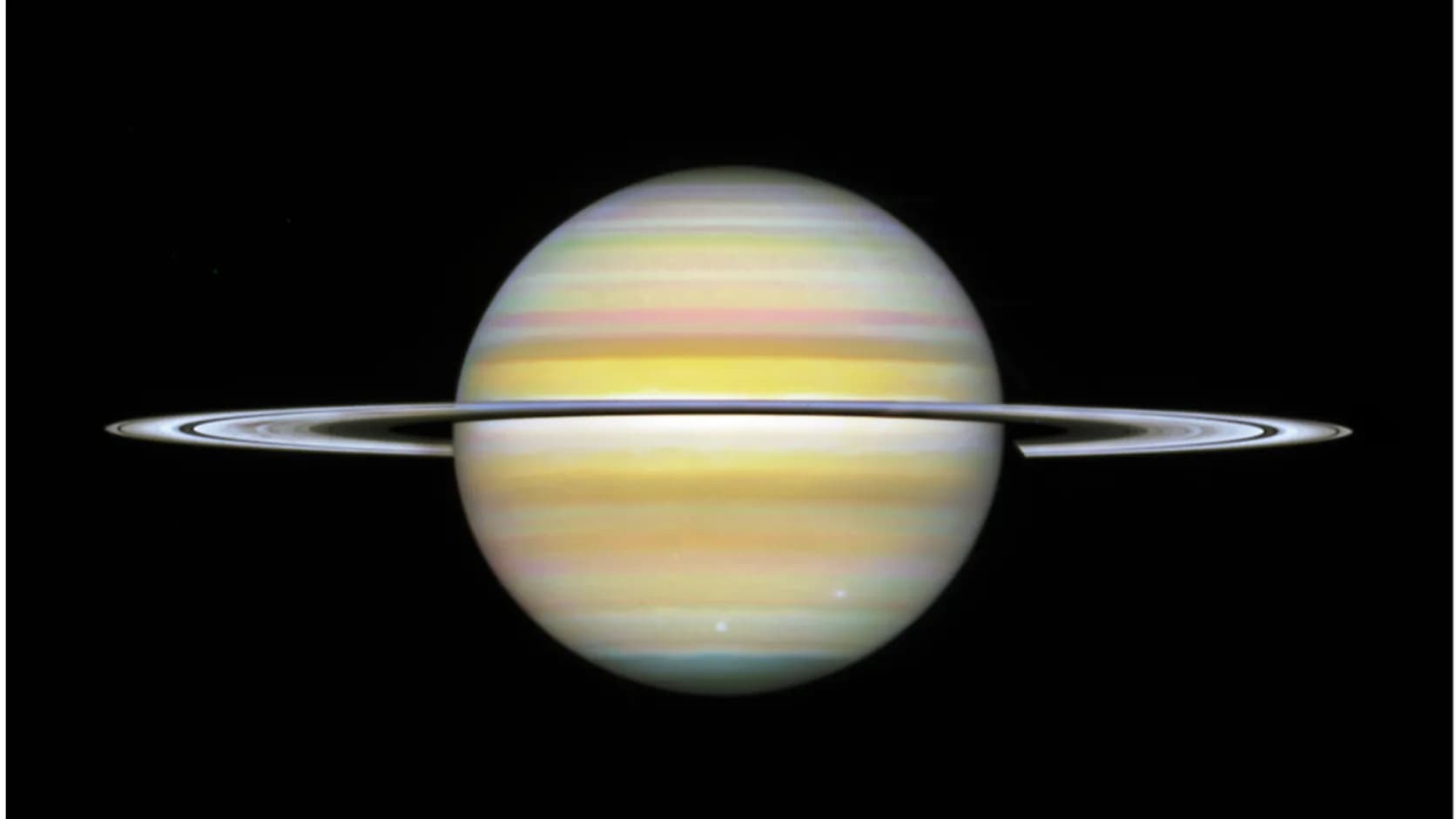
Saturn's South Pole Has a New Decagon
Saturn's north pole has worn a hexagon for more than 40 years. Now Hubble has confirmed an evolving 10-sided wave at the south pole—and scientists may be watching it form.
Saturn's north pole has worn a hexagon for more than 40 years. Now Hubble has confirmed an evolving 10-sided wave at the south pole—and scientists may be watching it form.
Saturn apparently looked at its famous six-sided weather pattern and decided it needed four more sides. Scientists using NASA's Hubble Space Telescope have confirmed a giant, evolving, 10-sided atmospheric wave circling Saturn's south pole. If the word "decagon" takes you back to geometry class, you are in the right neighborhood. The difference is that this shape is not drawn on paper. It is moving through the atmosphere of a gas giant roughly 886 million miles from the Sun.
The discovery is the first large, regular-sided jet pattern identified in Saturn's southern hemisphere. It also arrives with a particularly useful mystery: researchers do not think they are simply getting their first good look at something ancient. Evidence suggests the decagon may have formed recently and is becoming more distinct.
The shape is weather, not architecture

Saturn does not have a solid surface where somebody could plant a 10-sided fence. The planet is mostly hydrogen and helium, wrapped in bands of clouds, powerful jet streams, and storms. The decagon is a wave inside one of those southern jet streams.
Hubble observed it in several wavelengths of light, and those wavelengths probe different altitudes. The outline shifts slightly from one view to another, but the pattern remains visible through multiple layers of the atmosphere. That tells researchers it is more than a temporary line traced across the tops of a few clouds. It is a vertically extended structure in Saturn's weather system.
One detail in NASA's close-up image deserves an explanation before the internet invents one: the dashed circle and the "X" at the center mark an area where Hubble did not capture data. It is not the location of a spacecraft, a secret base, or Saturn's misplaced treasure map.
A discovery built one year at a time

This was not a one-photograph surprise. Hubble's Outer Planet Atmospheres Legacy program, known as OPAL, photographs the outer planets year after year so scientists can compare slow changes that would be easy to miss in a single visit.
When researchers worked backward through the record, they found subtle hints of the southern pattern in Hubble data from 2023. In 2024, planetary scientist Agustín Sánchez-Lavega and amateur astronomers Trevor Barry and Jean-Paul Oger noticed an undulating band in ground-based images. Additional observations in 2025 made the case stronger. Hubble then supplied the sharp, full-rotation views needed to confirm the decagon.
That sequence is a fine reminder that modern astronomy is not always a lone observatory announcing a finished answer. Sometimes the first clue comes from patient observers on the ground, the confirmation comes from a telescope in orbit, and the real discovery emerges only after several years of images are lined up beside one another.
Six sides up north, 10 down south

Saturn's northern hexagon is the famous relative in this story. Voyager images revealed it in the early 1980s, and scientists have found it every time the north pole has been visible—for more than 40 years. NASA describes the hexagon as a wavy jet stream about 20,000 miles across, with winds around 200 miles per hour and a massive rotating storm at its center.
Researchers have looked for a comparable southern feature for decades. Hubble observations going back to 1990 did not reveal a lasting polygon there, and the Cassini spacecraft, which orbited Saturn from 2004 through 2017, found no evidence of a long-lived southern counterpart.
That history is one reason the new decagon is so intriguing. It appears to be a developing feature, not merely an old one that somebody finally noticed. The two poles may be related without being twins. Both patterns live in powerful jets, but one has six sides and has endured for decades; the other has 10 sides and is still changing. The comparison gives scientists a rare natural experiment in how winds, temperature differences, and atmospheric depth can organize a flowing gas into surprisingly regular geometry.
Why now? Saturn works on a long calendar
Saturn completes one trip around the Sun in about 29.4 Earth years. Its axis is tilted by 26.73 degrees—close to Earth's tilt—so the planet experiences seasons. As those seasons changed, Saturn's south pole gradually tilted back into view from Earth, opening a better observing window just as the new pattern was becoming easier to see.
The planet itself moves much faster than its calendar. A Saturn day lasts only about 10.7 hours. Hubble can follow the planet through full rotations without the blurring caused by Earth's atmosphere, letting researchers test whether the sides remain coherent as the world turns beneath them.
Seasonal visibility explains why scientists can study the south pole more clearly now. It does not yet explain why the decagon formed. That is the question the team is carrying forward.
A changing mystery is the useful kind
Researchers plan to keep watching with Hubble, add observations from the James Webb Space Telescope, and compare the results with computer models. They want to learn whether the decagon settles into a stable configuration like the northern hexagon, continues to evolve, or disappears. They also want to know what is driving the wave and what it can teach us about atmospheric motion on giant planets—and possibly about fluid patterns closer to home.
There is a broader lesson in the discovery. Some of the best science comes from returning to the same place on a regular schedule. OPAL was built to create a long record, not to chase one headline. Because that record already existed, scientists could see a faint beginning in 2023, a stronger signal in 2025, and a phenomenon worth following in 2026.
Saturn is not decorating its poles. It is running enormous physics experiments in moving gas, and we are far enough away that a single season takes years to unfold. The decagon may become a permanent landmark, or it may fade before the northern hexagon even looks impressed. Either way, humanity appears to have caught a planet in the act of building something new—and that is a better story than a finished mystery sitting still.