We Have Been Looking at the Universe Through a Keyhole
NASA's Roman telescope will send home more data than people can inspect alone. AI will help astronomers find what deserves a closer look.
NASA's Roman telescope will widen humanity's view so dramatically that machines will have to help decide where human attention goes next.
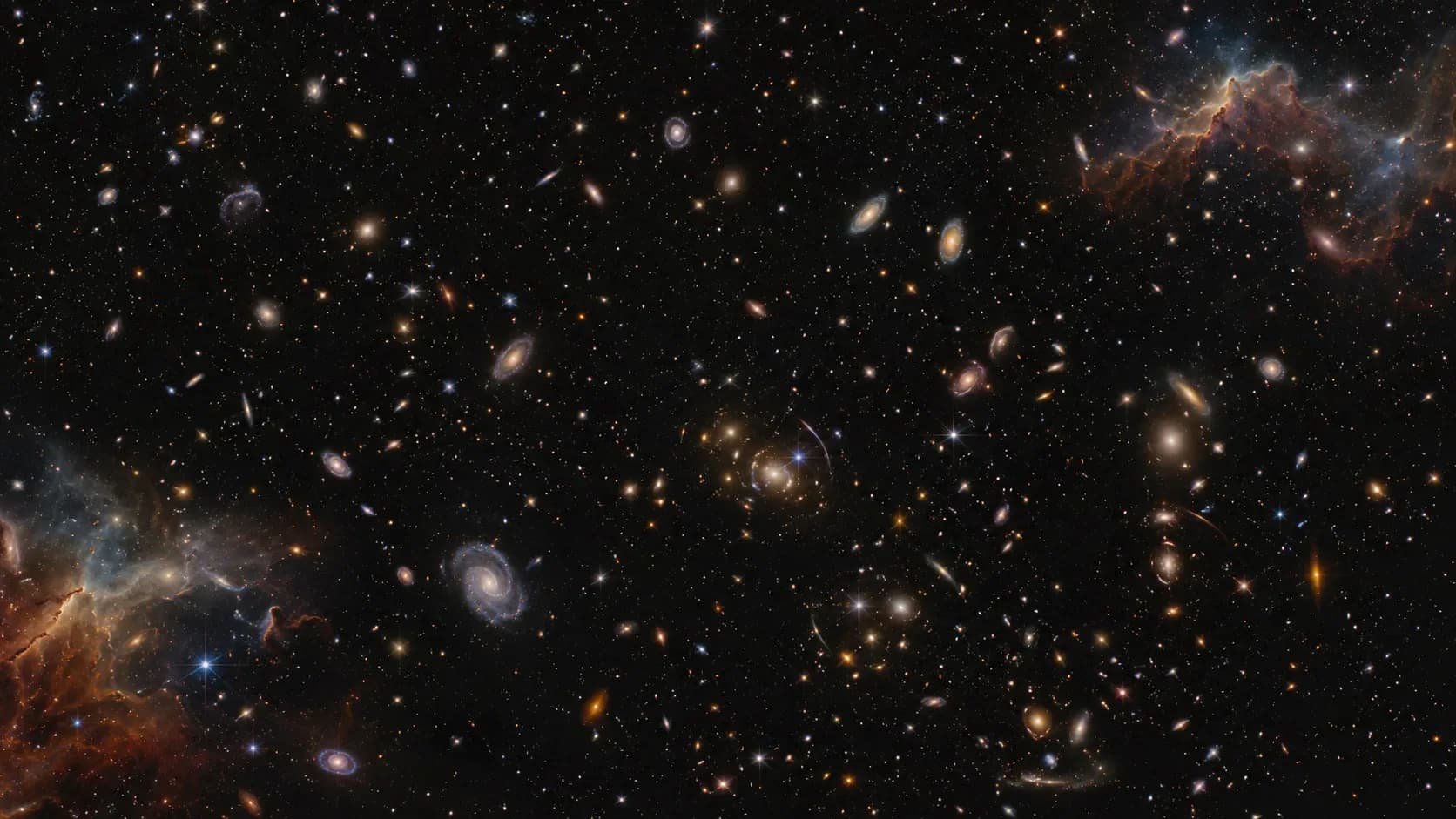
For most of human history, looking into the universe meant looking through a keyhole. We could see enough to know something enormous was on the other side, but never enough to take in the whole room. Each generation widened that opening. Ground-based observatories revealed that the stars were not fixed decorations. Hubble showed galaxies forming in places that had appeared empty. The James Webb Space Telescope began looking deeper into cosmic history with extraordinary infrared vision.
Now NASA has launched another observatory with a different assignment: not merely to stare farther into one small piece of the sky, but to open the view. The Nancy Grace Roman Space Telescope launched from Kennedy Space Center on August 30 aboard a SpaceX Falcon Heavy. It is now beginning a roughly three-month, million-mile journey toward the second Sun-Earth Lagrange point, known as L2. NASA expects the telescope's first images in early 2027.
A Wider Window

Roman carries a mirror about the same diameter as Hubble's, but its field of view is at least 100 times larger. Its 300-megapixel Wide Field Instrument uses 18 detectors to collect vast infrared panoramas. NASA says Roman is designed to survey the universe about 1,000 times faster than Hubble.
That comparison explains why Roman matters. Hubble and Webb are magnificent at examining carefully selected regions in deep detail. Roman will provide the broad map around those regions. One telescope can discover an intriguing neighborhood; another can study an individual address. Astronomy needs both.
Across those enormous surveys, Roman may measure light from as many as a billion galaxies during its lifetime. Scientists will use the patterns to study dark energy—the still-mysterious force associated with the accelerating expansion of the universe—and dark matter, the invisible framework whose gravity helps shape galaxies and clusters. Roman will also search for planets beyond our solar system and test technology for directly imaging worlds hidden in the glare of their stars.
More Than Human Eyes Can Examine

Opening the view creates a new problem: someone has to look at what comes through it. Roman is expected to send back about 1.4 terabytes of information every day—the highest data rate yet for a NASA astrophysics mission. That works out to roughly 42 terabytes in a 30-day month.
Claims that a month of Roman data would take people years to inspect are difficult to reduce to one exact number because "inspect" can mean many different things. But the underlying point is correct. No group of astronomers could personally examine every object, every change, and every possible relationship hidden in that stream.
The telescope is therefore only one part of the discovery system. Automated processing will prepare and organize the observations. Machine learning and artificial intelligence will help classify objects, compare repeated views, recognize patterns, and flag unusual findings. Citizen scientists may help inspect selected material and improve the systems that decide what deserves a closer look. Professional astronomers will verify the results, interpret what they mean, and decide what questions should come next.
Roman will not replace the astronomer. It will replace the impossible demand that an astronomer look at everything.
AI as the First Set of Eyes

This is one of the clearest examples of where artificial intelligence belongs. Roman will not ask AI to decide what the universe means. It will ask AI to help find the pieces that people might otherwise never notice.
A faint object may brighten and disappear between observations. A distant galaxy may bend light in a way that reveals invisible mass. A pattern spread across millions of galaxies may say something about how the universe expanded. Somewhere inside the flood may be an event nobody expected the telescope to capture at all.
NASA-supported researchers are already developing machine-learning tools for Roman because conventional methods cannot recover all the information carried in surveys this large and complex. Some systems will reconstruct possible earlier states of the universe. Others will create realistic simulated surveys so scientists can test their methods before drawing conclusions from the real sky. Another project combines citizen science and deep learning to train an AI "visual inspector" for Roman's spectroscopy.
The machines can narrow billions of possibilities to a manageable number. They can say, in effect, "Something here does not look like the others." But a human still has to wonder why.
The Discoveries We Did Not Schedule
The most exciting promise of Roman may not be any single item on its scientific checklist. It may be the things that do not yet have names. Hubble repeatedly found uses and discoveries its builders could not fully anticipate. Roman's wide surveys will create a public archive that researchers can revisit with questions that have not been invented yet. As analytical tools improve, the same observations may yield new discoveries years after Roman sends them home.
That changes the relationship between a telescope and the people using it. Roman is not simply a camera pointed into space. It is the beginning of a partnership among an observatory, enormous computing systems, artificial intelligence, citizen scientists, and professional astronomers. Each part does something the others cannot. The telescope sees more. The machines sort faster. Human beings ask why it matters.
We have spent centuries peering through the keyhole and trying to understand the room from the sliver we could see. Roman is about to push the door open. When it does, our first problem will no longer be whether there is enough to discover. It will be deciding where to look first.